How to Master the Mat: The Best Way to Learn Yoga Online
The Best Way to Learn Yoga Online (And Why More People Are Doing It at Home)
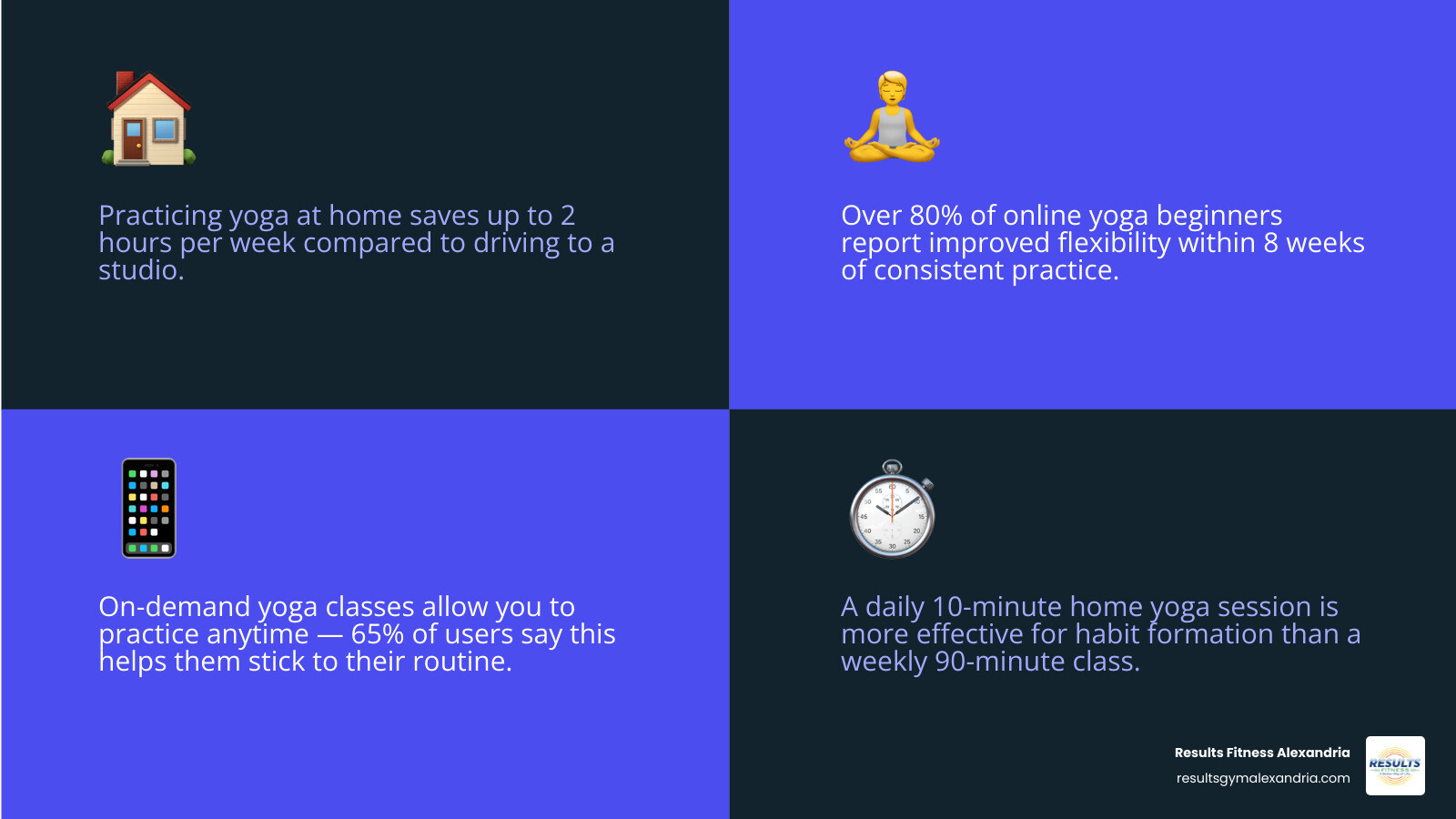
The best way to learn yoga online combines structured, progressive instruction with consistent daily practice — even if that practice is just 10 minutes long.
Here is a quick-start answer if you just need the essentials:
- Start with a beginner-friendly program — look for live or on-demand classes with a qualified instructor.
- Set up a dedicated space — all you need is a yoga mat, a 2×2 meter area, and a device with internet access.
- Build a short daily routine — 10 to 15 minutes of consistent practice beats a two-hour session once a week.
- Choose poses you enjoy first — this builds a positive habit before you tackle harder sequences.
- Progress intentionally — move from foundational poses to breathwork, then add meditation as you grow.
Yoga has never been more accessible. You no longer need to rearrange your entire schedule, find a babysitter, or drive across town to get a great practice in. For busy people — especially those juggling work, family, and everything in between — the ability to roll out a mat at home and follow expert instruction on a screen is a genuine game-changer.
When one yoga teacher first encouraged her students to practice at home, the reaction was somewhere between confusion and mild panic. Wait — there’s homework in yoga? But that small nudge unlocked something important: the realization that a meaningful practice does not need to happen in a studio to be effective. A short, simple session at home can be just as powerful — sometimes more so — because you are completely in charge of it.
I’m Jennifer Rapchak, Fitness Director at Results Fitness Alexandria and a certified personal trainer with over 14 years of experience helping people build sustainable fitness habits. My background in structured programming and group fitness gives me a clear-eyed view of the best way to learn yoga online — and in this guide, I will walk you through exactly how to do it. Let’s start with the why.
Why Learn Yoga Online?
When we think of starting a yoga journey, we often picture walking into a dimly lit, incense-scented studio. While studio classes are fantastic, taking your practice home and learning online offers unique advantages that a crowded room simply cannot match.
The best way to learn yoga online is to view your home mat not as a secondary option, but as a deeply personal sanctuary. Here are four powerful benefits of establishing an online, home-based practice:
- Self-Knowledge: In a studio class, it is easy to get caught up in comparison. We look at the person next to us effortlessly holding a headstand and feel pressured to push past our physical limits. At home, there is no audience. You are forced to look inward, listen to your body, and understand your personal physical and mental boundaries.
- Self-Help: Your home practice is entirely customizable. If you wake up with tight shoulders from sitting at your desk all day, you do not have to follow a pre-set studio flow. You can choose a sequence specifically designed to target your upper body. Learning how yoga can help improve your flexibility at your own pace allows you to use yoga as a direct tool for recovery and pain relief.
- Self-Indulgence: Practicing at home is highly indulgent. You have complete freedom over your environment. You can wear your most comfortable, mismatched pajamas, play your favorite music (or practice in complete silence), and move at whatever speed feels right. It is a space where you make all the rules.
- Exponential Growth: When you rely solely on scheduled studio classes, your progress is tied to a calendar. With online learning, you can practice daily. Even a 10-minute session done consistently compounds over time, leading to rapid improvements in both physical strength and mental clarity. You will quickly see how meditation and yoga can lower your stress levels when integrated into your daily home routine.
How to Design an Effective Home Yoga Practice
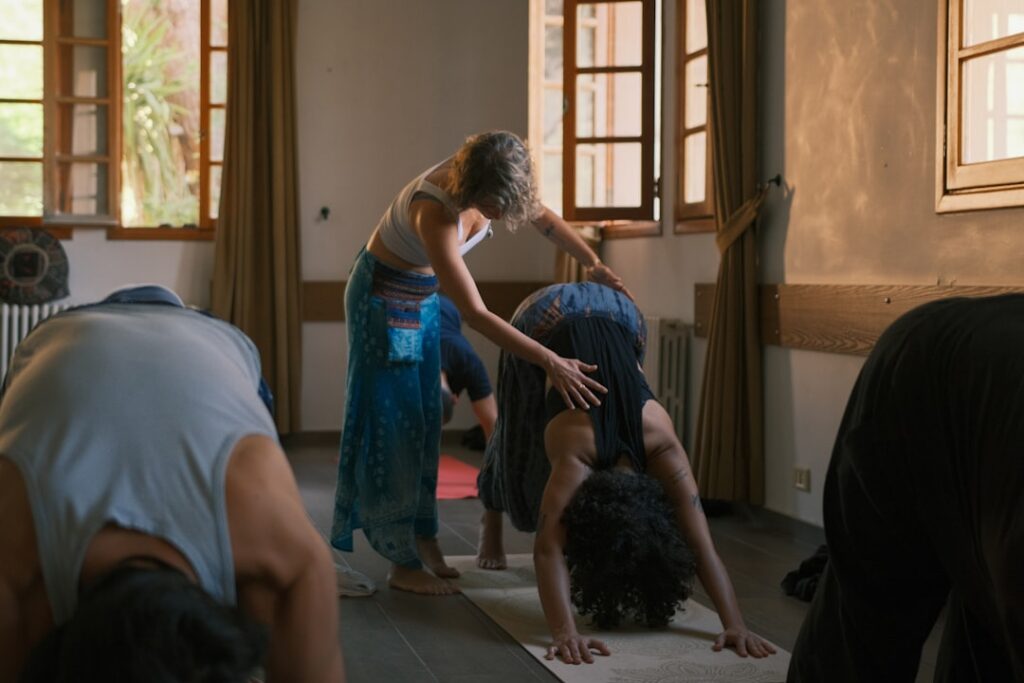
Many beginners struggle to transition from being led by an instructor to guiding themselves. The secret is that you do not need to cook up a complex, “restaurant-caliber” sequence on your own. A simple, “peanut-butter-toast” style practice — basic, nourishing, and quick — is highly effective.
To design a home practice that actually sticks, we recommend following a few foundational steps. Start by checking out the best beginner yoga routine for strength and flexibility to get a sense of how foundational movements fit together.
When designing your sequence, keep these key principles in mind:
- Start with Quiet: Spend the first two minutes in stillness. Sit comfortably or lie down in Corpse Pose (Savasana). Use this time to self-regulate, ground your mind, and assess how your body feels.
- Set an Intention: Before you move, decide what you want out of the session. It could be as simple as “I want to focus on my breath” or “I want to release tension in my lower back.”
- Move in All Directions: A complete physical practice should move your spine in all six anatomical directions:
- Lateral flexion (side-to-side stretching)
- Flexion (folding forward)
- Extension (bending backward)
- Rotation (twisting left and right)
- Inversion (going upside down, even gently like a Downward Dog)
- Choose Poses You Love: If you want to build a consistent habit, your practice must feel like a carrot, not a stick. Do not force yourself into painful or highly frustrating poses. Focus on movements that feel deeply satisfying.
Essential Equipment and Space Setup
You do not need an expensive home gym to learn yoga online. In fact, keeping your setup minimal reduces the friction of getting started. If you are curious about what to expect when starting out, check out our guide on yoga for newbies what to expect in your first session.
To set yourself up for success, gather these basic items:
- A High-Quality Yoga Mat: Choose a mat with good grip to prevent your hands and feet from slipping.
- A Quiet 2×2 Meter Space: You only need enough floor space to lay your mat down and extend your arms and legs without hitting furniture.
- Your Device: A laptop, tablet, or smartphone. Position your screen at eye level or slightly lower so you can easily see the instructor without straining your neck during poses.
- A Stable Internet Connection: Crucial for streaming high-definition video or participating in live sessions.
- A Notebook: Keep a journal nearby to jot down alignment tips, how certain poses felt, or thoughts that came up during meditation.
Structuring a Short, Effective Practice for Busy Schedules
The biggest misconception about yoga is that it requires a 60-to-90-minute commitment. In reality, a short, focused daily practice is infinitely better than a long class once a week.
When time is tight, aim for a 10-to-15-minute routine. This brief pause in your day acts as a psychological reset, making the rest of your afternoon feel more spacious and productive. You can explore the best restorative yoga and flow classes for stress relief to learn how to structure short, calming sequences that melt away tension in minutes.
The Best Way to Learn Yoga Online: Free vs. Paid Programs
As you begin your journey, you will find a massive variety of online resources. Understanding the differences between free content and structured, paid programs is key to finding the best way to learn yoga online for your lifestyle.
| Feature | Free Online Resources (e.g., YouTube, Apps) | Paid Online Programs & Certifications |
|---|---|---|
| Cost | Free (with ads or limited features) | Varies (e.g., $100 to $550+ for deep courses) |
| Structure | Unstructured; self-selected videos | Highly structured; progressive curriculum |
| Feedback | None; one-way streaming | Live, real-time alignment feedback over Zoom/Meet |
| Community | Public comment sections | Private student networks & lifetime alumni circles |
| Goal | General fitness, stretching, and relaxation | Deep personal mastery or professional teaching |
| Certification | None | Yoga Alliance Certified (RYT 200, RYT 500) |
While free videos are excellent for casual stretching, they often lack the step-by-step progression needed to build true skill and prevent injury. If you want to understand the deeper layers of the practice, exploring what are the different types of yoga can help you decide which style deserves your focus.
For those looking to transition from casual home practice to a comprehensive understanding, structured online training programs are highly effective. For example, traditional online programs like the Online Yoga Teacher Training Course | 100, 200, 300 Hour Yoga Alliance Certified offer a structured pathway.
These programs typically range from 100-hour foundations for personal practice to 200-hour professional certifications. They are incredibly accessible, with courses like the 200 Hour Yoga Teacher Training – July 2026 Batch | 100% Online Live & Self-Paced – Yoga Alliance | Yogatatva yoga teacher training courses online yoga alliance certified offered for ₹8,999 (approximately $108 USD), or internationally recognized qualifications starting around $549 with flexible payment plans.
Choosing the Best Way to Learn Yoga Online for Your Goals
Your selection should align directly with your current skill level and long-term aspirations. If you are looking for a dynamic, sweat-inducing workout, you might want to read from Ashtanga to restorative the ultimate guide to yoga classes or explore how power yoga is the ultimate full body workout.
If your goal is simply to move your body and destress after work, a daily 15-minute on-demand flow is perfect. However, if you want to master alignment, understand anatomy, study the history of yoga, or even teach others, enrolling in a structured 100-hour or 200-hour online course is the most efficient path.
Why a Structured Program is the Best Way to Learn Yoga Online
Structured programs offer several distinct advantages over random video streaming:
- Expert Instruction: You learn from highly trained teachers who guide you through systematic progressions.
- Progressive Sequencing: Classes build logically on top of one another, ensuring you develop the strength and flexibility required for advanced poses safely.
- Live Interactive Sessions: Many premium programs utilize Zoom, Google Meet, or WhatsApp Video Calls to provide real-time posture adjustments and answer your questions directly.
- Global Timezone Adaptability: High-quality online courses schedule live sessions to accommodate students in different time zones, ensuring you never miss out on interactive learning.
- Holistic Education: Instead of just physical poses (asanas), a structured program introduces you to joint-loosening series (Anti-Rheumatic groups), breathwork (Pranayama), anatomy, and traditional philosophy.
Essential Beginner Poses and Sequences to Start Today
When starting at home, it is vital to focus on the basics. Proper alignment keeps you safe and ensures you get the maximum benefit out of every movement. To build a strong foundation, we recommend learning to master the basics with Iyengar yoga, a style famous for its precision, safety, and use of supportive props.
The 10-Minute Foundational Sequence
This simple, highly effective sequence is the perfect “peanut-butter-toast” routine to start your day. Hold each pose for 5 to 10 deep, steady breaths:
- Reclining Big Toe Pose (Supta Padangusthasana): Lie on your back. Loop a strap, towel, or belt around the ball of your right foot and extend your leg toward the ceiling. Keep your shoulders relaxed on the floor. This gently opens up tight hamstrings and calves.
- Seated Forward Fold (Adho Mukha Sukhasana): Sit cross-legged. Reach your arms overhead, then gently fold forward from your hips, resting your hands on the floor in front of you. This releases tension in your outer hips and lower back.
- Downward-Facing Dog (Adho Mukha Svanasana): Press up onto your hands and feet, lifting your hips toward the sky to form an inverted “V” shape. Keep a soft bend in your knees to prioritize a long, straight spine.
- Low Lunge (Anjaneyasana): Step your right foot forward between your hands and lower your left knee to the mat. Sweep your arms upward, opening up your chest and stretching your hip flexors.
- Pigeon Prep (Eka Pada Rajakapotasana): Bring your right knee forward behind your right wrist, laying your shin down at an angle. Extend your left leg straight behind you. Fold forward gently over your front leg to deeply stretch your glutes and hips.
- Child’s Pose (Balasana): Kneel on the floor, touch your big toes together, and sit back on your heels. Separate your knees hip-width apart, fold forward, and rest your forehead on the mat. Extend your arms forward and breathe deeply into your back body.
Overcoming the Challenges of a Home Yoga Practice
While the convenience of practicing at home is unmatched, it also introduces unique hurdles. Without a teacher physically in the room and a scheduled class to attend, it is easy to let distractions get in the way.
Understanding how to build consistency is key to using the ultimate guide to yoga for anxiety and stress relief effectively. To keep your home practice on track, use this simple habit loop:
Here is how to navigate the most common home practice obstacles:
- Distractions: Your phone buzzing, laundry piled in the corner, or family members walking through the room can easily break your focus. The Fix: Set a specific “yoga time” and communicate it to your household. Put your phone on “Do Not Disturb” and close the door to your practice space.
- Lack of Motivation: On days when you feel exhausted or busy, rolling out your mat can feel like a mountain. The Fix: Give yourself permission to do a “micro-practice.” Tell yourself you will only do 5 minutes of gentle stretching. More often than not, once you get moving, you will want to keep going.
- No Accountability: It is easy to skip a session when no one is waiting for you at the studio. The Fix: Join an online community, sign up for a structured course with live interactive sessions, or partner with a friend to text each other once your daily practice is complete.
Frequently Asked Questions about Online Yoga
Do I need prior yoga experience to start learning online?
No, you do not need any prior experience. Many online courses and platforms are designed specifically for absolute beginners. Consistency and a willingness to learn are far more important than your starting flexibility or strength. You will build both naturally over time.
How do online yoga classes fit into a busy schedule?
Online learning offers ultimate flexibility. You can choose on-demand classes that fit into your exact schedule, whether that is a quick 10-minute stretch before work or a longer flow on the weekend. Many structured programs also offer recorded versions of their live classes, allowing you to catch up whenever it is convenient for you.
What equipment do I need to successfully practice yoga at home?
To get started, you only need a high-quality yoga mat, a quiet 2×2 meter space, and an internet-connected device (like a laptop or smartphone). As you progress, you may want to add basic props like foam blocks, a yoga strap, and a notebook to write down your reflections.
Conclusion
Finding the best way to learn yoga online is all about creating a sustainable, enjoyable habit that fits seamlessly into your life. By leveraging structured online programs, setting up a simple home space, and committing to short, consistent sessions, you can experience all the physical and mental benefits of a dedicated yoga practice right from your living room.
However, we also know that nothing replaces the energy, community, and hands-on guidance of an in-person environment. If you live in the Alexandria, Virginia area, you can combine the convenience of your online home practice with the supportive atmosphere of a local fitness community.
At Results Fitness Alexandria, we offer dynamic, welcoming classes designed for all fitness levels. Whether you are looking to build strength, reduce stress, or complement your home yoga routine with personalized training, we are here to support your journey. Come try our amenities, meet our expert instructors, and find your flow with a free 1-day pass. Check out our Group Fitness/Yoga schedule today and take your practice to the next level!