The Ultimate Guide to Yoga for Anxiety and Stress Relief
Why Yoga for Anxiety and Stress Is One of the Most Effective Tools for a Calmer Mind
Yoga for anxiety and stress is one of the most accessible, evidence-backed ways to calm your nervous system — and the research is clearer than ever.
Here’s a quick snapshot of what the science shows:
- Yoga significantly reduces anxiety symptoms compared to standard stress-management education
- 54% of yoga participants showed meaningful anxiety improvement after 12 weeks vs. 33% in a stress education group
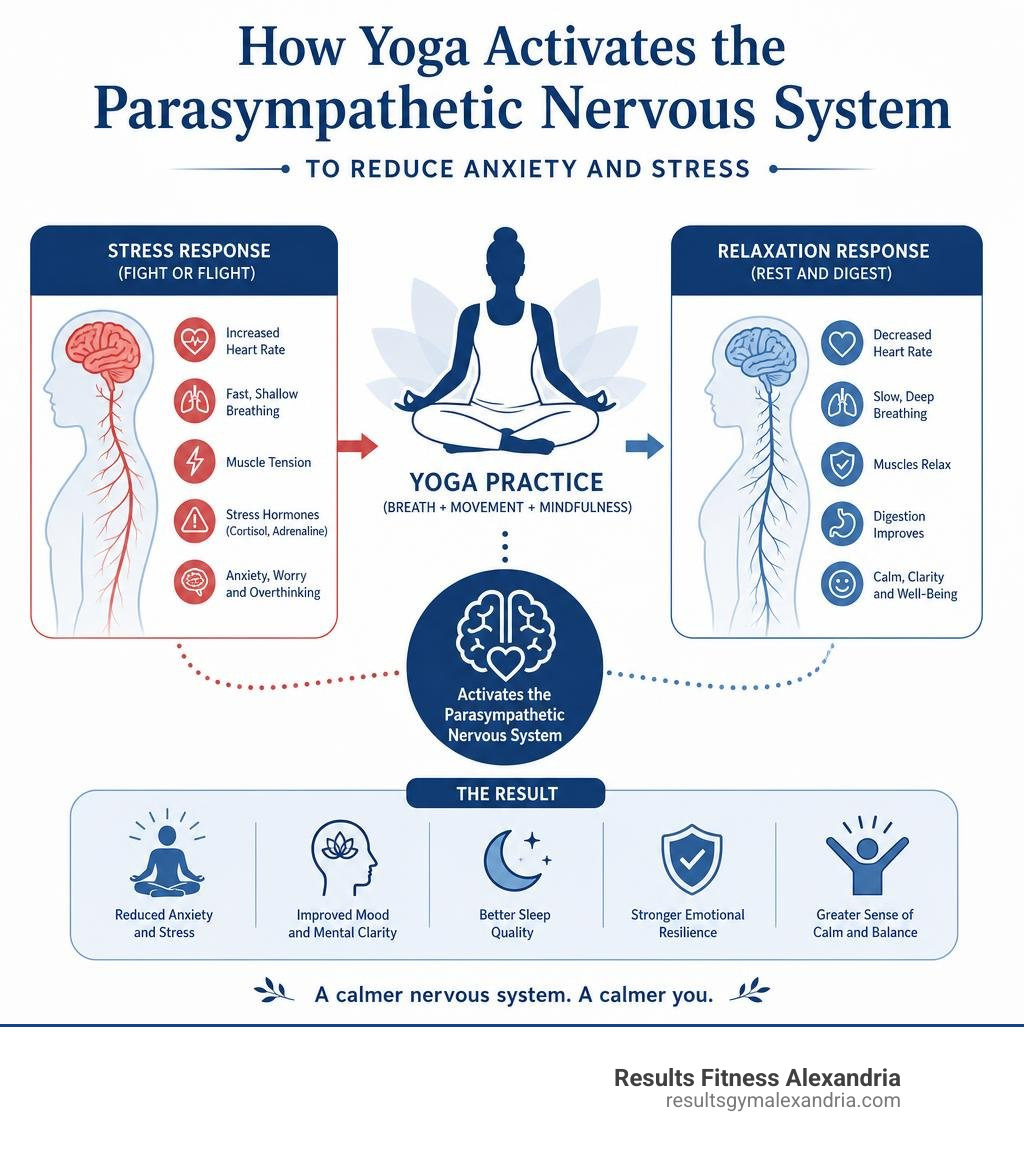
- Yoga works by activating the parasympathetic nervous system, lowering cortisol, and raising GABA — a brain chemical linked to calm
- It produces measurable changes in brain wave activity, including more alpha waves (relaxation) and fewer beta waves (mental stress)
- Benefits are real for both short-term relief and long-term mental resilience
Even 10 to 20 minutes of daily practice can make a difference. You don’t need to be flexible, experienced, or have a lot of time.
Millions of Americans live with chronic worry and nervousness — generalized anxiety disorder alone affects an estimated 6.8 million people. Many never find a treatment approach that fits their life. Yoga offers something different: a practice you can tailor to your schedule, your body, and your needs.
I’m Jennifer Rapchak, Fitness Director at Results Fitness Alexandria, and with over 14 years of experience in fitness programming, I’ve seen how mindful movement practices like yoga for anxiety and stress can transform how people feel in both body and mind. In this guide, I’ll walk you through exactly how to use yoga to find real, lasting relief.
The Clinical Evidence Supporting Yoga for Anxiety and Stress
When you are in the grips of chronic worry, your body is essentially operating under a constant false alarm. Your brain perceives a threat, which triggers the adrenal glands to flood your system with cortisol and adrenaline. Your heart rate climbs, your breathing becomes shallow, and your muscles tighten. For the 6.8 million Americans dealing with generalized anxiety disorder (GAD), this state of high alert is not a temporary response to danger—it is a daily reality.
Fortunately, clinical research shows that yoga provides a direct, somatic pathway to turn off this false alarm. A landmark systematic review and meta-analysis published in Frontiers in Psychology analyzed 30 randomized controlled trials with 2,288 participants. The researchers found that yoga exercise has a moderate and statistically significant effect on reducing stress (effect size of -0.54), anxiety (effect size of -0.52), and depression (effect size of -0.50) in healthy populations. This proves that yoga is not just a physical workout; it is a powerful preventive mental health intervention.
At the chemical level, yoga helps restore balance to your brain chemistry. Chronic anxiety is closely linked to low levels of gamma-aminobutyric acid (GABA), the brain’s primary inhibitory neurotransmitter. Think of GABA as the brain’s natural tranquilizer—it slows down overexcited nerve cells, quietening mental chatter. While traditional cardiovascular exercise boosts mood through endorphins, brain imaging studies show that yoga uniquely elevates GABA levels. This chemical shift, combined with a reduction in cortisol, helps transition the nervous system from a state of fight-or-flight to a state of rest-and-digest.
| Feature / Outcome | Yoga Practice | Cognitive Behavioral Therapy (CBT) | Standard Stress Education |
|---|---|---|---|
| Response Rate (3 Months) | 54% of participants met clinical improvement criteria | 71% of participants met clinical improvement criteria | 33% of participants met clinical improvement criteria |
| 6-Month Retention | Benefits may decline without a consistent home practice | Benefits remain highly stable and statistically significant | Minimal to no long-term symptom reduction |
| Primary Mechanism | Somatic regulation, vagus nerve stimulation, GABA elevation | Cognitive restructuring, behavioral exposure, thought tracking | Intellectual understanding of stress, basic lifestyle tips |
| Best Suited For | Relieving physical tension, somatic anxiety, and nervous system dysregulation | Managing chronic cognitive worry, intrusive thoughts, and core beliefs | General education and mild, temporary situational stress |
How Yoga for Anxiety and Stress Compares to CBT
To truly understand where yoga fits into a mental health plan, we have to look at how it stacks up against the gold standard of psychological care: Cognitive Behavioral Therapy (CBT).
In a major randomized controlled trial comparing treatments for generalized anxiety disorder, researchers evaluated three groups over 12 weeks: one receiving Kundalini yoga (which integrates physical postures, breathing exercises, deep relaxation, and meditation), one receiving CBT, and a control group receiving standard stress management education.
The results were eye-opening. Yoga was significantly more effective at reducing anxiety symptoms than standard stress education. Specifically, 54% of those in the yoga group experienced a meaningful clinical improvement, compared to only 33% in the stress education group. However, CBT remained the most effective overall, with 71% of participants meeting the response criteria.
Furthermore, the study highlighted a crucial difference in long-term retention: at the six-month follow-up, the benefits of CBT remained highly stable, whereas the benefits of the yoga protocol were no longer statistically significant compared to the control group. This tells us two important things:
- Yoga is a highly effective, accessible, and fast-acting tool for short-term anxiety relief and stress reduction.
- Consistency is absolutely essential. Unlike CBT, which teaches cognitive frameworks that stick with you, yoga is a physiological practice. To keep enjoying its stress-relieving rewards, you have to keep stepping onto the mat.
Rather than viewing them as competing options, we love to think of them as the ultimate tag-team. CBT helps you untangle your anxious thoughts from the top down, while yoga calms your anxious body from the bottom up. To explore how this physical side of wellness complements your lifestyle, check out our guide on mind-body fitness.
Physiological Markers of Stress Reduction
One of the coolest aspects of modern science is that we no longer have to rely solely on subjective “how do you feel?” questionnaires to know that yoga works. We can actually see it happening in real-time through advanced physiological monitoring.
When we look at multimodal biosignals—such as electroencephalograms (EEG), heart rate variability (HRV), galvanic skin response (GSR), and functional magnetic resonance imaging (fMRI)—the physical proof of yoga’s impact is undeniable:
- Brain Wave Activity (EEG): Yoga fundamentally alters the electrical activity in your brain. Research shows that a consistent yoga practice leads to a 1.67% reduction in beta waves (the fast brain waves associated with active thinking, worry, and high stress). At the same time, it triggers a 15.40% increase in alpha waves (representing relaxed alertness) and a 5.04% increase in theta waves (associated with deep meditation and light sleep). Most impressively, yoga practice results in a 19.31% increase in delta waves (restorative sleep waves) and an 18.68% increase in gamma wave coherence, which is linked to feelings of intense bliss and cognitive integration.
- Heart Rate Variability (HRV): HRV measures the variation in time between consecutive heartbeats. A high HRV means your autonomic nervous system is highly adaptable and resilient to stress. Yoga consistently boosts HRV, signaling a healthy shift away from sympathetic dominance and toward parasympathetic recovery.
- Galvanic Skin Response (GSR) & Electromyography (EMG): GSR measures skin conductance (which increases when you sweat under stress), while EMG measures muscle tension. Studies show immediate drops in both GSR and EMG readings during and after yoga, indicating a release of physical tension.
- Brain Structure & Function (fMRI): Magnetic resonance imaging reveals that regular yoga practitioners actually have a thicker cerebral cortex and hippocampus. These are the areas of the brain responsible for memory, attention, and emotional self-regulation. Furthermore, meditation and yoga reduce the size and reactivity of the amygdala—the brain’s fear center—helping you respond to daily stressors with calm logic rather than panic.
If you want to experience these biological shifts for yourself, joining a group class can provide the structure and support you need. Learn more about mindful movement classes to see how they fit into your wellness routine.
Designing Your Practice: Poses, Breathing, and Meditation
An effective practice of yoga for anxiety and stress does not require you to twist your body into a human pretzel. In fact, trying to force yourself into complex, physically demanding shapes when you are already stressed can have the opposite effect, triggering a stress response instead of calming it down.
Instead, a well-rounded stress-relief practice balances three core elements: asana (gentle, grounding physical postures), pranayama (deliberate breathing exercises), and meditation. By combining these three elements, you create a complete sensory shift that coaxes your nervous system into a state of safety.
Essential Poses in Yoga for Anxiety and Stress
When designing a routine specifically for stress relief, the goal is to choose restorative, grounding poses that release tension in the hips, shoulders, and lower back—areas where we notoriously store emotional stress.
Here are four essential poses that physical therapists and yoga instructors recommend for calming a racing mind:
- Child’s Pose (Balasana): This is the ultimate posture for safety and introspection. Kneel on your mat, sit your hips back onto your heels, and fold your torso forward, resting your forehead gently on the floor or a yoga block. Reach your arms forward or let them rest alongside your body. This pose gently stretches the lower back and hips while physically turning your attention inward, away from external stressors.
- Legs-Up-the-Wall Pose (Viparita Karani): A classic restorative posture that is incredibly therapeutic for anxiety. Lie on your back and swing your legs up so they rest flat against a wall, keeping your hips as close to the wall as comfortable. Place a small pillow under your lower back if needed. This gentle inversion encourages venous blood flow back to the heart, lowers your heart rate, and signals your nervous system that it is safe to relax.
- Cat-Cow Stretch (Marjaryasana-Bitilasana): Moving in and out of this gentle flow with your breath helps release tension along the entire spine. On your hands and knees, inhale as you arch your back and lift your chest (Cow), then exhale as you round your spine toward the ceiling and tuck your chin (Cat). Repeat this slowly and rhythmically to build body trust and release physical rigidity.
- Corpse Pose (Savasana): Often called the most important pose in yoga, Savasana is where your body integrates the benefits of your practice. Lie flat on your back, let your feet fall open naturally, and place your arms at your sides with your palms facing up. Close your eyes and focus on letting your entire weight sink into the floor.
For a short, accessible sequence you can do at home, check out this guide on 10-Minute Gentle Yoga for Anxiety and Burnout. If you are completely new to the mat and want to build a solid foundation, our team has put together beginner yoga routines designed to build strength and flexibility safely.
Trauma-Informed Breathwork and Pranayama
The fastest way to change your emotional state is to change your breathing. Your breath is a direct remote control for your autonomic nervous system. When you take short, shallow breaths, you tell your brain you are in danger. When you slow down and extend your breathing, you tell your brain you are safe.

In trauma-informed yoga, we emphasize gentle breathwork that avoids breath retention (holding your breath), which can sometimes feel restrictive and trigger panic in an anxious mind. Instead, we focus on simple, soothing patterns:
- Elongated Exhales: A simple yet profound technique. Inhale deeply through your nose for a count of four, then exhale slowly through your mouth (as if blowing through a straw) for a count of eight. Making your exhales longer than your inhales immediately stimulates the vagus nerve, triggering a drop in heart rate and blood pressure.
- Bhramari Pranayama (Humming Bee Breath): Sit comfortably and close your eyes. Take a deep breath in, and as you exhale, make a steady, low-pitched humming sound in the back of your throat. The physical vibration of the hum stimulates the vagus nerve in your neck, providing immediate mental relaxation and a feeling of inner peace.
- Sudarshan Kriya: This rhythmic breathing technique has been clinically shown to improve stress tolerance, enhance cognitive function, and significantly raise EEG alpha wave power, signaling deep mental relaxation.
To practice these techniques in a safe, trauma-sensitive space, try this free Breathwork For Anxiety And Overwhelm session.
Short-Term vs. Long-Term Effects of Yoga on Mental Health
The beauty of yoga is that it offers both immediate triage and long-term structural remodeling for your brain.
In the short term, even a single 15-minute gentle session can act as an emergency brake for acute stress. It lowers your immediate cortisol levels, releases tight muscles, and helps ground you in the present moment when you feel overwhelmed. It is a fantastic tool to use right before a big meeting, after a stressful commute, or to help you wind down for a restful night’s sleep.
In the long term, a consistent yoga practice actually reshapes your brain’s anatomy—a phenomenon known as neuroplasticity. MRI studies of regular, long-term yoga practitioners show:
- Increased Gray Matter Density: Regular practice prevents the age-related shrinkage of the hippocampus (the brain’s memory and emotional processing center) and the cerebral cortex (responsible for executive decision-making and focus).
- Calmed Amygdala: The amygdala—your brain’s emotional smoke detector—becomes less reactive. This means that over time, things that used to trigger an immediate panic response (like a full inbox or a sudden change in plans) no longer cause the same level of internal chaos.
- Improved Vagal Tone: Your vagus nerve becomes highly efficient at pulling your body back to a calm state after a stressful event, meaning you bounce back from daily stressors much faster.
To start building these long-term neurological benefits, try incorporating a short, daily routine like this 15-Minute Gentle Yoga Practice to Ease Stress. Understanding the different types of yoga can also help you choose a style that matches your specific mental and physical goals.
Practical Guide: How to Safely Start Your Yoga Journey
Starting any new physical routine can feel a little intimidating, especially if you are already dealing with anxiety. The last thing we want is for your stress-relief practice to cause you more stress!
Here are a few practical, friendly guidelines to keep your practice safe, comfortable, and supportive:
- Check in with Your Doctor First: If you have any pre-existing physical conditions, joint issues, or injuries, it is always a smart idea to talk with a healthcare professional before starting. They can help you identify any specific movements to avoid or modify.
- Ditch the “No Pain, No Gain” Mindset: Yoga is not about pushing your body to its absolute limits. If a pose ever feels painful, pinching, or makes it hard to breathe, back off immediately. Your breath should always flow smoothly; if you find yourself holding your breath, that is a clear sign you are pushing too hard.
- Embrace Props: Blocks, straps, bolsters, and folded blankets are not “cheating”—they are incredibly helpful tools that bring the floor closer to you. Using a block under your hands in a forward fold or placing a blanket under your knees can make a pose feel infinitely more supportive and relaxing.
- Keep It Low to the Mat: When you are feeling highly anxious or physically exhausted, you do not need to do standing, balance-heavy poses. A fully seated or reclined sequence can be incredibly nurturing and grounding.
If you are feeling a bit nervous about stepping into a studio for the first time, don’t worry! We have put together a friendly guide on yoga for newbies so you know exactly what to expect, what to wear, and how to set yourself up for a wonderful first experience.
Frequently Asked Questions about Yoga for Stress Relief
Can yoga replace therapy for generalized anxiety disorder?
No, yoga should not be viewed as a direct replacement for clinical mental health therapy or prescribed medications. Think of yoga as a powerful, evidence-based complementary therapy. While CBT and traditional talk therapy help you identify, challenge, and reframe anxious thought patterns, yoga works from the bottom up to calm the physical sensations of anxiety in the body. Using them together often yields the best, most comprehensive results.
How often should I practice yoga to see stress-relief benefits?
Consistency is far more important than duration. Practicing for just 10 to 20 minutes a day is significantly more beneficial for your nervous system than doing one long, two-hour class once a week. A short, daily routine helps keep your vagal tone high, regularly lowers cortisol, and continually reinforces a sense of physical safety and mindfulness in your daily life.
What should I do if a yoga pose triggers my anxiety?
It is surprisingly common for certain yoga poses—especially deep chest openers or intense hip stretches—to release stored physical tension and trigger a sudden wave of anxiety or vulnerability. If this happens to you:
- Gently ease out of the pose immediately.
- Transition into a safe, grounding posture like Child’s Pose or simply sit comfortably.
- Keep your eyes open and look around the room to orient yourself to your physical surroundings.
- Focus on slow, elongated exhales to tell your nervous system that you are safe in the present moment.
Conclusion
Managing daily stress and anxiety is a journey, and having the right tools—and the right community—makes all the difference. At Results Fitness Alexandria, we believe that fitness and mental well-being go hand-in-hand. Our welcoming, supportive studio in Alexandria, Virginia, is designed to help you step away from the daily grind, reconnect with your breath, and build a strong, resilient mind and body.
Whether you are a seasoned yogi or have never stepped foot on a yoga mat, our expert instructors are here to guide you every step of the way with personalized modifications and a warm, zero-judgment atmosphere.
Ready to experience the stress-relieving power of yoga for yourself? We would love to invite you to try our amenities with a free 1-day pass! Come explore our fitness classes, personal training, yoga sessions, and convenient childcare. Join our Group Fitness/Yoga classes today and take the first step toward a calmer, healthier, and more balanced you.