Master the Basics with Iyengar Yoga
Why Iyengar Yoga Is the Smartest Starting Point for Beginners
Iyengar yoga for beginners is a structured, alignment-focused style of yoga that uses props, precise postures, and careful sequencing to make yoga accessible — no flexibility or experience required.
Here’s what makes it beginner-friendly at a glance:
- Alignment first — every pose is broken down so your body learns correct positioning from day one
- Props are welcome — blocks, straps, and blankets help you get the full benefit of each pose without strain
- Slow and deliberate — poses are held longer, giving you time to understand what your body is doing
- Structured sequences — you build skill gradually, one pose at a time
- Safe for all fitness levels — modifications make it suitable whether you’re 25 or 75
B.K.S. Iyengar, the founder of this method, put it simply in Light On Life:
“Yoga allows you to rediscover a sense of wholeness in your life, where you do not feel like you are constantly trying to fit broken pieces together.”
That idea sits at the heart of this practice — and it’s exactly why so many beginners find it less intimidating than other yoga styles.
If you’ve been putting off yoga because you feel stiff, out of shape, or just don’t know where to start, Iyengar yoga meets you exactly where you are.
I’m Jennifer Rapchak, Fitness Director at Results Fitness Alexandria, and with over 14 years of experience designing fitness programs for people at every level, I’ve seen how a structured, precision-based approach — like what you’ll find in Iyengar yoga for beginners — builds real, lasting results. Let’s walk through everything you need to know to get started with confidence.
What is Iyengar Yoga for Beginners?
At its core, Iyengar yoga is a form of Hatha yoga that focuses on the structural integration of the body. Named after B.K.S. Iyengar, who developed the method in the 20th century, it rose to global prominence after the 1966 publication of his seminal book, Light on Yoga. While many modern yoga styles focus on “flow” or moving quickly from one pose to another, Iyengar yoga is the “slow-cooker” of the yoga world. We prioritize precision, timing, and sequencing above all else.
For those just starting out, understanding What Are The Different Types Of Yoga is essential to finding the right fit. Unlike Vinyasa, which can feel like a cardio workout, Iyengar yoga is a laboratory for exploration. You aren’t just doing a pose; you are studying it.
The History of the Method
B.K.S. Iyengar was a sickly child who turned to yoga for health. Because his body had limitations, he began using household items—bricks, belts, and furniture—to help him achieve the correct alignment in traditional asanas (poses). This innovation changed the face of modern yoga. He proved that yoga wasn’t just for the naturally flexible; it was for everyone.
How It Differs from Other Styles
When you’re looking for From Ashtanga To Restorative The Ultimate Guide To Yoga Classes/, you’ll notice that Iyengar stands out because of its meticulous nature. In an Iyengar class, you might only do six or seven poses, but you will do them with such anatomical accuracy that you’ll feel muscles you never knew existed.
| Feature | Iyengar Yoga | Vinyasa / Power Yoga |
|---|---|---|
| Pace | Slow, deliberate, and held longer | Fast-paced, one breath per movement |
| Primary Focus | Anatomical alignment and precision | Flow, heat, and cardiovascular health |
| Use of Props | Extensive (blocks, straps, chairs, walls) | Minimal (mostly just a mat) |
| Goal | Structural integrity and mental clarity | Physical fitness and “flow state” |
| Accessibility | High (easily modified for injuries) | Moderate (requires certain baseline mobility) |
Core Principles: Alignment, Props, and Sequencing
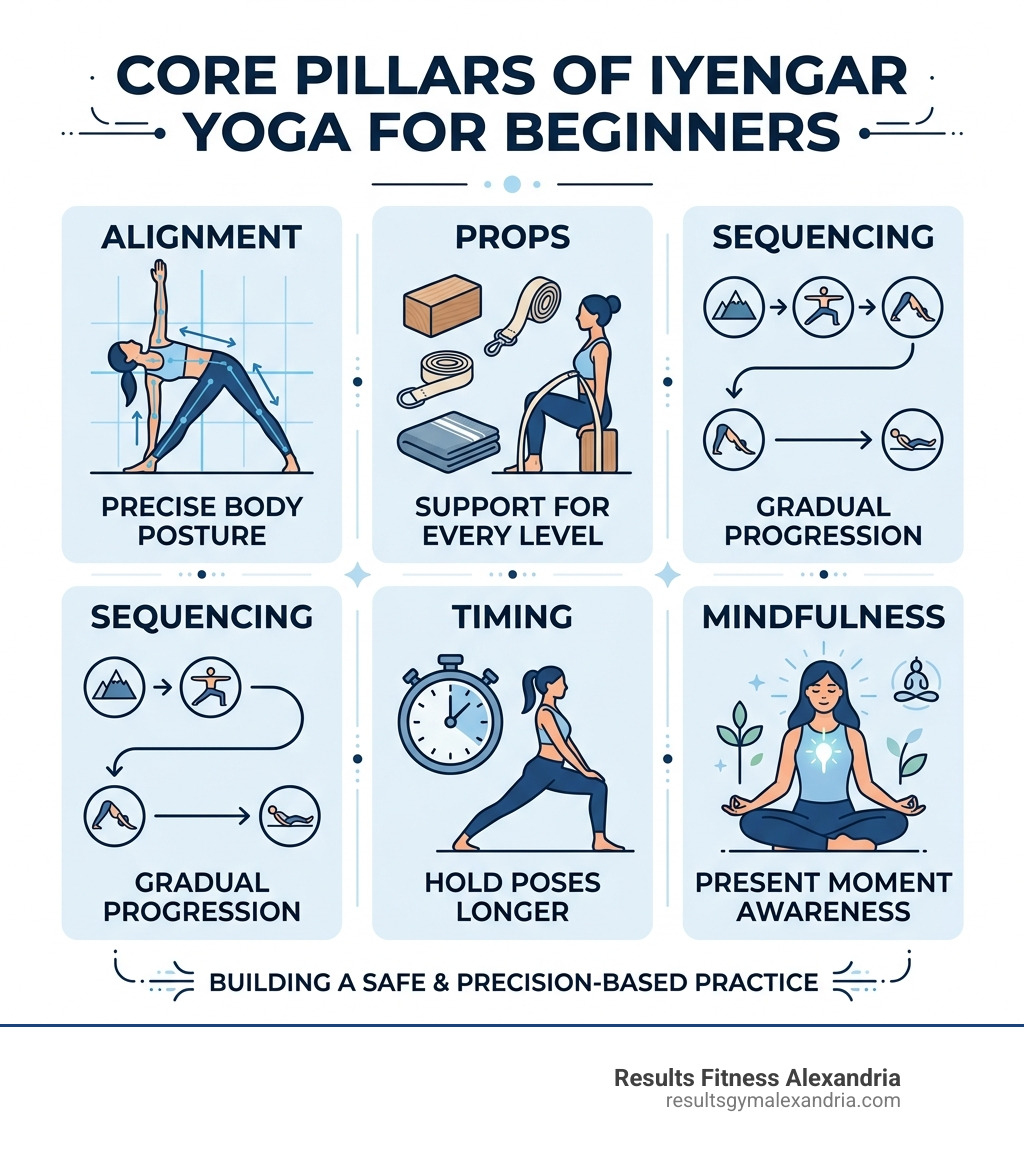
The “secret sauce” of iyengar yoga for beginners lies in three pillars: alignment, props, and sequencing. These aren’t just rules; they are the tools we use to ensure you don’t get injured while you’re getting fit.
1. Precision Alignment
In Iyengar yoga, we don’t just “reach for our toes.” We focus on where the weight is in our feet, the rotation of our thighs, and the length of our spine. This anatomical precision ensures that the energy flows correctly and that joints are protected. This is particularly helpful when you are learning How Yoga Can Help Improve Your Flexibility, as it prevents you from “cheating” the stretch by rounding your back or collapsing your chest.
2. The Use of Props
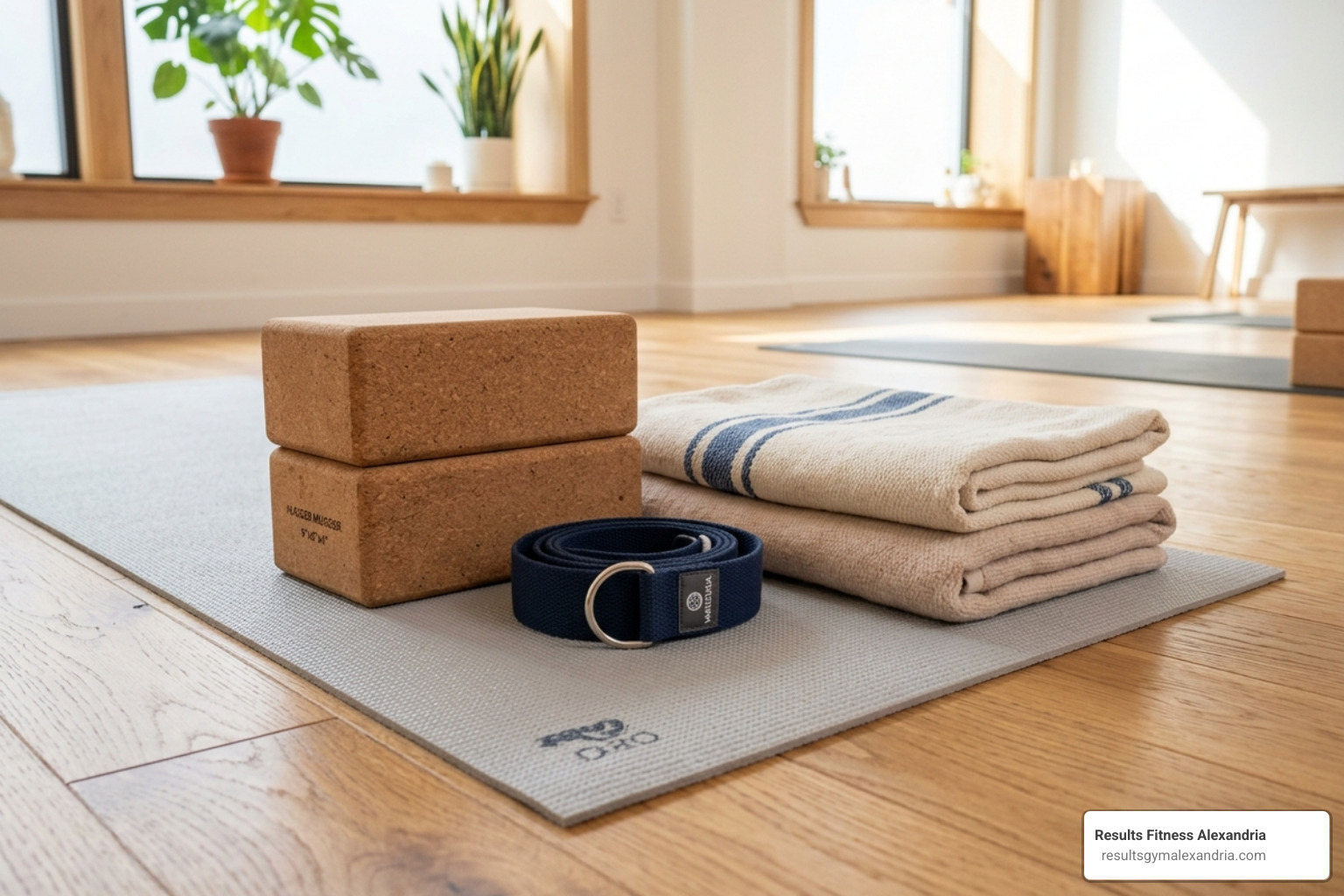
Props are the great equalizer. In many fitness circles, using a “modification” is seen as a sign of weakness. In Iyengar yoga, props are a sign of intelligence. They allow a beginner with tight hamstrings to experience the benefits of a forward bend without straining their lower back. Common props include:
- Blocks: To bring the floor closer to your hands.
- Straps: To extend your reach.
- Blankets: To cushion joints or support the neck.
- Bolsters: For restorative poses that calm the nervous system.
As noted in this Iyengar Yoga for Beginners: A Comprehensive Guide to Mindful Practice | Republic World , props aren’t just for beginners—they are used by advanced practitioners to deepen their understanding of a pose.
3. Systematic Sequencing
The order of poses matters. In Iyengar yoga, we follow a specific progression that prepares the body for what’s coming next. Typically, a beginner class starts with standing poses to build strength and stability, moves into forward bends or twists, and always ends with restorative poses like Savasana to integrate the work.
Essential Iyengar Yoga for Beginners Poses
If you are just starting your journey, you don’t need to master 200 poses. In fact, focusing on a few foundational standing poses is the best way to build a “vertical reference” for your body. Here are the essentials we recommend for anyone Working Out For Beginners Female or male who wants to build a solid foundation.
Tadasana (Mountain Pose)
Tadasana is the blueprint for every other pose. It looks like “just standing,” but it is an active, engaged posture.
- How to do it: Stand with your big toes touching and heels slightly apart. Distribute your weight evenly across the four corners of your feet. Lift your kneecaps, tuck your tailbone slightly, and roll your shoulders back.
- Why it matters: It teaches you how to find center and improves posture instantly.
Utthita Trikonasana (Extended Triangle Pose)
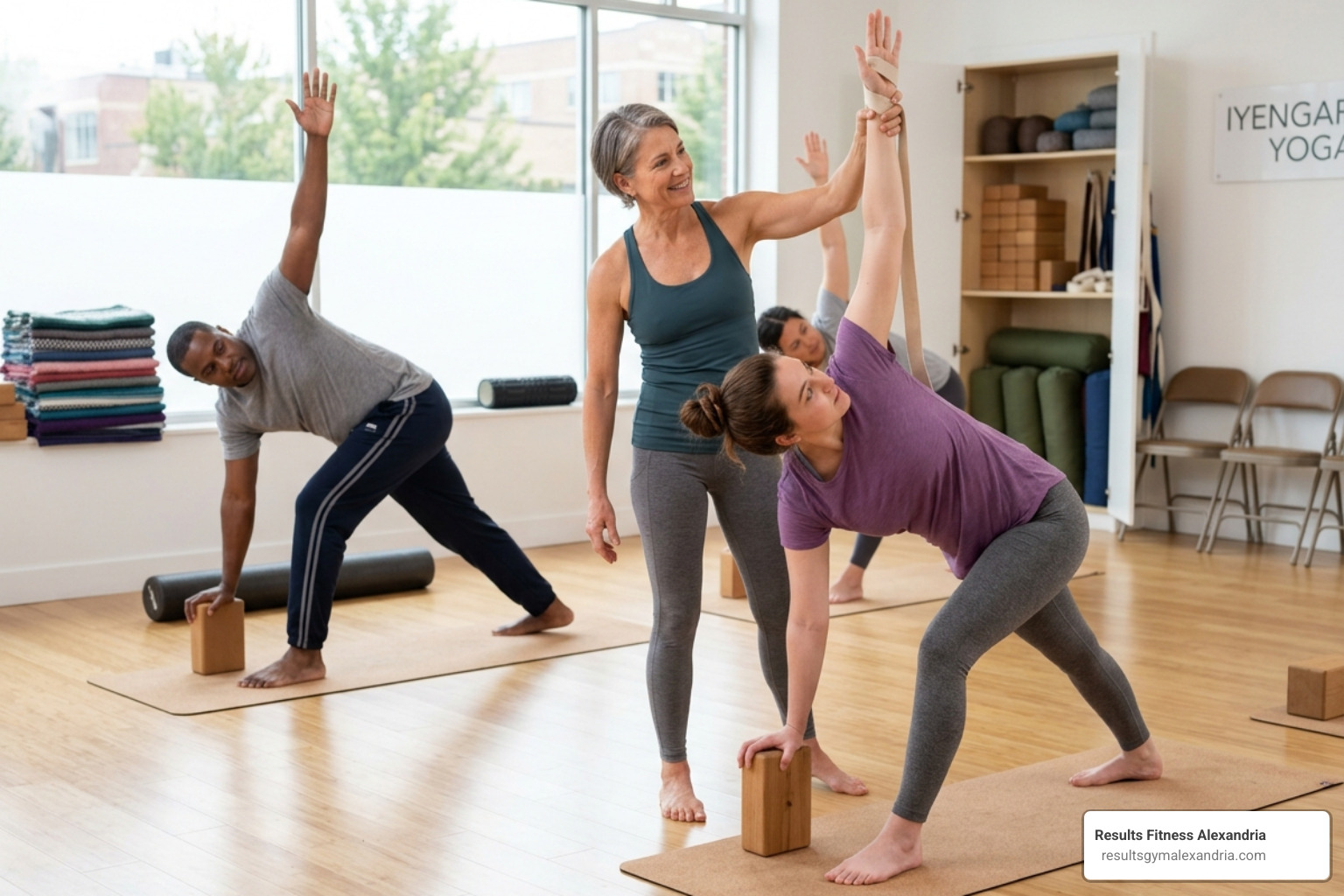
This is a classic lateral extension. Beginners often try to touch the floor and end up rounding their backs. In Iyengar yoga, we use a block under the bottom hand.
- The Focus: Keeping the chest open and the spine long. It’s better to have your hand on a block or your shin with a straight spine than to touch the floor with a hunched back.
Virabhadrasana II (Warrior II)
Warrior II builds incredible leg strength and stamina.
- The Focus: Ensuring the front knee is directly over the ankle and not “caving in.” We look for a strong, horizontal line through the arms and a steady gaze over the front hand.
Utthita Parsvakonasana (Extended Side Angle Pose)
This pose combines a deep lunge with a side stretch.
- The Focus: Creating one long, diagonal line from the outer edge of the back foot all the way to the fingertips of the extended arm.
Savasana (Corpse Pose)
Never skip this. Savasana is often called the most difficult pose because it requires total stillness. In Iyengar yoga, we might use a folded blanket under the head to ensure the neck is neutral. This pose is vital for nervous system restoration, allowing the body to absorb the benefits of the practice.
Starting Your Home Practice Safely
While we always recommend starting with a certified teacher to learn the ropes, establishing a home practice is where the real transformation happens. However, “practicing at home” doesn’t mean “doing whatever you want.” To stay safe and effective, follow these guidelines from the Home Practice for Beginners – Iynaus resources.
The “Rules” of Practice
- Empty Stomach: Practice at least 2-3 hours after a heavy meal. Yoga involves twists and compressions that don’t mix well with digestion.
- Nostril Breathing: Breathe only through your nose. This helps regulate the nervous system and keeps the body’s internal heat consistent.
- Active Body, Passive Brain: This is a classic Iyengar tip. While your muscles are working hard, your brain should remain “watchful” and calm, not stressed or judgmental.
- Consistency over Intensity: When Creating An Effective Workout Routine For Beginners/, it is much better to practice for 15 minutes every day than for two hours once a week.
Setting the Scene
You don’t need a dedicated studio. A clear patch of floor and a wall are your best friends. If you don’t have professional props yet, get creative with household alternatives:
- Instead of blocks: Use firm, thick books (dictionaries work great).
- Instead of a strap: Use a bathrobe tie or a sturdy belt.
- Instead of a bolster: Use firm bed pillows or rolled-up beach towels.
Maintaining a “Beginner’s Mind”
In Iyengar yoga, we often say that “staying a beginner is the new advanced.” Approach every practice with curiosity. Don’t bring “yesterday’s pose” to the mat. Every day your body is different—tighter in the morning, looser in the evening—so listen to what it needs now.
Frequently Asked Questions about Iyengar Yoga
Is Iyengar yoga for beginners suitable for everyone?
Yes! One of the biggest myths is that you need to be flexible to do yoga. That’s like saying you need to be clean to take a bath. Iyengar yoga is specifically designed for accessibility. Because we use props and modifications, it is suitable for all ages and fitness levels. However, if you have high blood pressure, recent surgeries, or are pregnant, you should always consult with your instructor first, as certain inversions or deep twists might be contraindicated. For a broader look at how yoga fits into a fitness regime, check out our Group Fitness Classes Ultimate Guide/.
Can I practice Iyengar yoga for beginners at home without props?
While props are a hallmark of the style, you can absolutely practice without them by using your own body and your environment for support. For example, using a wall for balance in standing poses or using your own shins as a “prop” during forward bends. If you are a woman starting a new fitness journey, a Womens Beginner Gym Workout/ can often be complemented by these “no-prop” yoga sessions to help with recovery and flexibility.
How often should I practice as a beginner?
For most beginners, practicing 2–3 times weekly is the “sweet spot.” This frequency allows your body to build familiarity with the poses and develop the necessary stamina without feeling overwhelmed. As you become more comfortable, you can increase the frequency. The goal of Creating An Effective Workout Routine For Beginners/ is sustainability. It’s better to start small and stay consistent than to burn out in the first two weeks.
Conclusion
Mastering the basics of iyengar yoga for beginners is about more than just stretching; it’s about building a relationship with your body based on respect, precision, and mindfulness. By focusing on alignment and using the tools available to you—whether those are professional blocks or a stack of books—you create a foundation for lifelong health and mobility.
At Results Fitness Alexandria, we believe that fitness should be accessible, safe, and effective for everyone. Whether you’re looking to improve your flexibility, recover from an injury, or simply find a moment of peace in a busy week, our Group Fitness/Yoga/ classes offer the expert guidance you need to succeed.
Ready to see what a difference precision makes? We invite you to Join our Group Fitness Classes and experience our community firsthand. We even offer a free 1-day pass so you can try our amenities and find the perfect class for your level. Stop “trying to fit broken pieces together” and start your journey toward wholeness with us today.