Cardio endurance exercise: 5 Ultimate Boosts
Why Cardio Endurance Exercise is Your Key to a Stronger, More Energized Life
Cardio endurance exercise is any physical activity that gets your heart pumping and your breathing faster for an extended period. These exercises—like walking, running, cycling, swimming, or dancing—strengthen your heart and lungs while improving your body’s ability to deliver oxygen to your muscles.
Here’s what cardio endurance exercise does for you:
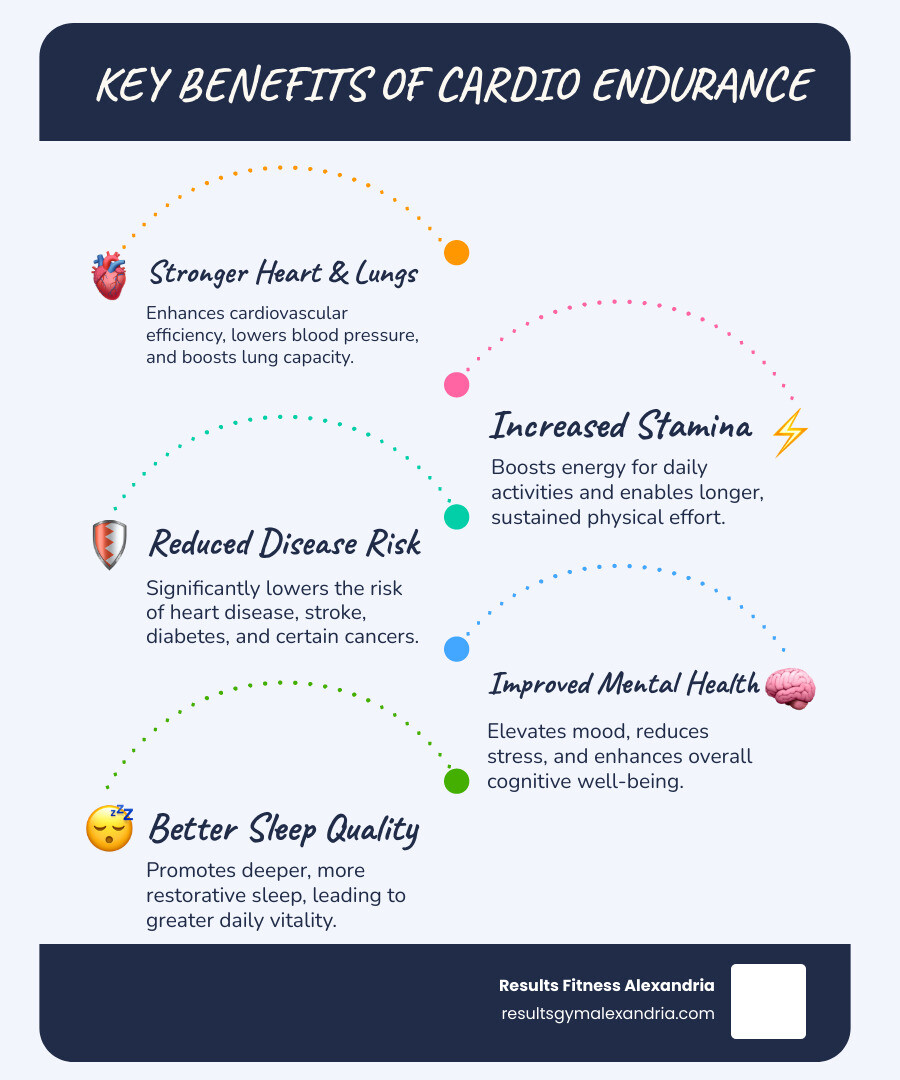
- Strengthens your heart and lungs so they work more efficiently
- Lowers your risk of heart disease, stroke, diabetes, and certain cancers
- Boosts your energy for daily activities like climbing stairs or playing with kids
- Improves your mood and helps you sleep better
- Increases your stamina so you can stay active longer without getting tired
Ever feel like your energy levels are stuck on low? Wish you had the stamina to chase after your kids, tackle that ambitious hiking trail, or simply power through your workday without hitting the afternoon slump? You’re not alone. The good news is that building your cardiovascular endurance doesn’t require hours at the gym or expensive equipment. It starts with understanding what your body needs and finding activities you actually enjoy.
Cardiovascular endurance—also called aerobic fitness or cardiorespiratory endurance—measures how well your heart, lungs, and blood vessels supply oxygen to your muscles during sustained physical activity. When you improve this capacity, everyday tasks become easier. You’ll climb stairs without getting winded, keep up with your family, and have energy left over at the end of the day.
The health benefits extend far beyond fitness. Regular cardio exercise can reduce your risk of heart disease by improving cholesterol levels and blood pressure. It strengthens your heart muscle, making it more efficient at pumping blood. Many people also experience better sleep quality, improved mental well-being, and a general sense of vitality.
I’m Jennifer Rapchak, Fitness Director at Results Fitness Gym in Alexandria, Virginia. With over 14 years as a certified personal trainer and expertise in high-intensity interval training (HIIT) and group fitness, I’ve helped countless individuals find how cardio endurance exercise transforms not just their fitness, but their entire quality of life. Whether you’re just starting out or looking to take your endurance to the next level, this guide will give you a clear blueprint for success.
What is Cardiovascular Endurance and Why Does It Matter?
At its core, cardio endurance exercise is about the efficiency of your cardiovascular system. This incredible system, comprising your heart, lungs, and blood vessels, acts as your body’s oxygen delivery service. The better your cardiovascular endurance, the more efficiently your heart can pump oxygen-rich blood to your working muscles, and the more effectively your lungs can take in and use that oxygen. This means you can sustain physical activity for longer periods without feeling fatigued.
Think of it this way: if your body is a car, your cardiovascular system is the engine. The more tuned up your engine is, the further and faster you can go without running out of gas. This efficiency isn’t just for athletes; it’s a fundamental indicator of overall physical fitness and health for everyone.
Why does this matter for your daily life? Strong cardiovascular endurance translates directly into an easier time with everyday tasks. Carrying a full laundry basket up a flight of stairs, playing with your kids or grandkids in the park, or simply maintaining energy through a long workday becomes less of a struggle. You’ll have more stamina and energy to enjoy life’s moments.
Beyond convenience, improving your cardio endurance exercise dramatically reduces your risk of developing chronic diseases. Regular physical activity is robustly associated with a decrease in cardiovascular mortality as well as the risk of developing cardiovascular disease. This includes conditions like heart disease, stroke, and type 2 diabetes. We know that active young people typically have a maximum oxygen consumption (VO2 max) of 35 to 50 milliliters of oxygen per kilogram of weight per minute. Endurance athletes push this even further, often reaching 70 to 85 ml/kg/min. These numbers highlight the body’s incredible capacity to adapt and improve with consistent training. For more on how endurance training can benefit you, explore our guide on More on the benefits of endurance.
The Core Benefits of a Stronger Heart

A strong heart is truly the foundation of a healthy body, and cardio endurance exercise is your best tool for building it. The benefits extend throughout your entire system:
- Lowers Blood Pressure: Regular aerobic exercise improves circulation, which can lead to a significant reduction in both systolic and diastolic blood pressure. A stronger heart can pump more blood with less effort, easing the pressure on your arteries.
- Improves Cholesterol Levels: Consistent cardio can help improve your blood lipid profile by raising HDL (good) cholesterol and lowering LDL (bad) cholesterol. This reduces the buildup of plaque in your arteries, guarding against heart disease.
- Strengthens Heart Muscle: Your heart is a muscle, and just like any other muscle, it gets stronger with exercise. This increased strength allows it to pump blood more efficiently, reducing its workload at rest and during activity.
- Boosts Lung Capacity and Oxygen Efficiency: As you engage in cardio endurance exercise, your lungs become more efficient at taking in oxygen and your body becomes better at transporting it to your working muscles. This means you can breathe easier during exertion and your muscles receive the fuel they need more readily.
- Increases Energy and Stamina: By optimizing your heart and lung function, you’ll experience a noticeable increase in your overall energy levels and stamina. This translates to less fatigue throughout the day and the ability to stay active for longer without feeling winded.
- Better Sleep Quality: Physical activity has been shown to be an effective option to improve your sleep quality. Regular exercise can help you fall asleep faster and enjoy deeper, more restorative sleep.
- Improved Mental Health: The benefits aren’t just physical. Engaging in cardio endurance exercise can significantly benefit your mental health. Exercise is a powerful stress reliever and can improve mood, reduce symptoms of anxiety and depression, and boost cognitive function. Studies have shown that physical activity is an effective option to improve mental health.
These comprehensive benefits underscore why prioritizing your heart health through cardio endurance exercise is one of the best investments you can make in your overall well-being. To further support your journey to a healthier heart, check out our insights on how to achieve better heart health.
The Best Cardio Endurance Exercise for Your Goals
When it comes to choosing the best cardio endurance exercise for you, the key is to find activities that involve rhythmic and continuous movement, engage large muscle groups, and most importantly, that you genuinely enjoy. The “best” exercise is always the one you’ll stick with. Whether you prefer solo workouts or group settings, there’s a cardio option out there for you. We’ve compiled some of the top 5 cardio exercises that can help you achieve your goals.
Steady-State Cardio
Steady-state cardio involves maintaining a moderate intensity level for a sustained duration. This is often referred to as your “conversation pace” because you should be able to hold a conversation without gasping for air, but still feel challenged. It’s the cornerstone of building a strong aerobic base.
Examples of effective steady-state cardio endurance exercise include:
- Walking: Brisk walking is an excellent, low-impact option that’s accessible to almost everyone. You can increase the challenge by walking uphill or adding light weights.
- Jogging/Running: A classic choice for improving endurance. Start with a mix of walking and jogging intervals if you’re new to it, gradually increasing your running time.
- Cycling: Whether outdoors or on a stationary bike, cycling is a great way to lift your heart rate while being gentle on your joints. Adjust resistance for varied intensity.
- Swimming: A full-body workout that’s incredibly low-impact, making it ideal for those with joint issues or recovering from injuries. Explore swimming for fitness for more details.
- Elliptical or Stair Climber: These machines at Results Fitness Alexandria provide continuous movement with adjustable resistance, offering effective low impact cardio options that are easy on your joints.
Steady-state cardio is perfect for longer sessions, allowing your body to efficiently use oxygen and burn fat for fuel.
High-Intensity Interval Training (HIIT)

If you’re looking for a time-efficient way to boost your cardiovascular endurance and burn calories, High-Intensity Interval Training (HIIT) might be your new favorite. HIIT involves alternating short, intense bursts of cardio endurance exercise with brief recovery periods. During the intense intervals, you push your heart to as high as 85% of its maximum heart rate. This type of training has been shown to improve people’s cardiovascular endurance by an impressive 38% to 79%!
Examples of HIIT exercises include:
- Sprinting: Short, all-out running efforts followed by walking or jogging for recovery. Sprint interval training (SIT) has been found to improve cardiovascular endurance by 4% to 13.5% after just two to eight weeks.
- Burpees: A full-body movement that combines a squat, push-up, and jump, getting your heart pumping quickly.
- Jump Squats: Explosive squats that add a plyometric element to increase intensity.
- Mountain Climbers: A dynamic plank variation that works your core and gets your heart rate up.
HIIT workouts are typically shorter than steady-state sessions, often ranging from 15-30 minutes, but they are incredibly effective. They challenge your body’s anaerobic system and lead to significant improvements in fitness. You can learn more about how to structure these workouts with our circuit training cardio guide and read about HIIT training benefits.
Examples of Cardio Endurance Exercise at Home
You don’t need a gym full of equipment to build excellent cardio endurance exercise. Many effective workouts can be done right in your living room with minimal to no equipment. This makes it incredibly convenient to fit exercise into a busy schedule. Here are some fantastic options:
5 At-Home Cardio Moves:
- Jumping Jacks: A classic full-body warm-up or standalone exercise. Stand with feet together, arms at your sides. Jump, spreading your feet wide and bringing your arms overhead. Jump back to the start. Repeat.
- High Knees: Stand in place and rapidly run, bringing your knees up towards your chest. Pump your arms as if you’re sprinting. This is a great way to simulate running indoors.
- Mountain Climbers: Start in a plank position, hands directly under your shoulders. Bring one knee towards your chest, then quickly switch to the other leg, mimicking climbing a mountain. Keep your core tight.
- Dancing: Put on your favorite music and just move! Dancing is a fun, expressive, and highly effective way to get your heart rate up. You can follow online dance workouts or just freestyle.
- Air Jump Rope: No actual rope needed! Mimic the motion of jumping rope, swinging your arms and jumping lightly on the balls of your feet. This is excellent for coordination and cardiovascular conditioning.
These exercises can be done in circuits (performing one after another with short rests) or in intervals. For example, do each exercise for 45 seconds, rest for 15 seconds, and then move to the next. Repeat the circuit 2-3 times. For more ideas and guidance, check out our full guide on exercise for cardiovascular endurance at home.
How to Build, Measure, and Progress Your Endurance
Building cardiovascular endurance is a journey, not a destination. It requires a systematic approach, often summarized by the FITT principle: Frequency, Intensity, Time, and Type. Understanding these elements will help you design an effective cardio endurance exercise program that continually challenges your body and leads to improvement. For beginners, it’s especially important to start smart. Our guide on building cardio endurance for beginners offers a great starting point.
Measuring Your Starting Point
Before you can improve, you need to know where you stand. Measuring your current cardiovascular endurance provides a baseline and helps you track your progress.
- Professional Fitness Assessment: The gold standard for assessing fitness is often a professional assessment. These tests can provide information about how well your heart and lungs are working to get oxygen to your muscles during exercise. Your results may indicate your risk for developing heart disease or other chronic diseases. These assessments often include resting blood pressure and heart rate measurements. We recommend seeking a professional fitness assessment at Results Fitness Alexandria to get a comprehensive understanding of your current fitness level.
- Timed Mile Run/Walk: A simple self-assessment is to time yourself walking or running a mile. As your endurance improves, your time will decrease. This is an easy way to track progress without special equipment.
- VO2 Max: This refers to your maximum oxygen consumption during exercise. While laboratory tests are the most accurate, you can estimate your VO2 max using online calculators with a few basic variables like your weight and mile time. Active young people typically have a VO2 max of 35 to 50 ml/kg/min, while endurance athletes can reach 70 to 85 ml/kg/min.
- Resting Heart Rate: A lower resting heart rate often indicates better cardiovascular fitness. Track your pulse first thing in the morning before getting out of bed. As your heart gets stronger, it can pump more blood with fewer beats.
- Rate of Perceived Exertion (RPE) Scale: This is a subjective but very useful way to gauge intensity. It’s a scale from 0 (no exertion) to 10 (maximal effort). For moderate intensity, aim for an RPE of 3-4, where you can still talk but are breathing harder. For vigorous intensity, aim for an RPE of 5-7, where speaking more than a few words is difficult.
Recommended Guidelines for Exercise
The Physical Activity Guidelines for Americans, 2nd edition, provide clear recommendations for adults to maintain and improve their health through physical activity. These guidelines suggest:
- Duration and Frequency: Aim for at least 150 to 300 minutes of moderate-intensity cardio endurance exercise per week, or 75 to 150 minutes of vigorous-intensity aerobic activity. This can be broken down into manageable chunks. A memorable goal is at least 30 minutes a day, at least five days a week.
- Consistency: Spreading your activity throughout the week is more beneficial than cramming it all into one or two sessions.
- Variety: Incorporating different types of cardio exercises helps work different muscle groups and keeps your routine interesting.
Even starting with 10-15 minutes of cardio endurance exercise at a time and gradually building up is effective. Every minute counts! To help you plan your weekly workouts, refer to The Physical Activity Guidelines for Americans and our guide on how often you should work out.
How to Progress Your Cardio Endurance Exercise
To continually improve your cardiovascular endurance, you need to apply the principle of progressive overload. This means gradually increasing the demands on your body over time. Without this progression, your body will adapt to your current routine, and improvements will plateau.
Here’s how you can effectively progress your cardio endurance exercise:
- Gradually Increase Duration: This is often the easiest way to start. If you’re currently exercising for 20 minutes, try adding 2-5 minutes to your sessions each week until you reach your desired duration. Start with 10-15 minutes at a time and gradually build up.
- Gradually Increase Intensity: Once you’re comfortable with your duration, you can make your workouts harder. This could mean:
- Walking more briskly or running faster.
- Increasing the incline on a treadmill or resistance on a bike.
- Adding hills to your outdoor walks or runs.
- Incorporating more vigorous intervals into your steady-state sessions.
- Add New Activities: Introducing different types of cardio endurance exercise challenges your body in new ways and prevents boredom. If you primarily walk, try cycling or swimming. If you do steady-state, add a HIIT session once or twice a week.
- Increase Frequency: If you’re currently exercising three days a week, try adding a fourth or fifth day.
A good rule of thumb for safe progression is the 10-20% rule: do not increase your time or distance by more than 10-20% each week. This allows your muscles and joints to adapt, reducing the risk of injury. Patience is key. While you might start to notice improved endurance within two months of consistent training (around 90 minutes per week), sustained progress comes from a thoughtful, gradual approach.
It’s also crucial to avoid overtraining. Listen to your body, ensure adequate rest, and don’t push too hard, too fast. For more detailed strategies on advancing your training, explore our guide on cardio training for better endurance.
Cardio vs. Other Training & Special Health Considerations
A truly well-rounded fitness routine incorporates more than just cardio endurance exercise. While cardio is vital for heart health, strength training and flexibility exercises play equally important roles in achieving overall physical fitness, promoting musculoskeletal health, and preventing injuries. It’s about creating a harmonious balance. Our article on creating a balanced fitness routine combining cardio, strength, and flexibility digs deeper into this synergy.
Cardio vs. Strength Training and Flexibility
Let’s break down the distinct contributions of each type of exercise:
| Exercise Type | Primary Goal | Examples
| Exercise Type | Primary Goal | Benefits You to find the best way to do so in functional fitness. That’s why we’re here to help you steer through the options and find the perfect fit for your lifestyle and goals.
Cardio vs. Strength Training and Flexibility
While all three types of exercise are crucial for a healthy, capable body, they serve different primary purposes:
| Exercise Type | Primary Goal | Examples