
Cardio Training for Better Endurance: Achieve Strong 2025
Why Building Cardiovascular Endurance Changes Everything
Cardio training for better endurance is the foundation that transforms how you feel during daily activities and athletic pursuits. Whether you’re chasing after your kids or training for your first 5K, improved cardiovascular endurance makes everything easier by training your heart, lungs, and muscles to work efficiently together.
Quick Answer for Building Better Endurance:
- Start with 150 minutes of moderate cardio per week (30 minutes, 5 days)
- Use the 10% progression rule – increase duration or intensity by 10% weekly
- Mix steady-state cardio (walking, cycling) with HIIT workouts
- Focus on consistency over intensity when starting out
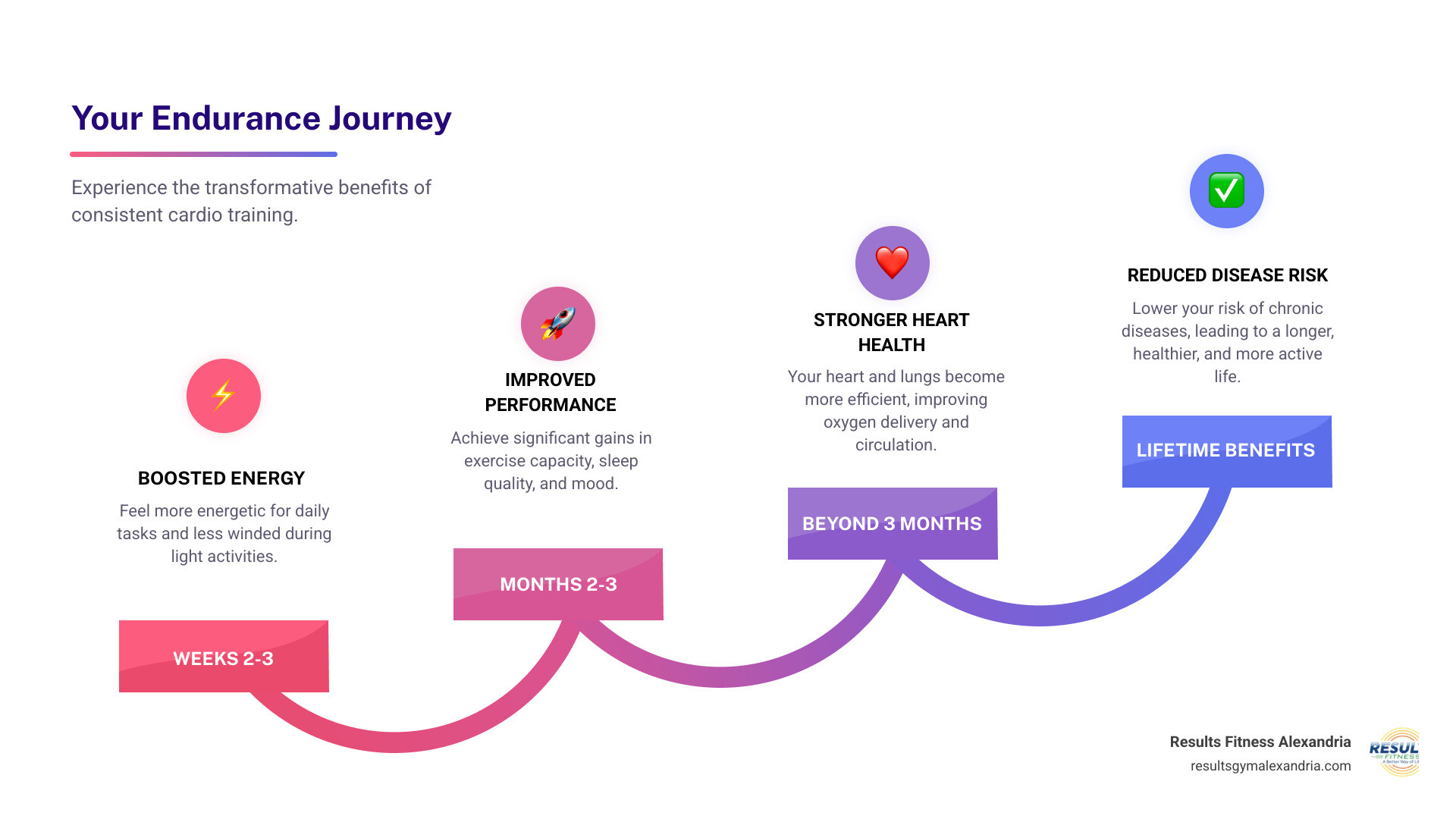
- Expect noticeable improvements in 2-3 weeks, significant changes in 2-3 months
Research shows that regular cardio training can improve cardiovascular endurance by 38% to 79% with high-intensity interval training. Even moderate activities like brisk walking can lower your risk of heart disease while boosting your energy, sleep, and mood.
I’m Jennifer Rapchak, Fitness Director at Results Fitness Alexandria. With over 14 years of experience, I’ve seen how the right approach to cardio training for better endurance builds confidence and energy that extends far beyond the gym.
What is Cardiovascular Endurance and Why Does It Matter?
Cardiovascular endurance is a measure of how efficiently your heart, lungs, and blood vessels supply oxygen to your muscles during sustained physical activity. As the experts at NCBI put it, Cardiovascular endurance is the ability of your heart and lungs to fuel your body with oxygen. This isn’t just for athletes; it’s about making everyday life easier, from carrying groceries to playing with your grandchildren.
Beyond making daily tasks a breeze, strong endurance significantly reduces your risk of chronic diseases like heart disease, high blood pressure, and type 2 diabetes. It’s also a fantastic mood booster. Exercise can be as effective as antidepressants for some, partly due to the release of endorphins, your body’s natural feel-good chemicals. For more on creating a well-rounded regimen, see our guide on More info about creating a balanced fitness routine.
Endurance vs. Stamina: Understanding the Difference
While related, endurance and stamina aren’t the same. Endurance is your body’s physical ability to sustain exercise for an extended period. Stamina is the mental and physical feeling of having the energy to continue. Improving your physical endurance directly boosts your stamina. Endurance has two components:
- Cardiovascular endurance: Your heart and lungs’ ability to supply oxygen.
- Muscular endurance: Your muscles’ ability to work continuously without fatigue.
The Health Benefits of Strong Cardio Endurance
The benefits of cardio training for better endurance transform your health:

- Lowering blood pressure: A stronger heart pumps blood more efficiently, reducing force on your arteries.
- Improving cholesterol levels: Cardio can raise HDL (good) cholesterol and lower LDL (bad) cholesterol.
- Weight management: Cardio workouts burn calories, aiding in weight loss or maintenance.
- Better sleep quality: Physical activity can improve sleep patterns by reducing stress and anxiety.
- Stronger immune system: Aerobic exercise activates your immune system, making you less susceptible to viral illnesses.
- Increased energy and stamina: An efficient cardiovascular system delivers more oxygen to your cells, boosting energy.
- Mood improvement: Regular cardio reduces tension and anxiety, contributing to a more positive outlook.
- Bone health: Weight-bearing cardio like walking or jogging helps reduce the risk of osteoporosis.
- Longevity and independence: Higher cardio fitness levels are linked to longer life and greater independence with age.
The Blueprint: How Much Cardio Do You Need?
So, how much cardio training for better endurance do you need? The American Heart Association recommends at least 150 minutes of moderate activity per week. This breaks down to an achievable 30 minutes a day, 5 days a week. Moderate activity can be anything from a brisk walk to cycling at a comfortable pace.
If you prefer a quicker workout, you can substitute with 75 minutes of vigorous activity per week, such as running or swimming laps. You can also mix and match moderate and vigorous activities. For greater health benefits, you can aim for more than 300 minutes of moderate activity weekly, but be sure to include variety to avoid injury.
Our guide on creating a workout routine for beginners can help you build a sustainable foundation.
Finding Your Intensity: Heart Rate Zones and the Talk Test
Understanding workout intensity is key to getting results without burning out. A simple way to start is by estimating your maximum heart rate: 220 minus your age.
- Moderate intensity: Aim for a heart rate between 50-70% of your maximum. You should be able to hold a conversation.
- Vigorous intensity: Aim for 70-85% of your maximum heart rate. You’ll only be able to speak a few words at a time.
The American Heart Association offers resources to help you know your target heart rates.
For a simpler method, use the talk test. During moderate exercise, you can talk but are slightly breathless. During vigorous exercise, you can’t say more than a few words. Another tool is the Rate of Perceived Exertion (RPE) scale (0-10). Moderate exercise feels like a 3-4, while vigorous is a 5-7. Listening to your body is the most important tool for training effectively and safely.
Your Ultimate Guide to Cardio Training for Better Endurance
Effective cardio training for better endurance rests on three principles: consistency (regular workouts are better than sporadic intense ones), progressive overload (gradually increasing the challenge), and variety (mixing up activities to prevent plateaus and boredom).

How to Start Your Cardio Training for Better Endurance
If you’re new to cardio, start where you are. Begin with 10-15 minute sessions to allow your body to adapt without being overwhelmed. Once comfortable, apply the 10% progression rule: increase your duration or intensity by no more than 10% each week. Most importantly, listen to your body and adjust your intensity based on how you feel.
Great beginner-friendly exercises include:
- Brisk walking: Gentle on joints and requires no special equipment.
- Cycling on a stationary bike: A low-impact option where you control the resistance.
- Swimming: A full-body workout that’s very kind to your joints.
- Light jogging: Introduce this by alternating between walking and short jogging intervals.
For more ideas, see our guide on top cardio exercises.
Advanced Cardio Training for Better Endurance: Incorporating HIIT
Once you have a solid cardio base, consider High-Intensity Interval Training (HIIT). HIIT involves alternating short bursts of all-out effort with recovery periods. For example, push yourself hard for 30 seconds, then recover for 60-90 seconds.
HIIT is time-efficient, offering an effective workout in just 20-30 minutes. Research shows HIIT improved cardiovascular endurance by 38% to 79% and is excellent for improving your VO2 max (your body’s ability to use oxygen).
A simple HIIT workout: After a 5-10 minute warm-up, alternate 30-second sprints with 60-second recovery walks for 8-12 rounds. Finish with a 5-10 minute cool-down. Limit HIIT to 1-2 times per week, balanced with steady-state cardio. Learn how to combine workout types in our guide on integrating strength training with cardio.
Training Smart: Avoiding Risks and Adapting Your Routine
As you see results from your cardio training for better endurance, it’s tempting to overdo it. Training smart means knowing when to push and when to recover to stay healthy for the long haul.

Pay attention to signs of overtraining, such as persistent fatigue, a higher resting heart rate, poor sleep, mood changes, or chronic muscle soreness. These are signals to ease up.
- Rest days are growth days. This is when your muscles repair and your heart becomes more efficient. Aim for at least one full rest day per week.
- Vary your activities to prevent overuse injuries. Mix treadmill sessions with swimming or cycling to give your joints a break.
- Proper warm-ups and cool-downs are your insurance against injury. Start with 5-10 minutes of light movement and dynamic stretches. End your workout by gradually lowering your heart rate and doing static stretches while your muscles are warm.
Exercising Safely with Health Conditions
If you have any health conditions or are recovering from a cardiac event or stroke, consult with your doctor first before starting a new exercise program. This is crucial for your safety.
Your doctor can provide personalized guidance on what types of exercise are safe and effective for you. Cardio is often a key part of recovery, but it must be done thoughtfully. The guidance on exercise after a stroke or cardiac event offers valuable resources for a gradual approach.
At Results Fitness Alexandria, our experienced personal trainers know how to adapt workouts for all health backgrounds, ensuring your training is both safe and effective.
Tracking Your Journey: How to Measure Endurance Progress
Watching your progress is one of the most rewarding parts of cardio training for better endurance. Knowing what to look for helps you celebrate your victories.
- Keep a workout log: Note the exercise, duration, and how you felt. Recording your RPE or heart rate provides concrete data on your improvement.
- Track distance and duration: Notice if you can go farther in the same amount of time or exercise for longer than you could a few weeks ago.
- Use the talk test: You’ll find that you can talk more easily during workouts that once left you breathless. This shows your cardiovascular system is adapting.
- Try fitness assessments: For objective data, consider the 1.5-mile run test or a timed walk/cycle test to estimate your VO2 max improvements.
Celebrating milestones is crucial for motivation. Acknowledging small wins reinforces your commitment. When motivation is low, every step forward counts. Our guide on More info on staying motivated offers strategies to keep you going.
Frequently Asked Questions about Endurance Training
Here are answers to common questions about cardio training for better endurance.
How quickly will I see improvements in my endurance?
You’ll likely feel a difference within 2-3 weeks of consistent training, such as getting less winded on stairs. More significant changes, like noticeable increases in running distance or a lower resting heart rate, typically take 2-3 months. Consistency is more important than intensity for long-term adaptation.
Is it better to do long, slow cardio or short, fast intervals?
Both are essential for well-rounded cardio training for better endurance. Long, steady-state cardio builds your aerobic base, teaching your body to use fuel efficiently. High-intensity intervals (HIIT) improve your VO2 max and your ability to sustain high-intensity efforts. A balanced routine that includes both will yield the best results. Our guide on cardio vs. strength training explores different workout strategies.
Can I build endurance with low-impact exercises?
Absolutely. Low-impact exercises are fantastic for building endurance, especially if you have joint concerns or are recovering from an injury. They are just as effective as high-impact options for improving heart health.
- Swimming: A full-body workout with no impact on joints.
- Cycling: An excellent cardio workout without the stress of running.
- Elliptical training: Mimics running without the impact.
- Rowing: A powerful, full-body exercise that builds both cardio and strength with minimal joint stress.
For more on water-based workouts, check out our guide on aquatic exercise.
Conclusion
We’ve covered how cardio training for better endurance can transform not just your workouts, but your entire life. By strengthening your heart and lungs, daily activities like climbing stairs or playing with family become easier and more enjoyable.
Endurance is a journey, not a destination. Consistency and patience are more important than perfection. The key takeaways are your foundation for success: start with manageable goals, progress gradually, mix in variety, and always listen to your body.
A consistent, smart approach is what creates remarkable, long-term changes. At Results Fitness Alexandria, we’ve seen countless members find their true capabilities by improving their cardiovascular endurance. Our expert trainers can help you create a personalized plan that fits your fitness level and goals.
Starting can feel overwhelming, which is why we offer a free 1-day pass to experience our supportive community. Take the first step towards lasting endurance today. Your future, more energized self is waiting. Come see how our state-of-the-art cardio equipment and amenities can support you on your journey.