
Circuit training cardio: Master Your 2025 Fitness
Why Circuit Training Cardio is Your Most Efficient Path to Fitness
Circuit training cardio combines strength building and heart-pumping cardio into one time-efficient workout. This method involves moving through a series of exercises with minimal rest, keeping your heart rate liftd while building muscle and endurance. It’s a time-efficient, full-body workout that’s versatile and easily modified for any fitness level.
The beauty of this approach is its simplicity and effectiveness, delivering comprehensive results without requiring hours at the gym. Whether you’re a busy parent or new to fitness, circuit training cardio offers a powerful solution by combining strength and cardio into one format.
I’m Jennifer Rapchak, Fitness Director at Results Fitness Alexandria. With over 14 years of experience as an ACE-certified personal trainer, I’ve seen how circuit training cardio can transform fitness routines for people at every level.
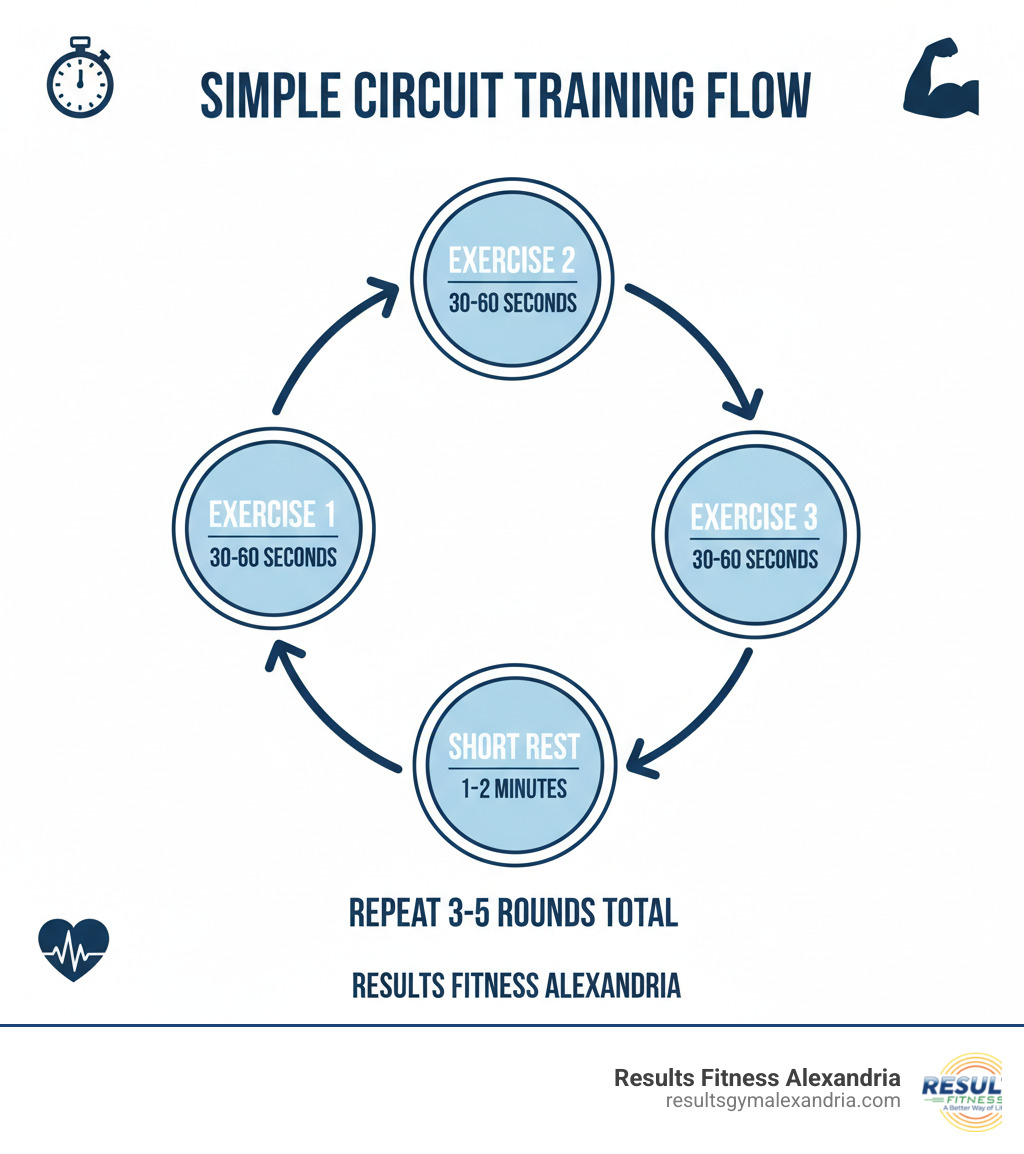
Circuit training cardio definitions:
What is Circuit Training and How Does It Boost Cardio?
Circuit training cardio involves moving through a series of exercises one after another with minimal rest. This structure keeps your heart rate liftd throughout the workout. The American Council on Exercise notes that these minimal rest periods produce a significant cardiorespiratory response, as your heart works hard to deliver oxygen to your muscles. This makes circuit training an effective way to build muscular endurance, develop strength, and boost cardiovascular health in one time-efficient session.
| Feature | Circuit Training | HIIT (High-Intensity Interval Training) |
|---|---|---|
| Intensity | Medium to high, but typically not maximal | Maximum effort (80-95% of max heart rate) |
| Duration | 30-60 minutes | 15-25 minutes |
| Work-to-Rest Ratio | Minimal rest between exercises (15-30 seconds), longer rest between circuits (90 seconds to 2 minutes) | Short, intense bursts (under 30 seconds) with specific recovery periods |
| Primary Goal | Mixed: Strength, endurance, calorie burn, general fitness | Primarily cardiovascular improvement and fat burning |
The Core Benefits of Adding Cardio to Your Circuits
Adding a cardio element to your circuits means you’re working smarter. Here are the core benefits:
- Improved cardiovascular health: Your heart becomes stronger and more efficient at pumping blood, making daily activities easier.
- Increased calorie burn: Interval-based training is effective for weight loss. Research shows that it helps reduce weight and waist circumference. You also benefit from the “afterburn effect,” where your body continues to burn calories post-workout.
- Boosted muscular endurance: Your muscles learn to work efficiently even when fatigued, improving performance in sports and daily life.
- Improved lactate threshold: By regularly challenging your body, you can push harder for longer before feeling muscle burn. This is key to build cardio stamina.
- Time-saving: Combining strength and cardio makes it perfect for busy schedules.
Key Differences Between Circuit Training and HIIT
While circuit training cardio and High-Intensity Interval Training (HIIT) seem similar, they have key differences. Understanding them helps you choose the right workout for your goals.
HIIT involves maximum effort intervals, working at 80-95% of your maximum heart rate for short bursts (under 30 seconds), followed by specific recovery periods, as per ACSM HIIT guidelines. It’s an all-out effort followed by recovery.
Circuit training cardio operates at a more moderate, sustainable intensity. You maintain an liftd heart rate throughout the workout without the extreme peaks of HIIT. A typical HIIT session is 15-25 minutes due to its intensity, while circuit training runs 30-60 minutes.
Rest periods also differ. In circuit training, rest between exercises is minimal, with a longer break between circuits. HIIT requires specific recovery periods to prepare for the next max-effort interval. Both are effective, but circuit training is often more accessible for beginners. You can learn more about HIIT exercises to see which you prefer.
How to Structure Your Circuit Training Cardio Workout
Creating an effective circuit training cardio workout is about having the right mix and flow. The structure is simple: choose your exercises, perform them back-to-back with minimal rest, then repeat the sequence. Key components include exercise selection, alternating muscle groups, setting work-to-rest ratios, and determining the number of rounds. This continuous movement is what transforms a regular strength workout into a cardiovascular powerhouse.
Structuring a Routine for Effective Circuit Training Cardio
At Results Fitness Alexandria, we design circuit training cardio routines that are challenging and achievable through smart exercise selection and sequencing.
- Choose 5-10 exercises: Select compound movements that cover major patterns like pushing (push-ups), pulling (rows), squats, lunges, and hinges (deadlifts). These engage multiple muscle groups for maximum efficiency.
- Alternate muscle groups: Switch between upper body, lower body, and core exercises. For example, follow squats (lower) with push-ups (upper). This allows one muscle group to recover while another works, helping you maintain intensity.
- Add cardio bursts: Insert 30-60 second cardio exercises like jumping jacks every few strength moves to keep your heart rate liftd.
- Decide on timing: Use either reps (10-15 per exercise) or timed intervals (30-60 seconds per exercise). Timed intervals are great for cardio, while reps help focus on form for strength moves.
- Plan your rest: After completing one full circuit, rest for 90 seconds to 2 minutes before starting the next round. This structure is key to integrating strength and cardio effectively.
Adapting Circuits for Every Fitness Level
Circuit training cardio is easily adapted for any fitness level.
- For beginners: Focus on form with bodyweight exercises. Take longer rests (15-30 seconds) between exercises and complete 1-2 circuits. The goal is to master movements and build a foundation.
- For intermediate levels: Reduce rest between exercises to 10-15 seconds and add light dumbbells or resistance bands. Increase the duration or reps and aim for 2-3 circuits.
- For advanced challenges: Minimize rest between exercises and complete 3-5+ circuits. Incorporate heavier weights, complex movements, and explosive exercises, aiming for an 8/10 Rate of Perceived Exertion (RPE).
Always listen to your body and progress gradually. Our fitness classes for all levels are designed with this flexibility to ensure a safe and effective workout for everyone.
The Best Exercises and Sample Routines
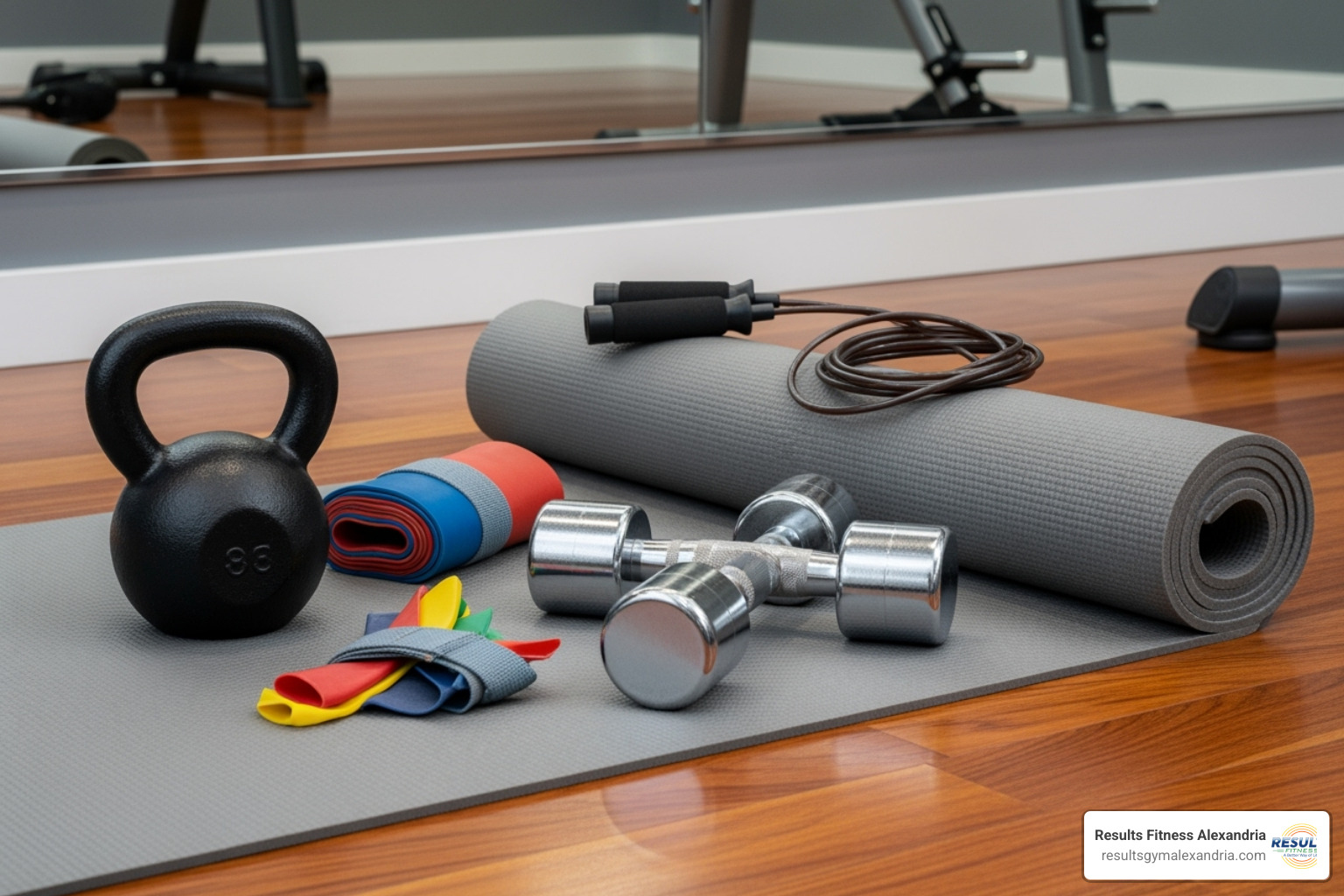
The beauty of circuit training cardio is its versatility. You don’t need a gym full of fancy machines. The key is choosing exercises that challenge multiple muscle groups at once. Compound movements like squats are the backbone of effective circuits. Bodyweight exercises are perfect with no equipment, while free weights like dumbbells add resistance. The secret is selecting exercises you can perform with good form while maintaining a challenging pace.
Effective Cardio Exercises for Circuit Training
To keep your heart rate high during circuit training cardio, incorporate these effective exercises:
- Jumping Jacks: A classic, full-body move that requires no equipment.
- High Knees: Drives your heart rate up while engaging your core.
- Burpees: A challenging exercise combining strength and cardio.
- Mountain Climbers: Builds core stability while providing a cardio punch.
- Kettlebell Swings: A powerful hip-hinge movement that builds strength and lifts heart rate.
- Jump Rope: A portable option that improves coordination and agility.
- Box Jumps: Builds explosive power and gets your heart rate up quickly.
These movements engage large muscle groups and can be performed at high intensity. For more ideas, see our guide to the top 5 cardio exercises to boost your endurance.
Sample Routines for Ultimate Circuit Training Cardio
Here are two sample routines. For both, perform each exercise for 45 seconds, rest 15 seconds between exercises, and take a 90-second rest after each round. Aim for 3-4 rounds.
Bodyweight-Only Circuit:
This routine requires no equipment and can be done anywhere.
- Bodyweight Squats
- Push-ups (on knees or toes)
- Mountain Climbers
- Alternating Lunges
- Plank
- Burpees
Dumbbell & Cardio Blast Circuit:
This routine adds resistance with a pair of dumbbells.
- Goblet Squats
- Renegade Rows
- Jumping Jacks
- Dumbbell Lunges
- Overhead Press
- High Knees
These routines are adaptable to your fitness level. Always prioritize good form. For more structured guidance, our fitness classes for weight loss offer an excellent environment to experience circuit training cardio.
Achieving Your Goals and Staying Safe

With circuit training cardio, you can achieve a variety of fitness goals. The combination of strength and cardio work keeps your heart pumping while engaging multiple muscle groups. The “afterburn effect” (EPOC) means your body keeps burning extra calories for hours after your workout. For endurance, circuit training improves your lactate threshold, training your body to work harder for longer. However, with this power comes the need for safety. Proper form should always be your number one priority over speed or weight.
Using Circuits for Specific Fitness Goals
Circuit training cardio can be customized to meet your specific fitness goals.
- For Fat Loss: Design circuits with high intensity, minimal rest, and full-body compound movements. Add explosive cardio bursts like burpees to maximize calorie burn. Combine with consistent nutrition for best results.
- For Building Endurance: Extend the duration of each exercise and reduce rest periods. Incorporate more cardio-focused elements like jump rope or mountain climbers to build cardio stamina.
- For Muscle Toning: While not for building massive muscle, circuit training is excellent for creating a lean, defined look. Incorporate resistance with dumbbells or bands and focus on performing enough repetitions to challenge your muscles.
Potential Risks and Safety Considerations
While circuit training cardio is beneficial, safety is paramount to prevent injury.
- Always warm up: Spend 5-10 minutes on light cardio and dynamic stretches to prepare your muscles and get blood flowing.
- Prioritize proper form: Form is non-negotiable. If you feel your technique failing due to fatigue, reduce the intensity, rest, or use a modified version of the exercise.
- Avoid technical lifts when fatigued: Stick to simpler movements you can perform safely. Avoid complex lifts like Olympic lifts when tired.
- Listen to your body: Differentiate between the discomfort of a challenge and pain. Pain is a signal to stop. Allow for adequate rest days for muscle recovery.
- Cool down and stretch: Spend 5-10 minutes after your workout on light movement and static stretching to gradually lower your heart rate and improve recovery.
Frequently Asked Questions about Circuit Training Cardio
How is circuit training different from HIIT?
While both get your heart pumping, circuit training cardio and HIIT are different. Circuit training involves moving through a series of exercises with minimal rest, working at a moderate to high intensity for 30-60 minutes. It blends strength and cardio at a steady, challenging pace. HIIT involves short bursts of maximum effort (80-95% of max heart rate) for 30 seconds or less, followed by specific recovery periods. HIIT workouts are shorter (15-25 minutes) due to their intensity. In short, circuit training is a sustained effort, while HIIT is all-out sprints with rest.
How many calories does a cardio circuit burn?
Circuit training cardio is a significant calorie burner, though the exact number depends on factors like body weight, intensity, and exercise choice. A 30-minute circuit can burn 250-500+ calories. Plus, the “afterburn effect” (EPOC) means your metabolism stays liftd for hours post-workout, burning additional calories as your body recovers. This gives you more metabolic benefit than steady-state cardio.
How often should I do circuit training for the best results?
For best results, consistency is key. We recommend circuit training cardio 2-3 times per week on non-consecutive days. Rest days are crucial for muscle recovery and rebuilding, which is when you get stronger. Active recovery like walking or stretching is fine on off days. Overtraining can lead to burnout or injury, so focus on quality, consistent workouts rather than daily sessions. Finding a sustainable routine is the goal we help clients achieve here at Results Fitness Alexandria.
Conclusion
Circuit training cardio is an efficient and effective way to transform your fitness. By combining strength and cardio, it delivers remarkable results in less time, whether your goal is weight loss, endurance, or strength. Its power lies in keeping you engaged and challenged, with constant movement and the added benefit of the afterburn effect.
The flexibility of circuit training means it can be adapted for any fitness level, from bodyweight exercises at home to advanced routines with equipment. At Results Fitness Alexandria, our experienced trainers can help you design safe, effective circuits custom to your goals, guiding you on proper form to keep you motivated.
Ready to experience the power of circuit training cardio? We invite you to try our facilities with a free 1-day pass. Come explore our cardio amenities and find a workout that delivers results and that you’ll actually look forward to.