
Build cardio stamina: 7 Ultimate Exercises
Why Building Cardiovascular Endurance Matters for Your Health
To build cardio stamina, you need consistent aerobic exercise that challenges your heart and lungs over time. Here’s what works:
Quick Start Guide:
- Start with 15-30 minutes of moderate cardio 3-5 days per week
- Choose activities you enjoy like walking, cycling, or swimming
- Gradually increase duration by 10-20% each week
- Add HIIT workouts 1-2 times per week for faster results
- Track your heart rate to stay in the 60-85% zone
Whether you’re struggling to climb stairs without getting winded or you want to keep up with your kids at the playground, improving your cardiovascular endurance makes everyday tasks feel easier. Research shows that people can see measurable improvements in their cardio stamina in just 8-12 weeks with consistent training.
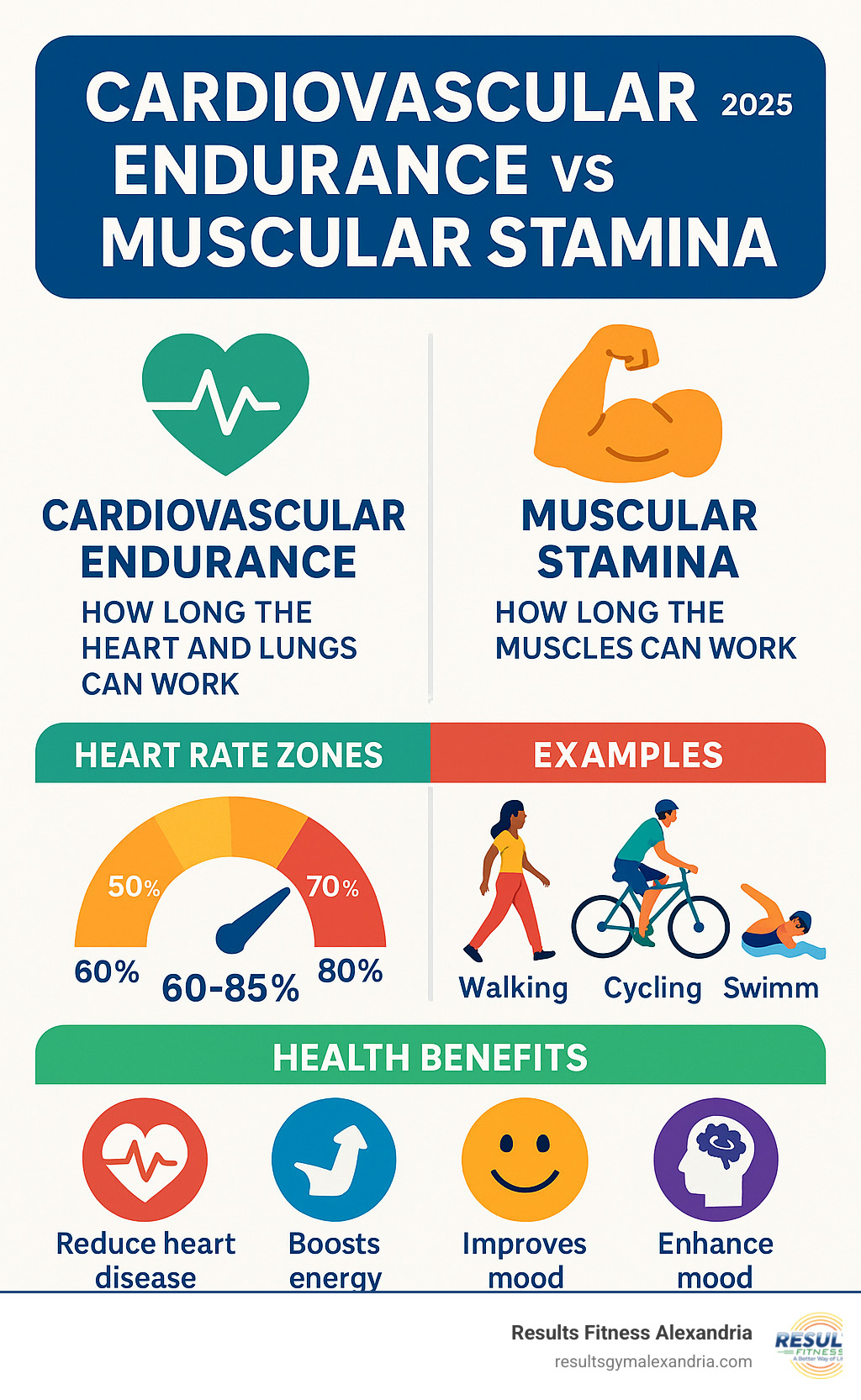
Cardiovascular endurance is your heart, lungs, and blood vessels’ ability to supply oxygen to your muscles during sustained physical activity. Unlike muscular stamina (how long specific muscles can work), cardio endurance affects your whole body’s ability to keep going.
The benefits go far beyond fitness. Regular cardio exercise reduces your risk of heart disease, high blood pressure, obesity, type 2 diabetes, and stroke. It also boosts your energy levels and improves your mood through the release of endorphins.
As Jennifer Rapchak, Fitness Director at Results Fitness Alexandria with over 14 years of personal training experience, I’ve helped countless members build cardio stamina through structured workout programs and personalized coaching. My expertise in HIIT, strength training, and progressive exercise programming has shown me that anyone can improve their cardiovascular endurance with the right approach and consistency.
Understanding and Measuring Your Cardiovascular Endurance
Cardiovascular endurance, also called aerobic or cardiorespiratory fitness, is your heart, lungs, and blood vessels working together to deliver oxygen to your muscles during exercise. When this system is efficient, you can build cardio stamina and tackle daily activities without feeling winded.
Why it’s important goes beyond just feeling less tired. Strong cardiovascular endurance dramatically cuts your risk of heart disease, high blood pressure, obesity, type 2 diabetes, and stroke. According to scientific research on physical fitness components/11%3APhysicalFitness/11.03%3AHealthRelatedComponentsofPhysicalFitness), aerobic exercise is a vital part of physical fitness, strengthening your heart and lungs, boosting brain function, and improving mood.
VO2 max is the gold standard for measuring cardio fitness, showing the maximum amount of oxygen your body can use during intense exercise. While lab tests are precise, you can track your progress without them.
How to measure cardio fitness doesn’t require fancy equipment. Here are three practical ways to assess your current level:
- The 1.5-mile run test: Time yourself running or walking 1.5 miles. A faster time indicates better endurance.
- The talk test: At moderate intensity, you should be able to talk but not sing. If you’re breathless, you’re at a vigorous intensity.
- The perceived exertion scale: Rate your effort on a scale from 6 (no effort) to 20 (maximum). Aim for 12-14 for building endurance.
These simple tests provide a baseline and help you track your progress as you improve your cardiovascular fitness.
The Best Exercises to Build Cardio Stamina
To build cardio stamina, you need consistent aerobic exercise. The key is finding an activity you enjoy so you’ll stick with it long-term. Cardio exercises can be low-impact (gentler on joints) or high-impact (more intense, builds bone density). Low-impact options like swimming, cycling, and brisk walking are great for beginners or those with joint concerns. High-impact activities include running, jumping rope, and stair climbing.
Swimming is a particularly complete exercise. It’s incredibly low-impact while providing a full-body workout. For more on aquatic exercise, check out how aquatic exercise can help you lose weight and get in shape.

Here are top exercises to build cardio stamina:
- Running: A classic full-body workout that quickly lifts your heart rate. Alternate walking and jogging if you’re new to it.
- Cycling: An excellent low-impact option that builds leg strength and cardiovascular fitness, whether outdoors or on a stationary bike.
- Swimming: The ultimate full-body, low-impact exercise that engages nearly every muscle group.
- Rowing: A powerhouse, full-body workout that combines strength and cardio while being easy on the joints.
- Brisk Walking: Accessible and effective, especially when you add inclines or speed intervals.
- Stair Climbing: An efficient way to build leg strength and endurance, using a machine or real stairs.
- Jumping Rope: A portable, high-intensity workout that also improves coordination.
The best exercise is the one you’ll do consistently. Mixing up activities keeps your routine interesting and promotes well-rounded fitness.
The Critical Role of High-Intensity Interval Training (HIIT)
While steady-state cardio is great, High-Intensity Interval Training (HIIT) is a powerful tool to rapidly build cardio stamina. It involves alternating short bursts of all-out effort (anaerobic exercise) with brief recovery periods. This method forces your cardiovascular system to adapt and become more efficient.
Tabata is a popular HIIT format: 20 seconds of work followed by 10 seconds of rest, repeated eight times. The benefits of HIIT include a significant metabolism boost and incredible time efficiency—you can get an effective workout in 20-30 minutes.
Research shows that HIIT can improve endurance by 38% to 79%, making it a top tool for accelerating progress. However, HIIT is intense, so limit these workouts to once or twice per week. For more guidance, explore why you should give HIIT exercises a try.
Creating Your Stamina-Building Workout Plan
An effective plan to build cardio stamina can be structured using the FITT principle: Frequency, Intensity, Time, and Type.
- Frequency: How often you exercise. The American Heart Association recommends at least 150 minutes of moderate or 75 minutes of vigorous aerobic exercise per week, typically over 3-5 days.
- Intensity: How hard you work. For moderate intensity (50-70% of max heart rate), you can talk but not sing. For vigorous intensity (70-85% of max heart rate), you can only speak in short phrases. Estimate your max heart rate by subtracting your age from 220.
- Time: How long each workout lasts. Start with 10-15 minutes and gradually work up to 30 minutes or more. Significant improvements are often seen with at least 30 minutes of exercise, three times a week, for 8-12 weeks.
- Type: The kind of activity you do. Choose exercises you enjoy to ensure consistency. Mixing activities like cycling and swimming works different muscle groups.

Warm-ups and cool-downs are essential. A 5-10 minute warm-up with light cardio and dynamic stretches prepares your body for exercise. A 5-10 minute cool-down, gradually reducing intensity and followed by static stretches, aids recovery and reduces next-day soreness.
Strength training also supports cardio stamina by making muscles more efficient. Learn more about maximizing results by combining both types of exercise.
How to Gradually Build Cardio Stamina with Progressive Overload
To keep improving, you must gradually increase the demands on your body, a principle known as progressive overload. Your body adapts specifically to the training you do (the SAID principle), so if you do the same workout repeatedly, your progress will stall.
To avoid this, apply progressive overload:
- Use the 10 percent rule: Increase your workout duration or distance by no more than 10-20% each week to prevent injury.
- Increase duration: Gradually add a few minutes to your sessions each week.
- Increase intensity: Once you’re comfortable with the duration, increase your pace, add hills, or incorporate high-intensity bursts.
- Prevent plateaus: If progress stalls, change your routine by increasing intensity, duration, or switching to a new activity.
- Track progress: Monitor your duration, distance, and pace to stay motivated and see your improvements.
Consistency is key. Small, regular efforts are more effective than occasional heroic workouts to build cardio stamina.
Fueling Your Body: The Role of Nutrition and Rest
Workouts are only part of the equation to build cardio stamina. Proper nutrition and recovery are just as crucial for optimal performance.
Nutrition is your fuel. For sustained energy, you need a balance of macronutrients:
- Complex Carbohydrates: Your primary energy source. Found in whole grains, fruits, and vegetables.
- Lean Protein: Essential for muscle repair and growth. Found in lean meats, fish, beans, and lentils.
- Healthy Fats: A concentrated energy source for longer activities. Found in avocados, nuts, and olive oil.
Hydration is non-negotiable. Drink water throughout the day. For longer or more intense workouts, you may need electrolytes (like sodium and potassium) to replenish what’s lost in sweat.
Rest is when your body adapts and gets stronger.
- Sleep: Aim for 7-9 hours of quality sleep per night for tissue repair and hormone release.
- Active Recovery: On rest days, light activities like walking or stretching promote blood flow and reduce soreness.
- Overtraining Symptoms: Avoid pushing too hard without rest. Symptoms include persistent fatigue, decreased performance, and irritability. Listen to your body.
Nutrition Tips to Help Build Cardio Stamina
What and when you eat can significantly impact your ability to build cardio stamina.
- Pre-Workout Fuel: Eat easily digestible carbs 1-2 hours before your workout. A banana or a slice of whole-wheat toast works well. Avoid heavy meals.
- Post-Workout Recovery Meals: Within 30-60 minutes after exercise, have a meal with both carbs and protein to replenish energy and repair muscle. A smoothie with protein powder or Greek yogurt with berries are great choices.
- Timing Your Meals: Eat consistently throughout the day to maintain energy levels.
- Staying Hydrated During Exercise: For workouts under an hour, sip water every 15-20 minutes. For longer sessions, consider a sports drink with electrolytes.
- Foods to Limit: Minimize processed sugars and unhealthy fats, which can cause energy crashes. Focus on whole, unprocessed foods for sustained performance.
Frequently Asked Questions about Building Cardio Stamina
Here are answers to some common questions about how to build cardio stamina.
How long does it take to see improvements in cardio stamina?
The timeline depends on your starting fitness level and consistency.
- Beginners: You may feel less winded during daily activities in just 2-4 weeks.
- Measurable Gains: With consistent training (e.g., 30 minutes of cardio 3 times a week), most people see significant improvements in 8-12 weeks.
- Noticeable Improvements: Major changes, where you can tackle previously difficult activities, typically occur around the 2-3 month mark.
Your progress is affected by your starting point, workout frequency and intensity, nutrition, and recovery. Consistency is the most important factor.
What are common pitfalls to avoid?
Avoid these common mistakes to stay on track as you build cardio stamina:
- Overtraining: Pushing too hard without adequate rest leads to fatigue and injury. Recovery is when you get stronger.
- Inconsistency: Sporadic workouts won’t build stamina. Consistent, shorter workouts are better than occasional long ones.
- Poor form: Incorrect form in any cardio exercise can lead to injury and reduce effectiveness.
- Ignoring pain: Listen to your body. Sharp or persistent pain is a signal to stop, not push through.
- Neglecting nutrition and rest: Your body needs quality fuel and sleep to perform and recover.
- Setting unrealistic goals: Aim for gradual, sustainable progress to avoid frustration and injury.
Is it better to do cardio before or after weights?
The best order depends on your goals:
- Cardio first for endurance focus: If your main goal is to improve cardiovascular fitness, do cardio when you’re fresh to maximize intensity and duration.
- Weights first for strength focus: If building muscle is your priority, lift weights first when your muscles have maximum power.
For general fitness, you can do either first or split them into different days. The best approach is what aligns with your goals and what you can do consistently. For more details, see our cardio vs. strength training guide.
Start Your Journey to Better Endurance Today
Building cardiovascular endurance transforms how you experience daily life. We’ve covered the essentials to build cardio stamina: consistent aerobic exercise, progressive overload, smart nutrition, and proper rest. The path is clear: choose activities you enjoy, like running, swimming, or cycling, and apply the principles of gradual progression. Remember the 10 percent rule, leverage HIIT workouts, and build a solid base with steady-state cardio.
The long-term health benefits are immense. Everyday tasks become easier, your risk of heart disease, diabetes, and stroke decreases, and your mental toughness grows. This improved quality of life means more energy, better sleep, and greater confidence.
At Results Fitness Alexandria, our personal trainers can help you start this journey. We’ll create a personalized plan that applies these principles to your goals and lifestyle, whether you’re a beginner or an experienced athlete. Our facility has all the tools you need to succeed.
Ready to take the first step? Explore our cardio equipment and get your free 1-day pass today. Start building the endurance that will serve you for years to come.