
The Real Cost of Hiring a Private Trainer Explained
What Does a Private Trainer Actually Cost? (Quick Answer)
Understanding private trainer cost is the first step toward making a smart fitness investment — and the numbers vary more than most people expect.
Here’s a fast breakdown so you can compare at a glance:
| Training Type | Typical Cost |
|---|---|
| Gym-based (per session) | $40 – $100 |
| Independent trainer (per session) | $50 – $80 |
| In-home trainer (per hour) | $100 – $175 |
| Online coaching (per month) | $100 – $400 |
| Semi-private / small group | $20 – $60 per person |
| Monthly package (2x/week) | $300 – $1,000+ |
The national average sits around $55–$65 per session, but your real monthly cost depends on more than just the per-session rate. Gym membership fees, cancellation policies, and add-ons like nutrition coaching can push that number significantly higher.
That’s exactly what most people don’t find out until after they’ve already signed up.
A common frustration in the fitness world is spending months at a gym paying premium rates — but never actually progressing. Often, the problem isn’t the price. It’s not knowing what you’re paying for.
This guide breaks down every layer of personal training costs so you can compare options clearly and choose what’s right for your goals and budget.
I’m Jennifer Rapchak, Fitness Director at Results Fitness Alexandria, and with over 14 years of experience as an ACE-certified personal trainer, I’ve helped hundreds of clients navigate private trainer cost decisions to find a path that fits their life. Whether you’re brand new to fitness or feeling stuck in your current routine, understanding the real numbers is where confident decisions start.
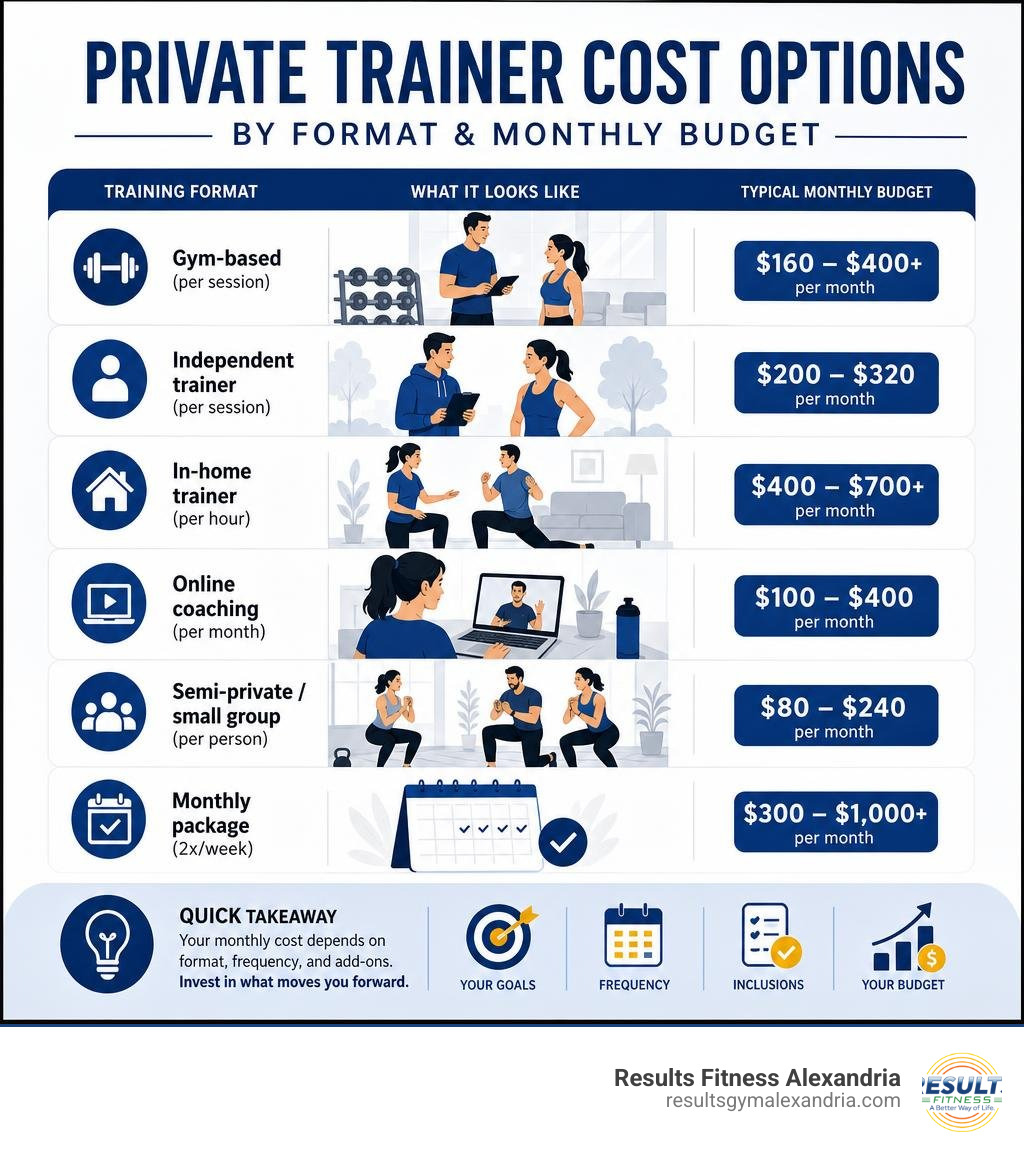
Key private trainer cost vocabulary:
What is the Average Private Trainer Cost in 2026?
As we look at the fitness landscape in 2026, the national average for a one-on-one personal training session ranges from $55 to $65 per hour. However, depending on where you train and who you work with, you can expect a broader range of $40 to $100+ per hour. For most people, this translates to a monthly investment of $300 to $600 if you train once or twice a week, or up to $1,000+ for premium, high-frequency packages.
When evaluating private trainer cost, it helps to understand how these rates are structured. Many trainers and fitness facilities steer away from single, pay-as-you-go sessions. Instead, they offer session packages (typically in groups of 5, 10, or 20 sessions) or monthly subscriptions. Purchasing training sessions in packages is one of the most reliable ways to secure a discount, often saving you 10% to 15% compared to single-session rates.
For instance, a trainer who charges a flat $80 for a single session might offer a 10-session package for $700, effectively lowering your per-session rate to $70. This structure benefits both parties: it gives the trainer a predictable schedule and commitment, while providing you with a lower rate and a clear runway to see real progress.

Investing in these structured packages is highly recommended because fitness results do not happen overnight. Most experts agree it takes about six weeks of consistent, guided effort to see noticeable changes in strength, stamina, and body composition. If you want to dive deeper into how this consistency transforms your body, check out our guide on The Amazing Benefits of Working with a Personal Trainer.
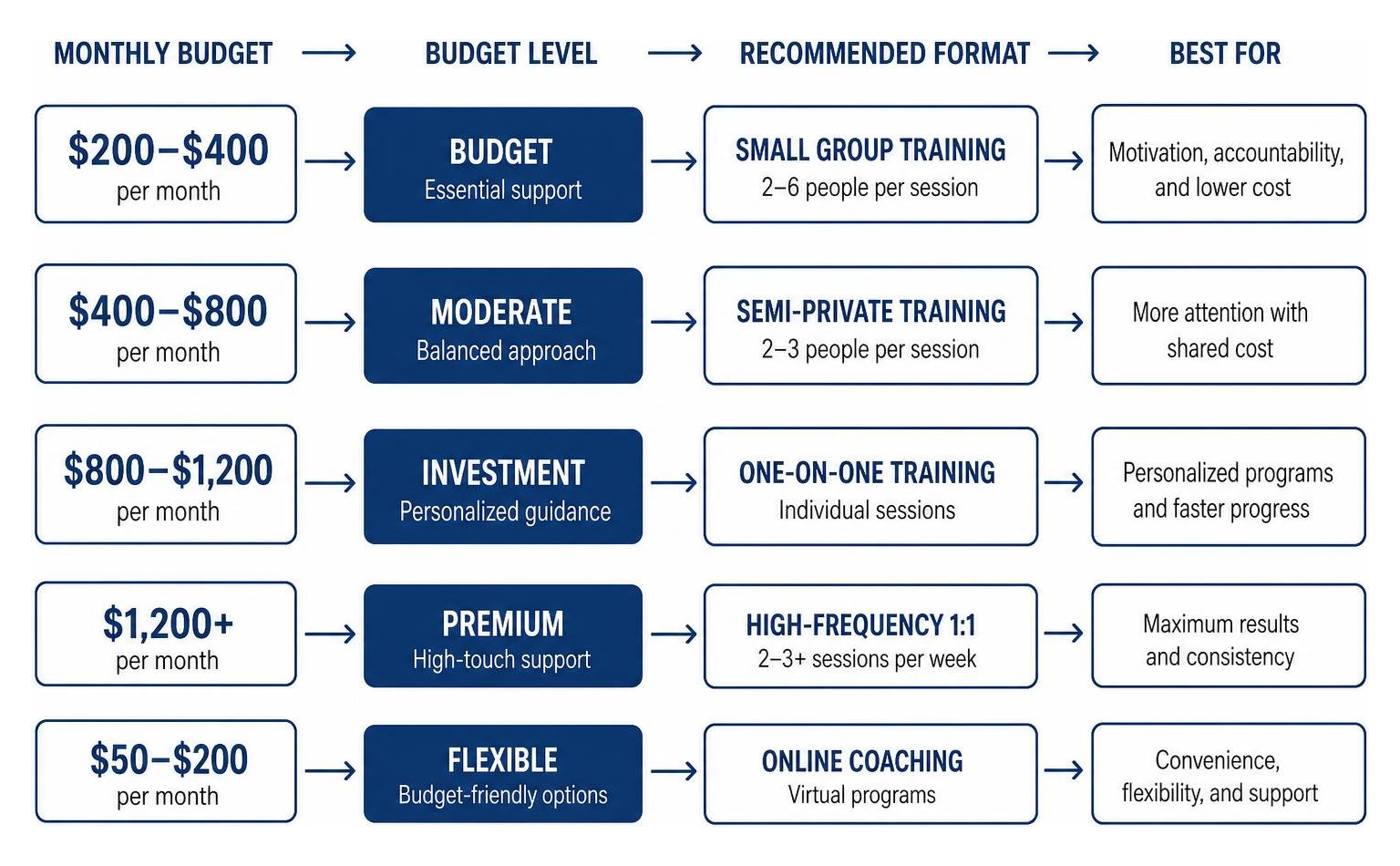
To help you visualize the different formats and how they align with your budget, we have mapped out the typical pathways:
For a comprehensive look at how these rates stack up globally, you can read more at How Much Does a Personal Trainer Cost? 2026 Rates.
Key Factors That Influence Personal Training Rates
Why does one trainer charge $50 an hour while another in the same neighborhood demands $150? The differences in private trainer cost are rarely arbitrary. They are driven by a specific set of variables that reflect the trainer’s background, the setting, and the level of service provided.
Here is a breakdown of the primary factors that shape personal training rates:
- Trainer Experience and Education: A newly certified trainer in their first year will naturally charge less than a veteran with a decade of experience. Veteran trainers possess a deeper library of movement regressions, faster diagnostic skills for movement imbalances, and a proven track record of client success.
- Certifications: Trainers holding gold-standard, nationally accredited certifications (such as NASM, NSCA, ACSM, or ACE) or specialized degrees in Kinesiology and Exercise Science command higher rates.
- Session Length: While the traditional session lasts 60 minutes, many facilities and independent trainers offer 30-minute or 45-minute sessions. These shorter sessions are highly efficient and offer a lower-cost entry point for busy professionals.
- Setting and Business Model: Training in a crowded commercial gym, a private boutique studio, or having a trainer travel to your home changes the overhead costs, which directly impacts the price you pay.
To give you a clearer picture of how experience and setting interact, here is a comparison of average rates in the regional market:
| Experience Level | Gym-Based Session | Private Studio / In-Home Session |
|---|---|---|
| Entry-Level (0-2 years) | $40 – $55 | $60 – $80 |
| Experienced (3-7 years) | $55 – $80 | $80 – $110 |
| Elite / Specialist (8+ years) | $80 – $120 | $120 – $175+ |
How Location and Setting Affect Private Trainer Cost
Geographic location is one of the most powerful drivers of personal training rates. In high-cost-of-living metropolitan areas like Northern Virginia and the broader Washington D.C. metro area, rates are naturally higher due to commercial real estate costs and local demand.
In Virginia, the average personal trainer cost is approximately $74 per session, which sits slightly above the national average. Within Northern Virginia, particularly in Alexandria, rates frequently range from $65 to $120+ per session due to the urban density and high concentration of specialized fitness professionals.
To put this in perspective, comparing regional rates can show you how much location dictates the market. For instance, you can look at Midwestern rates in the Personal Trainer Cost in Sioux Falls, SD (2026) — Compare Local Quotes | CostWhale guide, where average sessions sit closer to $60. The overhead of running a facility or traveling to clients in the DMV (D.C., Maryland, Virginia) area requires local trainers to adjust their pricing to match the regional cost of living.
The setting also plays a massive role:
- Commercial Gyms: These facilities often offer lower per-session rates because they subsidize their training programs with high-volume membership dues. However, you must also pay a monthly gym membership to access the trainers.
- Boutique Studios: These private spaces offer a highly focused environment with no crowds and high-end equipment. Because they cater to a capped membership, their per-session rates are typically higher, ranging from $80 to $150.
- In-Home Training: This is the most premium setting. Because the trainer must factor in travel time, vehicle wear-and-tear, and carrying portable equipment, in-home training rates start around $100 and can easily exceed $175 per hour.
If you are trying to figure out which environment aligns best with your lifestyle, our Step-by-Step Guide to Finding a Personal Trainer can help you weigh your local options.
How Specialization Impacts Your Private Trainer Cost
If you are looking for a trainer to help you sweat and stay accountable, a general certified personal trainer is a fantastic and cost-effective choice. However, if you have specific physical needs, you will likely require a specialist.
Specialized trainers have invested significant time and money into advanced credentials, and their pricing reflects that expertise:
- Rehabilitation & Medical Exercise Specialists: If you are transitioning out of physical therapy after an injury or surgery, these specialists design safe protocols to rebuild strength. Average rates: $80 – $150 per session.
- Sports Performance Coaches: Working with athletes to improve power, agility, and sport-specific skills requires advanced certifications like the CSCS (Certified Strength and Conditioning Specialist). Average rates: $75 – $120 per session.
- Prenatal & Postnatal Specialists: Training safely during and after pregnancy requires a deep understanding of pelvic floor health, diastasis recti, and shifting centers of gravity. Average rates: $65 – $100 per session.
For women seeking tailored fitness programs that address unique hormonal, strength, and life-stage goals, working with a specialist can make all the difference. Explore our Personal Trainer for Women Guide to see how specialized coaching can fast-track your progress safely.
Comparing Personal Training Pricing Models
When shopping around for a trainer, you will run into several different financial structures. Choosing the right model depends entirely on your budget, your need for flexibility, and your long-term fitness goals.

Here are the three most common pricing models you will find in the fitness industry today:
- Pay-Per-Session (A La Carte): You pay for each session individually. This offers the ultimate flexibility but is almost always the most expensive route. It is best for experienced gym-goers who only need occasional form checks.
- Monthly Packages (Subscription): You commit to a set number of sessions per week (e.g., 2x/week) billed monthly. This model provides the structure needed to build a habit and offers a discounted per-session rate.
- Membership-Inclusive Coaching: A modern approach where your gym membership fee includes ongoing coaching, program design, and check-ins, eliminating the need to pay high hourly rates.
If you are a beginner looking to build a foundation without getting overwhelmed by complex pricing, we recommend starting with a structured, introductory plan. Learn more about how to begin safely with our guide to a Start Strong with a Beginner Personal Training Program.
Traditional Per-Session vs. Monthly Subscription Models
Many people default to the traditional per-session model because it feels low-risk. You only pay when you show up. However, this model often works against your long-term success. When life gets busy, it is all too easy to cancel a session, disrupting your momentum and stalling your results.
Monthly subscription models, on the other hand, build accountability directly into your budget. Knowing you have dedicated sessions paid for each month encourages consistency.
For those who want the high-touch guidance of a trainer but find one-on-one monthly packages outside of their budget, small group or semi-private training is an incredible alternative. You share the session with 2 to 4 other participants, splitting the trainer’s hourly rate while still receiving personalized form correction and programming.
To see if this social, cost-effective style of training is right for you, check out our tips on Finding the Best Personal Training Groups Near Me.
Hidden and Additional Costs of Personal Training
When calculating your total monthly investment, looking solely at the trainer’s hourly rate can lead to unpleasant surprises. The fitness industry has several associated costs that can quietly inflate your bill if you don’t ask about them upfront.
Here are the most common hidden costs to keep on your radar:
- Gym Membership Dues: If you hire a trainer who works out of a commercial gym, you are almost always required to maintain an active membership to that gym in addition to paying your trainer’s fees. This can add $30 to $100+ to your monthly expenses.
- Cancellation Fees: Most trainers enforce a strict 24-hour cancellation policy. If you cancel late due to work, traffic, or just oversleeping, you will still be charged the full rate for that session.
- Program Design Fees: Some trainers charge an hourly rate for the time they spend with you, but charge an extra one-time or monthly fee to actually write the workouts you do on your own.
- Nutrition Coaching: Exercise is only one side of the coin. If you want customized meal plans, macronutrient tracking, or supplement protocols, many trainers charge this as an add-on service, adding $50 to $150+ per month to your package.
Understanding these variables is key to choosing a partnership that is sustainable for your wallet and your lifestyle. For a deeper dive into navigating these conversations and selecting the perfect fit, read our comprehensive guide on How to Choose a Personal Trainer: Everything You Need to Know.
Frequently Asked Questions About Personal Trainer Pricing
Is hiring a private trainer worth the investment?
Yes, especially if you view it as an investment in your long-term health and longevity rather than a short-term luxury. Working with a professional dramatically reduces your learning curve, keeps you safe from costly sports injuries, and provides the objective accountability required to make permanent lifestyle changes.
If you have spent years trying to reach your goals on your own without success, a trainer pays for itself by eliminating wasted time and gym memberships you don’t use. To explore what you can realistically expect from this partnership, read our article on 10 Benefits to Expect from Working with a Personal Workout Trainer.
What red flags should I look for to avoid overpaying?
To ensure you are getting true value for your hard-earned money, watch out for these common warning signs:
- No Initial Assessment: If a trainer takes you straight to the heavy weights on day one without assessing your joint mobility, core strength, and injury history, they are using a generic template.
- Lack of Progress Tracking: If your trainer doesn’t write down your weights, reps, and sets during your workouts, they are “winging it” rather than practicing progressive overload.
- Pushing Supplements: Be wary of trainers who spend your paid session time trying to sell you specific brands of protein powders, fat burners, or vitamins.
- Refusing to Show Credentials: A qualified professional will gladly share their accredited certifications and proof of liability insurance.
How often should I meet with a personal trainer?
For beginners, meeting with a trainer 2 to 3 times per week is ideal during the first 6 to 12 weeks. This frequency allows you to build muscle memory, master proper movement patterns, and establish a consistent routine.
Once you have built confidence and learned how to execute exercises safely on your own, you can taper down to 1 session per week for program updates, accountability checks, and advanced form refinement while performing your other workouts independently.
Conclusion
At Results Fitness Alexandria, we believe that high-quality fitness coaching should be transparent, accessible, and highly effective. We design our programs to eliminate the guesswork and hidden fees often associated with finding a great trainer. Located right here in Alexandria, Virginia, we provide a supportive, welcoming environment featuring top-tier personal training, dynamic fitness classes, yoga, and even on-site childcare to make your workouts completely stress-free.
Whether you want to build strength, recover from an injury, or simply find a routine you genuinely enjoy, we want you to experience our community firsthand. That is why we offer a free 1-day pass for local residents of all fitness levels to try our amenities and meet our coaching team.
Stop guessing about your routine and start moving with purpose. Start Your Fitness Journey Today and let us help you build a stronger, healthier future!