
Everything You Need to Know About Hiring a Home Gym Trainer
What is a Personal Fitness Trainer at Home?
A personal fitness trainer at home is a certified professional who brings the expertise, motivation, and equipment of a high-end gym directly to your living room, garage, or backyard. Unlike a traditional gym setting where you are one of many members navigating a sea of machines, in-home training is a “concierge” service. The focus is 100% on you for the duration of the session.
In this model, the trainer handles the logistics. They often bring portable tools like resistance bands, TRX straps, or adjustable dumbbells, meaning you don’t need a massive basement renovation to get started. You can learn how to master your body weights workout at home using just the space you have available.
The primary difference lies in the environment. At a gym, you are subject to the “gym culture”—the music, the crowds, and the wait times. At home, you have total privacy. This is a game-changer for those who want to learn how to get jacked without a gym membership or simply feel self-conscious exercising in front of others.

Why a Personal Fitness Trainer at Home Beats the Gym Commute
The number one reason people quit their fitness journey isn’t a lack of desire; it’s a lack of time. In 2026, the average professional works longer hours and faces more daily “micro-stressors” than ever before. When you hire a personal fitness trainer at home, you reclaim the 30 to 60 minutes usually spent driving, parking, and checking into a facility.
This time-saving element directly translates to consistency. It is much harder to “skip the gym” when the gym is standing at your front door at 6:00 AM. For many, especially when creating an effective workout routine for beginners, that knock on the door is the ultimate accountability tool. We also see this benefit heavily in personal training for women tips, where balancing childcare and professional life makes home-based sessions the only viable way to stay active.
Traditional Gym vs. In-Home Training Models
When deciding between the two, it helps to look at the practical differences. While a gym offers a vast array of heavy machinery, in-home training offers a tailored environment where every movement is functional and specific to your life.
| Feature | Traditional Gym | In-Home Personal Training |
|---|---|---|
| Travel Time | 15–45 minutes each way | 0 minutes |
| Privacy | Low (shared space) | High (your own home) |
| Equipment | Unlimited but often busy | Minimal but targeted |
| Accountability | Self-driven | High (trainer at your door) |
| Atmosphere | Loud/Distracting | Controlled/Focused |
Many people find that the “novelty” of a gym’s 50 different machines actually leads to confusion. Following a beginner gym workout in 5 simple steps is great, but having a professional in your home ensures your form is perfect on every single rep, reducing the risk of injury and maximizing the efficiency of your 45-minute session.
The Benefits of In-Home Personal Training
The data supports the effectiveness of this model. In the fitness industry, the Net Promoter Score (NPS) – a measure of customer satisfaction – typically hovers around 40 to 45. However, specialized in-home training models often report NPS scores over 90. This massive gap exists because the service is designed around the client’s success, not the gym’s bottom line. If you want a broader overview of how satisfaction metrics like NPS are used across industries, Wikipedia’s Net Promoter article offers a helpful reference.
Real-world success stories from home training are everywhere. We have seen clients lose upwards of 60 pounds and drop multiple pant sizes without ever stepping foot in a commercial health club. These results stem from the deep benefits of working with a personal trainer who understands your kitchen habits, your stress levels, and your home environment. When a trainer sees your “real life,” they can provide better benefits to expect from working with a personal workout trainer, such as nutrition advice that actually fits your pantry.
Customizing Your Personal Fitness Trainer at Home Experience
One of the greatest strengths of a personal fitness trainer at home is their ability to adapt to specific physical needs. Whether you are dealing with chronic back pain, recovering from a sports injury, or navigating postnatal fitness, the home environment allows for a safe, controlled “laboratory” for movement.
For women, this customization is particularly valuable. From personal trainer for women guide insights to our female personal trainers complete guide, we know that hormonal changes, bone density concerns, and pelvic floor health require a nuanced approach that a generic “boot camp” class simply can’t provide. A home trainer can integrate specific mobility and stability work that targets your unique biomechanics.
Improving Consistency and Accountability
Accountability is the “secret sauce” of fitness. It’s one thing to have a membership card in your wallet; it’s another thing entirely to have a professional coach waiting for you in your driveway.
Research shows that human-to-human accountability is significantly more effective than AI-based apps. While only about 7% of AI app users maintain their consistency over six months, those working with a live trainer see much higher retention rates. This is why many people search for a female personal trainer near me guide – they want a real person who will check in on them, correct their form in real-time, and motivate them on the days they feel like quitting.
Setting Up Your Space: Equipment and Requirements
A common myth is that you need a “mansion” or a fully decked-out “Iron Paradise” to train at home. In reality, most effective home workouts can happen in a space as small as 5’x5′. If you can lay down a yoga mat and extend your arms without hitting a lamp, you have enough room.

For most clients, the equipment needed is minimal and can be stored in a small closet or under a bed. Essential items often include:
- Adjustable Dumbbells: These replace an entire rack of weights and take up very little space.
- Resistance Bands: Perfect for home strength routines for busy women and mobility work.
- A Folding Bench: Can be tucked away when not in use.
- Stability Ball: Excellent for core engagement and can double as an office chair.
Space Optimization for Small Homes
If you live in a condo or a smaller apartment, don’t let the square footage stop you. Our personal trainers are experts at “space hacking.” We can use your stairs for cardio intervals, your kitchen counter for incline push-ups, and your sturdy door frames for resistance band anchors. The goal is to make the environment work for you, not against you.
How to Choose the Right In-Home Trainer
Not all trainers are created equal. When someone is entering your private home, the vetting process needs to be rigorous. You shouldn’t just look for someone who “looks fit”; you need a qualified professional.
Here is what we recommend looking for:
- Certifications: Look for accredited bodies like NASM (National Academy of Sports Medicine) or ACE (American Council on Exercise).
- Specializations: If you have an injury, look for a Corrective Exercise Specialist. If you are a senior, look for a Senior Fitness Specialist.
- Vetting: Ask if they have had a background check. Professional organizations often have a 7-step vetting process to ensure client safety.
- The “Vibe” Check: Use our guide on how to choose a personal trainer to prepare questions for your first consultation. Do they listen more than they talk? Do they ask about your medical history?
Pricing, Scheduling, and Session Length
In-home training is a premium service. You are paying not just for the workout, but for the trainer’s travel time and the convenience of staying home. In the Alexandria area, session lengths typically range from 45 to 60 minutes.
Expect to see different pricing tiers based on commitment. Often, purchasing a 12-week or 26-week “transformation package” is more cost-effective than paying session-by-session. Also, be aware of cancellation policies—most trainers require 24 to 48 hours’ notice to reschedule, as they have to coordinate their travel routes around their clients. You can find more details on our personal training services page.
Virtual vs. In-Person Home Training
In 2026, the lines between “in-person” and “at-home” have blurred thanks to technology.
In-Person Home Visits: The gold standard. The trainer is there to physically adjust your form, move equipment, and provide that tangible energy that pushes you through a final set.
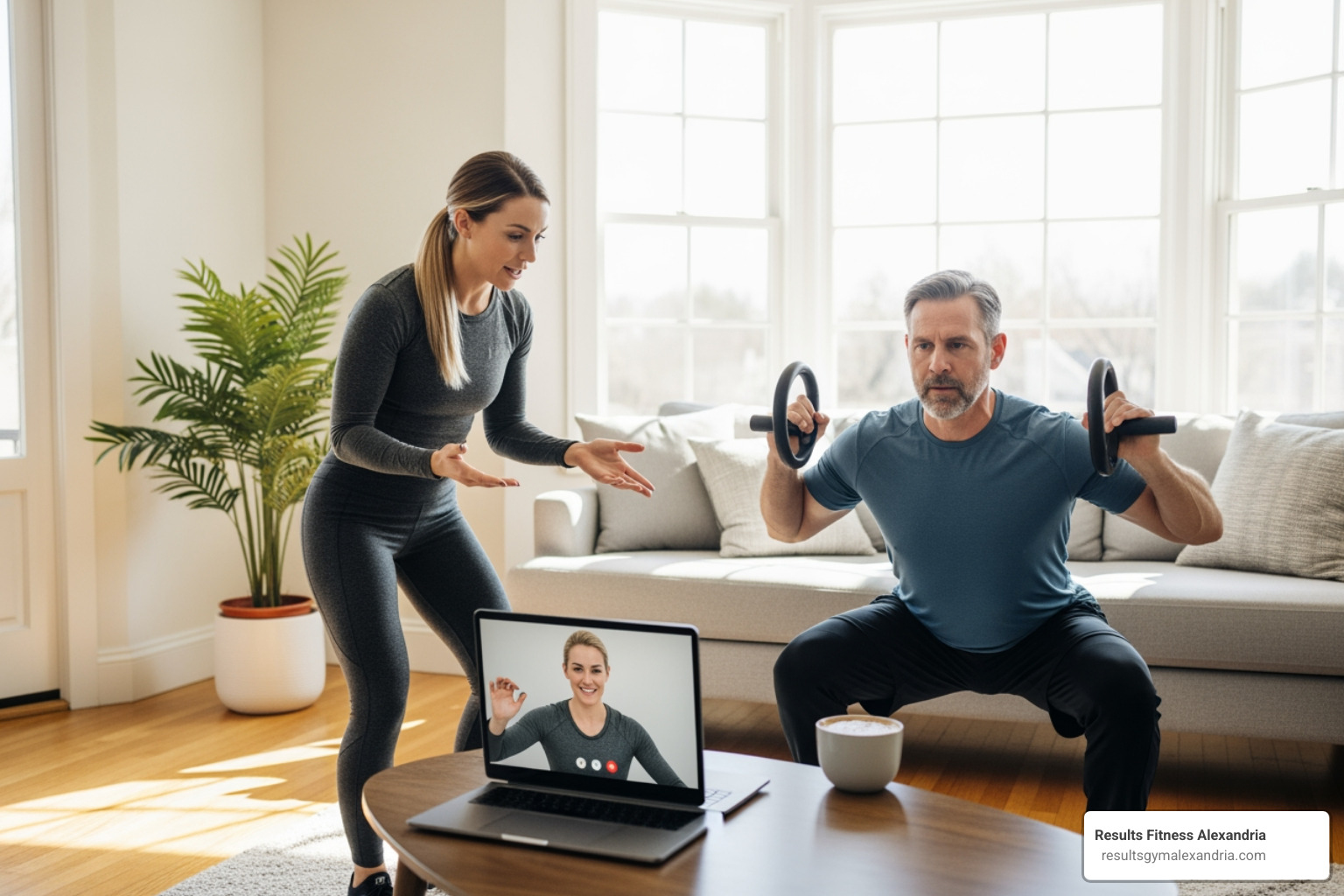
Virtual Training (Zoom/FaceTime): A highly effective and often more affordable alternative. It offers 97% of the scheduling flexibility of in-person training. A virtual trainer can still provide real-time form correction and motivation, and it’s a great option for those who travel frequently for work.
Hybrid Training Options for 2026
The most popular model we see today is the “Hybrid” approach. This might involve one in-person session a week to check form and progress, combined with two app-based workouts you do on your own. Using tools like the Trainerize app, we can track your weights, heart rate, and even your meals, ensuring that even when we aren’t in your living room, we are still coaching you toward your goals.
Frequently Asked Questions about Home Training
What equipment do I need to start?
You don’t need anything to start. Many trainers bring their own equipment for the first few sessions. Eventually, most clients find that owning a set of resistance bands and a pair of adjustable dumbbells makes their “homework” assignments easier to complete.
How much space is required for a home workout?
A 5’x5′ area is the standard minimum. If you can move your coffee table out of the way, you have a gym. We’ve successfully trained clients in narrow hallways, small balconies, and even home offices between meetings.
Can a home trainer help with specific medical conditions?
Yes, and in many cases, they are better equipped to do so than a general gym floor trainer. Home trainers often specialize in “special populations,” including those with MS, chronic back pain, or those preparing for joint replacement surgeries. By focusing on 80% nutrition and 20% targeted fitness, they can create a holistic recovery plan.
Conclusion
Hiring a personal fitness trainer at home is an investment in your most valuable asset: your health. By removing the barriers of travel, crowds, and confusion, you create a path to results that is sustainable for the long haul.
At Results Fitness Alexandria, we believe that every body is unique and every home can be a sanctuary for transformation. Whether you want to lose 60 pounds, recover from an injury, or simply feel more confident in your own skin, the right coach can make all the difference.
Ready to see how personalized coaching can change your life? Start your personal training journey today and let us bring the results to you.