Start Strong with a Beginner Personal Training Program
Your First Step to Getting Stronger Starts Here
Beginner strength exercises are the foundation of any successful fitness journey — and you don’t need to be fit, experienced, or have a gym membership to start.
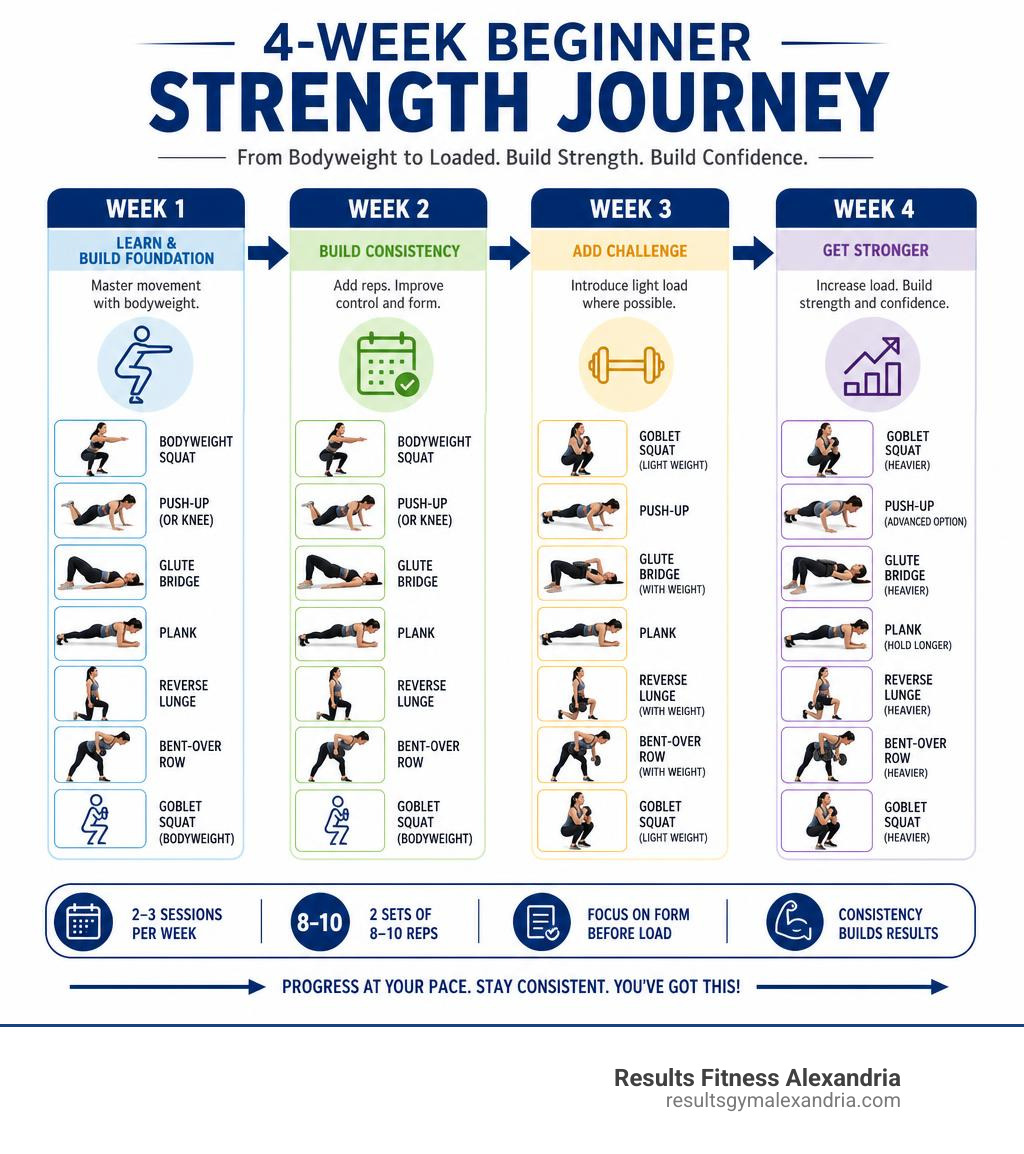
Here are the best beginner strength exercises to learn first:
- Bodyweight Squat — builds leg and glute strength using your own body
- Push-Up (or Wall/Knee Push-Up) — trains chest, shoulders, and triceps
- Glute Bridge — strengthens hips and lower back with no equipment
- Plank — builds core stability and spine control
- Reverse Lunge — improves balance and single-leg strength
- Bent-Over Row — works your upper back using a band, towel, or dumbbell
- Goblet Squat — adds load to your squat pattern safely
Start with 2–3 sessions per week, 2 sets of 8–10 reps per exercise, and focus on form before adding weight.
Getting started is often the hardest part. Many people feel unsure where to begin, worried they’ll do something wrong, or convinced they need to be in better shape before they start training. None of that is true.
Research consistently shows that just two strength sessions per week is enough to build meaningful muscle and improve long-term health — including reducing your risk of heart disease and cancer by 10–20%. And the best part? You can begin with zero equipment, right at home.
This guide walks you through everything: the best exercises, a 4-week plan, proper form, warm-ups, and how to stay consistent when motivation dips.
I’m Jennifer Rapchak, Fitness Director at Results Fitness Alexandria and a certified personal trainer with over 14 years of experience helping people of all fitness levels get started with beginner strength exercises safely and effectively. Whether you’re brand new to training or returning after a long break, the approach I’ll share here is the same one I use with my own clients every day.
Beginner strength exercises helpful reading:
Why Strength Training Is the Best Starting Point for Beginners
Strength training is one of the most practical ways to start exercising because it improves the way your body handles everyday life. It helps you stand up from a chair, carry groceries, climb stairs, pick things up safely, protect your joints, and feel more confident in your own body.
It is also surprisingly beginner-friendly. You do not need to start with heavy barbells or complicated machines. In fact, the best first step is usually learning basic movement patterns:
- Squat
- Push
- Pull
- Hinge
- Lunge
- Carry
- Brace your core
Once those patterns feel comfortable, everything else gets easier.
Strength training also supports muscle mass, bone density, metabolism, balance, posture, and long-term health. For women especially, lifting has become much more common and empowering. Research noted in the fitness industry shows women’s free weight use increased by 150% between 2011 and 2021, and we love seeing more beginners discover that strength training is not intimidating once they have the right guidance.
For a deeper women-focused approach, see our guide to womens strength training.
What Strength Training Does for Your Body and Mind
The benefits go far beyond “getting toned.” Strength training helps your whole system work better.
Physical benefits include:
- Builds and maintains lean muscle
- Strengthens bones and supports bone density
- Improves balance and coordination
- Supports joint stability
- Helps posture and core control
- Makes daily tasks easier
- Helps preserve independence as you age
- Supports metabolism and body composition
Health research also suggests that just one hour of strength training per week may help lower the risk of heart disease and cancer by 10-20%. Strength training 2-3 times per week has also been linked with longer life and lower heart disease risk, especially for women.
Mental and emotional benefits matter too. Resistance training has been associated with reduced symptoms of depression, improved confidence, better stress management, and a stronger sense of self-efficacy. In plain English: you start proving to yourself, “Hey, I can do hard things.” That feeling carries into the rest of life.
And no, you do not need to crawl out of the gym dramatically like a movie hero after every workout. Effective training should challenge you, not flatten you like a pancake.
How Often Beginners Should Strength Train Each Week
Most beginners do best with 2-3 nonconsecutive strength sessions per week.
A simple schedule might be:
- Monday: Strength
- Tuesday: Rest or walk
- Wednesday: Strength
- Thursday: Rest or mobility
- Friday: Strength
- Weekend: Walk, stretch, recover
Each workout can last 25-45 minutes, including warm-up and cool-down. Start with full-body workouts because they let you practice important movements often without overloading one area.
Beginner guidelines:
- 1-3 sets per exercise
- 8-12 reps per set
- 60-90 seconds rest between sets
- 48 hours of recovery before training the same muscles hard again
- Stop each set with 1-3 good reps left in the tank
For a simple research-backed breakdown of key movement patterns, this NPR guide on six foundational strength movements is a helpful read.
Best Beginner Strength Exercises to Master First
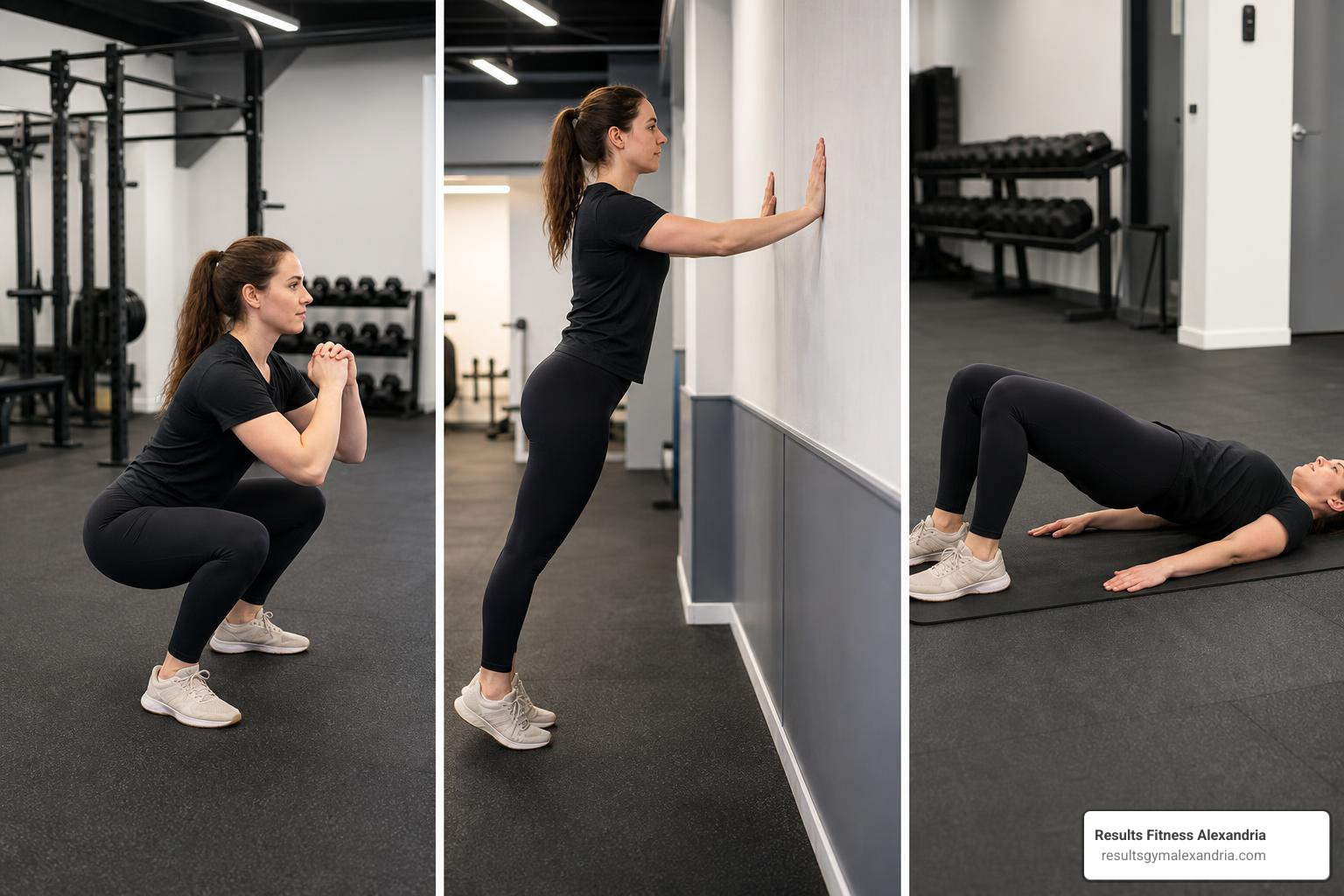
The most effective beginner strength exercises are not fancy. They are foundational. They teach your body how to move with control, create tension, and build strength safely.
At Results Fitness Alexandria, we usually begin with compound movements. These exercises use multiple joints and muscle groups at once, which makes them efficient and practical.
Think of them as the “greatest hits” of strength training.
Beginner Strength Exercises You Can Do With No Equipment
Start here if you are new, returning after a break, or training at home.
Bodyweight Squat
- Trains: quads, glutes, hamstrings, core
- Tip: Sit your hips back like you are reaching for a chair.
Chair Squat or Sit-to-Stand
- Trains: legs and glutes
- Tip: Use a stable chair without wheels. Stand up slowly without using your hands if possible.
Wall Push-Up
- Trains: chest, shoulders, triceps
- Tip: Keep your body in a straight line and lower with control.
Knee Push-Up
- Trains: upper body and core
- Tip: Keep your hips from sagging. Your torso should move as one unit.
Glute Bridge
- Trains: glutes, hamstrings, hips, low back support
- Tip: Press through your heels and squeeze your glutes at the top.
Reverse Lunge
- Trains: legs, glutes, balance
- Tip: Step backward instead of forward. Many beginners find this easier on the knees.
Split Squat
- Trains: single-leg strength
- Tip: Hold a wall or chair for balance.
Plank
- Trains: core stability
- Tip: Think “ribs down, glutes tight, breathe.”
Dead Bug
- Trains: deep core control
- Tip: Move slowly and keep your lower back from arching.
Calf Raise
- Trains: calves and ankle strength
- Tip: Rise up slowly, pause, and lower with control.
Step-Up
- Trains: legs, glutes, balance
- Tip: Use a low, stable step and drive through the whole foot.
Standing Hip Abduction
- Trains: outer hips and balance
- Tip: Stand tall and move your leg out to the side without leaning.
If you want more beginner-focused lifting guidance, read our article on beginner weight training for women.
Minimal-Equipment Moves That Build Full-Body Strength
Once bodyweight exercises feel controlled, light resistance can help you keep progressing.
Good minimal-equipment options include:
- Goblet Squat with a dumbbell, kettlebell, or loaded backpack
- Dumbbell Row using one or two dumbbells
- Household Row using a sturdy towel setup or resistance band
- Romanian Deadlift with dumbbells, a backpack, or water jugs
- Floor Press with dumbbells instead of a bench
- Overhead Press with light dumbbells or water bottles
- Farmer’s Carry with dumbbells, grocery bags, or loaded totes
- Biceps Curl with dumbbells or water bottles
- Resistance Band Row for upper back strength
Household items can absolutely work. A backpack with books, water bottles, soup cans, or filled shopping bags can create enough resistance for a beginner. The muscles do not know whether the weight came from a fancy rack or your pantry. They only know tension.
How to Choose the Right Exercise Variation
The right variation is the one you can do with control, confidence, and no joint pain.
Use this simple rule: earn the harder version.
| Movement Pattern | Bodyweight Option | Household-Item Option | Dumbbell Option |
|---|---|---|---|
| Squat | Chair squat | Backpack squat | Goblet squat |
| Push | Wall push-up | Incline push-up on counter | Dumbbell floor press |
| Pull | Towel row setup | Band row | One-arm dumbbell row |
| Hinge | Hip hinge drill | Backpack deadlift | Romanian deadlift |
| Lunge | Supported reverse lunge | Backpack split squat | Dumbbell reverse lunge |
| Carry | March in place | Grocery bag carry | Farmer’s carry |
| Core | Dead bug | Slow dead bug with pause | Plank with shoulder tap |
Choose an easier version if:
- You feel joint pain
- You cannot control the lowering phase
- You lose balance repeatedly
- Your form changes before the set is done
- You hold your breath the whole time
Choose a harder version if:
- Your reps feel smooth and stable
- You can complete all reps with good form
- The last 2 reps feel challenging but not chaotic
- You have been consistent for several weeks
Your 4-Week Beginner Personal Training Program
A good beginner plan should build skill first, then strength. The goal is not to destroy yourself. The goal is to finish thinking, “I could do that again.”
That is how consistency is built.
For more help designing a routine, see our guide on creating an effective workout routine for beginners.
Weeks 1–2: Build a Bodyweight Foundation
In weeks 1-2, focus on learning movement patterns.
Frequency: 2-3 workouts per week
Time: 25-30 minutes
Effort: Moderate, around 6 out of 10
Goal: Practice form and build confidence
Sample Workout A:
- Chair Squat – 2 sets of 8-10 reps
- Wall Push-Up – 2 sets of 8-10 reps
- Glute Bridge – 2 sets of 10 reps
- Supported Reverse Lunge – 2 sets of 6-8 reps per side
- Dead Bug – 2 sets of 6 reps per side
- Plank – 2 rounds of 15-25 seconds
Sample Workout B:
- Bodyweight Squat – 2 sets of 8-10 reps
- Incline Push-Up – 2 sets of 8 reps
- Hip Hinge Drill – 2 sets of 10 reps
- Step-Up – 2 sets of 6-8 reps per side
- Band Row or Towel Row – 2 sets of 8-10 reps
- Calf Raise – 2 sets of 10-12 reps
Rest 60-90 seconds between sets.
Weeks 3–4: Add Load, Reps, or Control
In weeks 3-4, keep the same basic movements but make them slightly more challenging.
Frequency: 3 workouts per week
Time: 30-40 minutes
Effort: 6-8 out of 10
Goal: Add safe challenge
Ways to progress:
- Add 1 set
- Add 2 reps per set
- Add light dumbbells
- Use a loaded backpack
- Slow down the lowering phase
- Add a pause at the hardest point
- Reduce rest slightly
- Try a more advanced variation
Sample Workout C:
- Goblet Squat – 3 sets of 8-10 reps
- Dumbbell Floor Press or Incline Push-Up – 3 sets of 8-10 reps
- Dumbbell Row or Band Row – 3 sets of 10 reps
- Romanian Deadlift – 3 sets of 8-10 reps
- Reverse Lunge – 2-3 sets of 8 reps per side
- Plank – 3 rounds of 20-30 seconds
Sample Workout D:
- Bodyweight Squat with 3-second lowering – 3 sets of 10 reps
- Overhead Press with light dumbbells – 2-3 sets of 8 reps
- Glute Bridge with pause – 3 sets of 10-12 reps
- Step-Up – 3 sets of 8 reps per side
- Farmer’s Carry – 3 rounds of 20-30 seconds
- Dead Bug – 2 sets of 8 reps per side
Weekly Schedule, Sets, Reps, and Rest
Here is a simple weekly structure:
| Day | Plan |
|---|---|
| Monday | Strength Workout A or C |
| Tuesday | Walk, mobility, or rest |
| Wednesday | Strength Workout B or D |
| Thursday | Yoga, stretching, or rest |
| Friday | Strength Workout A or C |
| Saturday | Easy walk or active recovery |
| Sunday | Rest |
Beginner training targets:
- 1-3 sets per exercise
- 8-12 reps per set
- 60-120 seconds rest
- 4-6 weekly sets per major movement pattern
- 2-3 full-body workouts per week
If you miss a workout, do not double up the next day. Just return to the plan at the next available session. Fitness is not a fragile glass vase. One missed day will not break it.
Form, Warm-Up, Cool-Down, and Home Equipment Basics

Good form is not about looking perfect. It is about moving safely, using the right muscles, and building strength you can actually use.
This is where personal training can be especially helpful. A coach can see what you cannot feel yet: knees collapsing inward, shoulders shrugging, ribs flaring, or a lower back doing the job your hips should be doing.
If you feel nervous before your first session, read how to master your first weight lifting session.
How to Perform Beginner Strength Exercises With Good Form
Use these form cues for almost every beginner strength movement:
- Keep your spine neutral, not rounded or overarched
- Brace your core like you are preparing for a cough
- Keep your knees tracking in line with your toes
- Press through your whole foot, not just your toes
- Lower the weight or your body with control
- Do not rush the hardest part of the movement
- Keep your shoulder blades gently pulled back during rows
- Exhale during effort, inhale during the easier phase
- Stop if you feel sharp pain
- Use a mirror, video, or coach for feedback
A helpful beginner tempo is:
- 2 seconds down
- 1 second pause
- 1 second up
Slowing down makes lighter exercises feel more effective and gives your brain time to learn the movement.
The 5-Minute Warm-Up and Cool-Down Every Beginner Should Use
Do not skip your warm-up. Cold muscles are not famous for making great decisions.
5-minute warm-up:
- March in place or brisk walk – 60 seconds
- Arm circles – 30 seconds each direction
- Hip hinges – 10 reps
- Leg swings – 8 reps per side
- Ankle circles – 8 per side
- Bodyweight squats – 8 slow reps
After your workout, cool down for 5 minutes.
5-minute cool-down:
- Slow walk or easy marching – 60 seconds
- Hamstring stretch – 30 seconds per side
- Hip flexor stretch – 30 seconds per side
- Chest doorway stretch – 30 seconds
- Child’s pose or relaxed breathing – 60 seconds
The cool-down helps signal to your nervous system that the work is done. It also gives you a quiet minute to appreciate that you showed up.
Equipment You Need—and Bodyweight Alternatives
You do not need much to start.
Helpful home equipment:
- Yoga mat
- Stable chair
- Resistance band
- Light dumbbells
- Water bottles
- Loaded backpack
- Towel
- Wall
- Low step
- Supportive shoes
- Workout log or notes app
Bodyweight alternatives:
- Wall push-up instead of dumbbell press
- Chair squat instead of goblet squat
- Glute bridge instead of hip thrust machine
- Dead bug instead of weighted core work
- Step-up instead of leg press
- Band row or towel row instead of cable row
At the gym, equipment can help you progress safely because you have more options: dumbbells, benches, cable stations, machines, and coaching support. For a simple starting framework, read how to do a beginner gym workout in 5 simple steps.
Common Mistakes, Motivation, and When to Progress
The first month is less about intensity and more about trust. You are teaching your body, schedule, and brain that strength training belongs in your life.
Mistakes That Cause Soreness, Burnout, or Injury
Avoid these common beginner mistakes:
Using too much weight too soon
- Start lighter than you think. Your joints, tendons, and technique need time.
Skipping the warm-up
- Five minutes can reduce stiffness and improve movement quality.
Training every day
- Muscles adapt during recovery. More is not always better.
Chasing soreness
- Soreness is not the goal. Progress is the goal.
Rushing reps
- Fast, sloppy reps build bad habits. Controlled reps build strength.
Ignoring pain
- Muscle effort is normal. Sharp joint pain is not.
Holding your breath
- Breathe steadily. Exhale during effort.
Comparing yourself to others
- Someone else’s chapter 20 has nothing to do with your chapter 1.
Having no plan
- Random workouts produce random results.
Underfueling
- Protein, hydration, and sleep matter. Your body cannot build with imaginary materials.
Motivation Strategies for the First Month and Beyond
Motivation is nice, but habits are more reliable. Motivation is like weather. Habits are like your calendar.
Try these strategies:
- Schedule workouts like appointments
- Start with 25-minute sessions
- Track reps, sets, and how you feel
- Take progress photos if they help you
- Use a workout buddy or coach
- Put encouraging notes where you will see them
- Celebrate small wins
- Keep workouts enjoyable
- Aim for your first 10 sessions, not a perfect body
- Pair training with an existing habit, like after work or before dinner
A powerful mindset shift is this: do not ask, “Do I feel motivated today?” Ask, “What is the smallest version of my workout I can complete today?”
Sometimes the answer is one set of squats and a walk. That still counts.
For more structured options, visit our strength training programs complete guide.
Signs You’re Ready to Add Weights or Advanced Exercises
You may be ready to progress when:
- Your form is clean and repeatable
- You have no joint pain during or after workouts
- You can complete all reps without losing control
- The last 2 reps feel challenging but steady
- Your balance feels stable
- You have trained consistently for 3-4 weeks
- Your effort feels around 6-8 out of 10
- You recover well between sessions
Progress gradually:
- Add 1-2 reps first
- Then add a set
- Then add 2-5 pounds
- Then try a harder variation
- Then try single-leg or slower-tempo work
Do not progress everything at once. That is how a beginner workout becomes a surprise wrestling match with gravity.
Frequently Asked Questions About Beginner Strength Exercises
Can beginners build strength without dumbbells?
Yes. Beginners can build strength with bodyweight exercises, household items, tempo changes, extra reps, pauses, and better control.
Good no-dumbbell exercises include:
- Squats
- Lunges
- Push-ups
- Wall push-ups
- Glute bridges
- Planks
- Dead bugs
- Step-ups
- Calf raises
- Sit-to-stands
To keep progressing without weights, slow down each rep, increase range of motion, add reps, add sets, reduce rest, or move to a harder variation.
Should beginners do cardio or strength training first?
If you are doing both in the same workout, do strength training first. You will have more energy for technique, balance, and safe lifting.
After strength work, add easy cardio such as:
- Walking
- Cycling
- Elliptical
- Light incline treadmill
- Low-impact intervals
Cardio is great for heart health and endurance, but when learning strength skills, fresh muscles and focus matter.
Is soreness required to build muscle?
No. Soreness is not required.
Delayed onset muscle soreness, often called DOMS, can happen 24-48 hours after a new workout. It is common, especially in the first few weeks. But soreness does not prove you had a better workout.
Better signs of progress include:
- More reps with the same exercise
- Better form
- Improved balance
- More control
- Slightly heavier weights
- Less fatigue from the same workout
- More confidence
Mild soreness is usually fine. Sharp pain, swelling, limping, or pain that worsens during warm-up is a signal to stop and get guidance.
Conclusion
Beginner strength training does not have to be complicated. Start with simple movements, train 2-3 days per week, warm up, use good form, and progress slowly. That is enough to build real strength.
At Results Fitness Alexandria, we help beginners learn the basics in a supportive environment with personal training, fitness classes, yoga, childcare, and options for all fitness levels. If you want coaching, accountability, or just a safe place to begin, we would love to help.
Your first month is not about perfection. It is about showing up, learning your body, and proving to yourself that strength is something you can build.
Ready to start? Try strength training amenities with us and use your free 1-day pass to experience Results Fitness Alexandria.