Rowing Machine Interval Training to Boost Your Cardio Game
Why Rowing Machine Interval Training Delivers More in Less Time
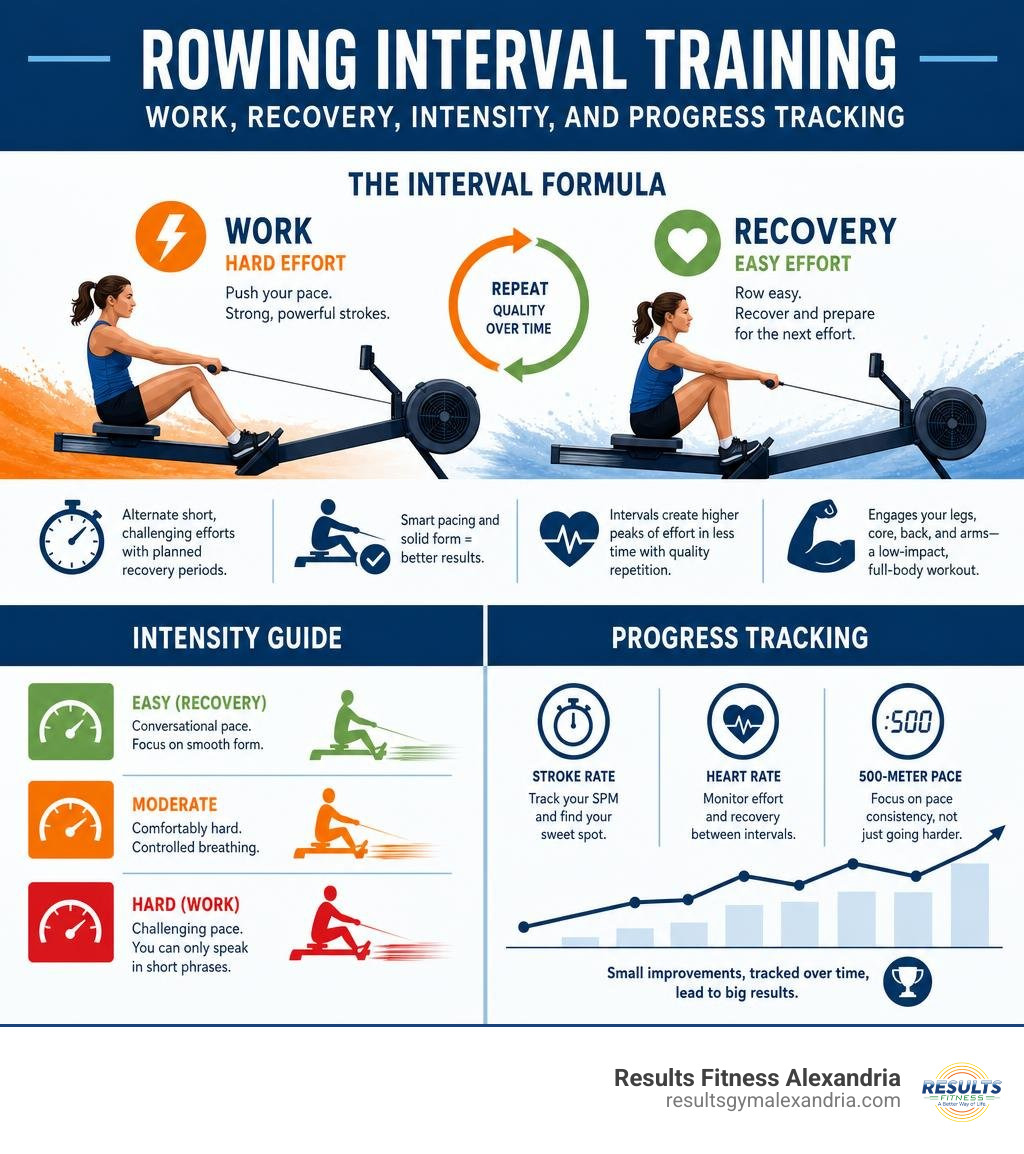
Rowing machine interval training alternates short, challenging rowing efforts with planned easy-recovery periods. It is a low-impact way to build cardio fitness, use your legs, core, back, and arms together, and fit a demanding workout into a busy schedule.
- For fat loss and general fitness: Use manageable hard intervals with easy rowing between them.
- For cardio conditioning: Increase either the length, pace, or number of intervals over time.
- For performance: Track stroke rate, heart rate, and 500-meter pace rather than simply pulling harder.
- Compared with steady cardio: Intervals create higher peaks of effort in less time, while recovery periods help you repeat quality work.
Rowing engages roughly 86% of the body’s muscles, so each interval asks more of the body than cardio that relies mainly on the lower body. Research also supports interval training as an effective way to improve VO2max, a key measure of aerobic fitness. The catch: hard rowing exposes weak technique quickly, so smart pacing and solid form matter as much as effort.
I’m Jennifer Rapchak, Fitness Director at Results Fitness Alexandria and an ACE-certified personal trainer with more than 14 years of experience coaching HIIT, strength, and group fitness. I use rowing machine interval training as a practical, scalable tool to help people build conditioning without needing long workouts.
Simple rowing machine interval training word guide:
Science-Backed Benefits of Rowing Machine Interval Training
When you hop on an indoor rowing machine (often called an ergometer or erg), you are engaging in one of the most metabolically demanding cardiovascular exercises available. Unlike cardio modalities that focus almost exclusively on the lower body, rowing machine interval training recruits approximately 86 percent of the muscles in your body. Every stroke requires a coordinated chain of muscle fire across your quadriceps, hamstrings, glutes, core, lats, rhomboids, rear deltoids, biceps, and forearms.
Because rowing combines resistance with high oxygen demand, high-intensity intervals on the erg trigger significant physiological adaptations:
- Excess Post-Exercise Oxygen Consumption (EPOC): High-intensity interval training (HIIT) pushes your body into an anaerobic state during work intervals. To restore dynamic equilibrium, rebuild fuel stores, and clear metabolic byproducts, your body elevates its oxygen consumption and caloric expenditure after you finish. Studies demonstrate that this “afterburn effect” can keep your metabolic rate elevated for up to 14 hours post-workout.
- Substantial VO2max Improvements: VO2max represents the maximum volume of oxygen your body can utilize during incremental exercise. Research shows that structured interval training yields dramatic aerobic capacity gains. In fact, a scientific study on sprint interval training in rowers demonstrated that a 6-week Sprint Interval Training (SIT) regimen increased VO2max by 6.3% (from 51.9 to 55.2 mL·kg⁻¹·min⁻¹) and reduced 2,000-meter race time trial performance by 3.7%.
- Unrivaled Time Efficiency: Finding time for 60-minute cardio sessions every day can be tough. Science indicates that high-intensity interval training allows athletes and fitness enthusiasts to achieve equivalent cardiovascular and metabolic health benefits in about 40% less time than long, moderate-intensity steady-state workouts.
- Enhanced Muscle Endurance and Power: Because you push against mechanical resistance on every drive phase, interval rowing builds localized muscle endurance in your legs, posterior chain, and back while simultaneously challenging your cardiovascular system.
If you are curious about how high-intensity interval workouts accelerate conditioning across various training styles, take a look at our complete guide on Why You Should Give HIIT Exercises a Try.
Rowing Intervals vs. Steady-State Cardio and Traditional HIIT
To understand why rowing machine interval training stands out in functional fitness, it helps to compare it against traditional steady-state cardio (like long zone-2 jogging) and non-rowing HIIT modalities (like treadmill sprints or high-impact plyometrics).

Here is how rowing intervals compare across critical exercise metrics:
- Joint Stress and Impact: Running and plyometrics exert repetitive ground reaction forces on your ankles, knees, lower back, and hips. Rowing is entirely non-weight-bearing and low-impact. This allows you to work at 90% or higher of your maximum heart rate without punishing your joints.
- Muscle Engagement Distribution: Treadmills, exercise bikes, and stairclimbers isolate the lower body. When lower-body fatigue sets in during running, your heart rate often drops because upper-body motor unit recruitment is minimal. Rowing distributes the workload across the legs (60%), core (20%), and upper body pull (20%), spreading cardiovascular stress over a much larger muscle mass.
- Dynamic Effort vs. Rhythm Control: On a treadmill or spin bike, increasing speed simply requires moving your feet faster. On a rowing machine, stroke rate (strokes per minute or SPM) is separate from power output. You can row at a relaxed, controlled stroke rate of 24 SPM while generating high force through your leg drive, or you can quicken your cadence to 32 SPM for fast sprints. This dual control lets you fine-tune energy systems with precision.
- Target Heart Rate Zones: During steady-state cardio, your heart rate usually stays within 60% to 75% of your maximum heart rate (MHR). True HIIT intervals on the rower drive your heart rate up to vigorous (77–85% MHR) or maximal (85–95%+ MHR) zones during “on” efforts, followed by active recovery drops to 60–70% MHR.
By interspersing high-power outputs with active recovery, you build both an aerobic base and anaerobic threshold capacity in a single session. If you want to explore integrating cardio intervals with resistance work, check out our guide on how to Maximize Your Minutes A Cardio Strength Interval Workout Plan.
Mastering Proper Rowing Mechanics and Equipment Setup
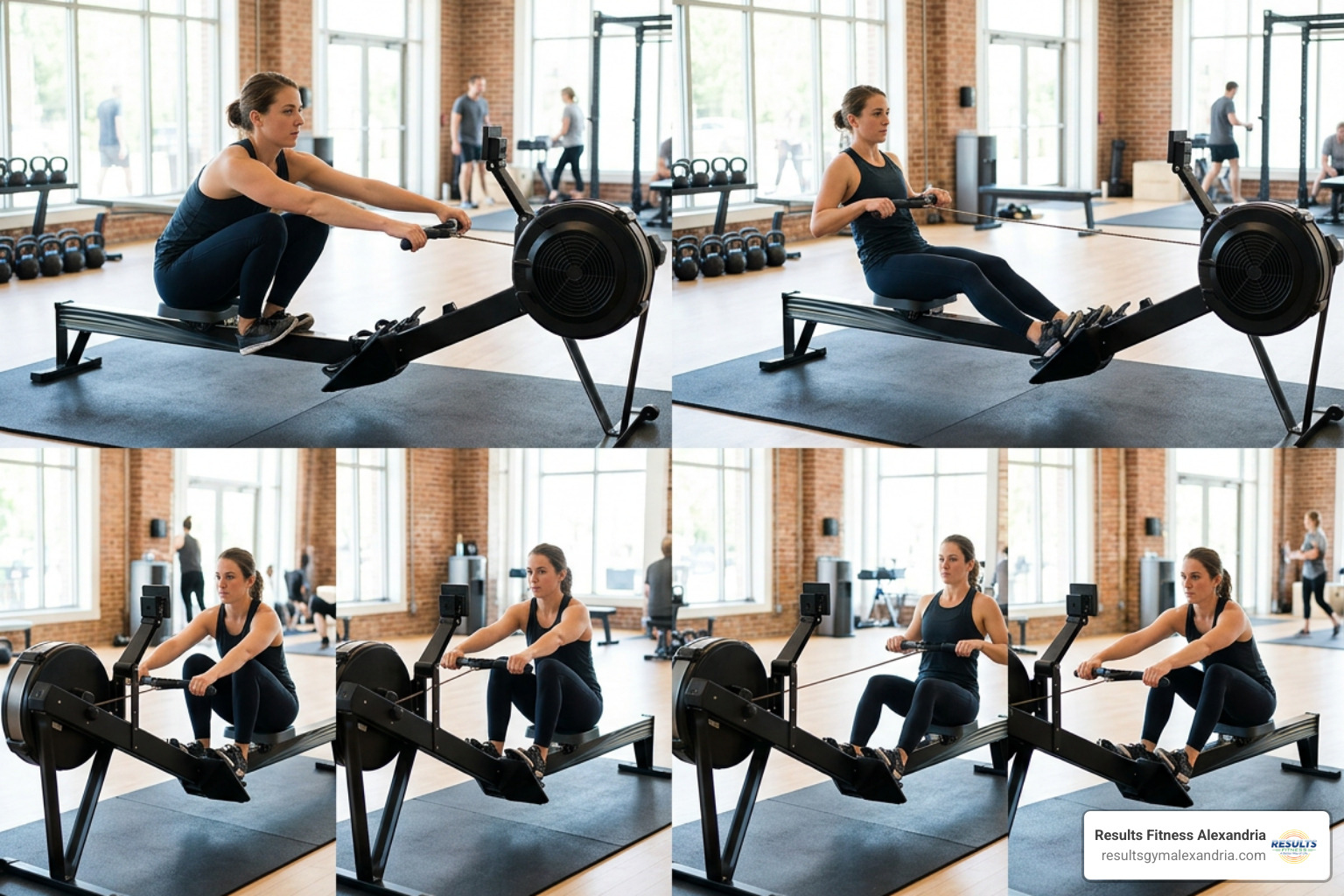
High-intensity intervals require proper technique. When sprinting on an ergometer, fatigue can cause compromised mechanics if you rush your stroke. Maintaining precise posture and fluid timing maximizes speed, power output per stroke, and injury prevention.
Equipment setup is equally important. Many exercisers falsely assume that cranking the rowing machine’s damper lever all the way up to 10 generates the best workout. On an air-resistance rower (like a Concept2), the damper controls the volume of airflow entering the flywheel housing, altering how heavy the pull feels.
A damper setting of 3 to 5 corresponds to a normal drag factor (roughly 110–130) that mirrors the real resistance of a racing shell on smooth water. Setting the damper to 10 creates excessive drag, forcing premature lumbar fatigue and slowing down handle acceleration during explosive interval work.
When choosing between air and water resistance rowers:
- Air Resistance Rowers: Resistance responds exponentially to handle speed. The harder you drive with your legs, the more air drag the flywheel creates. This makes air rowers ideal for high-intensity intervals and sprint tracking via exact /500m split metrics.
- Water Resistance Rowers: Utilize a physical paddle churning through a water tank. They offer smooth resistance and realistic acoustic feedback, making them great for continuous rhythm and dynamic interval efforts.
To review proper form before increasing your training volume, explore The Ultimate Rowing Form Checklist Avoid These Common Mistakes.
Key Phases of the Rowing Stroke
To produce maximum wattage while protecting your spine, perform the rowing stroke in four sequential phases:
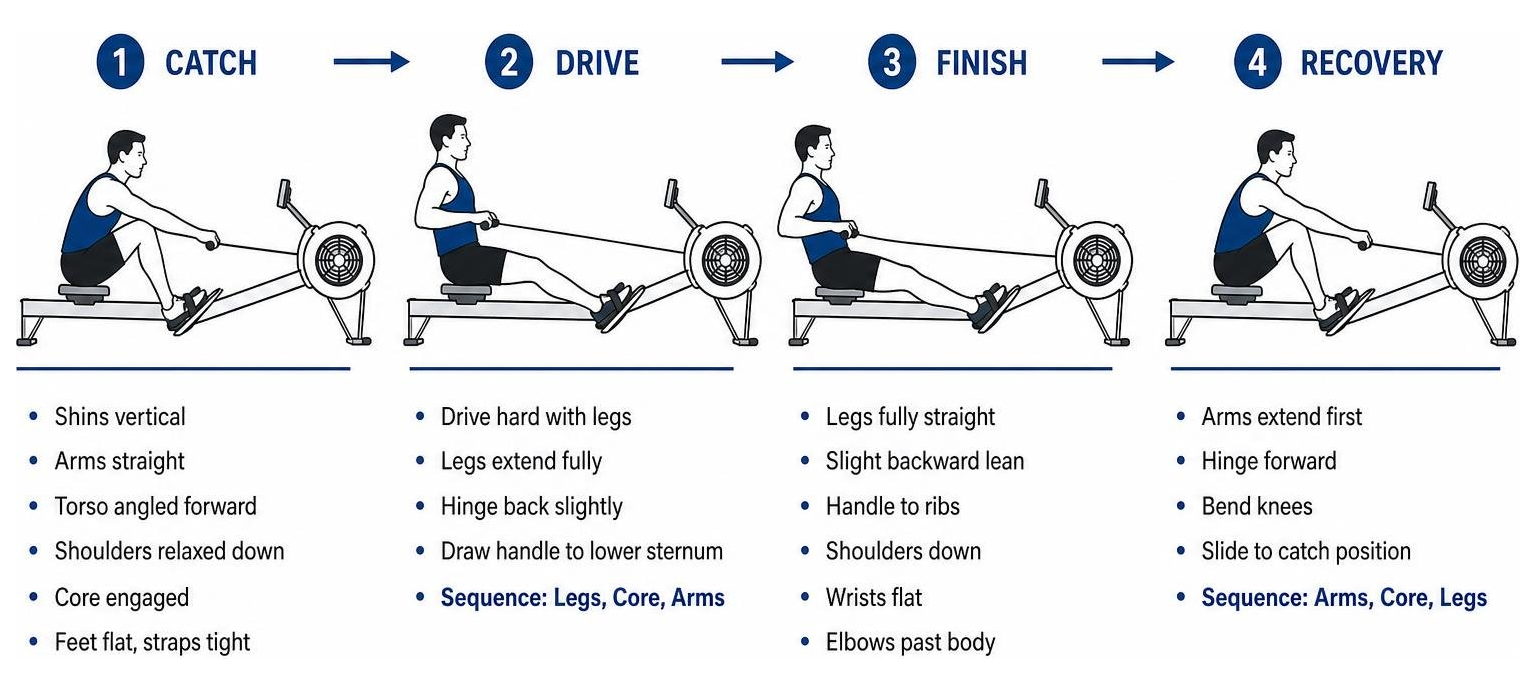
- The Catch: Sit tall on the seat with your shins vertical, arms fully extended forward, wrists flat, and shoulders relaxed down away from your ears. Hinge forward at the hips with your torso angled slightly forward (at about a 1 o’clock position). Your core is engaged, and your feet are flat against the footplates with straps tightened across the ball of the foot.
- The Drive: Initiate the movement by driving hard through your feet, extending your legs fully before moving your upper body. Once your knees are nearly extended, hinge back slightly at the hips (to an 11 o’clock position), and finally draw the handle smoothly toward your lower sternum with your back and arms. Remember the muscle sequence: Legs, Core, Arms.
- The Finish: Your legs are fully straight, your core is braced in a slight backward lean, shoulders are down, and the handle rests softly against your ribs below the chest. Wrists remain flat, and elbows swing naturally past your torso.
- The Recovery: Reverse the drive sequence smoothly. Extend your arms forward first until they are fully straight, hinge forward from the hips to lean the torso forward, and then bend your knees to slide the seat back to the catch position. Remember the recovery sequence: Arms, Core, Legs.
A golden rule of interval rowing is maintaining a 1:2 drive-to-recovery rhythm ratio. The drive phase should be dynamic and explosive (1 count), while the recovery phase should be smooth and controlled (2 counts). Rushing the recovery deprives your muscles of oxygen and reduces drive power on the next stroke.
Structured Workouts for Every Athletic Level
Whether you are stepping onto an ergometer for the very first time or training for a competitive 2,000-meter time trial, structuring your work-to-rest ratios, stroke rates, and target split paces ensures steady progress.
The table below outlines sample rowing machine interval training routines broken down by fitness level:
| Fitness Level | Routine Name | Work / Rest Protocol | Target Stroke Rate (SPM) | Total Workout Time | Primary Fitness Focus |
|---|---|---|---|---|---|
| Beginner | Base Builder 30/90 | 30s Hard / 90s Easy x 8-10 rounds | 24 – 26 SPM | ~20 mins | Stroke mechanics, leg drive baseline |
| Intermediate | Fat Loss & Power 1:1 | 1 min Hard / 1 min Easy x 10-12 rounds | 28 – 30 SPM | ~25 mins | Anaerobic threshold, EPOC calorie burn |
| Advanced | 500m Sprint Repeat | 500m Hard / 2 mins Active Rest x 5-6 rounds | 30 – 34 SPM | ~25-30 mins | Max VO2max, race pace conditioning |
| Performance | 2 x 7-Minute TR Zone | 7 mins TR Zone / 7 mins Rest x 2 rounds | 26 – 28 SPM | ~46 mins (w/ warm-up) | 2k time trial power endurance |
For a broader breakdown of how to transition from steady-state rows to high-intensity intervals, take a look at our comprehensive article on Workouts on a Rowing Machine From Steady State to High Intensity.
Beginner Rowing Machine Interval Training Protocols
When starting out, your primary goals are developing a rhythmic stroke, driving through the legs rather than pulling with the upper body, and managing fatigue.
10-Minute Introductory Interval Session
- Warm-up: 2 minutes light rowing at 18–20 SPM.
- Interval Work (5 rounds): 30 seconds at vigorous effort (24 SPM) / 30 seconds light active recovery paddling.
- Cool-down: 3 minutes light rowing at 18 SPM.
20-Minute Baseline Interval Workout
- Warm-up: 5 minutes progressive light rowing (building from 18 to 22 SPM).
- Interval Work (8 to 10 rounds): 30 seconds at high intensity (24–26 SPM, driving hard through footplates) followed by 90 seconds of light, easy recovery rowing (18–20 SPM).
- Cool-down: 3 to 5 minutes easy recovery rowing and upper body stretches.
This 1:3 work-to-rest ratio allows complete heart rate recovery between rounds so you can prioritize solid posture. As your conditioning improves, you can easily progress to a 1:2 or 1:1 ratio.
If you are brand new to ergometer workouts, review The Complete Beginner Guide to Rowing Machine Workouts and explore Best Rowing Workouts for Beginners to Build Fitness Fast.
Intermediate and Advanced Rowing Machine Interval Training Workouts
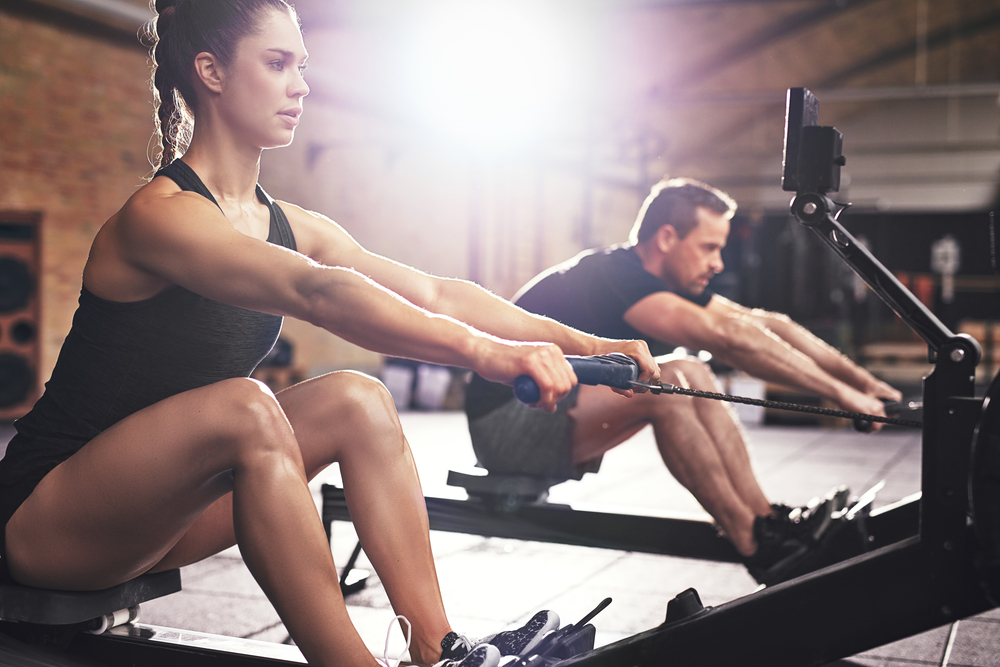
Intermediate and advanced athletes can handle higher work volumes, tighter recovery windows, stroke rate modulation, and race-specific pacing strategies.
25-Minute Stroke Rate Pacing Interval (Intermediate)
This workout focuses on stroke rate precision.
- Warm-up: 5 minutes easy rowing (20 SPM).
- Round 1 (4 mins): 1 min @ 24 SPM, 1 min @ 26 SPM, 1 min @ 28 SPM, 1 min @ 30 SPM.
- Rest: 2 minutes light active recovery.
- Round 2 (4 mins): 1 min @ 26 SPM, 1 min @ 28 SPM, 1 min @ 30 SPM, 1 min @ 32 SPM.
- Rest: 2 minutes light active recovery.
- Round 3 (4 mins): Repeat Round 1 structure pushing for slightly faster /500m split times.
- Cool-down: 4 minutes low-intensity paddling (18 SPM).
30-Minute Cardio-Strength Circuit (Intermediate/Advanced)
Combining off-machine plyometrics or bodyweight movements with ergometer sprints keeps your heart rate elevated while building full-body muscle endurance.
- Warm-up: 5 minutes light rowing.
- Circuit (4 rounds):
- Row 500 meters at high effort (28–30 SPM).
- 15 Bodyweight Jump Squats.
- 12 Push-ups or Dumbbell Rows.
- 45 seconds Plank Hold.
- Rest 90 seconds before starting the next round.
- Cool-down: 5 minutes light rowing.
You can learn more about combining strength and ergometer conditioning in our guide on How to Build Muscle and Burn Fat with Rowing Circuits.
The 2 x 7-Minute Transportation Rowing (TR) Workout (Advanced)
Targeted directly at improving a 2k race time trial score, this performance workout focuses on high-intensity Transportation Rowing (TR) intensity—working near your VO2max.
- Warm-up (15 mins): Progressive ladder starting at light pace (18 SPM) through UT2 (Aerobic Threshold) and UT1 (Aerobic Endurance), ending with short 10-stroke bursts at race pace.
- Interval 1 (7 mins): Row continuously at 26–28 SPM maintaining your target 2k split pace.
- Active Rest (7 mins): Light paddle at 18 SPM allowing metabolic clearance.
- Interval 2 (7 mins): Row continuously at 26–28 SPM, focusing on drive mechanics through fatigue.
- Cool-down (10 mins): Low-intensity rowing at 20 SPM.
If you are training specifically for benchmark performance tests, check out this external guide on 2k Rowing Machine Training With 7 Minute Intervals and explore this 7 Minute Rowing Machine Interval Workout resource.
Short on time? You can also try our quick-hitting guides like Row Your Way to Fitness in a 10-Minute Rowing Machine Workout or check out Row Your Heart Out with These 20-Minute Workouts.
How to Program, Progress, and Avoid Common Mistakes
Integrating rowing machine interval training into your weekly fitness routine requires smart programming and recovery management. Because interval sessions strain both your central nervous system and metabolic pathways, perform them 1 to 2 times per week, allowing at least 24 to 48 hours of recovery or lower-intensity activity between hard sessions.
To ensure long-term fitness gains without hitting a plateau, apply progressive overload principles:
- Increase Volume: Progress from 8 interval rounds up to 10 or 12 rounds over several weeks.
- Decrease Rest Windows: Move from a 1:3 work-to-rest ratio (e.g., 30s work / 90s rest) to a 1:2 ratio (30s work / 60s rest), and eventually a 1:1 ratio (1 min work / 1 min rest).
- Improve Split Pace: Target a faster average /500m split pace on your performance monitor while keeping work durations constant.
- Vary Stroke Rates: Practice generating higher power at moderate stroke rates (24–26 SPM) before simply pulling faster at higher rates (30+ SPM).
Common Mistakes to Avoid
- Pulling Exclusively with the Arms: The stroke should be driven 60% by the legs, 20% by the core, and only 20% by the arms and back. Initiating the drive by pulling with the arms reduces handle power and strains the shoulders.
- Bending Knees Too Early on Recovery: Returning your knees up before your hands and torso hinge forward forces you to lift the handle over your knees. Always follow the pattern: Arms out, torso forward, then bend knees.
- Flying Off the Handle Early: Going all-out in the first 10 seconds of a 3-minute or 7-minute interval leads to premature lactate accumulation, causing your pace to collapse late in the round. Pace your early minutes evenly.
- Neglecting Monitor Split Tracking: Relying solely on physical sensation makes progress hard to measure. Track your average /500m split time displayed on the monitor to quantify power improvements across training cycles.
For more conditioning ideas, see our resource on Cardio Training for Better Endurance and review our HIIT Classes Near Me Complete Guide.
Frequently Asked Questions About Rowing Intervals
How often should I do rowing machine interval training workouts?
For optimal results, schedule rowing machine interval training sessions 1 to 2 times per week. High-intensity ergometer sessions create significant neuromuscular and metabolic fatigue. Ensure you take 1 to 2 rest days or engage in low-intensity steady-state cardio, yoga, or light strength training between interval days to prevent overtraining and support tissue recovery.
What is the best damper setting for high-intensity rowing intervals?
The optimal damper setting for most athletes during high-intensity intervals is between 3 and 5 (which corresponds to a drag factor of roughly 110–130 on Concept2 rowers). This setting mimics natural water resistance, protecting your low back while allowing explosive leg acceleration. High damper settings (8–10) cause early muscular fatigue without extra cardiovascular benefit.
How does rowing interval training burn so many calories in less time?
Rowing interval training burns calories rapidly because it engages approximately 86 percent of your total muscle mass simultaneously across your lower body, core, back, and arms. Combining heavy leg drive resistance with elevated heart rates creates a strong metabolic stimulus. Additionally, high-intensity intervals trigger Excess Post-Exercise Oxygen Consumption (EPOC), keeping your body burning extra calories for up to 14 hours after your workout ends.
Conclusion
Rowing machine interval training offers an incredible mix of low-impact cardiovascular conditioning, total-body muscle recruitment, and time-efficient calorie burn. By alternating intense work periods with active recovery, you boost your VO2max, elevate post-workout metabolic afterburn, and build lasting endurance without taxing your joints.
Whether you start with a simple 20-minute baseline interval routine or take on advanced stroke-rate pacing challenges, maintaining clean mechanics—drive with the legs, brace the core, and finish with the arms—is key to reaching your fitness goals.
At Results Fitness in Alexandria, Virginia, our personal trainers and group fitness instructors are dedicated to helping you master proper movement mechanics, structure smart interval workouts, and hit your target fitness goals. Ready to take your training to the next level? Stop by to try our indoor ergometers, top-tier cardio equipment, and expert personal training services. Explore Cardio Training Facilities and grab your free 1-day pass to experience the Results Fitness difference today!