Row, Row, Row Your Way to Fitness with These Incredible Rowing Machine Benefits
Why Rowing Machine Benefits Make It One of the Best Full-Body Workouts You Can Do
The rowing machine benefits your entire body in a single, smooth movement — and that’s what sets it apart from almost every other piece of cardio equipment at the gym.
Quick answer: What are the main rowing machine benefits?
- Full-body workout — engages up to 86% of your muscles, including legs, core, back, and arms
- Low-impact — gentle on joints, suitable for people with arthritis or joint pain
- Burns calories — a 155-pound person burns roughly 369 calories in 30 minutes of vigorous rowing
- Cardio + strength in one — builds muscular endurance while training your heart and lungs
- Improves posture — strengthens the upper back and core, countering the effects of sitting all day
- Accessible for all fitness levels — beginner-friendly, scalable, and easy to learn
- Mental health boost — the rhythmic motion supports focus, stress relief, and mindfulness
- Time-efficient — even 10 to 15 minutes delivers a meaningful, full-body training effect
Whether you’re short on time, dealing with sore knees, or just tired of the treadmill, rowing offers a refreshing and highly effective alternative.
You don’t need to be a competitive athlete — or even particularly fit — to get started. The rowing machine meets you exactly where you are, and grows with you as your fitness improves.
I’m Jennifer Rapchak, Fitness Director at Results Fitness Alexandria and a certified personal trainer with over 14 years of experience helping people discover the rowing machine benefits that match their goals. I’ll walk you through everything you need to know to row smarter, safer, and more effectively.
Rowing machine benefits terms to learn:
12 Rowing Machine Benefits That Make It a Full-Body Fitness Powerhouse
Rowing is one of the rare workouts that checks almost every box: cardio, strength endurance, joint-friendly movement, core training, posture work, calorie burn, and mental focus.
A helpful Cleveland Clinic guide to rowing benefits describes rowing as a low-impact, full-body workout that can improve stamina, strength, posture, and stress levels. That lines up with what we see with members at Results Fitness Alexandria: once people learn the movement, they often realize the rower is not “just another cardio machine.”
Here are the biggest benefits:
- Works most major muscle groups
- Builds cardiovascular endurance
- Strengthens legs, glutes, back, arms, and core
- Burns calories efficiently
- Supports fat-loss goals when paired with nutrition
- Reduces joint impact compared with running
- Improves posture and trunk control
- Builds muscular endurance and power
- Scales for beginners, athletes, and active recovery
- Supports heart and lung health
- Helps reduce stress through rhythmic movement
- Saves time because one machine trains so much at once
In other words, rowing is a lot like a group project where everyone actually does their part.
1. Rowing Works Your Legs, Core, Back, Arms, and Shoulders
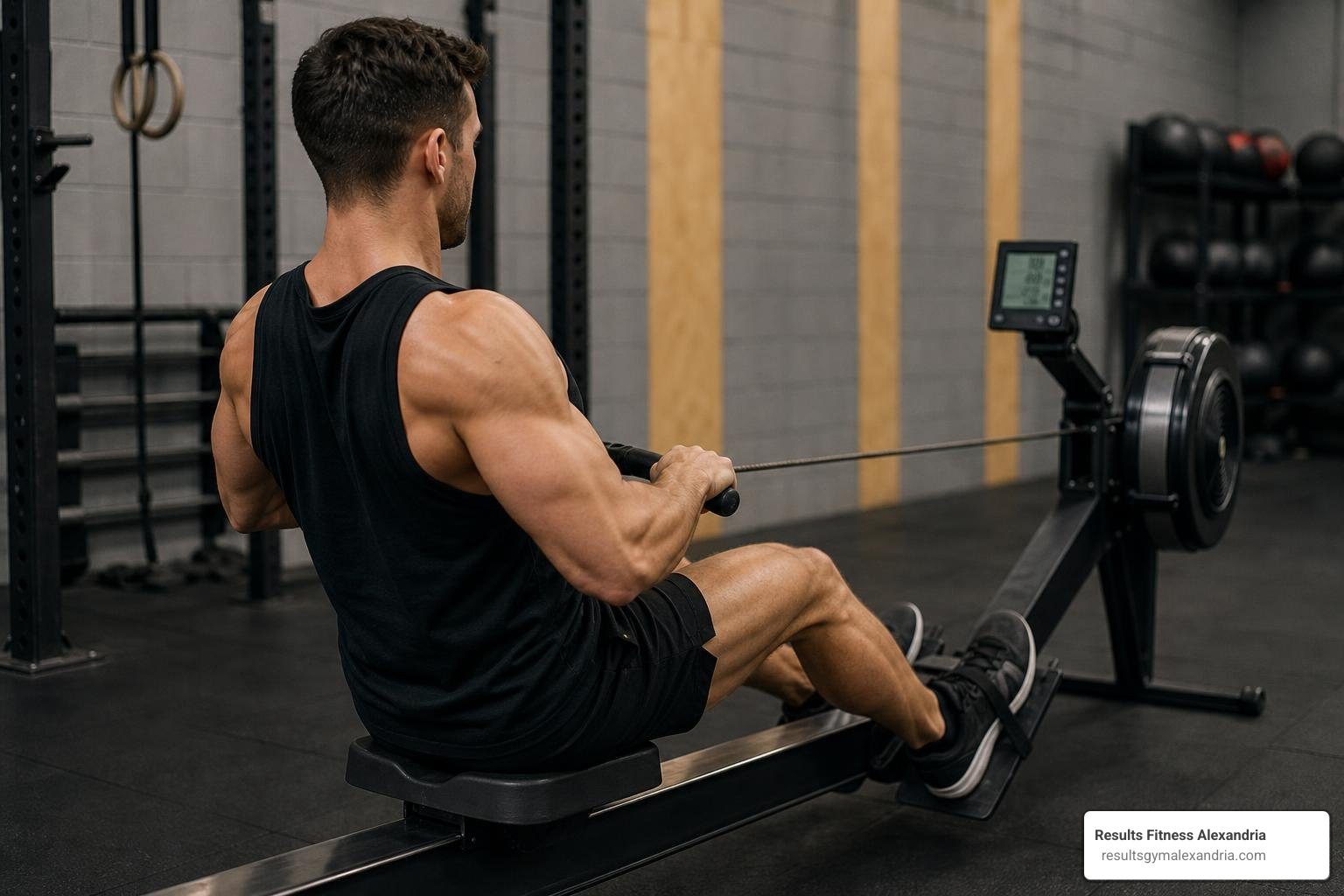
One of the most impressive rowing machine benefits is how many muscles are involved in each stroke. Research and fitness organizations commonly estimate that rowing engages roughly 80% to 86% of the body when performed with good technique.
The main muscles worked include:
- Legs: quadriceps, hamstrings, glutes, calves, hip flexors
- Core: abdominals, obliques, deep stabilizers, erector spinae
- Back: lats, rhomboids, traps, rear delts
- Arms and shoulders: biceps, forearms, deltoids
- Chest support muscles: pecs assist with control and posture
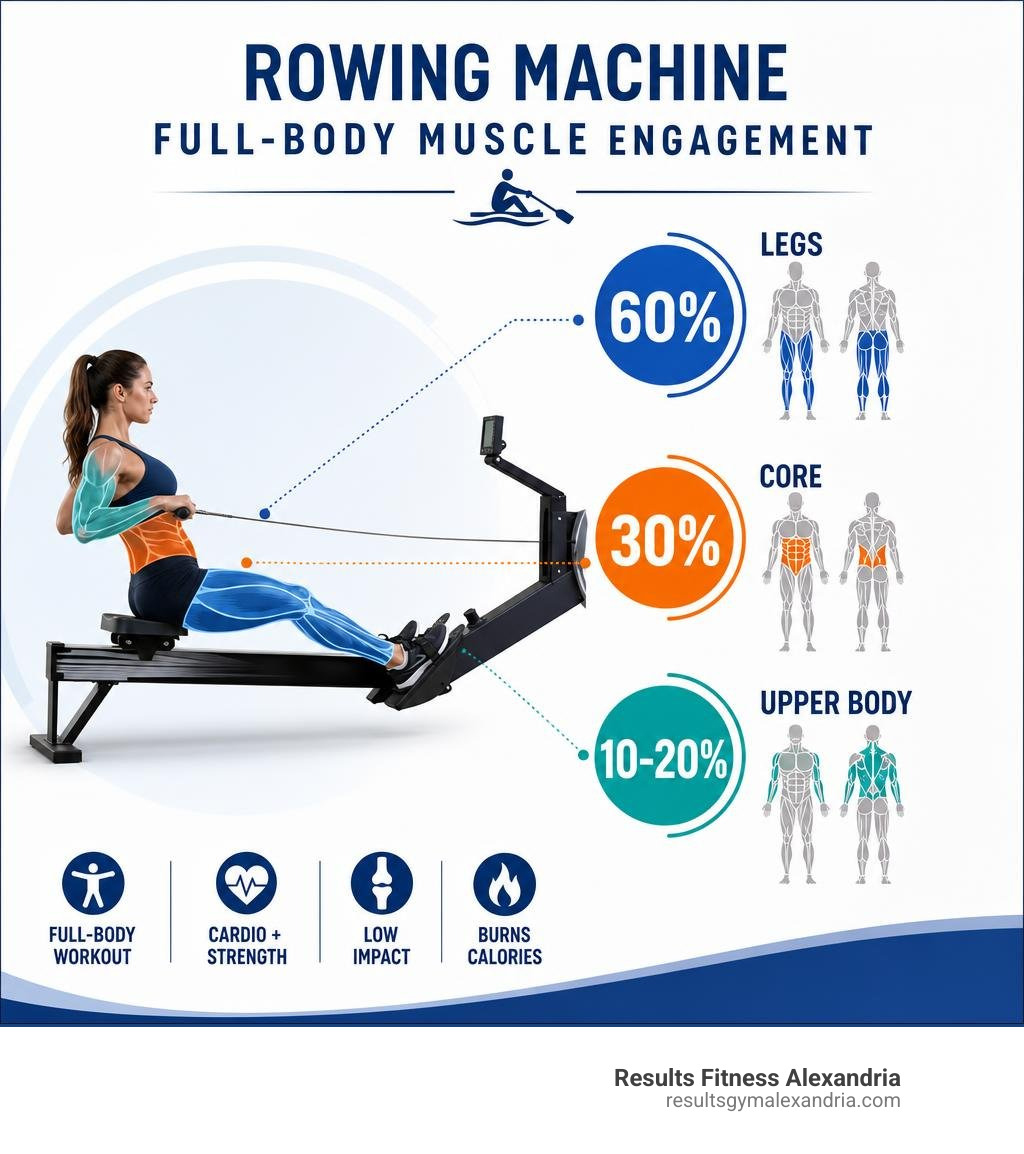
Rowing is often misunderstood as an arm workout. In reality, the stroke is mostly lower body. A good rule of thumb is that rowing is about 65% to 75% leg work and 25% to 35% upper-body work. Another common coaching breakdown is 60% legs, 30% core, and 10% to 20% upper body.
That means your legs start the power, your core transfers it, and your arms finish it. If your arms are doing all the work, the rower will let you know quickly – usually through tired biceps and unimpressed legs.
2. Rowing Machine Benefits Include Cardio and Strength in One Workout
Rowing blends aerobic exercise with resistance training. You are raising your heart rate while pushing through the footplates, bracing your core, hinging at the hips, and pulling against resistance.
That combination makes rowing excellent for:
- Aerobic conditioning
- Muscular endurance
- Stroke power
- Metabolic conditioning
- Interval training
- Steady-state cardio
- Active recovery at lower intensity
You can row gently in a lower heart rate zone for recovery, or you can use short intervals for a challenging HIIT workout. A 2022 study found that low-volume HIIT, even under 15 minutes per session, can improve fitness, glucose control, blood pressure, and cardiac function.
For a complete training plan, try our rowing machine full body workout.
3. It Burns Calories and Supports Weight Loss Goals
Rowing can support weight loss because it uses a lot of muscle at once, which increases energy demand. But here is the important truth: rowing helps with fat loss when it contributes to a calorie deficit. It cannot magically target belly fat. We wish spot reduction worked, but sadly, your body does not take requests like a DJ.
Harvard Health estimates that in 30 minutes of vigorous stationary rowing:
- A 125-pound person burns about 255 calories
- A 155-pound person burns about 369 calories
- A 185-pound person burns about 440 calories
A 2015 study of 24 people with low vision found that rowing 5 days per week for 6 weeks led to reduced fat mass and body fat percentage, along with improved cholesterol levels and back strength.
For best results, pair rowing with strength training, protein-rich meals, sleep, and consistent nutrition habits. For more help, read our guide to cardio workouts for belly fat.
4. It Boosts Heart, Lung, and VO2 Max Fitness
Rowing trains your cardiovascular system because it demands oxygen from large muscle groups at the same time. Your heart pumps harder, your lungs work more efficiently, and your body improves its ability to deliver oxygen.
Potential cardiovascular benefits include:
- Better aerobic endurance
- Improved VO2 max
- Stronger heart and lung capacity
- Better blood pressure response
- Improved glucose control
- Healthier cholesterol markers, including LDL improvements in some research
A medical review of rowing machine health benefits notes that rowing can support cardiovascular health, endurance, power, and posture when performed with proper form.
Rowing intervals are especially useful for heart and lung fitness. For example, alternating 1 minute hard with 1 to 2 minutes easy can challenge your cardiovascular system without the pounding impact of sprinting.
5. It Is Low-Impact and Joint-Friendly
Yes, rowing is low-impact. Since you are seated, your feet stay connected to the machine, and there is no jumping or repeated foot strike. That makes rowing a strong option for many people with knee, ankle, or hip sensitivity.
Research from 2014 found that after 8 weeks of rowing, participants improved joint torque in areas including the elbow, shoulder, lumbar spine, and knee by about 30%. Rowing has also been recommended in some contexts for people with early osteoarthritis because it can build strength without high impact.
Rowing may be helpful for:
- People managing joint discomfort
- Older adults
- Beginners who want low fall risk
- Active recovery days
- People returning to fitness after time away
Important note: low-impact does not mean no-risk. If you have arthritis, a recent injury, osteoporosis, or chronic pain, check with a healthcare professional before starting. Then begin with low resistance, shorter sessions, and coaching support.
6. It Improves Posture, Balance, and Core Strength
Rowing rewards good posture. To row well, you need a tall chest, neutral spine, strong hip hinge, and active core.
The movement strengthens the muscles that help counter desk posture, including:
- Upper back
- Rear shoulders
- Lats
- Rhomboids
- Core stabilizers
- Glutes and hamstrings
Each stroke teaches coordination: legs push, hips open, core braces, arms pull, then everything reverses in control. That rhythm improves body awareness, balance, and timing.
A simple cue we use: “Sit tall like someone is gently pulling the crown of your head upward.” If you collapse through the chest or round your low back, reduce the intensity and reset your form.
How Rowing Compares to Treadmills, Ellipticals, Bikes, and Other Cardio Machines
Rowing is not automatically “better” than every cardio machine. The best machine depends on your body, goals, preferences, and injury history. But rowing does offer a unique mix of low-impact cardio and full-body strength endurance.
| Machine | Impact Level | Main Muscles | Upper Body Use | Best For |
|---|---|---|---|---|
| Rowing machine | Low | Legs, glutes, core, back, arms | High | Full-body cardio, posture, endurance |
| Treadmill | Moderate to high if running | Legs, glutes, calves | Low | Running fitness, walking, incline work |
| Elliptical | Low | Legs, glutes, calves | Moderate | Low-impact cardio, steady endurance |
| Bike | Low | Quads, glutes, hamstrings | Low | Leg endurance, cycling fitness, recovery |
Rowing vs Treadmill: Less Impact, More Upper-Body Involvement
Running can be excellent, but it comes with repeated impact through the feet, ankles, knees, and hips. Rowing removes most of that pounding while still allowing hard cardiovascular work.
For people who carry extra body weight or experience knee discomfort, rowing can make it easier to reach a challenging heart rate without impact being the limiting factor.
Rowing vs Elliptical: More Pulling, Core, and Back Engagement
The elliptical is also low-impact, but rowing usually creates more pulling strength, core demand, and posterior-chain involvement. The upper back, lats, and shoulder blade muscles work more actively during rowing.
If your goal is posture plus cardio, rowing has an edge.
Rowing vs Bike: More Muscle Groups and Core Demand
Cycling is fantastic for leg endurance, but it is more leg-dominant. Rowing adds upper-body pulling, trunk stability, hip hinging, and back engagement.
That makes rowing a strong cross-training option for anyone who wants cardio without ignoring the rest of the body.
Proper Rowing Technique: Catch, Drive, Finish, and Recovery
Proper technique is the difference between “Wow, rowing feels amazing” and “Why does my back hate me?” The stroke has four phases: catch, drive, finish, and recovery.
The key order is:
- Drive: legs, body, arms
- Recovery: arms, body, legs
For more detailed technique ideas, see our guide on rowing machine workout methods.
The Catch: Start Strong Without Rounding Your Back
At the catch:
- Shins are close to vertical
- Knees are bent
- Arms are straight
- Chest is tall
- Shoulders are relaxed
- Spine stays neutral
- Core is lightly braced
- Feet are secure in the straps
Think “tall and ready,” not “folded like a lawn chair.”
The Drive: Push With Your Legs Before Pulling With Your Arms
The drive is where most of your power happens. Push through your feet first, using your quads, glutes, and hamstrings. Keep your arms straight as the legs extend, then open the hips and pull the handle.
Good drive cues:
- Push through the heels and midfoot
- Keep knees tracking forward
- Brace the core
- Do not yank with the arms first
- Let the legs create the power
The Finish: Brace Your Core and Pull to the Lower Ribs
At the finish:
- Legs are extended but not aggressively locked
- Torso leans back slightly
- Abs stay tight
- Handle comes toward the lower ribs or sternum
- Elbows travel back
- Shoulder blades gently squeeze together
- Wrists stay flat
Avoid pulling to your chin or shrugging your shoulders. Your traps do not need to audition for a drama role.
The Recovery: Return Slowly and Stay in Control
The recovery should be controlled, not rushed. Move in the reverse order:
- Arms extend forward
- Torso hinges forward from the hips
- Knees bend last as the seat slides forward
This gives you rhythm and protects your back. Many beginners rush the slide forward, but slowing down improves power and technique.
Common Rowing Mistakes That Cause Pain or Limit Results
Watch for these form errors:
- Rounding the low back
- Pulling with the arms too early
- Locking the knees hard
- Hunching the shoulders
- Overreaching at the catch
- Setting resistance too high
- Rushing every stroke
- Letting the knees collapse outward or inward
- Forgetting to brace the core
Low-back issues are among the more common rowing complaints, especially when the abdominals are not engaged. If your form breaks down, lower the intensity or stop for the day.
How Long to Row, How Many Calories You Burn, and Sample Workouts
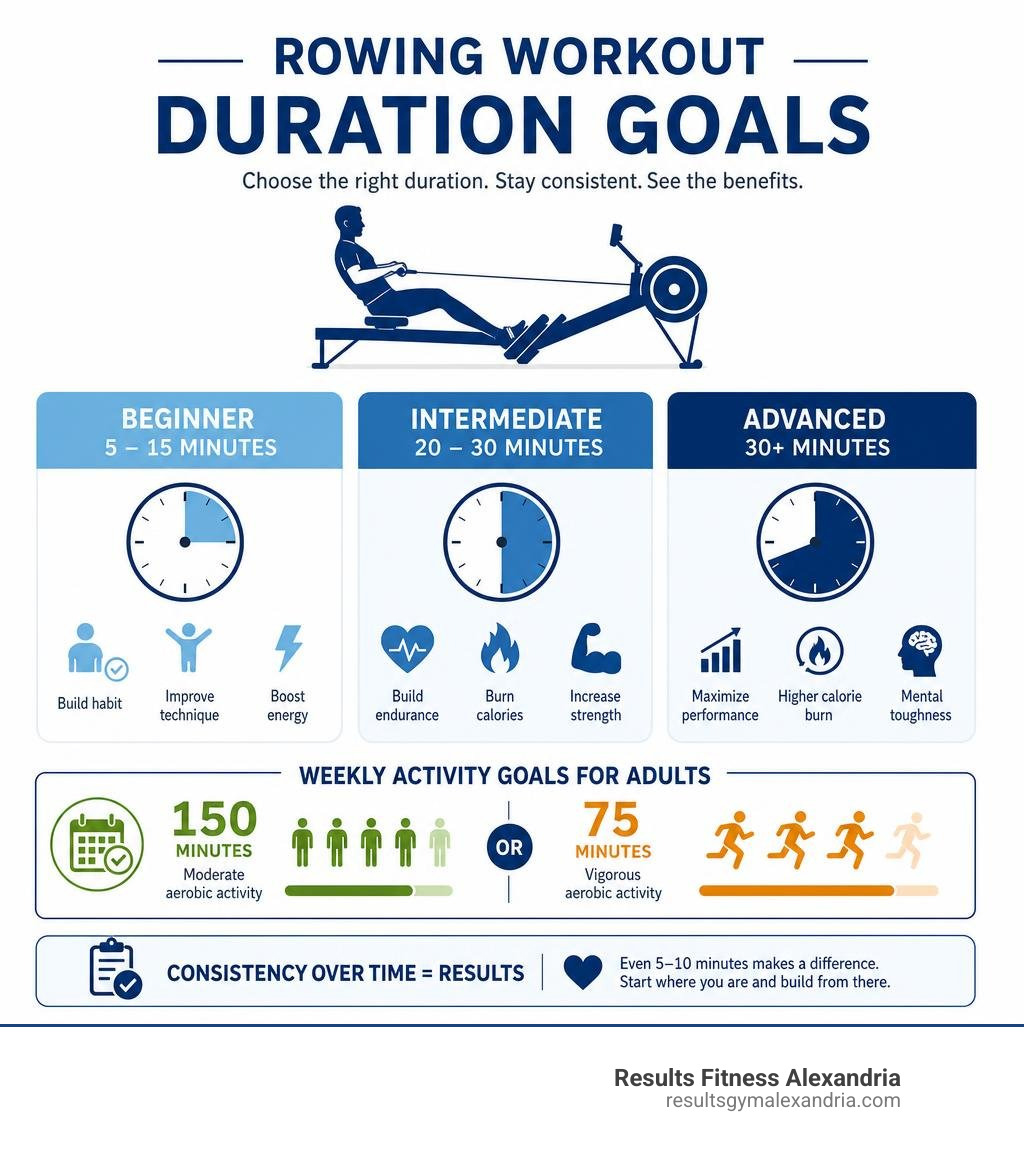
How long you should row depends on your fitness level and goal. Even 5 to 10 minutes can be useful when you are learning. A complete workout might be 20 to 30 minutes.
General weekly goals for adults often include 150 minutes of moderate aerobic activity or 75 minutes of vigorous activity. Rowing can help you meet either target.
Beginner Rowing Machine Benefits Start With 5 to 15 Minutes
If you are new, start small:
- 3 to 5 minutes easy warm-up
- 5 to 10 minutes technique practice
- 3 to 5 minutes cool-down
- Low to moderate resistance
- 3 days per week to start
Your first goal is not to destroy yourself. It is to learn the stroke and finish feeling like you could come back tomorrow.
Try this: row 1 minute easy, rest 1 minute, repeat 5 times. For more structure, use our 10-minute rowing workout.
20-Minute Rowing Workouts for Fitness, Endurance, and Fat Loss
A 20-minute row is a sweet spot for many people. It is long enough to improve endurance, but short enough to fit into a busy day.
Try one of these:
- Steady row: 20 minutes at a conversational pace
- Intervals: 5-minute warm-up, then 8 rounds of 30 seconds hard and 60 seconds easy, cool down
- Tempo row: 4 rounds of 3 minutes moderate-hard and 2 minutes easy
- Active recovery: 20 minutes light, smooth, and relaxed
For more options, check out our 20-minute rowing workouts.
30-Minute Rowing Calorie Burn Estimates
Calorie burn depends on intensity, body weight, fitness level, and technique. Harvard Health estimates vigorous rowing for 30 minutes burns about:
- 255 calories for a 125-pound person
- 369 calories for a 155-pound person
- 440 calories for a 185-pound person
Moderate rowing burns less, but it is easier to sustain. Compared with ellipticals and bikes, rowing is very competitive because it uses both upper and lower body.
How to Progress Without Overtraining
Progress gradually. A smart rule is to increase total time, distance, or intensity by no more than about 10% per week.
To stay healthy:
- Take rest days
- Strength train 2 to 3 days per week
- Stretch hip flexors after longer rows
- Strengthen glutes and hamstrings
- Stop if pain changes your form
- Track stroke rate, split time, or perceived effort
- Keep technique first, intensity second
For broader conditioning help, read our cardio endurance training tips.
Choosing and Using a Rowing Machine at Home or at the Gym
Rowing machines use different resistance systems, including air, magnetic, water, and hydraulic resistance. Each feels a little different, but the best rower is the one that feels smooth, stable, and easy to use consistently.
Consider:
- Footprint and foldability
- Noise level
- Seat comfort
- Handle grip
- Smooth rail movement
- Adjustable resistance
- Monitor metrics
- Heart rate compatibility
- Maintenance needs
- Frame stability
At the gym, ask a coach or trainer to help you set up. At home, read the manual, check bolts and straps regularly, and keep the rail clean.
What to Look for Before You Row
Before each workout, check:
- Foot straps are snug over the widest part of your feet
- Handle moves smoothly
- Seat glides without catching
- Resistance is appropriate
- Monitor shows stroke rate, distance, time, or split
- Area around the machine is clear
- Your posture feels tall and relaxed
If the damper or resistance is adjustable, start lower than your ego wants. Your back will thank you.
Tips for Better Rowing Workouts at Any Fitness Level
Use these simple coaching tips:
- Warm up for 3 to 5 minutes
- Start with low resistance
- Keep your chest tall
- Breathe with rhythm
- Count strokes to stay mindful
- Mix steady rows and intervals
- Pair rowing with strength circuits
- Use easy rows for recovery days
- Track progress with 500-meter split time or stroke rate
For more cardio guidance, see how to build cardiovascular endurance.
How to Combine Rowing With Strength Training, Yoga, and Other Cardio
Rowing is powerful, but balanced fitness still matters. Indoor rowing mainly moves your body forward and backward, so we also like to include lateral movement, rotation, mobility, and strength work.
A balanced week might include:
- 2 rowing cardio sessions
- 2 strength training sessions
- 1 yoga or mobility session
- 1 optional walk, stair climber, bike, or other cardio day
- 1 full rest day
Strength training helps build muscle and support fat loss. Yoga and mobility help your hips, spine, and shoulders move better. If weight loss is your goal, read our guide on cardio vs strength training for weight loss.
Frequently Asked Questions About Rowing Machine Benefits
What muscles does a rowing machine work?
A rowing machine works the legs, glutes, core, back, shoulders, and arms. Key muscles include the quads, hamstrings, glutes, calves, abdominals, obliques, lats, rhomboids, traps, biceps, forearms, and erector spinae.
With proper technique, rowing can engage about 80% to 86% of the body. The effort is mostly legs, with the core transferring power and the upper body finishing the pull.
Is rowing good for people with joint issues or arthritis?
Rowing can be a good option for many people with joint issues because it is seated and low-impact. It avoids the repeated pounding of running while still improving strength and cardiovascular fitness.
Research has shown improvements in joint function and strength after consistent rowing, including in people with early osteoarthritis. However, anyone with arthritis, chronic pain, or a recent injury should get medical clearance and begin gradually.
Can rowing help you lose belly fat?
Rowing can help reduce body fat, including belly fat over time, by burning calories and supporting lean muscle. But it cannot spot-reduce belly fat specifically.
For fat loss, combine rowing with:
- A consistent calorie deficit
- Strength training
- Protein-rich meals
- Sleep and recovery
- Progressive workouts
- Patience, because your body is not Amazon Prime
Conclusion
The rowing machine benefits nearly every part of your fitness: full-body strength endurance, heart and lung health, calorie burn, posture, core control, joint-friendly movement, and stress relief.
It is beginner-friendly, scalable, and efficient enough for busy schedules. Start with 5 to 15 minutes, focus on smooth technique, and build from there. If you want support, our team at Results Fitness Alexandria can help you learn proper form, create a plan, and combine rowing with personal training, strength work, yoga, and cardio.
Ready to try it for yourself? Explore our cardio training amenities in Alexandria and grab a free 1-day pass to experience Results Fitness Alexandria.