How to Rowing Machine Workout: 5 Effective Methods
Why a Rowing Machine Workout Belongs in Your Fitness Routine
A rowing machine workout is one of the most efficient ways to train your entire body in a single session. Here’s a quick summary of what you need to know:
| What You Want | What Rowing Delivers |
|---|---|
| Full-body workout | Activates ~86% of your muscles per stroke |
| Low-impact cardio | Easy on joints, safe for most fitness levels |
| Fat burning | High calorie burn through full-body engagement |
| Strength + cardio | Builds endurance and muscular strength together |
| Time efficiency | Effective sessions in as little as 10-20 minutes |
Whether you have 15 minutes or an hour, rowing adapts to your schedule and your goals.
The rowing machine is still one of the most underused pieces of equipment in any gym. Most people walk past it. That’s a mistake. Unlike a treadmill or stationary bike, rowing works your legs, core, back, and arms all at once — in one smooth, continuous movement. It’s low-impact, meaning it protects your joints while still pushing your cardiovascular system hard.
The numbers back this up. Indoor rowing participation grew nearly 20% between 2014 and 2021, and it’s easy to see why — results come fast when nearly every muscle in your body is doing the work.
I’m Jennifer Rapchak, Fitness Director at Results Fitness Gym with over 14 years of experience as an ACE-certified personal trainer, and I’ve seen how adding a structured rowing machine workout can transform a client’s fitness — especially for those who feel stuck or short on time. In the sections below, I’ll break down the science, the technique, and five proven workout methods you can start using today.
The Science and Benefits of a Rowing Machine Workout
When we talk about efficiency, we often point to the fact that a rowing machine workout engages nearly 85% to 86% of your musculature. In a single fluid stroke, you are activating your quads, calves, glutes, hips, core, back, shoulders, and biceps. It is essentially a Full Body Cardio experience that few other machines can match.
One of the most significant scientific advantages of rowing is its focus on the posterior chain. In our modern world, we spend a lot of time hunched over desks or phones, which weakens the muscles along the back of our bodies. Rowing forces those muscles — the hamstrings, glutes, and erector spinae — to fire repeatedly. This not only builds a powerful physique but also improves posture and helps prevent the “slump” many of us struggle with.
Joint Protection and Low-Impact Power
Because rowing is a seated, non-weight-bearing exercise, it offers incredible joint protection. We often recommend it for members who need to avoid the high-impact pounding of running but still want a Cardiovascular Fitness Program that challenges them.
The power output potential is also staggering. Research shows that elite rowers can sustain mechanical power outputs of up to 590 W during racing. While most of us aren’t hitting those Olympic numbers, the ability to generate massive power without hurting your knees or ankles makes rowing a “secret weapon” for longevity.
Metabolic Flexibility and Fat Oxidation
Rowing is a powerhouse for metabolic health. In controlled lab testing, maximal fat oxidation (MFO) rates during rowing have been measured at an average of 0.40 g·min⁻¹. Interestingly, research on rowing energy demands suggests that maximal fat oxidation peaks earlier in rowing (at about 31.6% VO₂peak) compared to running. This means you can start burning fat effectively even at relatively moderate intensities.
Furthermore, some modern rowing machines allow for “eccentric training,” which can increase oxygen consumption and muscle activation even further. By combining high-intensity bursts with steady-state recovery, you improve your “metabolic flexibility” — your body’s ability to switch between burning carbs and fats for fuel.
Mastering Proper Rowing Technique and Equipment Settings
Before you jump on and start pulling as hard as you can, we need to talk about form. If you “death-grip” the handle or rush the movement, you won’t just get tired faster — you’ll risk injury. Proper technique is what turns a mediocre session into an elite rowing machine workout.

The Four Phases of the Stroke
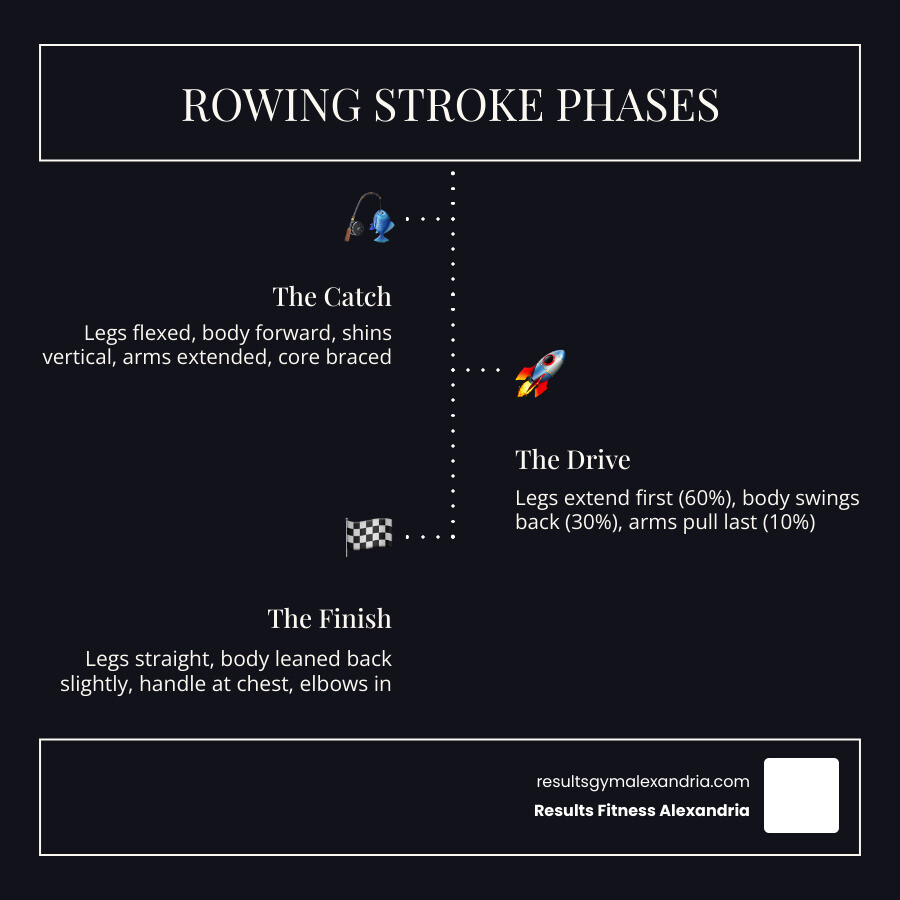
Think of the rowing stroke as a continuous loop divided into four distinct parts:
- The Catch: This is the starting position. Your knees are tucked, your arms are straight, and your torso is leaned slightly forward (at about a 1-o’clock position). Your shins should be vertical.
- The Drive: This is where the power happens. A common mistake is pulling with the arms first. Instead, think: Legs, then Core, then Arms. You should explode back with your legs. Once your legs are nearly straight, you hinge your torso back and finally pull the handle to your chest.
- The Finish: At the end of the drive, your legs are extended, your core is engaged, and the handle is at your lower ribs. You should be leaning back slightly (at about an 11-o’clock position).
- The Recovery: This is the “reset.” It should be the exact reverse of the drive: Arms, then Core, then Legs. Extend your arms, hinge your torso forward, and only then bend your knees to slide back to the catch.
The Golden Rule of Power Distribution: About 60% of your power should come from your legs, 30% from your core/trunk, and only 10% from your arms. If your biceps are screaming but your legs feel fine, you’re doing it wrong!
Damper Settings and Metrics
The “damper” is the lever on the side of the flywheel. Many beginners think setting it to 10 makes the workout “harder” or “better.” In reality, a damper setting of 4 to 6 is usually optimal for most people. It simulates the feel of a sleek boat on the water. Setting it too high can actually lead to a “grinding” stroke that ruins your rhythm and taxes your joints unnecessarily.
To track your Rowing Machine Workout, keep an eye on these metrics:
- Split Time (500m split): This is your “pace.” It tells you how long it would take you to row 500 meters at your current intensity.
- Stroke Rate (SPM): Strokes per minute. For most workouts, you’ll stay between 20 and 30 SPM.
- Watts: A measure of your pure power output.
Comparing Cardio Metrics
| Metric | Rowing | Running | Cycling |
|---|---|---|---|
| Primary Power Source | Legs (60%) | Legs (90%+) | Legs (95%+) |
| Impact Level | Very Low | High | Low |
| Muscle Activation | 86% | ~45% | ~35% |
| Core Engagement | High | Moderate | Low |
5 Effective Methods for Your Rowing Machine Workout
Now that you have the technique down, let’s look at how to structure your time on the machine. No single routine is “the best”; the right one depends on whether you want to burn fat, build stamina, or recover.
1. The 20-Minute HIIT Rowing Machine Workout
If you’re short on time but want maximum results, High-Intensity Interval Training (HIIT) is the way to go. This method is perfect for boosting your metabolism and burning calories long after you leave the gym.
- The Warm-Up: 5 minutes of easy rowing, gradually increasing your stroke rate from 18 to 22 SPM.
- The Main Set (40/20 Intervals): Alternate 40 seconds of “hard” rowing (high power, lower split time) with 20 seconds of “easy” recovery rowing. Repeat this for 10 minutes.
- The Tabata Finisher: If you’re feeling brave, try a Rowing Interval Training Workout using the Tabata protocol: 20 seconds of absolute max effort followed by 10 seconds of rest. Repeat 8 times.
- The Cool-Down: 3-5 minutes of very light rowing to bring your heart rate down.
This type of workout is excellent for fat loss. When debating Cardio Vs Strength Training For Weight Loss, HIIT rowing offers a unique middle ground because the high-resistance “drive” phase builds muscle while the interval structure torches fat.
2. Endurance-Building Pyramid Rowing Machine Workout
Building aerobic capacity requires spending more time on the machine, but doing the same pace for 40 minutes can be boring. A Rowing Pyramid Workout keeps your mind engaged while building serious Cardio Training For Better Endurance.
- Structure: This is a 42-minute session that focuses on consistency and stroke rate control.
- Interval 1: 3 min row (30 SPM) / 3 min rest -> 2 min row (30 SPM) / 2 min rest -> 1 min row (30 SPM) / 1 min rest.
- The Peak: 4 minutes of steady rowing at 28 SPM. This is your “base pace” test.
- Interval 3 (The Descent): 1 min row (30 SPM) / 1 min rest -> 2 min row (30 SPM) / 2 min rest -> 3 min row (30 SPM) / 3 min rest.
By varying the lengths of the intervals, you teach your body to recover quickly and maintain a Best Cardio Workout For Endurance mindset.
3. The 500m Power Sprint
This workout is all about explosive power. Interestingly, research shows that vertical jump height (a measure of lower-body explosive power) is a strong predictor of 500m rowing performance. If you want to build a Cardio Exercise For Stamina that also makes you more athletic, this is it.
- The Goal: Complete 4 to 6 rounds of 500-meter sprints.
- The Execution: Row 500 meters as fast as you can while maintaining good form. Do not let your back round!
- The Rest: Take a full 1:30 to 2:00 minutes of rest between sprints. You want your heart rate to drop enough so you can give 100% effort on the next round.
- Why it works: This mimics the “anaerobic threshold” training used in 2000m test prep for competitive rowers. It builds incredible leg power and mental toughness.
4. Steady-State Recovery Rows
Not every rowing machine workout needs to leave you breathless. Active recovery is a vital part of any training plan. On days when your muscles are sore from lifting, a low-intensity row can actually help you recover faster by increasing blood flow.
- Duration: 20-30 minutes.
- Intensity: Keep your heart rate in “Zone 2” (roughly 60-69% of your max heart rate). You should be able to hold a conversation while rowing.
- Technique Focus: Use this time to perfect your form.
- Power Tens: Every minute on the minute, take 10 “power strokes” where you focus on a sharp, powerful leg drive, then immediately return to your easy recovery pace.
This is similar to the benefits of a Stair Climber Workout — it keeps the body moving and the heart healthy without overtaxing your central nervous system. Plus, the rhythmic nature of steady rowing is known for providing great mental clarity.
5. Mixed-Modality Circuit Training
Rowing doesn’t have to be done in isolation. At Results Fitness Alexandria, we love combining the rower with strength exercises to create a Strength And Cardio powerhouse.
- The “500m Mixup”:
- Row 500 meters.
- Perform 15 Kettlebell Swings.
- Perform 15 Pushups.
- Perform 15 Air Squats.
- Repeat 4 times as an AMRAP (As Many Rounds As Possible) for 20 minutes.
Combining rowing with bodyweight movements is one of The Top 5 Cardio Exercises To Boost Your Endurance because it prevents any single muscle group from hitting total failure too early, allowing you to keep your heart rate elevated for longer.
Common Mistakes and How to Track Progress
Even with the best intentions, it’s easy to fall into bad habits. Here are the “Big Three” mistakes we see on the gym floor:
- Rushing the Recovery: Beginners often slide back to the catch too quickly. Your recovery should take about twice as long as your drive. Think: Power back (1 second), drift forward (2 seconds).
- The “Rainbow” Handle Path: If you have to lift the handle up and over your knees on the way back, you are bending your knees too early. Remember the sequence: Arms away, torso over, then bend the knees.
- Death-Gripping: You don’t need to squeeze the handle. Your hands should act like hooks. A tight grip leads to forearm fatigue and shoulder tension.
Tracking Your 21-Day Progression
To see real results, consistency is key. We recommend tracking your 500m split trends over a 21-day period.
- Week 1: Focus on form and finding your “base pace” (a pace you can hold for 10 minutes).
- Week 2: Introduce one HIIT session and one Endurance session.
- Week 3: Aim to lower your average 500m split by just 2-3 seconds across all workouts.
Using tools like ErgData or simply recording your “Watts” and “Split” in a journal will help you see the compounding fitness you’re building. If you’ve previously done Treadmill Endurance Workouts, you’ll find that rowing progress feels different — it’s as much about “skill” as it is about “lungs.”
Frequently Asked Questions about Rowing Machine Workouts
What is the best damper setting for beginners?
For almost everyone, a damper setting between 3 and 5 is perfect. It provides enough resistance to feel the “catch” of the water without being so heavy that it ruins your technique. Avoid the temptation to put it at 10; that’s like trying to ride a bike in the hardest gear up a hill — you’ll just wear yourself out too fast.
How many calories does a rowing workout burn?
Because rowing engages 86% of your muscles, it is a high-calorie burner. Depending on your weight and intensity, you can expect to burn between 400 and 800 calories per hour. A high-intensity 20-minute HIIT session can often burn as many calories as 45 minutes of moderate walking.
Is rowing better than running for weight loss?
“Better” is subjective, but rowing is often more efficient. While a treadmill might allow for higher maximal fat oxidation for some, rowing builds more muscle mass in the upper body and core. This increased muscle mass can raise your resting metabolic rate. Plus, for those with joint issues, rowing is much safer for long-term consistency.
Conclusion
The rowing machine workout is a versatile, powerful tool that deserves a spot in your weekly routine. Whether you are sprinting for power, rowing for recovery, or hitting a high-intensity circuit, the full-body benefits are undeniable. By mastering the “Legs, Core, Arms” sequence and staying consistent with your metrics, you’ll see improvements in your strength, stamina, and overall body composition.
At Results Fitness Alexandria, we’re passionate about helping you find the right balance of cardio services and strength training. Our expert trainers are always on hand to check your rowing form and help you integrate these methods into a personalized plan.
Ready to see what 86% muscle activation feels like? Come visit us in Alexandria, Virginia! We offer a free 1-day pass so you can try our rowers, attend a class, and experience our community firsthand. Let’s get to work!