Row Your Way to Fitness with This Ultimate Full Body Routine
The Rowing Machine Full Body Workout: Everything You Need to Know
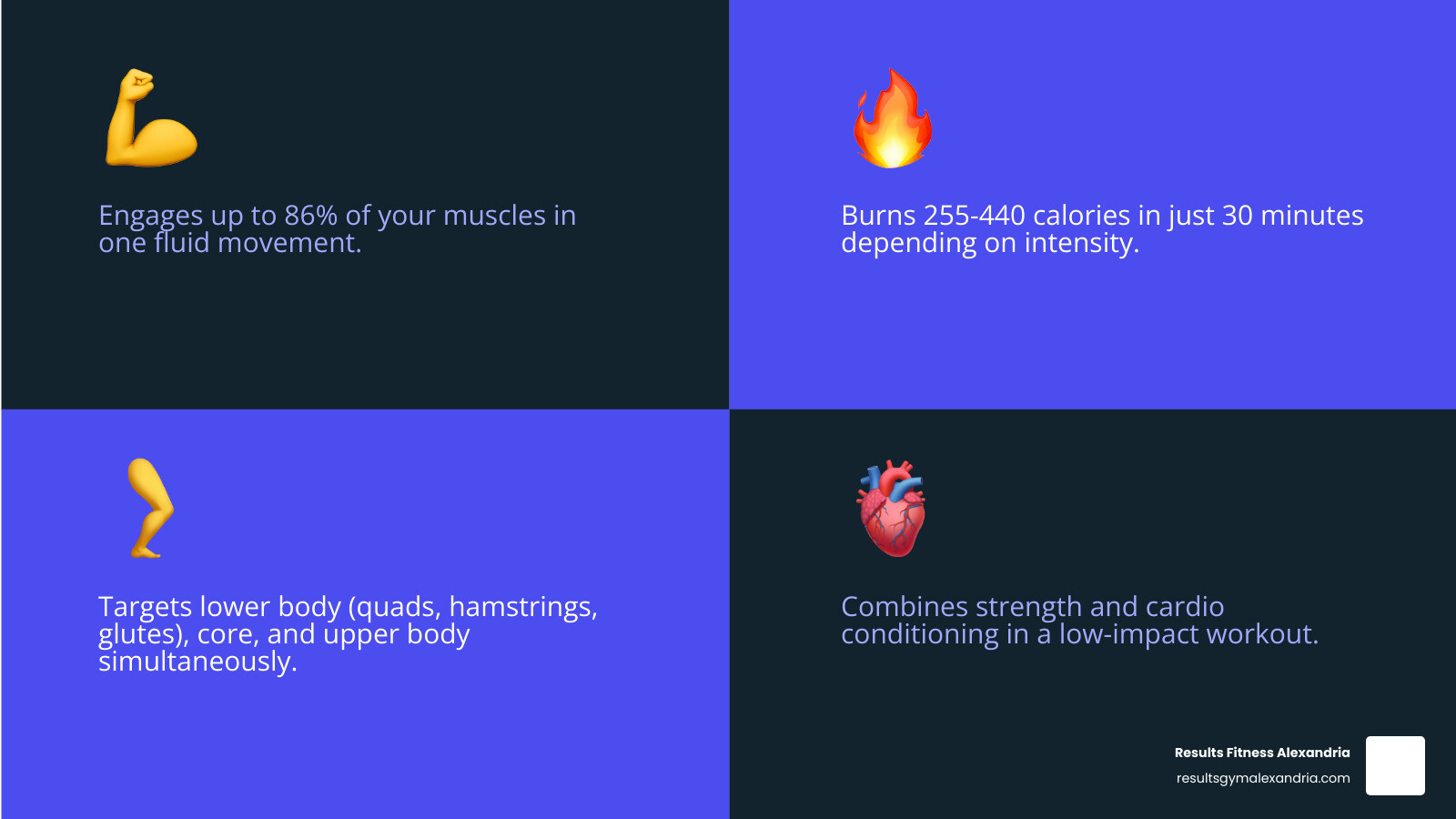
A rowing machine full body workout is one of the most efficient ways to build strength and endurance at the same time — engaging up to 86% of your muscles in a single, fluid movement.
Here’s what a rowing machine full body workout covers in one session:
- Lower body: quads, hamstrings, glutes, calves
- Core: abs, obliques, lower back stabilizers
- Upper body: lats, rhomboids, shoulders, biceps
- Cardiovascular system: sustained aerobic and anaerobic conditioning
- Calorie burn: roughly 255–440 calories per 30 minutes, depending on body weight and intensity
It’s low-impact, beginner-friendly, and works whether you have 10 minutes or an hour. And unlike most cardio machines, it trains both pushing and pulling muscles — giving you a more balanced workout in less time.
This guide will walk you through everything: proper technique, beginner-friendly workouts, progress tracking, and how to build rowing into a complete fitness routine.
I’m Jennifer Rapchak, Fitness Director at Results Fitness Gym with over 14 years of personal training experience — and I’ve seen how adding a rowing machine full body workout to a client’s routine can transform their strength, endurance, and body composition faster than most single-modality approaches. Whether you’re brand new to the rowing machine or looking to get more out of every stroke, this guide will give you the tools to do it right.
Rowing machine full body workout further reading:
Why a Rowing Machine Full Body Workout Works So Well
Rowing works so well because it blends strength and cardio into one repeating motion. Each stroke asks your legs to push, your core to brace, and your upper body to finish the pull. That means you are not just “doing cardio” – you are producing force, controlling posture, and sustaining effort at the same time.
Research commonly cites rowing as engaging about 86% of the body’s muscles. That is why it feels so different from walking on a treadmill or pedaling on a bike. You are coordinating nearly the whole body, not just moving the legs.
A rowing machine full body workout also has three big practical advantages:
- It is low impact, so it is usually easier on the joints than running
- It can burn a high number of calories in a relatively short session
- It can improve posture and trunk strength when technique is solid
For many people, rowing becomes the rare machine that can warm you up, challenge your lungs, strengthen your legs, and humble you just enough to keep you honest.
What muscles a rowing machine full body workout targets
About 60% of rowing power comes from the legs, around 30% from the trunk, and about 10% from the arms. So while rowing definitely trains the upper body, your legs are the engine.
Main muscles worked include:
- Quads during the leg drive
- Glutes and hamstrings as you extend the hips
- Calves as you push through the footplates
- Abs and obliques to brace and transfer force
- Lower back stabilizers to help maintain a neutral spine
- Lats and rhomboids during the pull
- Rear shoulders and upper back for posture
- Biceps and forearms as the handle finishes near the ribs

This push-pull pattern is part of what makes rowing so balanced. It trains the anterior and posterior chain together, which can help offset the “all push, no pull” approach many people accidentally develop in the gym.
Why rowing feels different from other cardio machines
Here is the simple version:
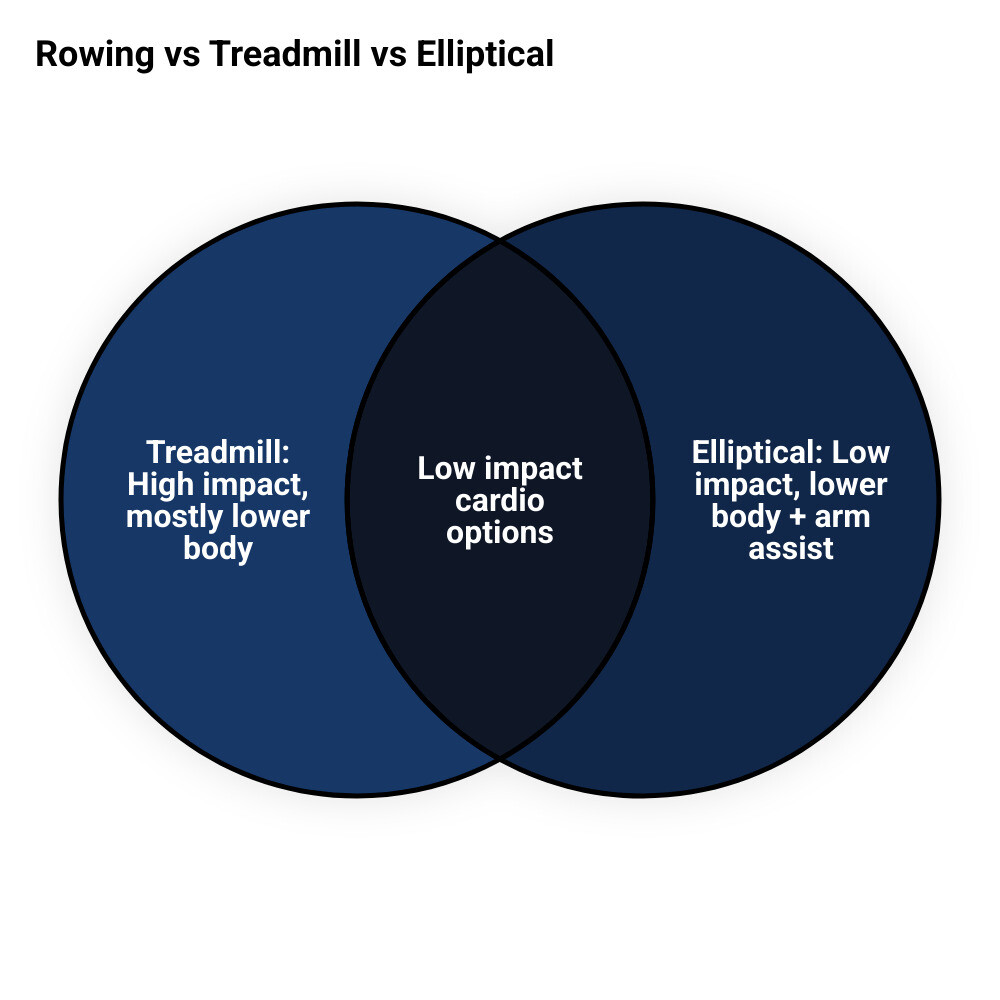
- Treadmill: high impact, mostly lower body
- Elliptical: low impact, mostly lower body with some arm assistance
- Rower: low impact, true full-body demand
Compared with a treadmill, rowing typically places less repetitive stress on the knees, hips, and ankles because there is no pounding. Compared with an elliptical, rowing generally requires more coordinated leg drive, core bracing, and upper-back pulling.
Rowing can also be very efficient for calorie burn. Vigorous rowing may burn roughly 255 calories in 30 minutes for a 125-pound person, 369 calories for a 155-pound person, and 440 calories for a 185-pound person. At high effort, some people can exceed 800 calories per hour.
So if you want a machine that trains more muscle while staying relatively joint-friendly, rowing is hard to beat.
Master Proper Technique for a Safer, Stronger Stroke
Good technique makes rowing more powerful and much safer. Poor technique turns it into a lower-back complaint machine. The goal is not to yank the handle harder. The goal is to sequence the stroke correctly.
Think of the stroke like this:
- On the drive: legs, body, arms
- On the recovery: arms, body, legs
That order matters.
How to set up the rowing machine before you start
Before the first stroke, take 30 seconds to set up well.
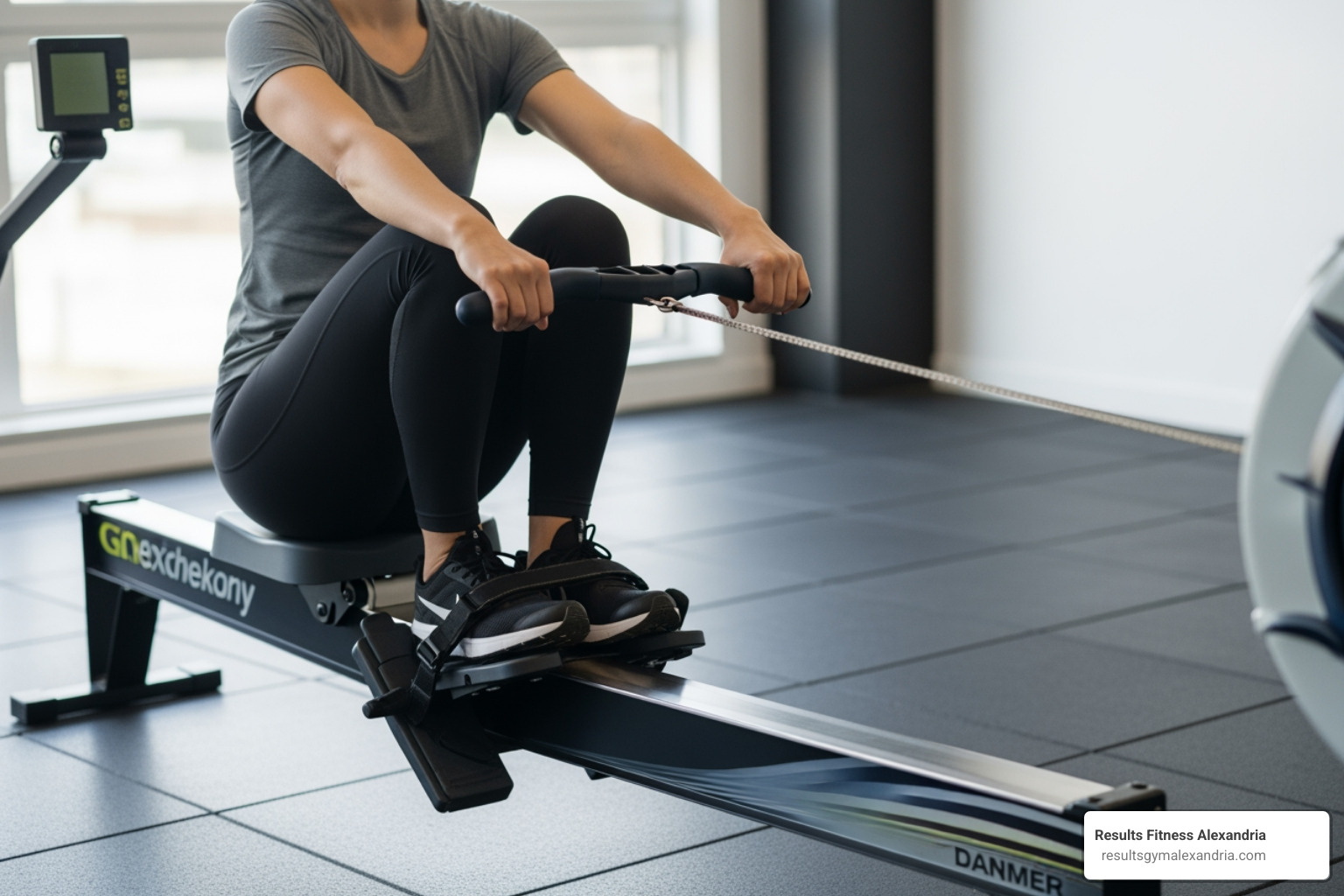
- Secure the foot straps over the widest part of your feet
- Hold the handle with a relaxed, even grip
- Sit tall with a neutral spine
- Set the resistance or damper at a moderate level, not “maximum because it looks cool”
- For many people, a moderate damper setting works best rather than the highest setting
- Warm up for 3 to 4 minutes in an easy Zone 2 effort before harder work
A very high resistance setting often causes beginners to muscle the stroke with the back and arms. That is usually where trouble starts. Start smooth, not heroic.
How to do the four phases of a rowing machine full body workout
The rowing stroke has four phases: catch, drive, finish, and recovery.
1. Catch
At the catch:
- Knees are bent
- Shins are close to vertical
- Arms are straight
- Torso is leaning slightly forward from the hips
- Spine stays long, not rounded
This is your loaded position. You should feel ready to push, not collapse.
2. Drive
The drive is where most of the work happens. Some coaching sources estimate about 60% of the effort comes here.
- Push through the legs first
- Keep the arms straight early in the drive
- As the legs approach extension, swing the torso from slightly forward to slightly back
- Finish by drawing the handle toward the lower ribs or upper abs
Think “push the machine away with the legs.” If you start by bending the arms, you waste power.
3. Finish
At the finish:
- Legs are long
- Core is braced
- Torso leans back slightly
- Elbows move behind the body
- Handle touches lightly near the lower chest or upper abs
Do not shrug your shoulders to your ears. Keep the neck relaxed.
4. Recovery
The recovery is the reset, and it should be controlled.
- Extend the arms away first
- Hinge the torso forward from the hips
- Then bend the knees to slide back to the catch
A useful rhythm is a quicker drive and a slower return. Some coaches like roughly a 3-second drive and 4-second recovery. The exact number is less important than this principle: do not rush back up the slide.
Breathing tip:
- Exhale during the drive
- Inhale during the recovery
How proper form boosts results and helps prevent injury
Form matters for performance, but it matters even more for your back. Research in rowers has found that a large share of injuries – reported as 25% to 81% in male rowers – involve the low back. One common issue is failing to brace the abdominal muscles during each stroke.
Proper form helps by:
- Letting the legs generate most of the power
- Allowing the trunk to transfer force instead of absorbing it poorly
- Reducing stress from rounding and yanking
- Keeping the recovery smooth instead of slamming into the next stroke
If you want more guidance, our rowing workout guide goes deeper into how to structure safer sessions.
Beginner drills to learn correct rowing form fast
Beginners improve much faster with drills than with random flailing. Yes, “random flailing” is the technical term we use when nobody is watching.
Try this short drill sequence:
- 10 drive-only reps
- 10 hip-opening reps
- 10 catch-only reps
You can also use these skill builders:
- Pick drill: start with arms only, then arms plus body, then half slide, then full stroke
- Pause drill: pause at the finish or body-over position to learn sequencing
- Mirror or side-view feedback: watch whether your spine stays neutral and shoulders stay relaxed
For more form help, see how to use the rowing machine with 5 effective methods.
The Best Rowing Machine Full Body Workout Plans for Every Goal
The best workout depends on your goal. Rowing is flexible enough to support fat loss, conditioning, endurance, and general fitness.
Beginner 10- to 15-minute workout
This is ideal if you are learning form or returning after time off.
- 3 minutes easy warm-up
- 6 rounds:
- 30 seconds moderate rowing
- 60 seconds easy rowing
- 2 to 3 minutes easy cool-down
Keep the effort around Zone 2 to low Zone 3 for most of the workout. Focus on clean strokes, not speed. If your form falls apart, slow down.
For a simple starting point, check out this 10-minute rowing workout.
20-minute full-body interval workout
Intervals are great when you want more calorie burn and conditioning without a long session.
Try this:
- 4 minutes easy warm-up
- 8 rounds:
- 1 minute hard at controlled effort
- 1 minute easy
- 4 minutes cool-down
Target:
- Stroke rate around 22 to 26 SPM for moderate intervals
- Slightly higher if technique stays solid
- RPE of 7 to 8 out of 10 on the hard efforts
This workout builds strength endurance, challenges the heart and lungs, and still leaves enough recovery to maintain good form. For more ideas, visit our 20-minute rowing workouts.
30-minute workout for endurance and fat loss
A 30-minute session is a sweet spot for many adults. It is long enough to build aerobic fitness but still realistic on a busy schedule.
Try this format:
- 5 minutes easy warm-up
- 10 minutes steady state in Zone 2
- 10 minutes tempo work in Zone 3 with sustainable effort
- 5 minutes cool-down
You can also row 20 to 25 minutes continuously at a conversational pace if you are building endurance.
This kind of workout supports:
- Aerobic base development
- Fat loss support through calorie expenditure
- Better pacing and stroke consistency
- Improved recovery between harder sessions
For a broader look at rowing benefits and intervals, see this scientific overview of rowing benefits.
How long and how often you should row
For most people, 3 to 5 rowing sessions per week works well. Total session time can range from 10 minutes to 30 minutes or more depending on fitness level and goals.
A simple guideline:
- Beginners: 10 to 15 minutes, 2 to 3 times weekly
- Intermediate: 20 to 30 minutes, 3 to 4 times weekly
- Advanced: 30 minutes or more, 4 to 5 times weekly with varied intensity
Always include:
- 3 to 10 minutes of warm-up
- 3 to 10 minutes of cool-down
- At least one easier day between hard rowing sessions if you are new
Progress by changing just one variable at a time:
- More total time
- More intervals
- Better split pace
- Slightly higher stroke rate
Track Progress and Avoid the Most Common Rowing Mistakes
If you do not track anything, every workout becomes “I think that felt harder?” That is not useless, but we can do better.
The key metrics that show real progress
The best rowing metrics are practical and easy to compare over time.
Track these:
- 500m split: your pace per 500 meters
- Stroke rate or SPM: strokes per minute
- Watts: power output
- Distance: how far you rowed
- Total time: workout duration
- Heart rate: especially useful for zone training
- RPE: rate of perceived exertion
A good benchmark system is to record your times for:
- 500m
- 2,000m
- 5,000m
If your split improves at the same stroke rate, that is progress. If your heart rate is lower at the same pace, that is also progress.
Common rowing mistakes and how to fix them
The most common mistakes are very fixable.
- Arms-first pull
- Fix: keep the arms straight until the legs have done most of the work
- Rushing the recovery
- Fix: slow down on the way forward; recovery should take longer than the drive
- Rounded back
- Fix: sit tall, hinge from the hips, brace the core
- Overreaching at the catch
- Fix: stop when shins are near vertical; do not collapse through the lumbar spine
- Death grip on the handle
- Fix: hold it firmly but lightly; forearms should not do all the work
- Too much resistance
- Fix: lower the setting and learn to produce power through timing, not brute force
When to increase intensity safely
Increase intensity only when:
- Your stroke order stays consistent
- Your back feels stable
- You can complete workouts without technique falling apart
- Recovery between sessions is good
Safe ways to progress include:
- Add 1 to 2 intervals
- Increase work intervals by 15 to 30 seconds
- Improve split time slightly
- Raise stroke rate gradually
If your low back starts talking too much, your form gets sloppy, or your pace crashes early, back off and build again. A lighter week every few weeks can help you recover and improve.
Build a Balanced Routine Around Rowing
Rowing is excellent, but it is even better when we pair it with strength work, mobility, and recovery. The goal is a balanced body, not becoming a person who only measures life in 500-meter splits.
The best strength exercises to pair with rowing
Because rowing already includes a strong lower-body push and upper-back pull, it pairs well with full-body strength training.
Great options include:
- Squats
- Deadlifts
- Lunges
- Pull-ups or assisted pull-ups
- Push-ups
- Planks
- Anti-rotation core work like Pallof presses
These build the leg strength, trunk stability, and upper-body balance that support stronger strokes. If you want a deeper look at programming, explore our guide to strength and cardio.
How to combine rowing with circuits and full-body cardio
Rowing works well in circuits because it raises the heart rate quickly without high impact.
Try this simple circuit for 3 to 4 rounds:
- 250 meters rowing
- 10 goblet squats
- 8 push-ups
- 10 reverse lunges total
- 30-second plank
You can also use rowing as:
- A 5- to 10-minute warm-up before lifting
- A metabolic finisher after strength training
- An active recovery station in a circuit workout
For more ideas, visit our resources on full body cardio and cardio circuits.
How rowing supports strength goals, weight loss, and general fitness
Rowing supports a wide range of goals because it is scalable.
For strength goals:
- It improves work capacity and posterior-chain endurance
- It reinforces leg drive and trunk stiffness
For weight loss:
- It can burn a lot of calories
- It helps preserve or build muscle better than some lower-muscle-demand cardio
- It fits easily into a calorie deficit plan
For general fitness:
- It improves heart and lung function
- It can reduce stress through rhythmic, repeatable movement
- It is joint-friendly enough for many people to stay consistent
For a broader overview of benefits, here is more on rowing machine benefits.
Frequently Asked Questions About Rowing Machine Full Body Workout
Is 20 minutes of rowing enough for a full-body workout?
Yes. Twenty minutes is enough if the session is structured well. A short interval workout or a steady moderate row can challenge your legs, core, upper back, and cardiovascular system in one session.
For beginners, 20 minutes may be plenty. For advanced exercisers, it may be a short but effective conditioning day.
What should I feel during rowing and what pain is a red flag?
You should feel:
- Legs working hard during the drive
- Core bracing throughout the stroke
- Upper back and arms finishing the pull
- Breathing becoming deeper and faster as effort rises
Red flags include:
- Sharp low back pain
- Pinching in the hips
- Shoulder pain during the pull
- Numbness, tingling, or pain that changes your movement
Muscle fatigue is normal. Joint pain is not a gold medal.
Should you row before or after strength training?
It depends on your main goal.
- Row before lifting if rowing technique or conditioning is the priority
- Row after lifting if strength or muscle gain is the priority
- Keep the pre-lift row easy if you are just warming up
A 5- to 10-minute easy row is a great warm-up. Hard intervals are usually better after lifting unless rowing performance is the main focus.
Conclusion
A rowing machine full body workout gives us a rare combination: high muscle involvement, strong calorie burn, low joint impact, and flexible workout options for every experience level.
The big takeaway is simple:
- Learn technique first
- Build gradually
- Track a few key metrics
- Mix rowing with strength and recovery work
- Stay consistent
If you are in Alexandria, Virginia and want help building a smart routine, Results Fitness can help you put rowing into a full program that matches your goals. You can also explore our cardio training options and claim a free 1-day pass to try our amenities for yourself.