The Complete Beginner Guide to Rowing Machine Workouts
Why Beginner Rower Workouts Are One of the Smartest Ways to Start Your Fitness Journey
Beginner rower workouts are one of the fastest ways to build full-body fitness without hammering your joints. If you’re short on time and want a workout that delivers real results, here’s what you need to know right away:
Quick-start guide for beginner rowers:
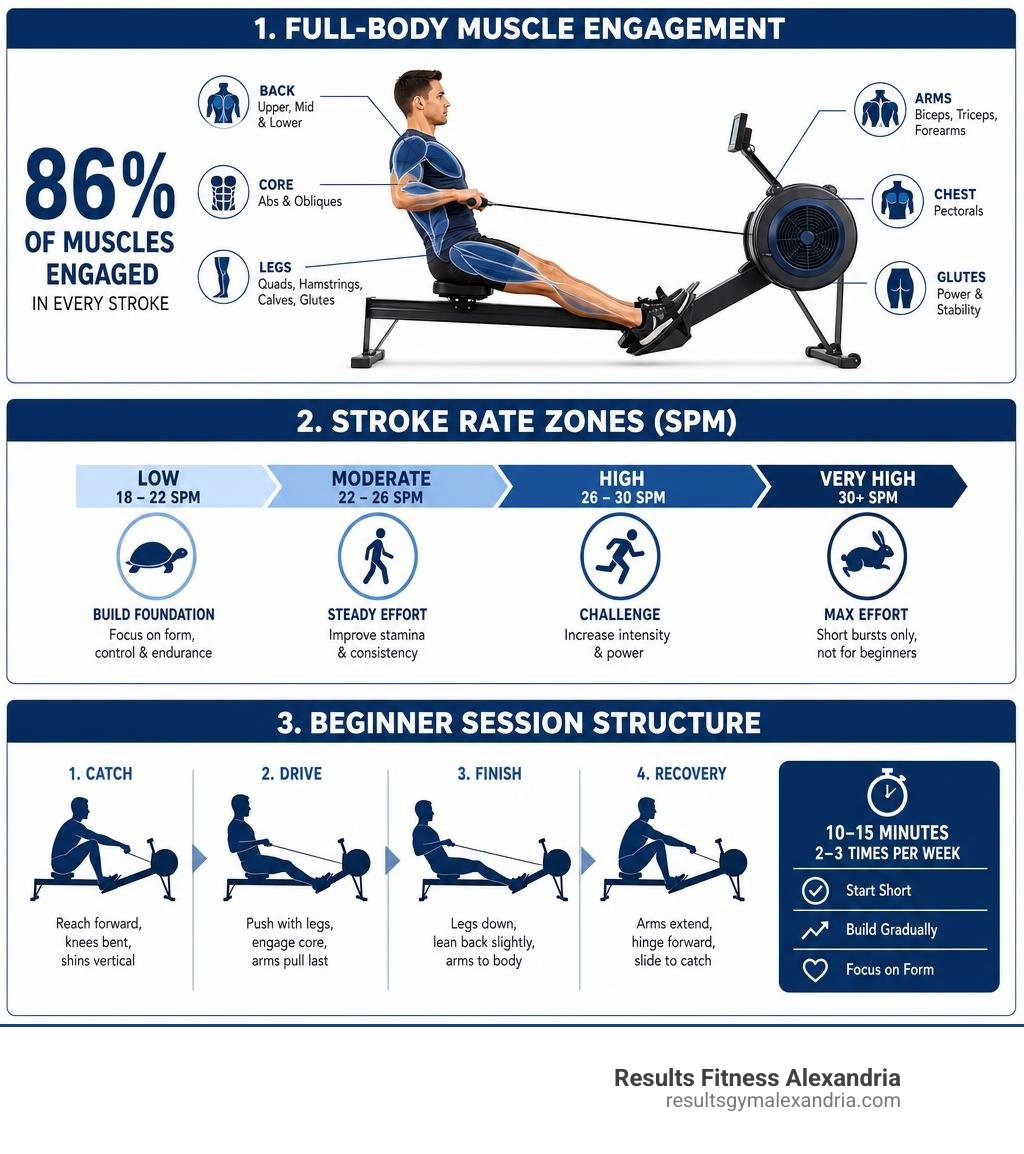
- Start short — 10 to 15 minutes per session, 2 to 3 times per week
- Keep your stroke rate low — aim for 18 to 22 strokes per minute (SPM) while learning
- Follow the four-stroke sequence — catch, drive, finish, recovery
- Focus on form first — power and speed come later
- Build gradually — add 2 to 3 minutes per session each week as you get stronger
The rowing machine is one of the most overlooked pieces of equipment in any gym. Yet it engages 86% of the body’s muscles in a single motion — combining cardio and strength training in one low-impact movement. Whether your goal is weight loss, endurance, or simply getting more active, the rower delivers.
Unlike a treadmill, it doesn’t beat up your knees. Unlike an isolated weight machine, it works your entire body at once. It does have a slight learning curve — but once you get it, it’s an incredibly rewarding workout.
I’m Jennifer Rapchak, Fitness Director at Results Fitness Alexandria and a certified personal trainer with over 14 years of experience designing beginner rower workouts and full-body fitness programs. In this guide, I’ll walk you through everything you need to get started safely and confidently.
Important beginner rower workouts terms:
The Core Benefits of Rowing Machine Workouts
If you are looking for an exercise that gives you the absolute most bang for your buck, look no further than the indoor rower. Many beginners walk past the rowing machine in the cardio section because it looks intimidating or complicated. However, taking the time to learn this machine will completely transform your fitness routine.
First and foremost, rowing is a cardiovascular powerhouse. According to a landmark 2023 study, 12 weeks of consistent indoor rowing significantly improves cardiorespiratory fitness. By utilizing both your upper and lower body simultaneously, your heart and lungs have to work extra hard to pump oxygen-rich blood to all of those active muscles. This leads to a highly efficient cardiovascular workout that helps lower the risk of heart disease, stroke, and diabetes.
Second, the muscular activation is unmatched. While cycling focuses heavily on your legs and running pounds your lower joints, rowing distributes the work across almost your entire body. Specifically, the movement is powered 55% by your legs (quadriceps, hamstrings, and glutes), 20% by your core (rectus abdominis, obliques, and lower back), and 25% by your upper body (latissimus dorsi, rhomboids, shoulders, and biceps). This balanced distribution means you are building lean muscle and strength while getting a fantastic cardio burn.
Another massive benefit for beginners is joint protection. Because you are seated and your feet are strapped securely into footplates, rowing is a completely zero-impact exercise. There is no hard pavement pounding your knees, hips, or ankles. This makes it an ideal choice for anyone recovering from an injury, carrying extra body weight, or looking to protect their joints as they age.
Finally, the calorie expenditure is highly efficient. A moderate-to-vigorous rowing workout can burn between 400 and 600 calories per hour depending on your body weight and effort level. Because it recruits so many muscle groups at once, it creates a massive metabolic demand, helping you burn calories during and even after your workout. To discover more about how this translates to your daily routine, check out our guide on Row Row Row Your Way to Fitness with These Incredible Rowing Machine Benefits.
Mastering the Four Stages of the Rowing Stroke
Before you start pulling the handle as fast as you can, we need to talk about technique. Unlike a treadmill where you just press “start” and walk, the rowing machine requires a specific movement pattern. Think of learning to row like learning to ride a bike: it takes a little focus at first, but once the muscle memory kicks in, it becomes second nature.
The golden rule of the rowing stroke is the sequence: Legs, Body, Arms on the way back, and Arms, Body, Legs on the way forward.
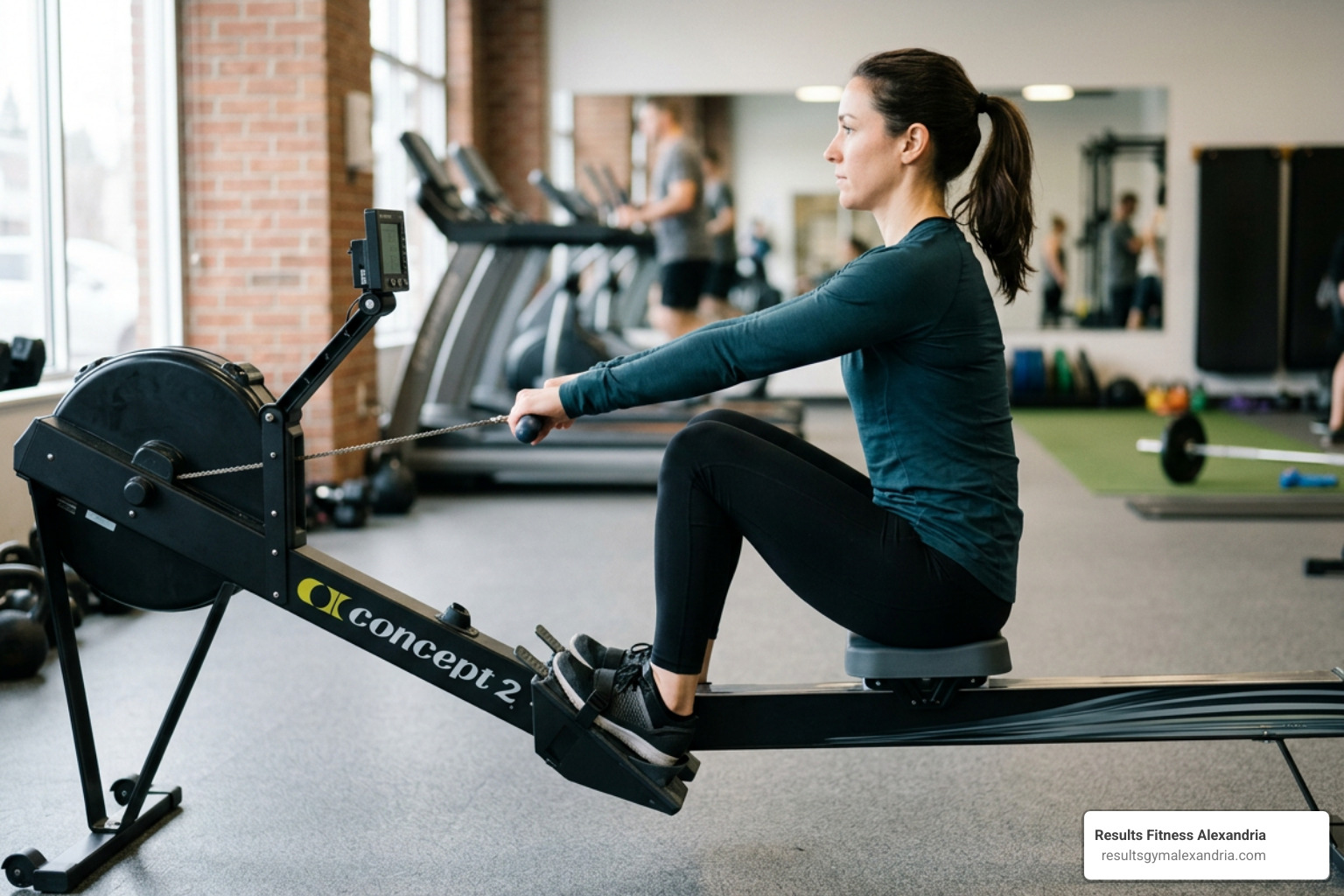
Let’s break down the four distinct phases of the rowing stroke:
1. The Catch (The Starting Position)
Sit tall with your spine neutral, shoulders relaxed and down (never hunched). Slide forward on the seat until your shins are vertical. Your arms should be completely straight, reaching forward toward the flywheel. Your torso should have a slight forward tilt from the hips, roughly at an “11 o’clock” position if you imagine a clock face. Keep your grip relaxed on the handle—do not squeeze it with a death grip.
2. The Drive (The Power Phase)
The drive is where the work happens. Initiate the movement by pressing powerfully through your legs. Keep your arms straight and your core braced as you push. Once your legs are almost fully extended, hinge your torso backward from the hips to about a “1 o’clock” position. Finally, pull the handle smoothly toward your chest, aiming for the space just below your ribs. Remember: the power comes from your legs first, not your arms!
3. The Finish (The End of the Stroke)
At the finish, your legs are fully extended, your core is engaged to support your slightly leaned-back torso, and the handle is held lightly against your lower chest. Your elbows should be bent and relaxed behind your body, with your wrists flat. This is a brief moment of suspension before you begin the return.
4. The Recovery (The Return Phase)
The recovery is your rest phase, and it should take twice as long as the drive phase. To return to the start, reverse the drive sequence exactly:
- First, extend your arms straight out toward the flywheel.
- Second, hinge your torso forward from the hips to the 11 o’clock position.
- Third, bend your knees and slide the seat forward to return to the catch.
A great way to practice this rhythm is to count to yourself: “One” on the powerful drive, and “Two, Three” on the slow, controlled recovery. If you want to dive deeper into perfecting your form with local experts, you can check out resources like Learn to Row.
Understanding Stroke Rate (SPM) and Key Metrics
When you sit down on a rowing machine, the monitor (often a Concept2 PM5) will display several numbers. For a beginner, this can look like a foreign language. Let’s demystify these metrics so you can track your progress effectively.
The most important metric for controlling your effort is Stroke Rate, measured in SPM (Strokes Per Minute). This is simply how many times you slide up and down the rail in one minute. A common mistake beginners make is thinking that a higher stroke rate always means a better workout. In reality, rowing at a lower stroke rate (18-22 SPM) forces you to focus on leg power and smooth technique.
To help you gauge your effort levels, we use the “talk test” and the table below:
| Stroke Rate (SPM) | Effort Level | Perceived Exertion (Talk Test) | Training Focus |
|---|---|---|---|
| 14 – 18 SPM | Very Light / Easy | Can easily sing or speak in full, uninterrupted sentences | Warm-up, cool-down, and technique drills |
| 18 – 22 SPM | Moderate / Steady | Can talk comfortably but sound like you are actively exercising | Zone 2 aerobic base building and endurance |
| 22 – 26 SPM | Challenging / Hard | Can only speak in short, broken sentences | Tempo rows and aerobic capacity building |
| 26+ SPM | Very Hard / Max | Unable to speak more than a word or two | HIIT intervals and short sprint finishes |
Beyond stroke rate, you will see your Split Time (often written as /500m). This is your pace, representing how long it would take you to row 500 meters at your current intensity. A lower split time means you are moving faster and applying more power. You may also see Watts, which measures the raw power output of each stroke.
When choosing a rower or starting out, look for these essential machine features:
- A clear, adjustable monitor: It should display your time, distance, SPM, and split time clearly at eye level.
- Adjustable foot straps: The strap should cross comfortably over the ball of your foot.
- A smooth seat glider: The seat should slide back and forth without sticking or squeaking.
- An adjustable damper setting: On wind-resistance rowers like the Concept2, the damper controls the airflow to the flywheel. Beginners should always keep this between 3 and 5 to protect their lower back and mimic the feel of a sleek boat on the water.
The Best Beginner Rower Workouts to Build Fitness
Now that you have the technique and metrics down, it is time to put them into practice. The beauty of rowing is its scalability. You do not need to spend hours on the machine to see incredible benefits. In fact, short, structured sessions are far more effective for building your aerobic capacity and stamina safely.
Before starting any new exercise routine, we always recommend consulting with a medical professional to ensure you are cleared for physical activity. Once you are ready, remember to always include a 3-to-5-minute gentle warm-up at 18 SPM to prep your muscles, and a 2-to-3-minute cool-down to let your heart rate recover.
If you are ready to explore structured routines, let’s look at some of our favorite beginner-friendly workouts. You can also view our overall guide on the core Rowing Machine Workout structures.
15-Minute Beginner Rower Workouts for Endurance
A 15-minute session is the perfect starting point to build physical and mental consistency. It is short enough to feel manageable, but long enough to stimulate cardiovascular adaptations.
A fantastic routine to try is the 15-Minute Pyramid Interval:
- Minutes 0-3: Easy warm-up row (18-20 SPM) focusing on a smooth sequence.
- Minutes 3-6: Moderate steady-state row (20-22 SPM). You should be breathing deep but still able to talk.
- Minutes 6-9: Challenging row (22-24 SPM). Focus on pushing harder with your legs, not rushing the slide.
- Minutes 9-12: Moderate steady-state row (20-22 SPM). Keep your form clean as fatigue sets in.
- Minutes 12-15: Easy cool-down row (18 SPM) to lower your heart rate.
This structured pyramid helps you practice shifting gears with your power output. For more short-duration inspiration, read our guide on how to Row Your Way to Fitness in a 10 Minute Rowing Machine Workout or check out the 15-Minute Beginner Rowing Machine Workout to Improve endurance guide.
35-Minute Beginner Rower Workouts for Stamina
Once you have spent a couple of weeks mastering shorter sessions, you can progress to a longer workout to build serious aerobic stamina. This is where we focus on Zone 2 training—maintaining a steady, conversational pace that builds your mitochondrial health and fat-burning efficiency.
A great routine is the 35-Minute Progressive Endurance Session:
- Minutes 0-5: Warm-up. Start at 18 SPM and gradually build to 20 SPM.
- Minutes 5-15: Steady State block 1. Row at a comfortable, consistent pace at 20 SPM. Keep your split time steady.
- Minute 15-17: Active recovery. Row very light at 16-18 SPM, letting your arms and legs move easily.
- Minutes 17-27: Steady State block 2. Return to your consistent pace at 20-22 SPM, trying to match or slightly beat your split time from the first block.
- Minutes 27-30: Power challenge. Increase your stroke rate to 24 SPM for 3 minutes, focusing on strong leg drives.
- Minutes 30-35: Cool-down. Row light at 18 SPM, followed by some light stretching off the machine.
For a structured multi-week plan that helps you build up to these longer distances, you can follow the official Beginner’s Training Plan for Concept2 or read our tips on how to Row Your Heart Out with These 20 Minute Workouts.
High-Intensity Interval Training (HIIT) on the Rower
If you want to boost your anaerobic power and maximize your calorie burn in a short amount of time, HIIT is an incredible tool. Because rowing is low-impact, it is a much safer option for high-intensity intervals than sprinting on a treadmill.
Try this simple 1:1 HIIT Rowing Workout:
- Warm-up: Row easy for 5 minutes, incorporating three 10-stroke “power bursts” to prime your system.
- The Intervals: Perform 6 to 8 rounds of:
- 30 seconds hard: Row at a high intensity (26+ SPM) with powerful leg drives.
- 30 seconds easy: Row very lightly, focusing on slow recovery slides to catch your breath.
- Cool-down: Row easy for 3 minutes.
During the hard intervals, do not sacrifice form for speed. Keep your posture tall and drive through your heels. For more advanced interval strategies, explore our article on How to Rowing Machine Workout 5 Effective Methods.
How to Progress Safely and Avoid Common Mistakes
As a beginner, your primary goal is to build consistency and avoid injury. The most common mistakes we see on the gym floor almost always involve form and progression.

Keep these common errors on your radar so you can avoid them:
- The “Shooting Butt”: This happens when your legs push back, but your handle stays forward, causing your torso to dump over. Make sure your core is braced so your torso and the handle move backward at the exact same time your legs push.
- Hunching the Shoulders: Pulling with hunched shoulders creates massive tension in your neck and upper back. Keep your shoulders relaxed, down, and away from your ears.
- Rushing the Recovery: Sliding forward too fast kills your momentum and wastes energy. The recovery is your rest. Take your time sliding forward!
- Overreaching at the Catch: Do not bend too far forward at the start of the stroke. Your torso should only tilt slightly from the hips (11 o’clock). Overreaching puts unnecessary strain on your lower back.
To progress safely, follow the principle of progressive overload. Do not try to row 5,000 meters on your first day. Instead, start with 2 to 3 sessions per week of 10 to 15 minutes. Increase your weekly volume by no more than 10% each week. For a structured, progressive approach, you can download the official BEGINNER TRAINING PLAN from British Rowing.
Frequently Asked Questions About Beginner Rowing
We receive many questions from new rowers at our Alexandria gym. Here are some of the most common queries to help you on your journey.
How often should a beginner use a rowing machine?
For true beginners, we recommend rowing 2 to 3 times per week, with at least one rest day between sessions. This gives your muscles, joints, and connective tissues time to adapt to the new movement pattern. As your fitness improves, you can safely increase this to 4 or 5 times per week, making sure to balance high-intensity days with easy, steady-state recovery rows.
What is a good damper setting for beginners?
A common misconception is that a damper setting of 10 provides the “best” workout. In reality, a setting of 10 creates a heavy, sluggish feel that can easily strain your lower back if your technique isn’t perfect. For beginners, we highly recommend keeping the damper setting between 3 and 5 (or a drag factor of roughly 110-120 on a Concept2 monitor). This setting best mimics the feel of a fast, light boat gliding across clean water and allows you to focus on quick, powerful leg drives.
How does rowing compare to running or cycling?
Rowing is unique because it combines the best elements of both running and cycling. Like cycling, it is completely low-impact and joint-friendly. However, while cycling is primarily a lower-body exercise, rowing engages your entire upper body and core. Compared to running, rowing provides a comparable cardiovascular and caloric burn but without the high-impact stress on your knees and ankles. It is truly the ultimate full-body, low-impact exercise.
Conclusion
Starting your rowing journey is one of the best investments you can make in your long-term health and fitness. By engaging 86% of your muscles, protecting your joints, and building incredible cardiovascular stamina, the rowing machine is a tool that will serve you for years to come.
The secret to rowing success is simple: form first, power second, speed third. Take your time, enjoy the process, and focus on the smooth rhythm of the stroke.
If you are located in Alexandria, Virginia, and want personalized guidance on your rowing form or fitness routine, we would love to help you at Results Fitness Alexandria. We offer expert personal training, exciting fitness classes, yoga, and convenient childcare to support your busy lifestyle.
We invite you to claim a free 1-day pass to experience our welcoming community and try out our top-tier cardio equipment firsthand. Come visit us and explore our Results Fitness Cardio Amenities to kickstart your fitness journey today!