Best Rowing Workouts for Beginners to Build Fitness Fast
Why the Best Rowing Workouts for Beginners Are Worth Your Time
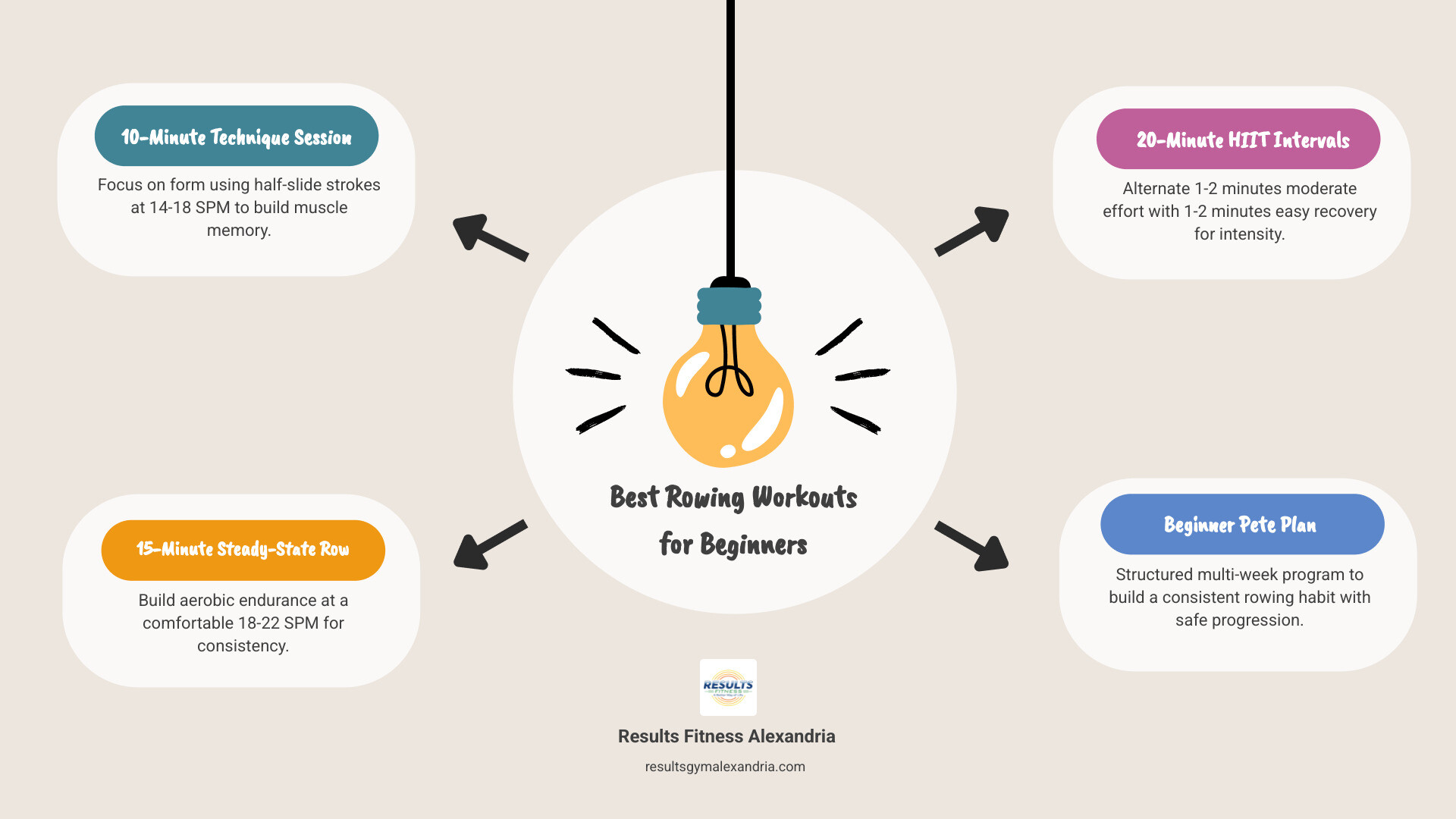
The best rowing workouts for beginners are short, structured sessions that build fitness without beating up your joints. Here’s a quick look at what works:
Top Beginner Rowing Workouts at a Glance:
- 10-Minute Technique Session – Focus on form using half-slide strokes at 14-18 SPM
- 15-Minute Steady-State Row – Build aerobic endurance at a comfortable 18-22 SPM
- 20-Minute HIIT Intervals – Alternate 1-2 minutes of moderate effort with 1-2 minutes of easy recovery
- Beginner Pete Plan – A structured multi-week program for building a consistent rowing habit
Rowing is one of the most beginner-friendly cardio options available. It’s low-impact, so it’s gentle on your knees and hips. And it works nearly every major muscle group — legs, core, back, and arms — all in one movement.
That said, most beginners sit down on the machine and have no idea where to start. How fast should you row? What do the numbers on the screen mean? How long should your session be?
This guide answers all of that — clearly and without the jargon.
My name is Jennifer Rapchak, Fitness Director at Results Fitness Alexandria and a certified personal trainer with over 14 years of experience designing programs just like these. I’ve helped countless clients discover the best rowing workouts for beginners and build real, lasting fitness from the ground up, and this guide distills everything I know into a simple, actionable plan you can start today.
Best rowing workouts for beginners terms to know:
Understanding Rowing Benefits, Machine Setup, and Proper Form
Before we strap our feet in, we need to understand why the rowing machine (often called an “erg” or ergometer) is such an incredible tool. Unlike running on a treadmill, which can be tough on your joints, indoor rowing is incredibly low-impact. Yet, it engages roughly 86% of your body’s muscle mass. By utilizing your legs, core, back, and arms simultaneously, you get a highly efficient strength and cardiovascular workout in a fraction of the time.
Discovering these row row row your way to fitness with these incredible rowing machine benefits is often the catalyst that turns fitness newcomers into lifelong rowers.
To make the most of your time on the erg, we must first look at how to set up the machine.
Setting Up Your Machine for Success
- The Monitor: Adjust the performance monitor so it sits at eye level. This prevents you from straining your neck during long sessions.
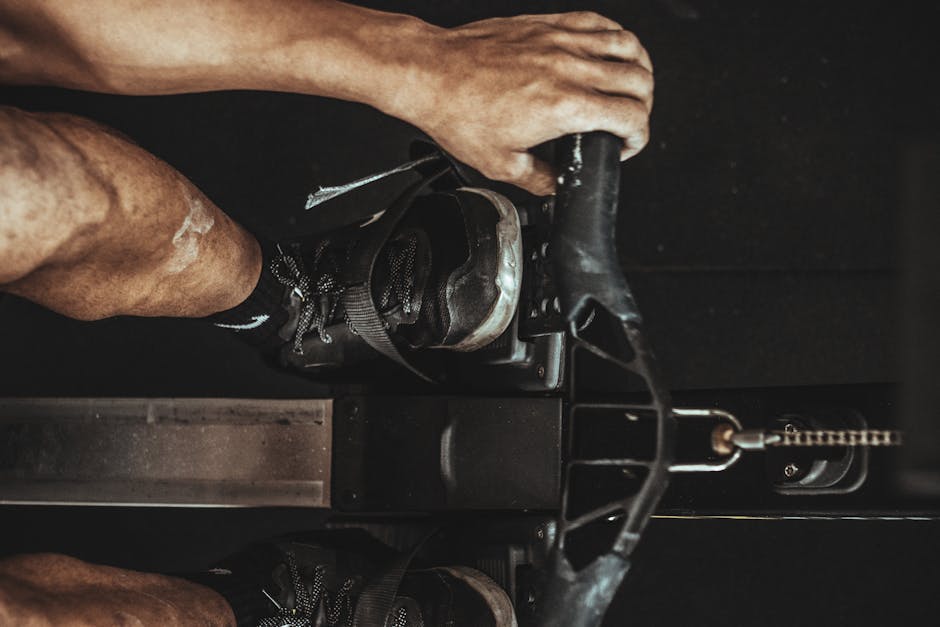
- The Foot Straps: Adjust the heel cups so the strap crosses directly over the widest part of your foot (the ball of your foot). Secure them tightly so your feet don’t slide around.
- The Damper Setting: The lever on the side of the flywheel housing is the damper, not a resistance dial. Cranking it to 10 is a classic beginner mistake. For beginners, we highly recommend keeping the damper set between 3 and 5. This allows you to focus on smooth, powerful movements without overloading your muscles too early.
Cracking the Monitor Metrics
When you look at the screen, you will see three key metrics:
- Stroke Rate (SPM): Located in the corner of the monitor, this is your “Strokes Per Minute.” Think of it as your cadence. For beginners, a good starting stroke rate is 18–24 SPM.
- Split Time (or /500m): This is your pace—specifically, how long it would take you to row 500 meters at your current effort level. A lower split time means you are rowing faster and generating more power.
- Watts: This measures your instantaneous power output. Tracking watts is a fantastic way to see how much force you are generating with your legs.
To truly understand how these numbers interact, check out the complete beginner guide to rowing machine workouts.
Mastering the Four Phases of the Stroke
To row efficiently and protect your lower back, you must master the proper sequencing. We use the simple cue sequence: Legs, Body, Arms on the way back, and Arms, Body, Legs on the way forward.
- The Catch: This is the starting position. Your knees are bent, your shins are vertical, your arms are straight, and your torso is hinged slightly forward from the hips.
- The Drive: This is the work phase. Initiate the movement by pushing forcefully with your legs. Once your legs are fully extended, hinge your torso backward slightly, and finally, pull the handle to your lower ribs.
- The Finish: Your legs are flat, your core is engaged, and you are leaning back slightly (think of an 11 o’clock position on a clock face). The handle is held lightly against your chest.
- The Recovery: This is the rest phase, and it should take twice as long as the drive (a 1:2 drive-to-recovery ratio). Extend your arms first. Once they are straight, hinge your torso forward from the hips. Only when the handle clears your knees should you bend your legs to slide back to the catch.
To keep your spine safe and ensure you aren’t making critical errors, refer to the ultimate rowing form checklist avoid these common mistakes before your first hard pull.
The Best Rowing Workouts for Beginners
Now that you have your form dialed in, let’s look at how to structure your training. Beginners often wonder about the difference between interval training and steady-state rowing.
- Steady-State Rowing: This involves rowing at a continuous, moderate pace for an extended period. It is the cornerstone of building an aerobic base and improving cardiovascular endurance.
- Interval Training (including HIIT): This alternates periods of high-intensity effort with periods of active recovery or rest. It is incredible for burning calories, boosting lung capacity, and building power.
For a deeper dive into how to balance these styles, read about workouts on a rowing machine from steady state to high intensity.
If you are ready to jump onto the machine today, here are three highly effective, copy-and-paste beginner templates. For more ideas, you can also explore these rowing machine workouts: 7 templates for beginners to intermediates – rowing machine .
10-Minute Technique Session: The Best Rowing Workouts for Beginners to Start
When you are brand new, your primary goal is building muscle memory. This short session isolates the phases of the stroke so you can learn proper sequencing without physical exhaustion.
- Warm-Up (2 minutes): Row easily at 14–16 SPM, focusing on a relaxed grip and keeping your shoulders down away from your ears.
- Technique Drill (5 minutes):
- Spend 1 minute doing arms-only rowing (legs straight, torso still).
- Spend 1 minute doing arms and body rowing (legs straight, swing from the hips).
- Spend 3 minutes doing half-slide strokes (only rolling the seat halfway up the slide). Focus on driving purely with the legs.
- Cool-Down (3 minutes): Row at an easy, conversational pace at 18 SPM.
This quick routine is the perfect way to build confidence. If you want to expand on this short-duration style, try our guide on how to row your way to fitness in a 10-minute rowing machine workout.
15-Minute Steady-State: The Best Rowing Workouts for Beginners to Build Endurance
This workout is designed to build your aerobic base. The goal here is consistency—keeping your split times and stroke rate as steady as possible throughout the entire session.
- Warm-Up (3 minutes): Gradually build your stroke rate from 16 to 18 SPM.
- Steady Row (10 minutes): Maintain a comfortable, conversational pace at 18–22 SPM. You should be working hard enough to sweat, but still able to speak in short sentences (the “talk test”).
- Cool-Down (2 minutes): Light paddling at 14–16 SPM to let your heart rate come down gradually.
For additional tips on pacing your steady-state sessions safely, check out the resources over at best beginner rowing workout for new rowers – airkayaks .
20-Minute HIIT Interval Workout
If you want to maximize your cardiovascular conditioning in a short window, high-intensity interval training (HIIT) is the answer. By alternating hard sprints with recovery, you push your heart rate up and burn calories efficiently.
- Warm-Up (5 minutes): Start light and include three 15-second “power bursts” at the end of the warm-up to prepare your muscles.
- HIIT Intervals (10 minutes):
- Row hard for 1 minute at 22–26 SPM (aiming to drop your split time by 5–10 seconds compared to your steady-state pace).
- Row very lightly for 1 minute for active recovery.
- Repeat this 1:1 cycle for a total of 5 rounds.
- Cool-Down (5 minutes): Easy paddling at 16 SPM, followed by some light stretching off the machine.
For more interval structures and to see how to scale this up as you get stronger, check out these Concept2 RowErg beginner workouts 2026: easy starter sessions or explore our collection of row your heart out with these 20-minute workouts.
A 4-Week Weekly Training Plan for Safe Progression
To see real changes in your cardiovascular health and muscle tone, you need a structured plan. The American Heart Association recommends getting at least 150 minutes of moderate cardiovascular exercise per week. While you won’t hit that on the rowing machine alone in week one, a progressive plan will help you safely build up your volume.
We recommend starting with either a 3-day or 4-day weekly plan. Always include at least one rest day between rowing sessions to allow your muscles and joints to recover.
Here is a simple comparison of how to structure your weeks:
| Week | 3-Day Weekly Plan | 4-Day Weekly Plan | Progression Focus |
|---|---|---|---|
| Week 1 | • Day 1: 10-Min Technique • Day 2: 15-Min Steady-State • Day 3: 10-Min Technique |
• Day 1: 10-Min Technique • Day 2: 15-Min Steady-State • Day 3: 10-Min Technique • Day 4: 15-Min Steady-State |
Establishing proper sequencing and building a basic routine. |
| Week 2 | • Day 1: 15-Min Steady-State • Day 2: 20-Min HIIT Intervals • Day 3: 15-Min Steady-State |
• Day 1: 15-Min Steady-State • Day 2: 20-Min HIIT Intervals • Day 3: 15-Min Steady-State • Day 4: 20-Min HIIT Intervals |
Introducing controlled intensity and monitoring split consistency. |
| Week 3 | • Day 1: 20-Min Steady-State • Day 2: 20-Min HIIT Intervals • Day 3: 20-Min Steady-State |
• Day 1: 20-Min Steady-State • Day 2: 20-Min HIIT Intervals • Day 3: 20-Min Steady-State • Day 4: 20-Min HIIT Intervals |
Increasing steady-state volume while maintaining good posture. |
| Week 4 | • Day 1: 20-Min Steady-State • Day 2: 25-Min Interval Mix • Day 3: 20-Min Steady-State |
• Day 1: 20-Min Steady-State • Day 2: 25-Min Interval Mix • Day 3: 20-Min Steady-State • Day 4: 25-Min Interval Mix |
Testing your endurance and preparing for longer continuous rows. |
As you progress, you might want to look into highly respected community programs like the Beginner Pete Plan, which systematically scales up your distance over several weeks.
To learn more about how to design a balanced routine that prevents burnout, take a look at our guides on creating an effective workout routine for beginners and building cardio endurance for beginners.
Common Rowing Mistakes and How to Avoid Them
Rowing is exceptionally safe, but sloppy technique can put unnecessary stress on your lower back. Keep an eye out for these four common beginner mistakes:
- Shooting the Hips: This happens when you push your legs flat, but your upper body remains slumped forward. Your seat moves backward, but the handle stays in place. To fix this, ensure your core is engaged and your torso hinges back in unison with your leg drive.
- Early Arm Bend: Many beginners try to pull the handle with their arms before their legs have finished driving. 60% of your power comes from your legs, 20% from your core, and only 20% from your arms. Keep your arms straight until your legs are fully extended.
- Cranking the Damper to 10: Setting the damper too high mimics pulling a heavy weight. It fatigues your muscles before your cardiovascular system gets a proper workout, leading to poor form and lower back strain. Keep it between 3 and 5.
- Bending the Knees Too Early: On the recovery phase, if you bend your knees before your arms have fully extended forward, you will have to lift the handle over your knees. This disrupts your rhythm. Keep your knees pressed flat until the handle has cleared them.
Frequently Asked Questions About Beginner Rowing
What stroke rate should beginners aim for?
Beginners should aim for a stroke rate of 18 to 24 strokes per minute (SPM). It is a common misconception that a faster stroke rate automatically means a better workout. In fact, keeping your stroke rate lower (around 20 SPM) forces you to drive harder with your legs and control your slide on the recovery, which is highly effective for building both power and cardiovascular endurance.
Is it okay to row every day as a beginner?
While rowing is low-impact, we do not recommend rowing every day when you are starting out. Your muscles, tendons, and lower back need time to adapt to the unique repetitive motion. Start with 3 to 4 sessions per week, and always listen to your body. If you feel muscle soreness, that is normal; if you feel joint or lower back pain, take a rest day.
What damper setting should I use?
We recommend a damper setting of 3 to 5 on a Concept2 machine (which corresponds to a moderate drag factor). This setting provides the most realistic feel of being on the water and allows you to focus on executing smooth, powerful leg drives without overloading your back muscles.
Conclusion
Finding the best rowing workouts for beginners is all about starting small, focusing on proper form, and gradually building your endurance. Whether you are looking to lose weight, build stamina, or find a joint-friendly alternative to running, the rowing machine is one of the most powerful tools in the gym.
At Results Fitness Alexandria, we are dedicated to helping you master your form and reach your fitness goals safely. Our expert personal trainers are always on hand to check your rowing technique, and our dynamic fitness classes are designed to keep you motivated and moving.
Ready to experience the difference for yourself? We invite you to claim a free 1-day pass to try our premium cardio amenities, explore our strength training equipment, and meet our community. Stop by our Alexandria, Virginia location today and let’s get rowing!