Bounce Into Fitness with These Simple Swiss Ball Exercises
The Easiest Way to Build Core Strength, Balance, and Stability
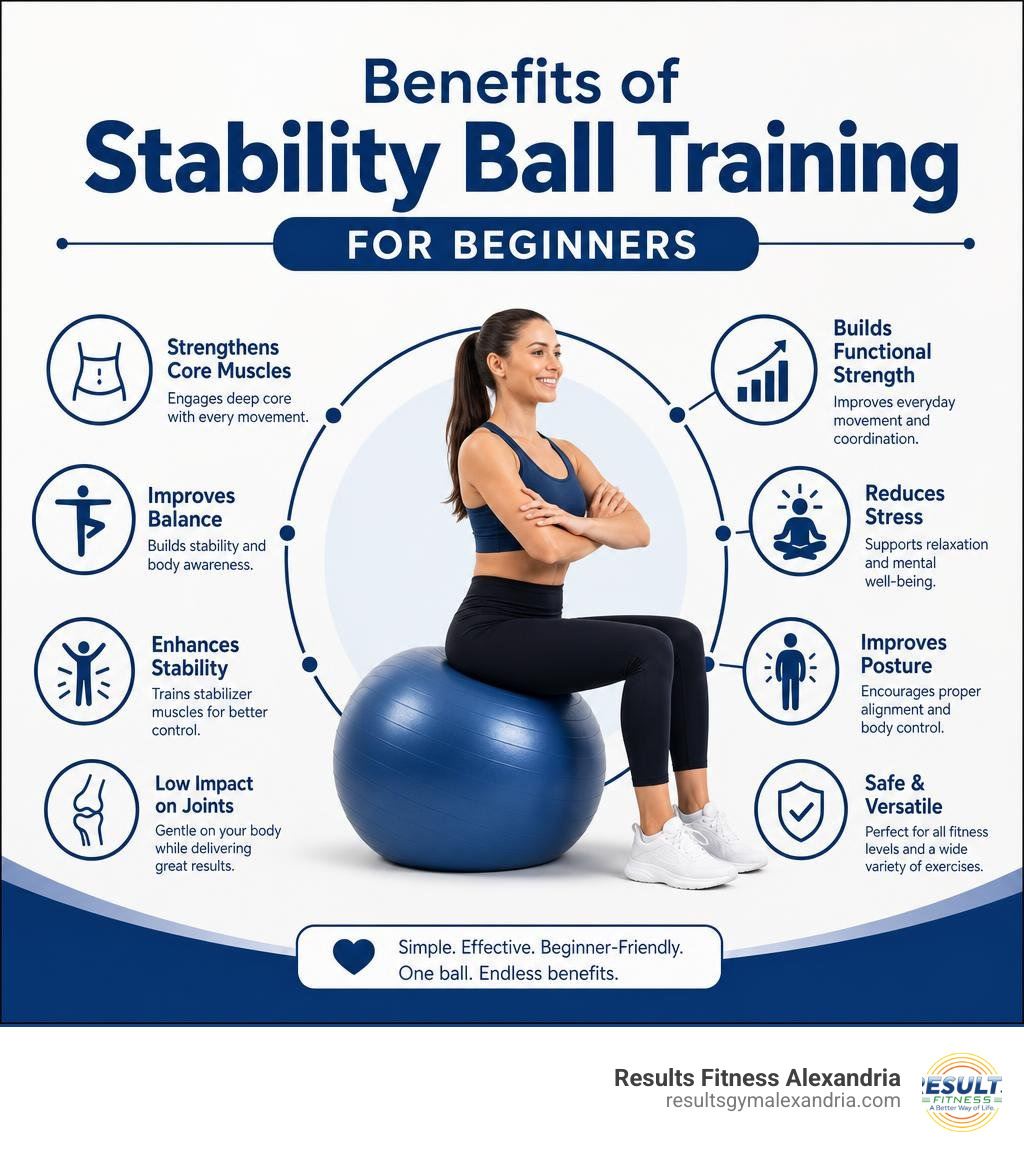
Yoga ball exercises for beginners are one of the most accessible ways to build core strength, improve balance, and protect your joints — all with a single piece of equipment.
Here are the best beginner yoga ball exercises to get started:
- Seated balance hold — sit upright on the ball and lift one foot at a time
- Ball circles — sit on the ball and slowly rotate your hips in circles
- Seated marches — alternate lifting knees while seated on the ball
- Wall squats — place the ball between your lower back and a wall, then squat
- Glute bridge — lie on your back with heels on the ball and lift your hips
- Stability ball crunch — roll back slightly on the ball and crunch upward
- Ball plank hold — place forearms on the ball and hold a straight-body position
- Back extension — lie face-down over the ball and lift your chest
What makes the yoga ball so effective is simple: the unstable surface forces your deeper stabilizer muscles to engage with every single movement — muscles that most traditional exercises completely miss.
You don’t need a gym membership, a full hour, or any prior fitness experience. Even 10–15 minutes a few times a week can produce real, noticeable results in your strength and posture.
I’m Jennifer Rapchak, Fitness Director at Results Fitness Alexandria and a certified personal trainer with over 14 years of ACE-certified experience designing programs that include yoga ball exercises for beginners as a foundational tool for core conditioning and balance training. Everything in this guide is built on what I’ve seen work for real people at every fitness level.
Common yoga ball exercises for beginners vocab:
What is a Swiss Ball and How Does It Benefit Beginners?
A Swiss ball — also known as a yoga ball, stability ball, or exercise ball — was originally developed in 1963 by an Italian toy maker and later used in Switzerland for pediatric physical therapy. Today, it is one of the most versatile and joint-friendly tools in the fitness world.
For beginners, the primary benefit of Swiss ball training is how it targets stabilizer muscles. Unlike traditional floor exercises, which rely on a stable surface, the inherent instability of a ball forces your body to constantly make micro-adjustments. This active stabilization recruits deep core muscles, such as the transverse abdominis and multifidus, which support your spine and pelvis.
Additionally, scientific research highlights that improved balance is directly correlated with athletic performance and injury prevention. In fact, studies show that structured stability training can reduce overall injury risk by up to 50%. Improved postural stability and symmetrical body alignment have been directly measured in training programs utilizing stability balls, making them ideal for correcting postural imbalances.
For those looking to build flexibility and joint mobility safely, the low-impact nature of the ball reduces pressure on the knees, hips, and lower back. It acts as a supportive cushion, making it highly accessible if you are returning to fitness or managing joint stiffness. To understand how this fits into a broader wellness plan, you can read about how yoga can help improve your flexibility.
To learn more about how stability training translates to overall functional strength, check out the resources at 9 Beginner Yoga Ball Exercises for Balance & Stability.
How to Choose the Right Size and Type of Yoga Ball
Using a yoga ball that is too large or too small is like wearing shoes that don’t fit — it compromises your form and increases your risk of slipping. When selecting a ball, the golden rule is the 90-degree angle rule: when you sit upright on the ball with your feet flat on the floor, your hips and knees should form a clean 90-degree angle, with your thighs parallel to the ground.
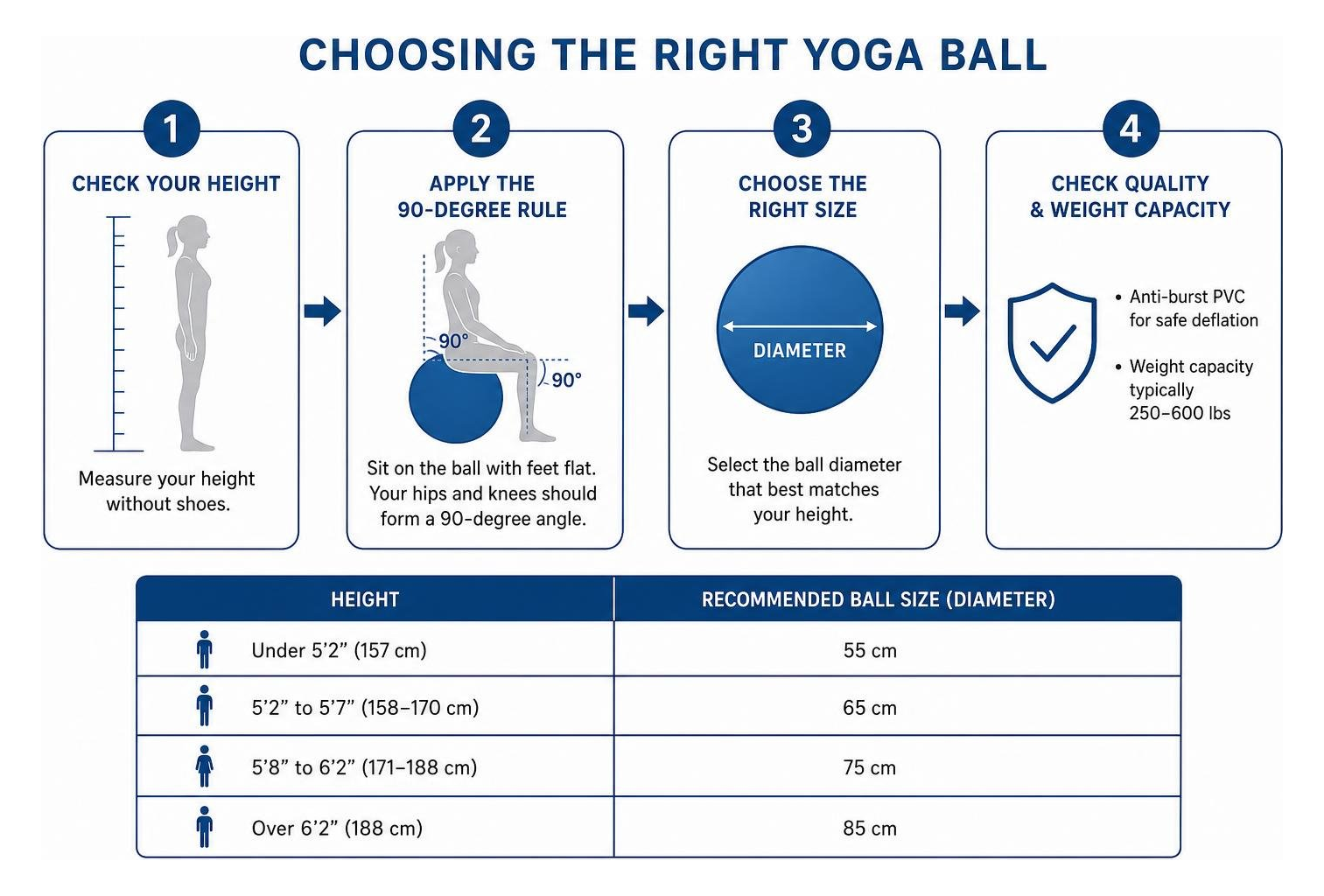
When shopping for a ball, always look for anti-burst PVC material. High-quality balls are designed to deflate slowly and safely if they are punctured, rather than popping suddenly like a balloon. Standard balls are typically rated to hold between 250 lbs and 600 lbs, so check the manufacturer guidelines to ensure it fits your needs.
Here is a quick reference table to help you choose the right ball diameter based on your height:
| Height | Recommended Ball Size |
|---|---|
| Under 5’1″ (155 cm) | 45 cm |
| 5’1″ to 5’7″ (155 – 170 cm) | 55 cm |
| 5’8″ to 6’1″ (173 – 185 cm) | 65 cm |
| Over 6’1″ (185 cm) | 75 cm |
Proper inflation is also key. If the ball is over-inflated, it will feel rock-hard and roll away too quickly, making balance incredibly difficult. If it is under-inflated, it will sink like a beanbag, reducing the instability that makes the exercises effective. Aim for a firm but slightly yielding feel. For a deeper dive into selecting and setting up your equipment, refer to Yoga Ball Workouts For Beginners: A Complete Guide – RevivoHub.
The Best Yoga Ball Exercises for Beginners to Build Core Strength
Building core strength is not just about getting a visible six-pack; it is about creating a stable, supportive shield around your spine. The core includes your abdomen, lower back, obliques, and glutes. By incorporating yoga ball exercises for beginners, you train these muscle groups to work in harmony, improving pelvic alignment and reducing everyday aches.
Research shows that gluteal muscle activation during squatting exercises increases significantly when performed with a Swiss ball compared to traditional squats. This means you get more lower-body and core engagement with less joint strain.
Seated Yoga Ball Exercises for Beginners to Improve Balance
If you are brand new to stability training, starting with seated exercises is the perfect way to build confidence and familiarize yourself with the unstable surface.
- Ball Circles: Sit tall on the ball with your feet flat on the floor, hip-width apart. Engage your core and place your hands on your thighs. Slowly rotate your pelvis in a circular motion to the right for 15–20 repetitions, then switch to the left. Keep your upper body relatively still, allowing the movement to originate from your hips.
- Seated Marches: While sitting upright, slowly lift your right heel off the ground, then progress to lifting your entire right foot a few inches. Lower it with control and repeat on the left side. Continue alternating for 1–2 minutes. You can hold onto a wall or a sturdy chair for balance if needed.
- Seated Balance Hold: Sit tall, engage your abdomen, and slowly extend one leg straight out in front of you. Hold this position for 5 to 10 seconds before lowering your foot. Perform 5–10 repetitions on each side.
These gentle movements are excellent preparation for dynamic activities. For those transitioning into structured studio classes, our guide on Yoga for Newbies: What to Expect in Your First Session offers great complementary advice.
Core-Targeted Yoga Ball Exercises for Beginners
Once you feel comfortable sitting on the ball, you can move on to exercises that directly challenge your abdominal wall and deep core stabilizers.
- Stability Ball Crunches: Sit on the ball and slowly walk your feet forward until the ball supports your lower back. Place your hands lightly behind your head or crossed over your chest. Exhale, contract your abs, and lift your upper torso to about a 45-degree angle. Lower back down slowly. Aim for 2–3 sets of 10–12 repetitions.
- The Deadbug (Ball Variation): Lie on your back on a flat mat. Place the yoga ball between your knees and your hands, squeezing it gently. Slowly lower your right arm behind you and extend your left leg straight out toward the floor, keeping your lower back pressed flat. Return to the starting position and repeat with the opposite arm and leg.
- Ball Plank Hold: Place the ball near a wall for safety. Place your forearms on the ball, step your feet back into a plank position, and hold your body in a straight line from head to heels. Engage your core and hold for 20–30 seconds.
For a way to put these moves together, check out the 15-Minute Yoga Ball Workout | Sunny Health & Fitness.
Lower Body and Back Support Exercises
The stability ball is incredibly effective for strengthening the glutes, hamstrings, and lower back while keeping the movements low-impact.
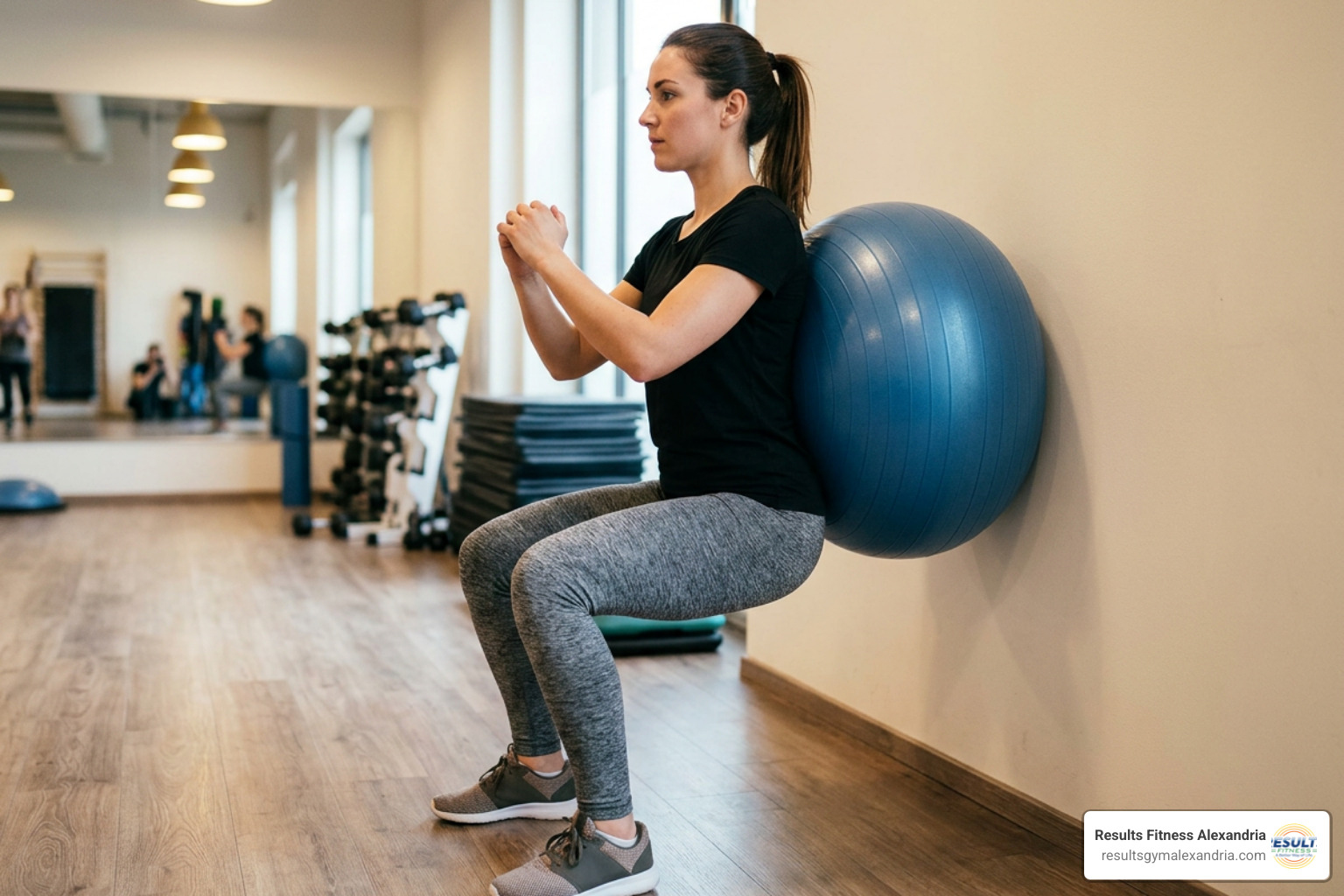
- Wall Squats: Place the ball between your lower back and a wall. Step your feet forward slightly, shoulder-width apart. Slowly lower your hips into a squat, keeping your weight in your heels and ensuring your knees do not drift past your toes. Press through your heels to return to standing. Perform 3 sets of 12–15 reps.
- Glute Bridges: Lie on your back on a mat with your knees bent and your heels resting on top of the ball. Press your heels into the ball, squeeze your glutes, and lift your hips toward the ceiling until your body forms a straight line. Hold for a second at the top, then lower with control. Perform 3 sets of 10–12 reps.
- Back Extensions: Kneel on the floor and lean your stomach and pelvis over the ball. Anchor your feet against a wall for support. Place your hands behind your head or by your sides, and slowly lift your chest off the ball, focusing on squeezing your lower back and glutes. Avoid hyperextending your neck. Perform 10–12 repetitions.
Here is a quick-reference list of beginner-friendly lower body exercises to add to your routine:
- Wall-assisted squats (focuses on quads and glutes)
- Stability ball glute bridges (targets hamstrings and lower back)
- Ball-supported lunges (improves single-leg stability)
- Seated leg presses (gentle on knee joints)
Safety Tips and Common Mistakes to Avoid
To get the most out of your training and prevent unnecessary slips or strains, keep these safety practices in mind:
- Use a Non-Slip Surface: Always practice on a yoga mat, carpet, or rubber gym flooring. Avoid smooth tile or polished wood floors, which can cause the ball to slide out from under you.
- Utilize Wall Support: When trying seated balance holds or planks for the first time, perform them near a wall or sturdy couch so you have a quick handhold if you lose your balance.
- Maintain a Neutral Spine: Avoid rounding your shoulders or letting your lower back sag during planks and crunches. Keep your spine aligned like a gentle, natural curve.
- Avoid Over-Inflation: A ball inflated to the point of being rock-hard will roll unpredictably and reduce traction.
- Never Skip Your Warm-Up: Spend 3–5 minutes doing light shoulder circles, gentle standing twists, or seated ball marches before diving into more challenging core exercises.

Learning to move mindfully is a skill that translates beautifully across all disciplines. If you appreciate precise alignment and form correction, you can learn more about how to master the basics with Iyengar yoga.
Frequently Asked Questions About Swiss Balls
Can I use a yoga ball if I have back pain?
Yes, when used correctly, a stability ball can be highly beneficial for back pain. The gentle instability naturally activates the deep core muscles that support the spine, taking pressure off your lower back. However, always consult with your doctor or physical therapist before starting, and immediately stop any exercise that causes sharp pain. For those looking to manage stress and physical tension holistically, explore The Ultimate Guide to Yoga for Anxiety and Stress Relief.
How often should a beginner use an exercise ball?
For beginners, we recommend using an exercise ball 2 to 3 times per week. This frequency allows your stabilizer muscles to adapt and grow stronger while giving them adequate rest to recover. As you build strength, you can easily integrate these movements into a daily mobility routine. To see how to combine stability work with overall body conditioning, look at The Best Beginner Yoga Routine for Strength and Flexibility.
Can I use a yoga ball as an office chair?
Using a yoga ball as an office chair is a great way to promote active sitting. Because the ball is unstable, your core and back muscles must engage continuously to keep you upright, which can prevent slouching. However, avoid sitting on it for an entire 8-hour workday right away. Start with 15–30 minutes at a time to prevent muscle fatigue, and gradually increase as your endurance improves.
Conclusion
Incorporating yoga ball exercises for beginners into your fitness journey is an incredibly rewarding, low-impact way to build a stronger core, improve your posture, and boost your daily balance. Whether you are using it at home or inside a professional training facility, consistency is the key to unlocking these long-term benefits.
At Results Fitness Alexandria, we are dedicated to helping our community move better, feel stronger, and live healthier lives. Located right here in Alexandria, Virginia, we offer comprehensive amenities, expert personal training, and highly supportive programs designed for every fitness level.
Ready to experience the difference for yourself? We invite you to claim a free 1-day pass to try out our facilities, meet our trainers, and explore our diverse classes. Check out our group fitness classes and take the first step toward a stronger, more balanced you today!