No Crunches, No Problem: Your Go-To Starter Ab Workout
Why a Starter Ab Workout Is the Best First Step for a Stronger Core
If you’ve been putting off core training because you don’t know where to begin, a starter ab workout is exactly what you need to build real strength — no experience required.
Here are the best beginner ab exercises to get you started:
- Deadbug – Lie on your back, arms up, knees bent at 90°. Lower opposite arm and leg slowly. Great for lower back safety.
- Bird Dog – From all fours, extend opposite arm and leg. Builds balance and core stability.
- Forearm Plank – Hold a straight line from head to heels on your forearms. Start with 20-30 seconds.
- Supported Side Plank – Drop your bottom knee down for support. Targets the obliques without strain.
- Bear Plank Hold – On all fours, hover knees just off the floor. Engages deep core muscles hard.
How to use these exercises:
- Do 2-3 exercises per session
- Work for 30-40 seconds, rest 15-20 seconds
- Train 1-3 times per week
- Rest at least 24 hours between sessions
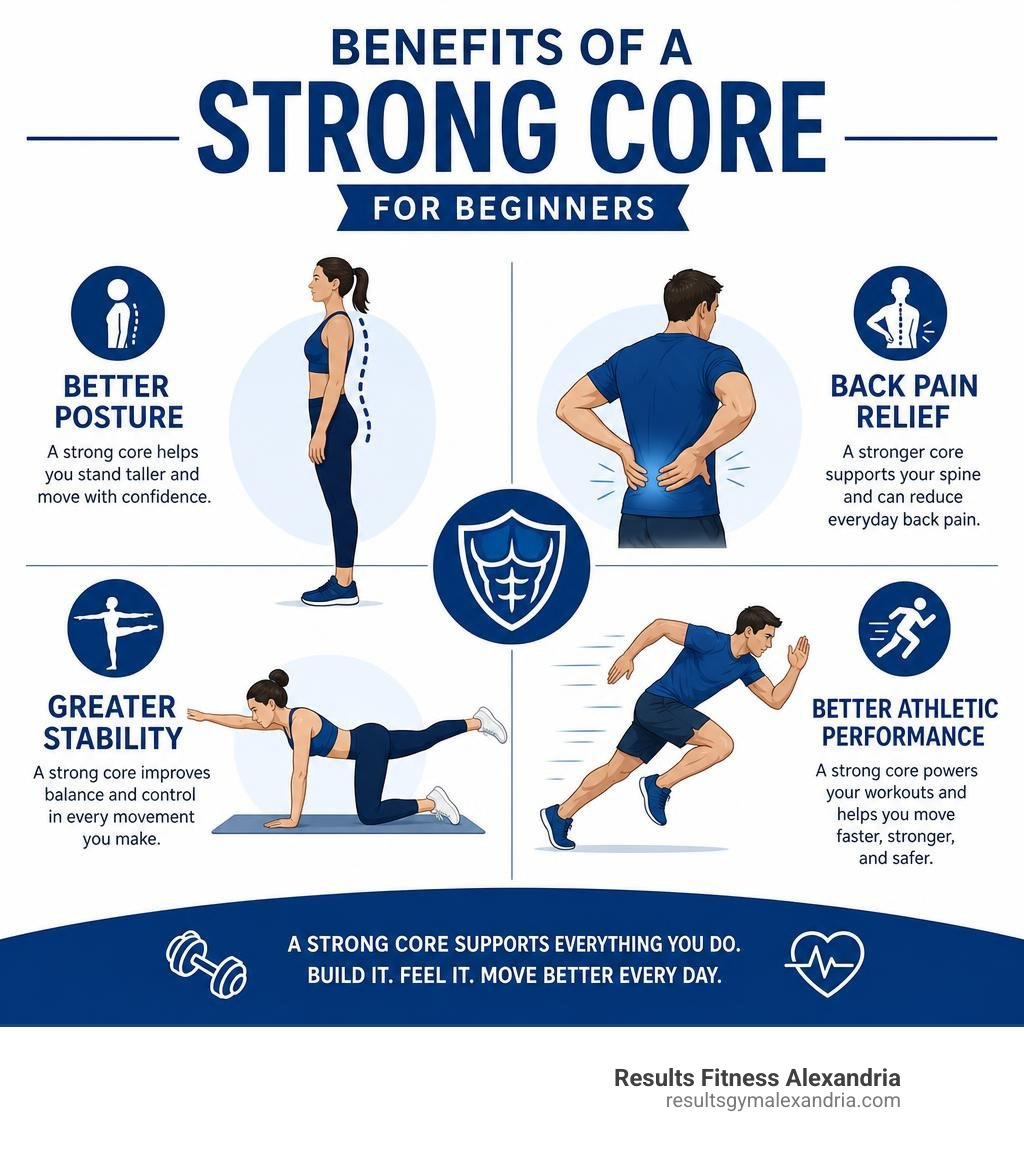
Core training isn’t just about looks. A strong core supports your spine, improves your posture, reduces back pain, and makes every other workout you do easier and safer. The good news? You don’t need hours in the gym — or even a single crunch — to build a solid foundation.
I’m Jennifer Rapchak, Fitness Director at Results Fitness Alexandria, and with over 14 years of ACE-certified personal training experience, I’ve helped hundreds of beginners build core strength through smart, accessible programming — including the kind of starter ab workout routines you’ll find in this guide. Let’s walk through everything you need to know to train your abs with confidence.
Starter ab workout basics:
Why Beginners Need a Dedicated Starter Ab Workout

When many people first decide to work on their midsection, they immediately jump into hundreds of daily crunches or sit-ups. Unfortunately, this often leads to neck strain, lower back pain, and frustration. As beginners, we need a dedicated starter ab workout that builds foundational strength before we worry about advanced, high-intensity movements.
A well-designed beginner routine focuses on stabilization first. By training the core to resist unwanted movement, we protect our spine and establish a baseline of strength that makes every other physical activity easier. Whether you want to lift heavier weights, run faster, or simply carry your groceries without throwing your back out, a strong center is your starting point. Explore more about why this matters in our guide Beyond the Abs: Why Core Classes Are Your Fitness Foundation.
The Real Benefits of Core Training
The benefits of a structured starter ab workout go far beyond aesthetics. While having a toned midsection is a nice bonus, the functional health benefits are the real game-changers.
First and foremost is injury prevention. A strong, conditioned core is a must if you want to run, lift, jump, and crush whatever flavor of fitness you like partaking in. When your core is weak, other larger muscle groups have to overcompensate, which frequently leads to muscle imbalances, burnout, and acute injuries.
Additionally, strengthening your ab muscles can actually help take pressure off the spine to ease back pain. Strength in the abdominals helps support healthy lower back function and keeps the lumbar spine from curving too far inward (a posture known as swayback, which can increase the risk of disc bulges and stress fractures). By training our core to stabilize the spine, we build a natural “weight belt” that keeps our posture aligned and our lower back safe. For more science-backed recovery and training methods, check out The Best Health and Fitness Tips Backed by Science.
Understanding Your Core Anatomy
To train your core effectively, it helps to understand that your “abs” are actually a complex, multi-layered system of muscles wrapping around your entire trunk. It is helpful to think of the core as a 3D box that stabilizes your whole torso:
- Rectus Abdominis: This is the outermost muscle layer—the famous “six-pack.” Its primary job is to flex the spine (bringing your chest toward your hips).
- Transverse Abdominis (TVA): The deepest abdominal layer. It acts like a natural corset, wrapping horizontally around your midsection to compress the abdomen and stabilize the spine.
- Internal and External Obliques: Located on the sides of your torso, these muscles allow you to rotate and bend sideways, while also resisting unwanted twisting forces.
- Erector Spinae & Multifidi: These back muscles run along your spine, helping you stand tall and maintain a neutral posture.
- Pelvic Floor & Diaphragm: These form the bottom and top of your core “box,” regulating intra-abdominal pressure and supporting your internal organs.
By targeting all of these muscles with accessible yet effective easy ab workouts, you protect yourself from injury and build a balanced, functional body.
The Ultimate No-Equipment Starter Ab Workout Routine
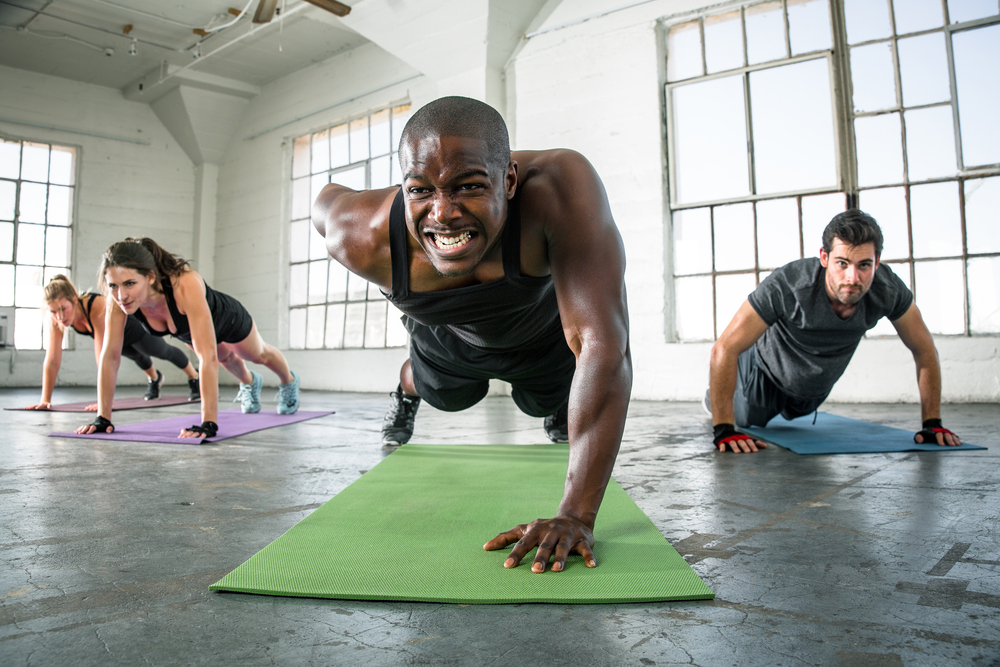
The beauty of a starter ab workout is that you do not need an expensive gym membership or fancy machines to get started. Bodyweight exercises are incredibly effective for teaching your muscles how to fire in unison.
This simple, five-exercise routine is designed to be completed anywhere—whether you are in our Alexandria studio or in your own living room. For a quick, guided visual companion, you can also check out this Quick 5 MIN AB WORKOUT For Beginners At Home (No Equipment) to see similar movements in action.
Let’s break down each exercise step-by-step so you can master the proper form.
1. Deadbug
The Deadbug is one of our absolute favorite beginner core exercises because it teaches you how to keep your lower back flat against the floor while moving your limbs. This is crucial for protecting your lumbar spine.
- How to do it:
- Lie flat on your back on a comfortable exercise mat. Extend your arms straight up toward the ceiling, directly over your shoulders.
- Lift your feet off the floor, bending your knees at a 90-degree angle so your shins are parallel to the floor (tabletop position).
- Press your lower back firmly into the floor. Imagine there is a grape underneath your lower back, and you want to squish it. Maintain this contact throughout the exercise.
- Slowly lower your right arm behind your head while simultaneously extending your left leg straight out in front of you, hovering both just above the floor.
- Pause for a second, then use your deep core muscles to pull your arm and leg back to the starting position.
- Repeat on the opposite side (left arm, right leg).
- Form tip: If you feel your lower back arching off the floor, do not lower your leg as close to the ground. Keep your leg higher in the air until your core strength improves.
2. Bird Dog
While the Deadbug trains your core from a face-up position, the Bird Dog works your core from all fours. This exercise is fantastic for building coordination, balance, and glute strength.
- How to do it:
- Start on your hands and knees in a tabletop position. Place your hands directly under your shoulders and your knees directly under your hips.
- Keep your head in a neutral position, looking down at the floor, and pack your shoulders back and down.
- Engage your core to keep your hips level and your spine flat like a tabletop.
- Slowly extend your right arm straight forward and your left leg straight backward.
- Reach through your fingers and press through your heel. Your extended limbs should form a straight line with your torso.
- Hold this position for 2 to 3 seconds, focusing on keeping your hips square to the floor (don’t let your right hip tilt upward).
- Return to the starting position and repeat with your left arm and right leg.
- Form tip: Keep your movements slow and controlled. Avoid arching your lower back at the top of the movement; focus on reaching outward rather than upward.
3. Forearm Plank
The plank is the ultimate isometric hold (meaning your muscles contract without moving). It teaches your entire core how to work together to resist gravity.
- How to do it:
- Place your forearms on the floor, parallel to each other, with your elbows positioned directly underneath your shoulders.
- Step your feet back one at a time, coming onto your toes so your body forms a straight line from your head to your heels.
- Squeeze your glutes, thighs, and abdominals. Push the floor away through your forearms so your chest doesn’t sag between your shoulders.
- Keep your gaze focused on the floor about a foot in front of your hands to keep your neck neutral.
- Hold this position for 20 to 30 seconds while breathing steadily.
- Form tip: Do not let your hips sag toward the ground (which strains the lower back) or pike up toward the ceiling. If a full plank is too intense, drop your knees to the floor to perform a modified plank.
4. Supported Side Plank
The Supported Side Plank targets the obliques on the sides of your waist, helping to stabilize your pelvis and lower back during lateral movements.
- How to do it:
- Lie on your right side with your right forearm on the floor, elbow directly under your shoulder.
- Bend your bottom (right) knee to a 90-degree angle, keeping your leg on the floor for support. Keep your top (left) leg straight, with your foot resting on the ground.
- Engage your obliques and lift your hips off the floor until your body forms a straight, diagonal line from your head to your left foot.
- Reach your left arm toward the ceiling or place your hand on your left hip.
- Hold this position for 15 to 30 seconds, keeping your hips pushed forward and your chest open.
- Lower down slowly, switch sides, and repeat.
- Form tip: Make sure your elbow stays directly under your shoulder to avoid putting unnecessary stress on your shoulder joint.
5. Bear Plank Hold
The Bear Plank Hold is a dynamic, highly effective variation of the traditional plank that targets the deep transverse abdominis and the quadriceps.
- How to do it:
- Start on your hands and knees in a tabletop position, with hands under shoulders and knees under hips. Tuck your toes.
- Engage your core, press firmly through your palms, and lift your knees just one to two inches off the floor.
- Keep your back completely flat, your neck neutral, and your knees hovering close to the ground.
- Hold this position for 20 to 30 seconds, focusing on pulling your belly button toward your spine.
- Lower your knees back to the floor with control.
- Form tip: Keep your knees close to the floor. If you lift them too high, you turn the exercise into a downward dog, which reduces the work on your abs. For more creative at-home variations, check out this 10 MINUTE AT-HOME AB WORKOUT .
How to Structure and Progress Your Starter Ab Workout
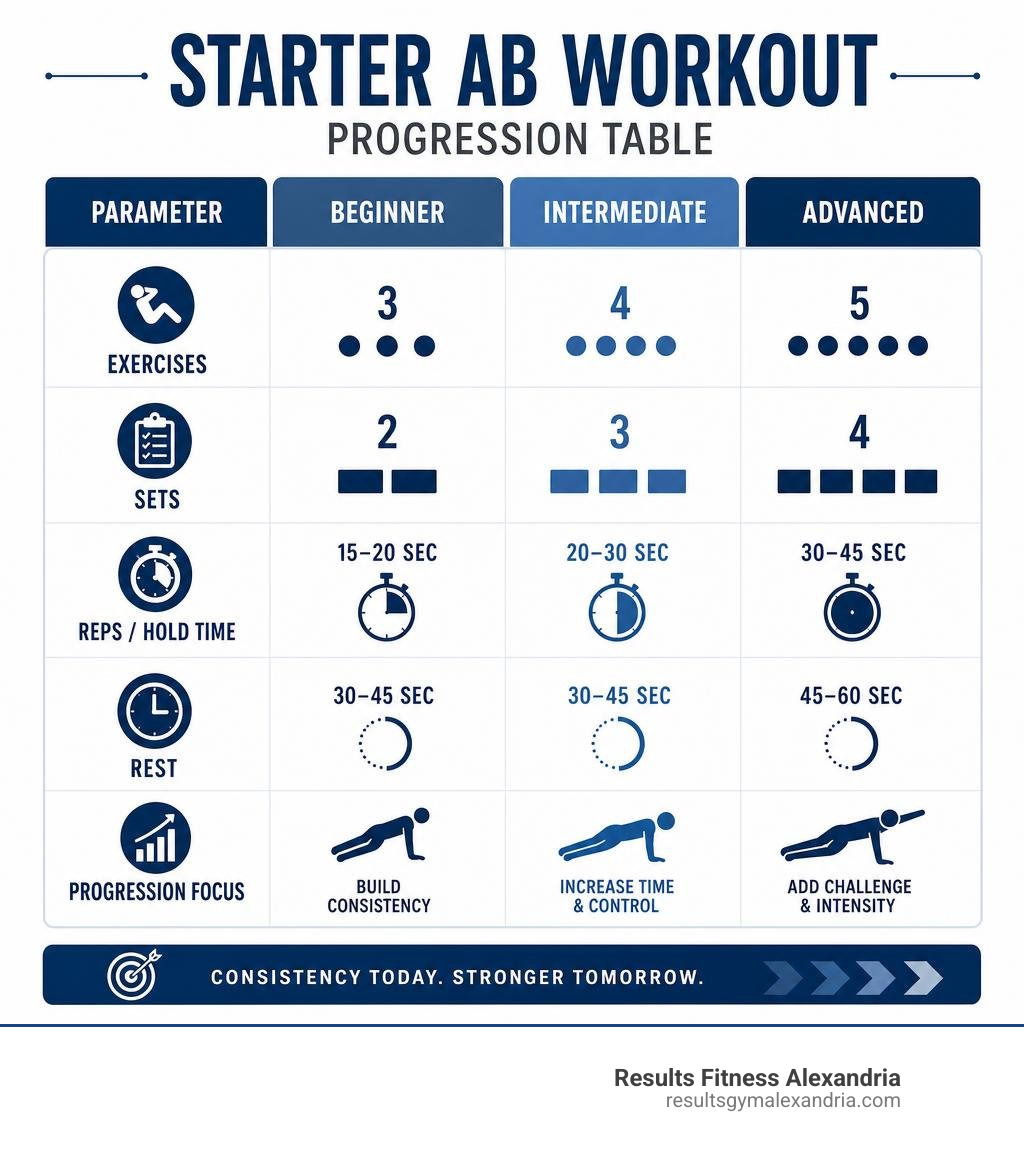
Now that you know the exercises, how do you put them together? You don’t have to invest hours of your week into your ab workouts to see strength gains. A quick, focused routine of 10 to 15 minutes is more than enough to build a solid foundation.
To help you visualize how to progress your training over time, we have put together this simple progression table:
| Parameter | Beginner | Intermediate | Advanced |
|---|---|---|---|
| Session Duration | 5 – 10 minutes | 10 – 15 minutes | 15 – 20 minutes |
| Frequency | 1 – 2 times per week | 2 – 3 times per week | 3 – 4 times per week |
| Exercise Type | Bodyweight stabilization | Dynamic bodyweight | Weighted & unstable |
| Rest Between Moves | 20 seconds | 15 seconds | 10 seconds (or none) |
| Rest Between Sets | 60 seconds | 45 seconds | 30 seconds |
If you prefer a structured, coach-led environment to keep you accountable, check out our Abs Class Workout to see how we program core work in our group training sessions.
Finding the Right Frequency and Duration
When starting out, consistency is far more important than intensity. We recommend performing your starter ab workout 1 to 3 times per week, either at the end of your regular workouts or as a standalone mini-session.
Rest days are essential to building strength and fitness in a healthy way; rest your abs for at least 24 hours after giving them a full workout. Muscles do not grow or get stronger during the workout itself—they develop during recovery when the microscopic tears in the muscle fibers heal. While some intermediate athletes might follow a Daily 15-Minute Ab Workout: 28-day Routine without Equipment for short-term challenges, beginners should stick to a few times a week to avoid overtraining and injury.
Applying Progressive Overload to Your Starter Ab Workout
Many people neglect progressive overload for ab training, limiting their results. They do the exact same 15-rep crunch routine for months and wonder why they stop seeing progress. Your core muscles respond to resistance training just like any other muscle group. To keep getting stronger, you must gradually increase the challenge.
You can apply progressive overload in several ways:
- Increase Time Under Tension: Instead of holding a plank for 20 seconds, aim for 25 or 30 seconds.
- Reduce Rest Time: Cut your rest periods between exercises from 20 seconds down to 15 seconds.
- Increase Repetitions: Slowly build from 8 slow, controlled reps per side on the Deadbug up to 12 or 15 reps.
- Add Resistance: Once bodyweight exercises feel easy, you can introduce light weights. For example, a simple 9-minute, weighted ab workout targets the entire core and is scalable by weight, using a single dumbbell or weight plate to add resistance to movements like Russian twists or reverse crunches. You can read more about how top coaches program these weighted variations in this Top Trainer Shares 9-Minute Core Workout to Build Ripped Abs – Men’s Journal .
Common Mistakes to Avoid in a Starter Ab Workout
When we are first starting a new fitness routine, it is incredibly easy to fall into bad habits. In core training, poor form not only reduces the effectiveness of the exercise, but it can also lead to lower back and neck pain. To get the most out of your training, join us for group classes to have a coach watch your form. Learn more about our community-focused approach in Strengthen Your Center: Exploring the Benefits of Core-Focused Group Workouts.
In the meantime, keep an eye out for these two highly common beginner mistakes.
Relying Too Much on Hip Flexors
One of the most common mistakes in abdominal training is letting the hip flexors (the muscles at the front of your hips) do all the work. When you perform traditional sit-ups with your feet hooked under a heavy object, your hip flexors naturally take over to pull your torso up, which can cause severe lower back strain.
To avoid this hip flexor dominance, focus on exercises that keep your pelvis stable. When you do perform sit-ups or roll-ups, try to hook your feet over (rather than under) an anchor point to engage your hamstrings, which naturally helps disengage the hip flexors. For a deeper look at how to isolate your abs and keep your hip flexors out of the equation, read the training breakdown in RIPPED ABS – Beginner Ab Workout (5 Minutes!) | ATHLEAN-X .
How to Breathe Properly During Your Starter Ab Workout
Have you ever caught yourself holding your breath during a tough plank? This is a very common reaction, but it actually limits your core stability and raises your blood pressure.
Proper breathing is essential for core engagement. We want to practice diaphragmatic breathing (breathing into our belly, not just our chest) while maintaining intra-abdominal pressure.
- The bracing technique: Before starting any movement, imagine you are about to get poked in the stomach. You would naturally tighten your midsection. This is called “bracing.”
- The breath: Maintain that tight brace while taking slow, controlled breaths. Exhale deeply through your mouth during the hardest part of the exercise (the exertion phase), and inhale through your nose as you return to the starting position. This constant flow of oxygen keeps your muscles fueled and helps stabilize your spine.
Frequently Asked Questions About Beginner Core Training
Starting a new routine always comes with questions. Here are the answers to the most common questions beginners ask us.
How does nutrition and body fat percentage affect visible abs?
It is a classic fitness truth: you can have the strongest core in the world, but if those muscles are covered by a layer of body fat, they won’t be visible. You cannot spot-reduce fat from your stomach by doing endless ab exercises.
To see visible muscle definition, you must lower your overall body fat percentage through a balanced diet and a slight calorie deficit. For men, visible six-pack abs will most likely be between 6-13% body fat. For women, you’ll need to lower your body fat to around 14-20%.
Focus on eating lean proteins, high-fiber whole grains, healthy fats, and plenty of vegetables. To understand the science of body composition and how to train effectively for your body type, check out the Best Ab Workout for Women (10-Minute Science-Based Plan) .
Are weighted or bodyweight ab exercises better for beginners?
For complete beginners, bodyweight exercises are always better. Your primary goal is to learn how to activate your deep core stabilizers (like the transverse abdominis) and maintain a neutral spine. Adding weight to an unstable, weak core is a fast track to injury.
Once you can easily complete 3 sets of 15 high-quality reps of bodyweight movements with perfect form, you can safely transition to weighted exercises to promote muscle hypertrophy and continue building strength.
What equipment do I need to start training my abs?
You don’t need any equipment to start! A simple, comfortable yoga mat to protect your knees, elbows, and spine from hard floors is more than enough.
As you progress, you can incorporate simple tools like a single dumbbell, a kettlebell, or a medicine ball to add resistance. If you are interested in workouts that target both your core and lower body using minimal equipment, explore our guide on Abs and Glutes.
Conclusion
Building a strong, functional core doesn’t require hours of painful crunches or complicated gym equipment. By starting with this simple, no-equipment starter ab workout, you will protect your lower back, improve your posture, and build a solid foundation of strength that supports everything you do.
At Results Fitness Alexandria, we believe that fitness should be accessible, safe, and fun for all levels. Whether you want to work one-on-one with a personal trainer to perfect your form, or join a supportive group of like-minded people in our classes, we are here to help you every step of the way.
Ready to take the first step toward a stronger, healthier you? Come visit our Alexandria, Virginia studio! Claim your free 1-day pass today to try our amenities and find the perfect class for your goals. Explore our group fitness classes to build a strong core and let’s start building your foundation together.