Abs and glutes: 3 Ultimate Workouts
Why Abs and Glutes Are Your Body’s Power Couple
Abs and glutes work together as your body’s ultimate power couple, creating a functional powerhouse that goes far beyond just looking good in the mirror. These muscle groups form the foundation of your core strength and are essential for nearly every movement you make throughout your day.
What Are Abs and Glutes?
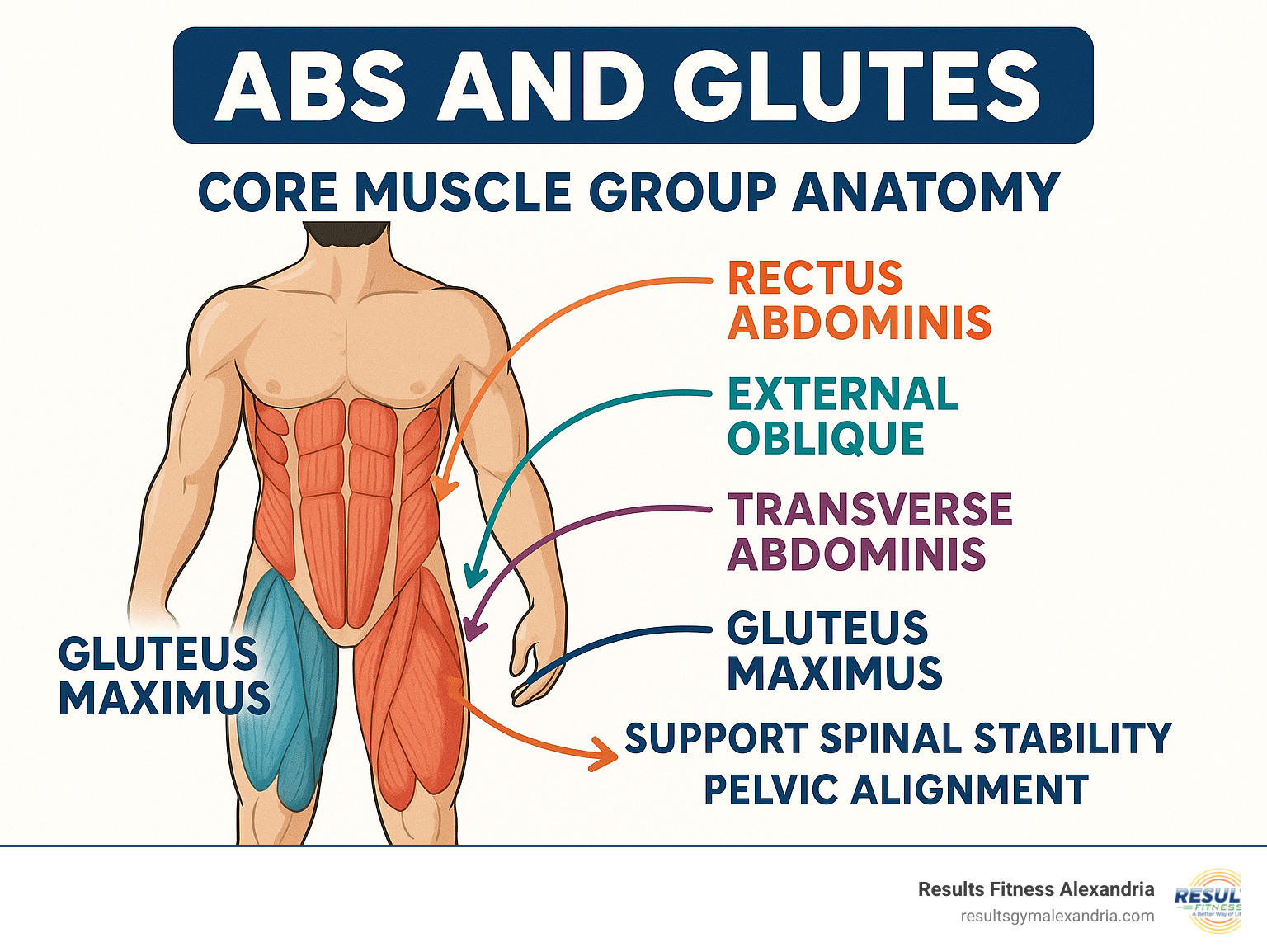
- Abs (Core muscles): Rectus abdominis (six-pack), obliques (side muscles), transverse abdominis (deep core)
- Glutes: Gluteus maximus (largest butt muscle), gluteus medius (side hip), gluteus minimus (deep hip stabilizer)
- Function: Work together to stabilize your pelvis, support your spine, and power your movement
The connection between these muscle groups is more important than most people realize. As fitness experts note, “having strong glutes go hand in hand with a strong core.” When one area is weak, the other tries to compensate – which can lead to back pain, knee problems, and poor posture.
Your glutes aren’t just for aesthetics. They’re actually part of your core system, wrapping around your body to create stability from your ribcage to your hips. Without functioning glutes, you’re setting yourself up for what experts call “gluteal amnesia” or “dead butt syndrome” – a real condition that affects people who sit too much.
I’m Jennifer Rapchak, Fitness Director at Results Fitness Alexandria, and I’ve spent over 14 years helping people build stronger cores through targeted abs and glutes training. My experience with CXWORX and core conditioning has shown me how transformative it can be when these muscle groups work together properly.
Simple Abs and glutes glossary:
The idea of a “six-pack” often dominates our perception of a strong core, but it’s much, much more. The primary muscles targeted in abs and glutes workouts include the rectus abdominis (the “six-pack” muscle), the obliques (side muscles), and the transverse abdominis (your deep, corset-like core muscle). But here’s the kicker: your core muscles also include the erector spinae (along your spine), the pelvic floor, the diaphragm, and, crucially, your glutes! Yes, your glutes are an integral part of your core. They all work as one, and for a truly strong core, they must work as one.
Why is it so important to train both the abs and glutes together? Because they are intimately connected and rely on each other for stability and efficient movement. When we move, these muscles stabilize our pelvis and spine, allowing for powerful and controlled motion. Think of your body as a finely tuned machine; if one part isn’t pulling its weight, another has to overcompensate. This leads us to our next point…

The Dangers of an Imbalance: “Dead Butt Syndrome” and Back Pain
Neglecting your glutes while focusing solely on your abs can set you up for injury and inefficiencies in your workouts and daily life. This imbalance is so common that it has a catchy, albeit concerning, name: “gluteal amnesia,” or more colloquially, “dead butt syndrome.” It might sound like a joke, but it’s a real issue, especially for those of us who spend too much time sitting down.
When our glutes aren’t regularly activated and strengthened, they essentially “forget” how to fire properly. This leads to issues with contracting these muscles, which can manifest as problems with your posture, changes to your walking gait, and perhaps most commonly, lower back and knee pain, and even injury. Why? Because if your glutes are weak, other muscles, particularly those in your lower back, will try to compensate for the lack of power and stability. This compensation causes increased strain on your back, and in turn, can place unnecessary force upon your knees and ankles.
A weak core, which includes your abs, contributes to this problem. If your core muscles aren’t providing enough stability from the spine above, your glutes won’t have a solid foundation to produce efficient movement. This can lead to an anterior pelvic tilt, where your pelvis tilts forward, causing your lower back to arch excessively. This posture puts undue stress on your spine and can make it difficult for your lower abdominal muscles to engage properly. As we dig deeper, “butt strengthening is core strengthening.” The two are inseparable. Learn more about this crucial connection here: Why your glutes are part of your core.
Benefits for Everyday Life and Athletic Performance
The benefits of strong glutes and a strong core extend far beyond aesthetics. They are foundational to how we move, perform, and even prevent pain in our everyday lives.
First, let’s talk about improved posture. When your abs and glutes are strong and balanced, they support your spine and pelvis, helping you maintain an upright and aligned posture. This reduces strain on your back and neck, making daily activities like standing, walking, and even sitting much more comfortable.
These muscle groups are also responsible for so many of the movements we make daily, contributing to better overall movement patterns. From simply getting out of a chair to carrying groceries, strong abs and glutes make everyday functional movements smoother and more efficient. Without a functioning set of glutes, you’re going to have a hard time doing much of anything with your body.
For athletes, the impact is even more profound. Strong glutes provide explosive power for activities like running, jumping, and lifting. They are key drivers in athletic performance, helping you to accelerate, change direction, and maintain balance. A strong core acts as the stable base from which all powerful movements originate.
Perhaps most importantly, training your abs and glutes together significantly contributes to injury prevention. By strengthening these key stabilizing muscles, you protect your lower back, knees, and ankles from the compensatory strain that occurs when these areas are weak. This balanced strength helps ensure your body moves as it’s designed to, reducing the risk of common exercise-related injuries.
Finally, for women in particular, the benefit of training the core and glutes goes far beyond just aesthetics. These muscles play a crucial role in supporting the pelvic floor, which is especially important for women’s health, particularly around pregnancy, postpartum, and healthy aging. A strong pelvic floor, supported by strong glutes, can improve bladder control, sexual health, and provide better support for internal organs. For more on the broader advantages of strength training, check out: 10 Benefits of Strength Training for Women.
The Ultimate Abs and Glutes Workout Routine
Now that you understand why abs and glutes work as a team, it’s time to put that knowledge into action! This routine focuses on functional movements that strengthen both muscle groups simultaneously, giving you real-world strength that carries over into your daily life.
Before we dive in, let’s talk about workout structure. Always begin with a dynamic warm-up to get your blood flowing and muscles ready to work. Think leg swings, arm circles, and gentle twists. After your workout, finish with a static cool-down where you hold stretches for 20-30 seconds to help your muscles recover.
Throughout your workout, focus on the mind-muscle connection. This means really thinking about the muscles you’re working and feeling them engage. It’s not about rushing through reps – it’s about quality movement that builds strength safely and effectively.
Standing Exercises for a Stronger Core
Standing exercises are fantastic because they challenge your balance while working your abs and glutes in a functional, upright position. You’re training your body the way it moves in real life – on your feet!
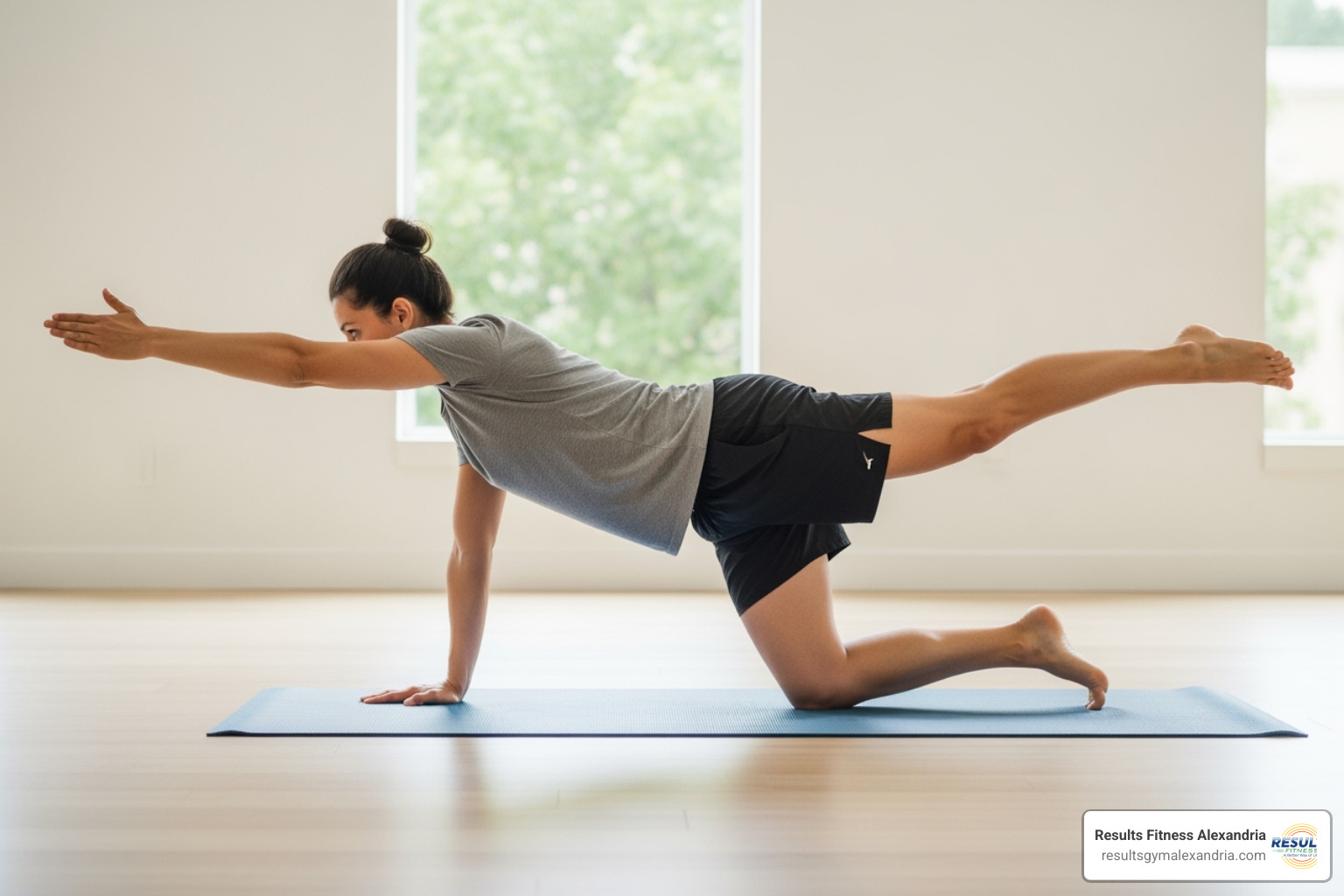
Squat to Oblique Twist is one of my favorite combination moves. Start with feet shoulder-width apart and lower into a squat as if you’re sitting back into a chair. As you stand up, lift one knee toward your chest while twisting your torso to bring the opposite elbow toward that knee. This powerhouse move hits your glutes, quads, and obliques all at once.
Lateral Lunge to Knee Drive adds a dynamic element that really fires up your glutes. Step out wide to one side, pushing your hips back as you lunge. Then drive that outside leg up into a knee drive, engaging your core for balance. This targets your gluteus medius – that important side glute muscle that keeps your hips stable.
Romanian Deadlifts (RDLs) might sound intimidating, but they’re incredible for your posterior chain. Stand tall, then hinge at your hips and lower your torso while keeping your back straight. You’ll feel a stretch in your hamstrings and a serious burn in your glutes. Your core works overtime to keep you stable throughout the movement.
Standing Lateral Leg Lifts round out our standing routine perfectly. Shift your weight to one foot and lift the other leg directly out to the side, keeping your torso upright. If balance is tricky, hold onto a wall or chair – there’s no shame in using support while you build strength!
Mat-Based Moves for Abs and Glutes
Mat exercises give you a stable base to really focus on muscle isolation and control. These moves let you fine-tune your form and feel every muscle working.
Glute Bridge March takes the basic glute bridge to the next level. Lift your hips into a bridge position, then slowly march your feet one at a time while keeping your hips level. Your glutes work to maintain the bridge while your core fights to keep you stable – it’s harder than it sounds!
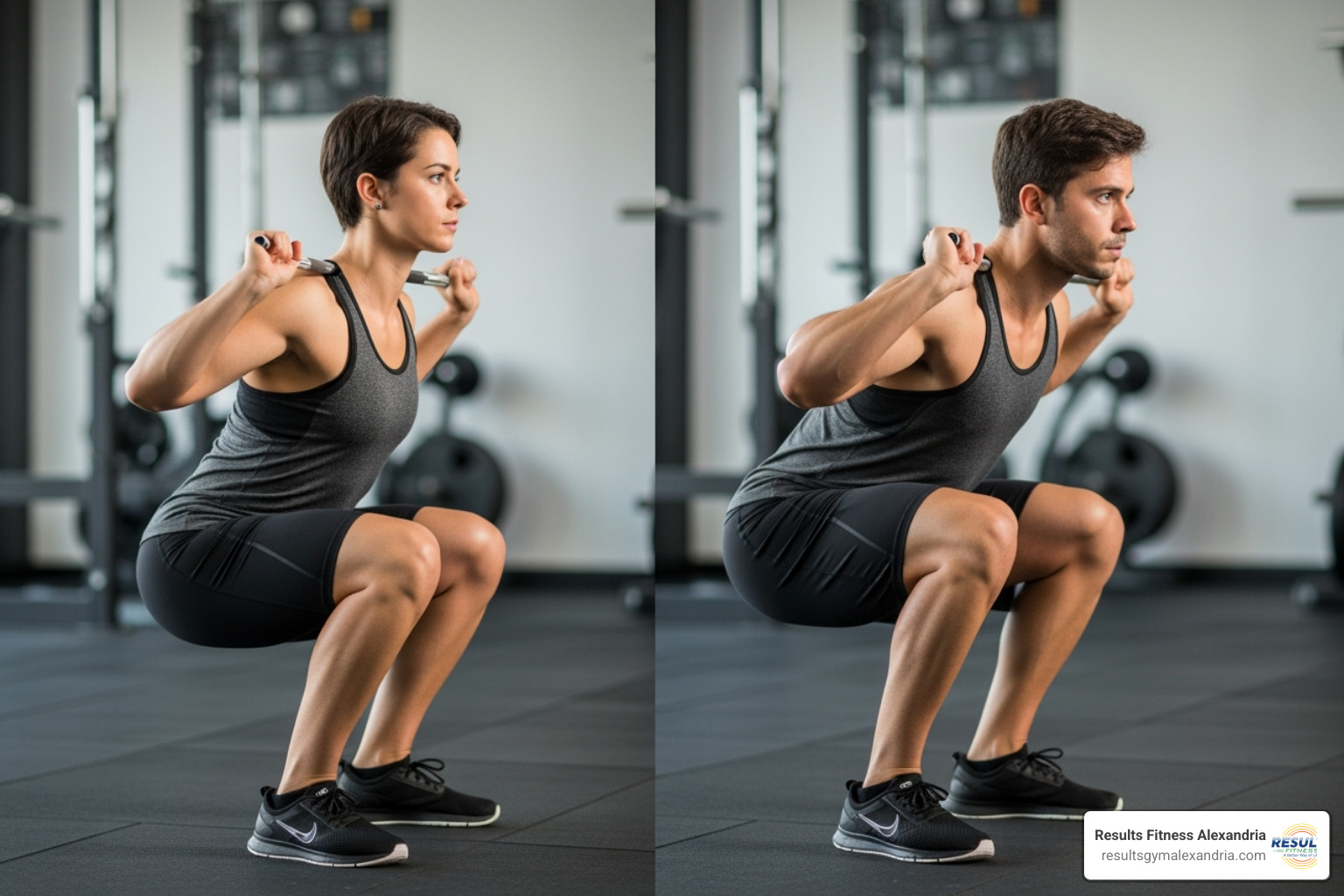
Bird Dog is the ultimate core stability exercise. From hands and knees, extend opposite arm and leg while keeping your hips level. This move strengthens your deep core muscles and glutes while improving your balance and coordination. It’s deceptively challenging and incredibly effective.
Fire Hydrant might make you giggle, but it’s serious business for your side glutes. From hands and knees, lift one leg out to the side like a dog at a fire hydrant. Keep your core tight and avoid tilting your torso – the movement should come purely from your hip.
Plank with Leg Lift amplifies the classic plank by adding glute activation. Hold a strong plank position, then slowly lift one leg a few inches off the ground. Your core works double-time to prevent your hips from sagging or rotating.
Bicycle Crunches finish our mat routine with focused ab work. Lie on your back and pedal your legs while twisting your torso to bring opposite elbow to knee. This move hits all your ab muscles while subtly engaging your hip flexors and glutes for stability.
The beauty of combining standing and mat exercises is that you get the best of both worlds – functional strength and targeted muscle building. For more guidance on building an effective routine, check out Creating an Effective Workout Routine for Beginners.
Perfecting Your Form and Maximizing Results
Getting the most out of your abs and glutes workouts isn’t just about showing up and going through the motions. It’s about moving with intention, focusing on quality over quantity, and truly connecting with the muscles you’re trying to strengthen.
Think of each rep as a conversation with your muscles. Controlled movements are your best friend here – no rushing, no bouncing, no letting momentum do the work for you. When you slow down and really focus on the muscle contraction, you’ll feel the difference immediately.
Breathing techniques might seem basic, but they’re game-changers for your core work. Here’s the simple rule: exhale during the hardest part of the movement (like when you’re crunching up or lifting your hips), and inhale as you return to the starting position. This isn’t just about getting oxygen to your muscles – it actually helps stabilize your core and gives you more power.
The magic happens when you accept progressive overload. Your muscles are smart – they adapt quickly to whatever you throw at them. So if you keep doing the same 10 squats every week, they’ll stop getting stronger. You need to keep challenging them by adding more reps, holding positions longer, or progressing to harder variations. It’s like giving your muscles a gentle nudge to say “hey, we can do better than this.” Learn more about this powerful principle: The Power of Progressive Overload: How to Keep Getting Stronger.
Common Mistakes to Avoid
Even fitness enthusiasts who’ve been at it for years can fall into these traps. Don’t worry – we’ve all been there, and recognizing these mistakes is the first step to fixing them.
Arching the lower back is probably the biggest culprit I see, especially during glute bridges and Romanian deadlifts. When your back arches too much, you’re essentially taking the work away from your glutes and putting stress on your spine. Keep that core engaged like you’re bracing for someone to tickle you – it works!
Using momentum might make you feel like you’re working harder, but you’re actually cheating your muscles out of the work they need to get stronger. If you find yourself swinging or bouncing through movements, it’s time to slow down and let your muscles do the heavy lifting.
Rushing repetitions is another common pitfall. I get it – sometimes you just want to get through your workout. But those slow, controlled movements where you really feel every muscle working? That’s where the magic happens. Try counting to three on the way down during your next set of squats – you’ll feel the difference.
Pulling on the neck during crunches is a classic mistake that can leave you with a sore neck and less effective abs work. Your hands are just there for light support. Let your abs and glutes do the work of lifting your torso.
And please, don’t forget to breathe! Holding your breath might seem like it helps you power through, but it can actually make you dizzy and reduce the effectiveness of your workout.
Level Up: Progressions and Equipment
One of the best things about abs and glutes training is how adaptable it is. Whether you’re just starting out or you’re ready for a serious challenge, there’s always a way to modify exercises to meet you where you are.
Starting with bodyweight regressions is perfectly fine – and smart! Can’t balance during standing exercises yet? Hold onto a chair or wall. Full plank too challenging? Drop to your knees. There’s no shame in starting where you are and building up gradually.
Resistance band progressions are like having a personal trainer in your pocket. Adding a mini band around your knees during glute bridges or around your ankles during leg lifts creates constant tension that makes your muscles work harder throughout the entire movement. The continuous resistance challenges your muscles in ways that bodyweight exercises alone can’t match. Benefits of using a resistance band are numerous for targeting specific muscle groups effectively.
When you’re ready to add dumbbells or kettlebells, you’re entering a whole new world of strength building. External weights turn exercises like squats and Romanian deadlifts into serious muscle-building powerhouses. Start light and focus on maintaining perfect form – you can always add more weight later.
Advanced variations are where things get really fun. Single-leg exercises like one-legged glute bridges or single-leg Romanian deadlifts will humble even the strongest athletes. Adding pauses at the peak of muscle contraction or increasing your range of motion are other ways to keep challenging yourself as you get stronger.
The goal isn’t just to get stronger in the gym – it’s to build functional strength that helps you move better in everyday life. Whether you’re carrying groceries, playing with your kids, or just getting up from a chair, strong abs and glutes make everything easier. What Is Functional Strength Training: A Simple Guide can help you understand how to make your workouts work for your life.
Frequently Asked Questions about Training
We get these questions about abs and glutes training all the time at Results Fitness Alexandria! Let me share some honest answers based on what I’ve learned from years of helping people build stronger cores.
How often should I train my abs and glutes?
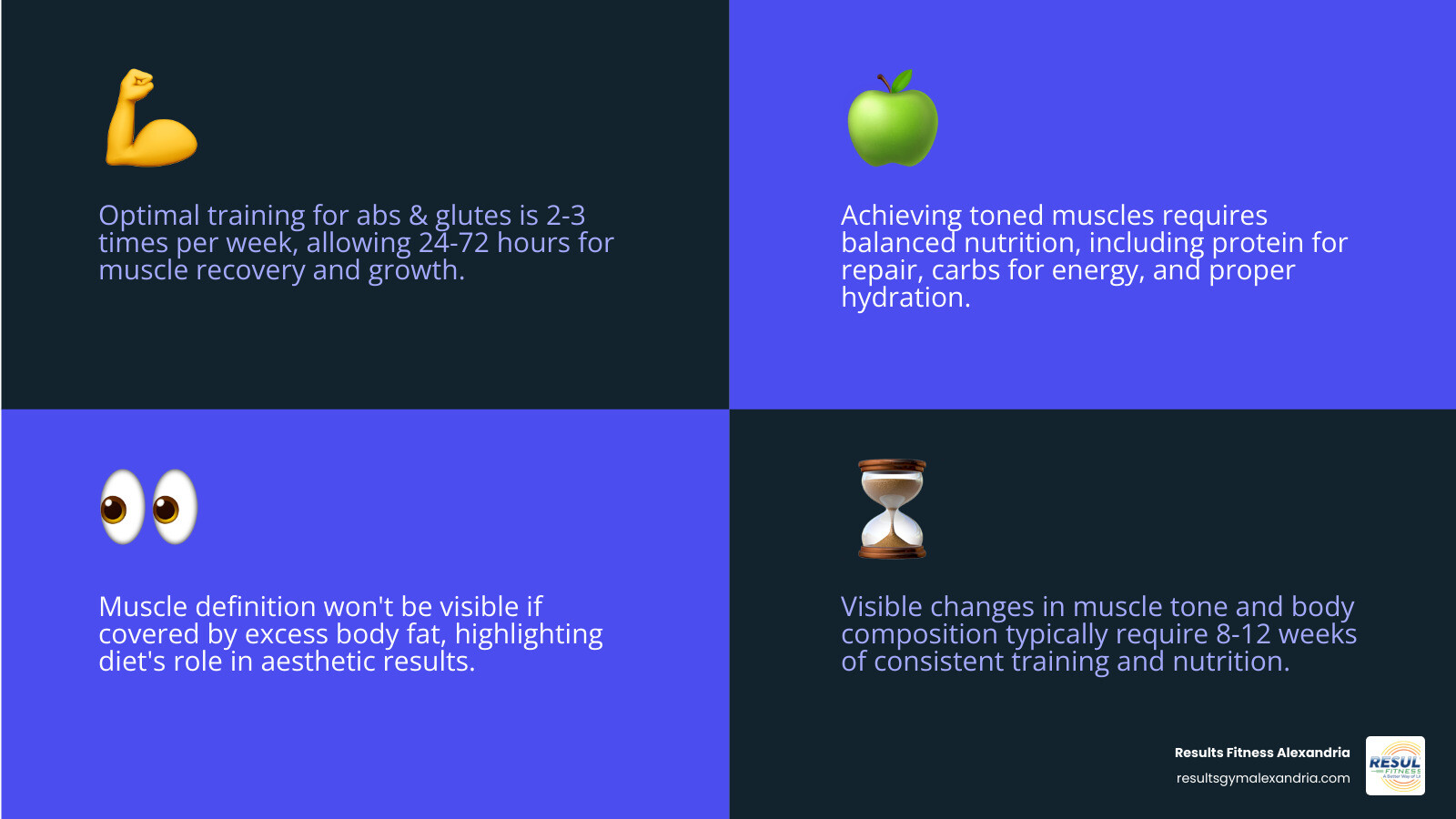
Here’s the sweet spot: 2-3 times per week works best for most people when you’re really challenging these muscles. I know it’s tempting to think “more is better,” but your muscles actually grow during recovery, not during the workout itself.
When you work your abs and glutes hard, you’re creating tiny tears in the muscle fibers. Your body then repairs these tears with new protein – that’s called muscle protein synthesis, and it takes about 24-72 hours to complete. If you train again before this process finishes, you’re actually interrupting your progress.
That said, if you’re doing lighter bodyweight movements that don’t leave you sore, you might be able to include some core work more frequently. The key is listening to your body. Still feeling sore from Tuesday’s workout? Give those muscles another day to recover.
Recovery isn’t just about preventing soreness – it’s when the magic happens. Your muscles get stronger, your movement patterns improve, and you build the foundation for your next great workout. For more ways to optimize this crucial time, check out: 10 Post-Workout Recovery Tips to Maximize Results.
Can I get a toned stomach and glutes without changing my diet?
I wish I could tell you yes, but I’d be doing you a disservice. The truth is, nutrition plays a huge role in how your abs and glutes look and feel.
Think of it this way: you might have the strongest core muscles in the world, but if they’re hidden under a layer of body fat, you won’t see that definition you’re working so hard for. It’s like having a beautiful sculpture covered by a sheet – the art is there, but it’s not visible.
Your muscles need protein for repair and growth after those challenging workouts. They need carbohydrates for energy to power through your training sessions. And don’t forget about hydration – even mild dehydration can affect your performance and recovery.
Here’s what I tell my clients: focus on building strength first, then worry about aesthetics. You’ll typically see and feel changes in your strength and movement within 4-6 weeks, while visible changes in muscle definition usually take 8-12 weeks with consistent training and proper nutrition.
The good news? Building stronger abs and glutes improves your posture, reduces back pain, and makes daily activities easier – benefits you’ll notice regardless of what the mirror shows. For more insight into how different types of training affect your goals, explore: Cardio vs. Strength Training for Weight Loss: Which Is Better?.
What’s better: standing or mat exercises?
This is like asking whether walking or sleeping is more important – they both serve different purposes, and you need both for optimal results!
Standing exercises are incredible for functional movement. When you do a squat with an oblique twist, you’re training your body the way it actually moves in real life. These exercises challenge your balance, coordination, and stability all at once. They’re preparing your abs and glutes for real-world activities like carrying groceries up stairs or playing with your kids at the park.
Mat exercises give you the stability and isolation you need to really focus on specific muscles. When you’re lying down doing a glute bridge march, you can concentrate entirely on squeezing those glutes without worrying about balance. This focused attention helps you build that crucial mind-muscle connection.
The magic happens when you combine both approaches. Standing exercises teach your muscles to work together as a team, while mat exercises help you strengthen individual players on that team. It’s like having both team practice and individual skill sessions – you need both for peak performance.
Variety is key not just for keeping your workouts interesting, but for challenging your muscles in different ways. Your body adapts quickly to routine, so mixing standing and mat exercises keeps your abs and glutes guessing and growing stronger.
For tips on structuring your workouts to include both types effectively, check out: Maximizing Your Gym Sessions: Tips for Efficient Workouts.
Conclusion
What a journey we’ve taken together! We’ve explored the incredible world of abs and glutes training, from understanding why these muscles work as your body’s ultimate power couple to mastering the exercises that will transform your strength and movement.
Think about everything we’ve finded today. Your abs and glutes aren’t just about looking great in your favorite jeans (though that’s a nice bonus!). They’re the foundation of functional strength that powers you through every squat to pick up your kids, every flight of stairs you climb, and every moment you stand tall with confidence.
We’ve seen how dangerous muscle imbalances can be – nobody wants to deal with “dead butt syndrome” or the back pain that comes from weak glutes trying to compensate. But now you know better! You understand that training these muscle groups together creates a synergy that protects your spine, stabilizes your pelvis, and gives you the power to move through life with ease.
The exercises we’ve shared – from those challenging standing moves that test your balance to the focused mat work that really makes you feel the burn – are your roadmap to building that balanced, functional strength. It’s not about perfection from day one. It’s about showing up consistently, focusing on proper form, and gradually challenging yourself as you get stronger.
Consistency is absolutely key. Those small efforts you make three times a week? They add up to incredible results over time. Your body will thank you with better posture, less pain, and the kind of strength that makes everyday activities feel effortless.
Building strong abs and glutes is about so much more than aesthetics – it’s about feeling confident in your body, moving without pain, and having the energy to tackle whatever life throws your way. Whether you’re chasing after grandkids or training for your first 5K, this foundation of core and glute strength will serve you well.
At Results Fitness Alexandria, we’re passionate about helping you find just how strong and capable your body can be. Our team understands that everyone’s fitness journey is unique, and we’re here to support you every step of the way – whether you’re just starting out or looking to take your training to the next level.
Ready to experience the power of strong abs and glutes for yourself? Come see what all the excitement is about!
Join our fun and effective group fitness classes to build your strength!