
How to Build an Effective Cardio Routine at Home
Why a Cardio Routine at Home Works Better Than You Think
Building a cardio routine at home is one of the most effective ways to improve your health without a gym membership, expensive equipment, or a rigid schedule. Here’s a quick look at what an effective home cardio routine involves:
Quick Answer: How to Build a Home Cardio Routine
- Choose your exercises – jumping jacks, high knees, mountain climbers, burpees, or marching in place
- Set your frequency – aim for 3-5 sessions per week
- Follow duration guidelines – 30 minutes per session covers most health goals
- Structure your session – 5-minute warm-up, 20 minutes of cardio, 5-minute cool-down
- Match intensity to your level – beginners aim for moderate effort; advanced users add HIIT intervals
- Progress gradually – increase duration, reduce rest periods, or add harder movements over time
You don’t need much. A small clear floor space and comfortable shoes are enough to get started.
According to health guidelines, adults should aim for at least 150 minutes of moderate-intensity aerobic activity per week — that’s just 30 minutes, five days a week. A well-designed home workout can get you there.
The challenge most people face isn’t access to equipment. It’s knowing what to do, how hard to push, and how to keep going when motivation dips.
That’s exactly what this guide covers.
I’m Jennifer Rapchak, Fitness Director at Results Fitness Gym in Alexandria, Virginia, and an ACE-certified personal trainer with over 14 years of experience designing programs — including countless cardio routines at home for clients at every fitness level. Whether you’re just getting started or looking to push past a plateau, I’ll walk you through everything you need to build a routine that actually sticks.
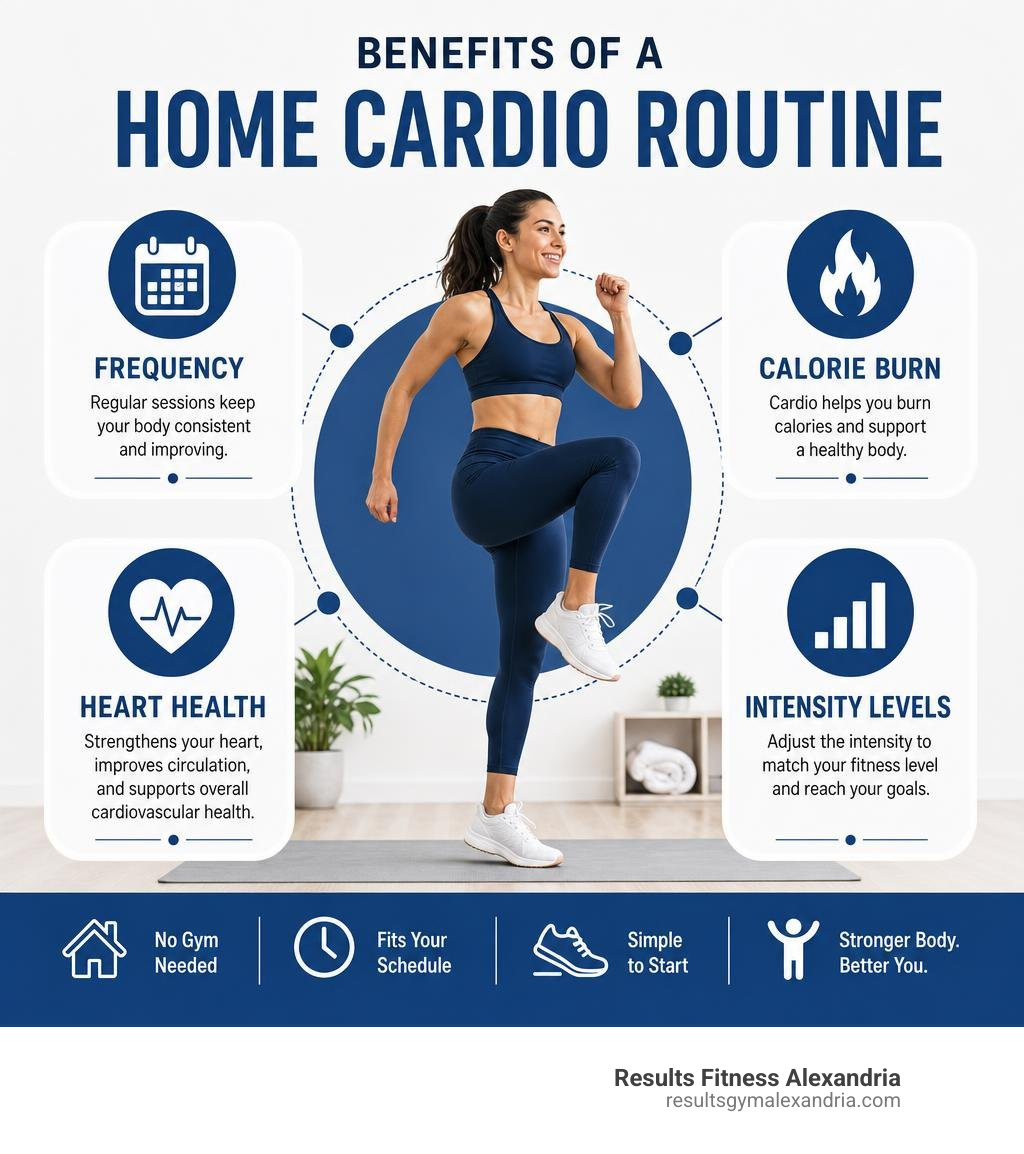
The Physical and Mental Benefits of Consistent Home Cardio
When we think of a cardio routine at home, we often focus on the physical aspect: sweating, burning calories, and breathing heavily. While those are fantastic markers of hard work, the internal physiological and neurological transformations are where the magic truly happens.
First, let’s talk about your heart. Your heart is a muscle, and just like your biceps or quads, it responds to resistance and demand. Consistent aerobic exercise strengthens the heart muscle, allowing it to pump more blood with less effort. Over time, this lowers your resting heart rate and reduces blood pressure.
In fact, regular aerobic exercise can reduce the risk of heart disease by up to 35% and lower the risk of stroke by 20% to 30%. By elevating your heart rate safely in your living room, you are actively building a shield against chronic cardiovascular conditions.
On the mental side, cardio is a powerful, fast-acting mood booster. When you engage in continuous movement, your brain releases a flood of neurotransmitters, primarily endorphins, often referred to as the body’s natural pain relievers and mood elevators. These chemicals interact with receptors in your brain to reduce your perception of pain and trigger positive, euphoric feelings.
At the same time, physical activity lowers levels of the body’s stress hormones, such as adrenaline and cortisol. If you have had a stressful day at work here in Alexandria, spending 20 to 30 minutes on a quick home cardio circuit can act as an immediate mental reset, clearing away brain fog and leaving you feeling calmer and more focused.
Let’s not forget the metabolic benefits. A single 30-minute moderate-intensity cardio session can burn approximately 200 to 300 calories, while a vigorous-intensity session can burn 300 to 450 calories. When combined with a balanced diet, this consistent energy expenditure supports weight management and helps optimize your metabolic rate. To discover how to structure your daily movement for long-term health, check out our guide on establishing a Daily Cardio Routine.
Additionally, if your primary fitness goal involves body composition changes, combining cardiovascular work with focused metabolic circuits is highly effective. You can dive deeper into these strategies by reading about The Best Cardio Workouts to Lose Belly Fat.
Designing Your Weekly Cardio Routine at Home
Building a sustainable routine requires a balance between structure and flexibility. If you dive in without a plan, it is easy to overtrain, lose motivation, or skip workouts entirely. To set yourself up for success, we recommend mapping out your week using basic principles of frequency, duration, and intensity.

Workout Frequency and Duration Guidelines
For general health and cardiorespiratory fitness, we recommend aiming for 3 to 5 sessions per week. If you are a complete beginner, starting with 3 sessions allows your muscles, joints, and connective tissues time to adapt. As your endurance builds, you can gradually increase to 4 or 5 sessions.
Each session should ideally last between 20 and 45 minutes, which easily fits into a busy schedule. Consistency beats duration every single time. A focused 20-minute workout performed four times a week will yield far better results than a grueling 80-minute session you only manage once a month.
Measuring Your Intensity Levels
How do you know if you are working hard enough? Without fancy heart rate monitors, you can easily track your intensity using the Rate of Perceived Exertion (RPE) scale and the simple talk test:
- RPE Scale (1 to 10): A rating of 1 represents sitting quietly on the couch, while 10 represents a maximum-effort sprint where you feel completely breathless.
- The Talk Test: This is a practical, real-world way to gauge your aerobic zone. If you can speak in full sentences but cannot sing, you are in a moderate-intensity zone. If you can only gasp out a word or two before needing a breath, you have crossed into vigorous intensity.
To help you visualize these differences, here is a quick comparison:
| Intensity Level | Target RPE | Heart Rate Range (% of Max) | Talk Test Description |
|---|---|---|---|
| Moderate | 3 to 4 | 65% – 75% | Can comfortably hold a conversation; breathing is noticeable but controlled. |
| Vigorous | 5 to 7 | 76% – 96% | Can only speak in short, broken phrases; breathing is deep and rapid. |
| Maximum Effort | 8 to 10 | 97% – 100% | Unable to speak; completely breathless; sustainable for only short bursts. |
Understanding these intensity zones is key to structuring your progression safely. To learn more about how to design your home space and select movements that naturally elevate your heart rate, read our comprehensive article on Exercise for Cardiovascular Endurance at Home. For a step-by-step approach to safely scaling your workouts over time, consult our Cardio Endurance Build Up Guide.
Beginner 30-Minute Cardio Routine at Home
If you are new to exercise or returning after a long break, your primary goal is to build a consistent habit without burning out or getting injured. A low-impact, steady-state structure is the perfect entry point. This routine keeps at least one foot on the ground at all times, reducing impact on your knees, hips, and ankles while still elevating your heart rate.
To get started, you can follow this simple, highly effective Beginner-friendly 30-minute home cardio workout plan:
- Warm-Up (5 Minutes):
- Marching in place (1 minute)
- Slow bodyweight squats (1 minute)
- Arm circles (30 seconds forward, 30 seconds backward)
- Side steps with gentle chest expansions (1 minute)
- High knee march (1 minute)
- Cardio Circuit 1 (10 Minutes – Perform 2 Rounds):
- Marching in Place / Low-Impact High Knees: 45 seconds work, 15 seconds rest. Focus on pumping your arms and raising your knees to hip height.
- Step Jacks (Low-Impact Jumping Jacks): 45 seconds work, 15 seconds rest. Step your right foot out to the side while raising your arms, return to center, and repeat on the left side.
- Bodyweight Squats: 45 seconds work, 15 seconds rest. Keep your chest up, sit back into your heels, and squeeze your glutes at the top.
- Side Steps with Speed Ball Arms: 45 seconds work, 15 seconds rest. Step side-to-side while rapidly rotating your fists around each other at chest height.
- Standing Toe Touches: 45 seconds work, 15 seconds rest. Reach your opposite hand toward your opposite foot in a controlled, rhythmic motion.
- Cardio Circuit 2 (10 Minutes – Perform 2 Rounds):
- Shadow Boxing: 45 seconds work, 15 seconds rest. Stand in an athletic stance and throw controlled jabs, crosses, and hooks.
- Reverse Lunges: 45 seconds work, 15 seconds rest. Step backward with one leg, lowering your hips until both knees are at a 90-degree angle, then return to standing.
- Skater Steps: 45 seconds work, 15 seconds rest. Step laterally to the right, sweeping your left foot behind you, then step to the left. Keep it low-impact by removing the jump.
- Wall Push-Ups: 45 seconds work, 15 seconds rest. Place your hands on a wall at shoulder width and perform controlled push-ups to engage your upper body.
- Fast Feet (Low-Impact): 45 seconds work, 15 seconds rest. Keep your feet low to the ground and pitter-patter them as quickly as possible.
- Cool-Down (5 Minutes):
- Gentle walking in place (2 minutes)
- Standing quad stretch (1 minute)
- Hamstring stretch (1 minute)
- Deep breathing and overhead reach (1 minute)
For those looking for a quick, structured starting point, you can also try this 10 Min Beginner Cardio Workout | New Year Sweaty Boost with Lilly Sabri. To build a strong foundation of knowledge before jumping in, we highly recommend reading our Cardio Endurance Training Beginners Guide. You can also check out this helpful 30-Minute Home Cardio Workout Plan – Go Healthy Pro for additional scheduling ideas.
Intermediate Circuit Training Structure
Once you have established a baseline of aerobic fitness, you can progress to intermediate circuit training. This structure introduces moderate-impact movements and utilizes a structured work-to-rest ratio to challenge both your aerobic and anaerobic energy systems.
In keeping with 2026 fitness trends, which emphasize time-efficient, functional bodyweight movements, this routine combines strength-endurance and cardio to maximize your calorie burn and muscle engagement.
For this routine, we will use a 45-second work, 15-second rest structure. Perform 3 total rounds of the following 6-exercise circuit, resting for 60 seconds between rounds:
- Squat Jumps: Drop into a half-squat, explode upward off the floor, and land softly, immediately transitioning into the next repetition.
- Plank Shoulder Taps: Hold a high plank position. Keeping your hips as still as possible, tap your left shoulder with your right hand, then your right shoulder with your left hand.
- Mountain Climbers: From a high plank, rapidly drive your knees toward your chest in an alternating, running motion while keeping your core tightly engaged.
- Lateral Shuffles: Lower your hips into a shallow athletic squat and shuffle rapidly 3 to 4 steps to the right, touch the floor, and shuffle back to the left.
- Jumping Jacks: Classic, full-effort jumping jacks to keep the heart rate elevated in the vigorous-intensity zone.
- Inchworms: Stand tall, fold forward to touch the floor, walk your hands out to a high plank, pause, and walk your hands back to your feet.
If you enjoy follow-along videos to keep you motivated, we recommend checking out this 35-Minute Low Impact Cardio (Video) | Nourish Move Love, which is fantastic for joint-friendly conditioning. For women looking to optimize their endurance training specifically, our resource on Cardio Endurance Tips Women offers excellent gender-specific training insights.
Advanced Progression for Your Cardio Routine at Home
For seasoned fitness enthusiasts, a high-intensity interval training (HIIT) protocol is the ultimate way to push your boundaries. HIIT alternates short bursts of maximum effort (RPE 8 to 9) with brief periods of active recovery or rest.
The primary advantage of HIIT is that it triggers Excess Post-Exercise Oxygen Consumption (EPOC), commonly known as the “afterburn effect.” Because your body has to work incredibly hard to restore its oxygen levels to normal after a high-intensity session, your metabolic rate remains elevated, meaning you continue to burn calories at an accelerated rate for hours after your workout is complete.
For this advanced pyramid complex, we will use a demanding 40-second work, 20-second rest ratio. Complete 4 total rounds, resting for 90 seconds between rounds:
- Burpees: Drop into a squat, jump your feet back into a push-up position, perform a push-up, jump your feet back to your hands, and explode into a vertical jump.
- “Screamer” Lunges: Step back into a reverse lunge, then explosively drive that back leg forward and upward, jumping off your front foot before landing softly back in the lunge. Switch legs halfway through the interval.
- Plyometric Push-Ups / Hand-Release Push-Ups: Lower your chest to the floor, then push up explosively so your hands briefly leave the ground, landing with soft elbows.
- High Knees: Run in place as fast as possible, driving your knees up to hip height while pumping your arms dynamically.
- Split Squat Jumps (Jump Lunges): Start in a lunge position and jump explosively, switching your legs in mid-air to land softly in a lunge on the opposite side.
To explore a fully structured, high-intensity program that requires zero equipment, check out The 30-Minute Home HIIT Cardio Plan: No Equipment Needed – USA Health Guides. To deepen your understanding of high-level conditioning principles, read our guide on choosing the right Cardio Endurance Exercise.
Essential Exercises and How to Modify Them
The beauty of a bodyweight-based cardio routine at home is its infinite adaptability. Every exercise can be dialed up or down depending on your current fitness level, joint health, or energy levels on any given day.
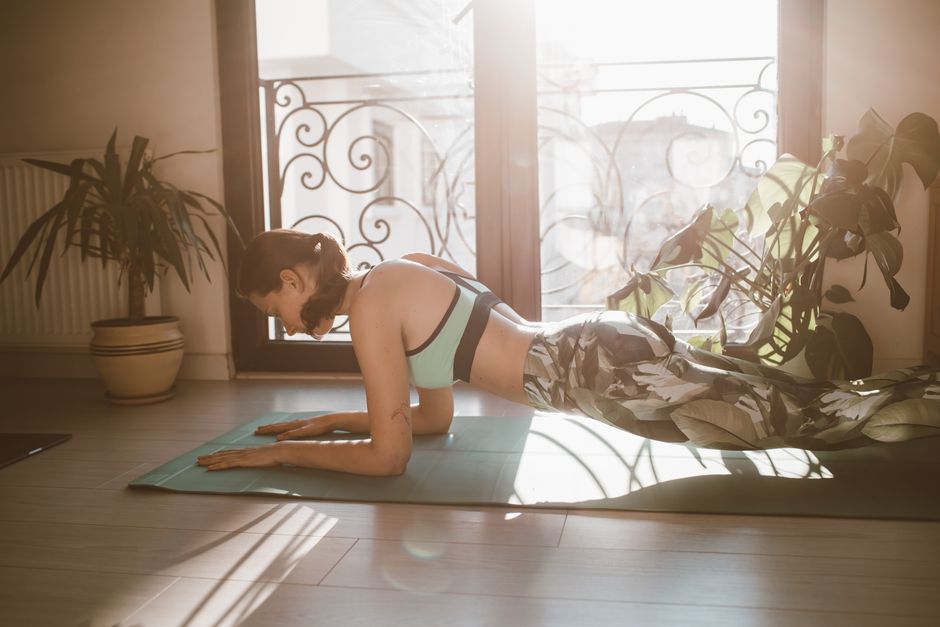
When we exercise at home, we do not have a trainer physically adjusting our posture, which makes understanding self-modification and joint protection critical for injury prevention.
Here is how to modify some of the most common cardio movements:
- The Burpee:
- Advanced: Full burpee with a push-up at the bottom and a vertical jump at the top.
- Intermediate: Step or jump back to a plank (no push-up), jump back in, and stand up without the jump.
- Beginner / Low-Impact: Place your hands on a sturdy chair or sofa, step back one foot at a time into an incline plank, step back in, and stand up tall.
- Mountain Climbers:
- Advanced: Rapid running pace with knees driving straight to the chest, keeping hips low.
- Intermediate: Slow, controlled knee drives to the chest, focusing on core stability.
- Beginner: Elevate your hands on a sturdy table, counter, or couch to reduce the angle and take pressure off your wrists and shoulders.
- Jumping Jacks:
- Advanced / Intermediate: Traditional jumping jacks, landing softly on the balls of your feet with a slight bend in your knees.
- Beginner: Step Jacks. Keep one foot planted while stepping the other out to the side, alternating back and forth to completely eliminate the impact.
If you are looking for a complete, guided workout that seamlessly demonstrates these modifications side-by-side, we highly recommend trying this HIIT Cardio and Abs Workout – No Equipment HIIT and Abs (Low Impact Mods) | Fitness Blender.
Safe Warm-Up and Cool-Down Protocols
Skipping your warm-up or cool-down is one of the most common mistakes home exercisers make. When you are short on time, it is tempting to jump straight into the high-intensity work, but this significantly increases your risk of acute injuries like muscle strains or joint sprains.
A proper warm-up (5 to 10 minutes) should always consist of dynamic stretching. Dynamic stretching involves moving your muscles and joints through their full range of motion in a controlled, rhythmic manner. This serves multiple purposes:
- It gradually elevates your heart rate and breathing rate, preparing your cardiovascular system for work.
- It increases blood flow to your working muscles, raising their temperature and making them more pliable.
- It lubricates your joints with synovial fluid, reducing friction and impact stress.
Excellent dynamic movements include arm circles, torso twists, leg swings, and bodyweight squats.
Conversely, your cool-down (5 minutes) should focus on static stretching and lowering your heart rate safely. Stopping abruptly after a vigorous workout can cause blood to pool in your lower extremities, leading to dizziness or lightheadedness. Spend 2 minutes walking slowly in place to allow your heart rate to recover, then transition to static stretches (holding a stretch for 20 to 30 seconds) for your major muscle groups, such as your hamstrings, quadriceps, calves, and chest.
Tracking Progress and Supporting Your Routine with Nutrition
To keep your home workouts exciting and effective over the long term, you need a way to track your progress. Without gym machines to tell you your speed or distance, you can track progress by recording:
- The density of your workouts: Can you complete more repetitions of an exercise within a 45-second work interval than you could two weeks ago?
- Your recovery rate: How quickly does your heart rate return to normal during your rest intervals?
- Your resting heart rate: Checking your pulse first thing in the morning is a direct reflection of your improving aerobic capacity.
Of course, exercise is only one piece of the puzzle. To perform your best during a demanding home cardio session, you must support your body with proper nutrition and hydration.
Drinking water throughout the day is essential, but you should also aim to consume a small pre-workout snack about 60 to 90 minutes before your session. A great pre-workout snack combines easily digestible complex carbohydrates for energy and a small amount of protein for muscle support—for example, a banana with a tablespoon of almond butter, or oatmeal with a sprinkle of protein powder.
If you are exercising to change your body composition, you might wonder how to balance your cardio with other forms of exercise. To understand the science behind structuring your week for optimal fat loss, read our breakdown of Cardio vs Strength Training for Weight Loss: Which is Better?. For those looking to master their gym and home transition seamlessly, check out our guide on How to Master Your Cardio Gym Workout Plan for Weight Loss.
Frequently Asked Questions about Home Cardio
How many times a week should I do cardio at home?
For most healthy adults, we recommend performing home cardio 3 to 5 times per week. This frequency provides enough cardiovascular stimulation to build aerobic capacity while allowing your body adequate time to recover and repair between sessions. For a deeper look into the physiological changes that occur with consistent training, read our expert advice on Cardio Training for Better Endurance.
Can I lose weight doing only home cardio?
You can lose weight with home cardio, but exercise is only half of the equation. Weight loss is primarily driven by a consistent calorie deficit, which means your nutrition habits play the most critical role. While cardio is excellent for increasing daily calorie burn and improving metabolic health, combining your cardio routine with a balanced, nutrient-dense diet and regular strength training is the most effective strategy for long-term weight management and preserving lean muscle mass.
What if I have bad knees or joint pain?
You do not need to jump to get an incredible cardio workout. By utilizing low-impact modifications—such as substituting stepping movements for jumping jacks, or using a sturdy chair to elevate your hands during mountain climbers and burpees—you can keep your heart rate high while completely protecting your joints. Focus on driving your power through your core and hips rather than relying on high-impact landings.
Conclusion
Building a cardio routine at home is an incredibly empowering step toward taking control of your physical and mental well-being. It removes the barriers of travel time, expensive equipment, and bad weather, leaving you with a straightforward, accessible path to better health. By starting slowly, focusing on proper form, and gradually increasing your intensity using the RPE scale, you can build a sustainable habit that delivers real, lasting results.
However, we also know that exercising alone in your living room can sometimes feel isolating, and there may come a day when you crave more variety, professional coaching, or the infectious energy of a supportive fitness community.
When you are ready to take your conditioning to the next level, we invite you to experience Results Fitness Alexandria. Located right here in Alexandria, Virginia, we offer premium fitness classes, expert personal training, restorative yoga, and convenient childcare to fit your busy lifestyle.
We would love to support you on your fitness journey. We invite you to claim a free 1-day pass to try our premium amenities, meet our coaches, and see how our community can help you reach your goals. Come visit us and Explore our premium cardio amenities today!