Crossfit workout cardio: 7 Peak WODs
Why CrossFit Workout Cardio Transforms Your Cardiovascular Fitness
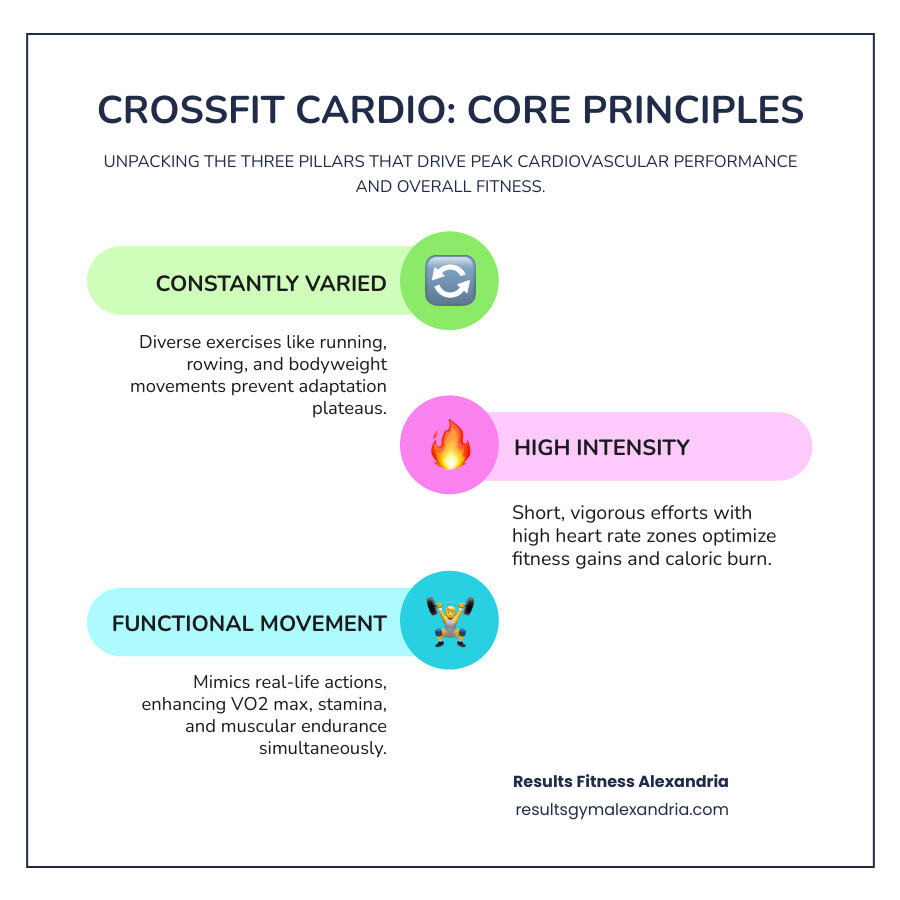
CrossFit workout cardio combines constantly varied functional movements performed at high intensity to dramatically improve your cardiovascular health and endurance. Here’s what makes it effective:
- High-Intensity Interval Training (HIIT): Short bursts of intense effort followed by brief rest periods
- Metabolic Conditioning (MetCon): Workouts that challenge multiple energy systems simultaneously
- Constantly Varied Movements: Running, rowing, cycling, burpees, and jumping exercises prevent adaptation plateaus
- Proven Results: Research shows CrossFit workouts lift heart rate to 91% of max and deliver vigorous-intensity cardiovascular benefits
Many people think building cardiovascular fitness means long, boring runs on a treadmill. But research from Texas A&M University-Corpus Christi shows that a single 20-minute CrossFit workout can burn over 260 calories while significantly improving both aerobic and anaerobic capacity. The workout tested elicited heart rates of 170.8 beats per minute and achieved an average MET level of 9.5—classified as vigorous intensity exercise.
The beauty of CrossFit workout cardio lies in its efficiency. You’re not just improving your heart health—you’re building strength, power, and muscular endurance simultaneously. Whether you’re a complete beginner struggling to find time for exercise or an experienced athlete looking to break through a plateau, CrossFit’s scalable approach offers a solution that fits your busy schedule.
I’m Jennifer Rapchak, Fitness Director at Results Fitness Alexandria with over 14 years of experience as an ACE-certified personal trainer specializing in high-intensity interval training and structured CrossFit workout cardio programming. I’ve helped hundreds of members find how functional fitness transforms not just their cardiovascular capacity, but their entire approach to health and wellness.
Key terms for crossfit workout cardio:
The Science Behind CrossFit’s Cardio Power
CrossFit workout cardio is a powerhouse for cardiovascular adaptations, pushing your body to become more efficient at delivering oxygen to working muscles. The science backs this up. A study on the CrossFit workout ‘Cindy’ revealed that in just 20 minutes, participants reached an average heart rate of 170.8 bpm (91% of max), classifying it as a ‘vigorous intensity’ workout. They burned over 260 calories, demonstrating the incredible efficiency of this training style.
While heart rate was high, oxygen consumption (VO2) was moderate, highlighting how CrossFit’s varied movements challenge the body to maintain cardiac output under unique stress. Another study on the benchmark ‘Isabel’ showed how even short, intense workouts use all three energy systems (aerobic, anaerobic, and phosphagen). This diverse energy system training means you’re not just improving aerobic capacity but also building anaerobic power and endurance. These physiological responses lead to tangible benefits: improved VO2 max, a higher lactate threshold, and increased stamina. It’s why HIIT exercises are so effective, and CrossFit lifts this by integrating strength and skill to build incredible muscular cardiovascular endurance.
Understanding Different CrossFit Workout Cardio Formats
CrossFit workout cardio uses constantly varied formats to prevent plateaus and build broad fitness. Each format targets your cardiovascular system differently:
- AMRAP (As Many Rounds/Reps as Possible): Complete as many reps as possible in a set time. This tests sustained effort and pacing, forcing your cardiovascular system to work overtime with minimal rest.
- EMOM (Every Minute on the Minute): Perform a task at the start of each minute, resting for the remaining time. This format is excellent for building work capacity and learning to manage heart rate by pushing hard and recovering briefly.
- For Time: Complete a set amount of work as fast as possible. This is a race against the clock that pushes your limits, requiring smart pacing based on the workout’s length.
- Chippers: A long list of exercises completed one after another. You “chip away” at the work, building incredible cardiovascular stamina and mental grit over longer durations.
Mastering the pacing for each format is key to maximizing your gym sessions and getting the most from your training.
CrossFit vs. Traditional Endurance Training
Many people associate cardio with long, steady-state (LISS) runs, but CrossFit workout cardio offers a more efficient path to peak performance through high-intensity interval training (HIIT) and functional strength. The fundamental difference is intensity and variety.
Here’s how they compare:
| Metric | CrossFit (HIIT/MetCon) | Traditional LISS Cardio (e.g., long-distance running) |
|---|---|---|
| Time Efficiency | High. Significant benefits in shorter workouts (20-30 min). | Low. Requires longer durations (45+ min) for similar benefits. |
| VO2 Max Improvement | Highly effective due to intense bursts pushing oxygen uptake limits. | Effective, but often requires longer durations. |
| Lactate Threshold | Excellent improvement from repeated high-intensity efforts. | Improves at a slower rate due to lower intensity. |
| Muscle Preservation | High. Builds and preserves muscle mass by combining cardio with strength. | Low. Can lead to muscle breakdown over long durations. |
| Caloric Burn (EPOC) | High “afterburn” effect (Excess Post-exercise Oxygen Consumption). | Moderate. Lower EPOC due to sustained, lower intensity. |
| Functional Movement | Integrates real-world movements, improving overall athleticism. | Often repetitive, sport-specific movements. |
| Variety | Constantly varied workouts prevent plateaus and target diverse systems. | Repetitive modality can lead to overuse injuries or plateaus. |
While traditional endurance training has its place, CrossFit’s blend of cardio and strength provides a superior pathway to overall fitness, helping you decide between cardio vs. strength training for weight loss.
7 CrossFit Workout Cardio WODs to Build Your Engine
Ready to rev up your heart and lungs? These CrossFit workout cardio WODs (Workouts of the Day) are designed to challenge your endurance, build stamina, and leave you feeling accomplished. We’ve chosen a mix that combines monostructural movements (like running and rowing) with gymnastics (bodyweight exercises) and light weightlifting, ensuring a comprehensive cardiovascular challenge. These are some of the best cardio workouts for endurance you’ll find!

1. The Classic Couplet: “Helen”
“Helen” is a benchmark workout that beautifully combines running, kettlebell swings, and pull-ups. It’s a fantastic test of cardiovascular endurance and muscular stamina.
- 3 Rounds For Time:
- 400-meter Run
- 21 Kettlebell Swings (Rx: 53 lbs men / 35 lbs women)
- 12 Pull-ups
- Why it’s effective for cardio: The run spikes your heart rate, while the swings and pull-ups add muscular fatigue, forcing you to sustain high output.
- Pacing strategy: Maintain a consistent pace on the run. Break swings and pull-ups into small, manageable sets to keep rest minimal.
2. The Bodyweight Burner: “Cindy”
“Cindy” is an iconic bodyweight benchmark that perfectly illustrates how effective simple movements can be for building a powerful cardio engine. It’s a fantastic example of a pure aerobic exercise.
- AMRAP in 20 minutes:
- 5 Pull-ups
- 10 Push-ups
- 15 Air Squats
- Cardiovascular response: As research shows, “Cindy” elicits a vigorous heart rate response (around 91% of HRmax) and high caloric burn. The continuous movement keeps your heart and lungs working hard for 20 minutes.
- Muscular endurance challenge: This WOD tests your ability to perform repetitive bodyweight movements under fatigue, pushing your cardiovascular system to its limits.
3. The Grinder: “Murph” (Modified for Cardio Focus)
“Murph” is a Hero WOD, typically performed with a 20-lb vest. For a pure CrossFit workout cardio focus, we can perform it without the vest, making it an incredible test of cardiovascular endurance.
- For Time:
- 1-mile Run
- 100 Pull-ups
- 200 Push-ups
- 300 Squats
- 1-mile Run
- Partitioning strategies: The best approach is to break up the reps. A common strategy is to perform 20 rounds of 5 pull-ups, 10 push-ups, and 15 squats. This keeps you moving and manages fatigue.
- Mental toughness: This long workout demands mental fortitude. The sustained effort, especially with the bookend runs, is a significant cardiovascular challenge.
4. The Sprint Interval: “Flight Simulator”
“Flight Simulator” is a unique workout that focuses purely on double-unders, but with a twist. It’s a fantastic way to improve anaerobic threshold and coordination under fatigue.
- For Time:
- 5-10-15-20-25-30-35-40-45-50-45-40-35-30-25-20-15-10-5 Unbroken Double-Unders
- Anaerobic threshold: The goal of unbroken sets creates intense bursts of activity followed by brief recovery, pushing your anaerobic capacity.
- Coordination under fatigue: Maintaining rhythm and coordination for double-unders when your heart is pounding is a serious challenge that builds both skill and stamina.
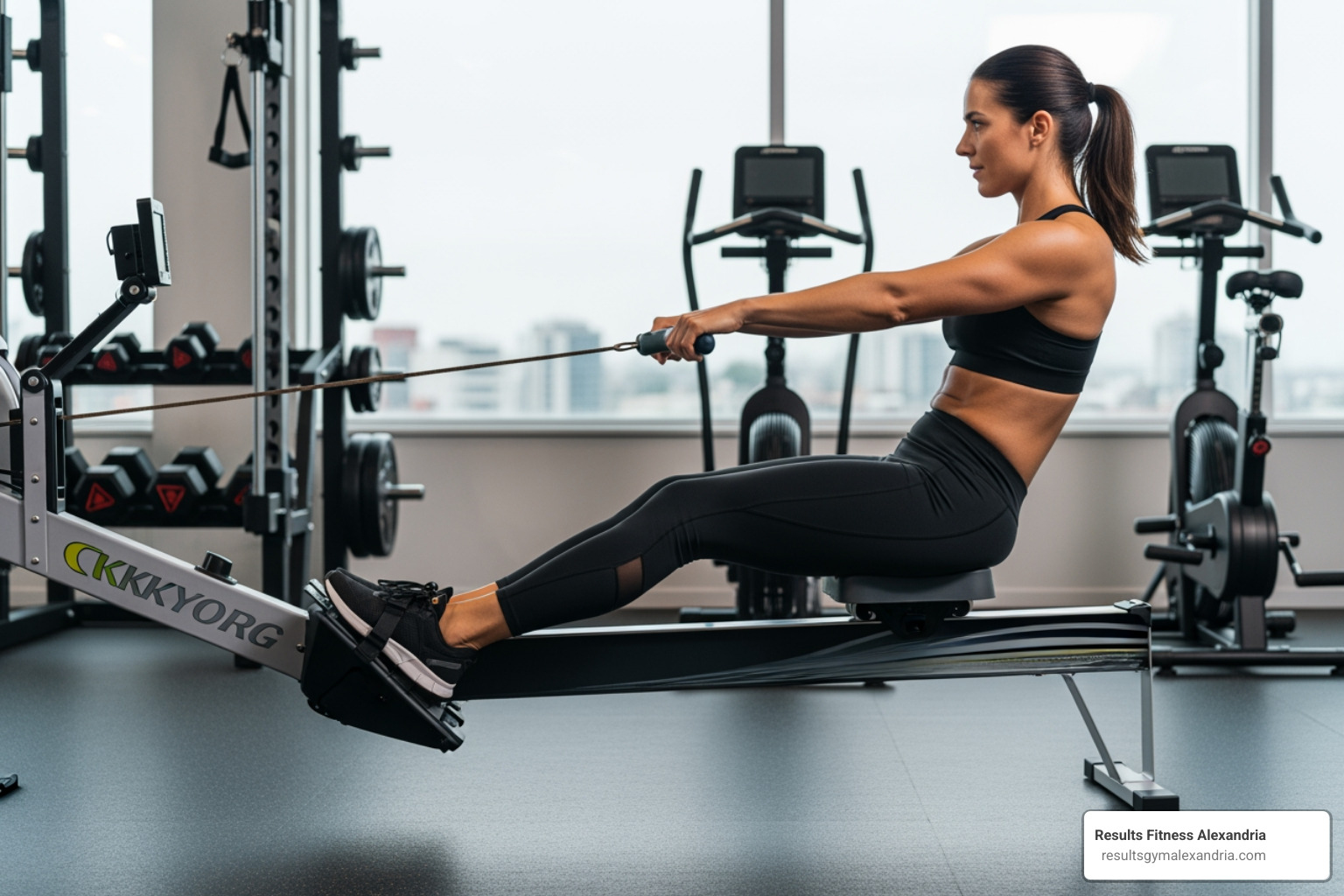
5. The Machine Test: 5k Row
The 5,000-meter row is a classic endurance test in CrossFit. It’s a pure monostructural cardio effort that will reveal the strength of your engine.
- For Time:
- 5,000-meter row
- Pacing: This is an endurance piece, not a sprint. Aim for a consistent split time per 500 meters and maintain a steady, powerful stroke rate.
- Damper setting: A setting of 4-6 is often ideal for a 5k, allowing for sustainable power.
- Technique tips: Focus on a powerful leg drive, then a core-to-arm finish. Recover in reverse. Proper technique on the rowing machine workout is key to efficiency.
6. The Chipper
This chipper workout combines a variety of movements, requiring sustained effort across multiple modalities.
- For Time:
- 50 Wall Balls (Rx: 20 lbs to 10 ft target men / 14 lbs to 9 ft target women)
- 40 Calorie Row
- 30 Burpees
- 20 Toes-to-Bar
- 10 Power Cleans (Rx: 135 lbs men / 95 lbs women)
- Sustained effort across multiple modalities: You’ll chip away at the reps for each exercise one by one. Your heart rate will stay liftd throughout, which is excellent for developing overall cardio training for better endurance.
- Strategy: Break up larger sets (Wall Balls, Calorie Row) into manageable chunks. Pace the burpees and be strategic on the more technical movements to avoid redlining.
7. The EMOM Challenge
This EMOM (Every Minute On the Minute) workout is a fantastic way to build work capacity and learn to manage your heart rate effectively.
- EMOM for 20 minutes (10 rounds):
- Minute 1: 15 Calorie Echo Bike
- Minute 2: 15 Burpees
- Building work capacity: The high volume of intense work followed by short, built-in rest teaches your body to recover quickly and maintain power.
- Managing heart rate: Completing the work within the minute forces a cyclical push-and-recover pattern that is highly effective for improving cardiovascular efficiency.
Smart Training: Scaling, Recovery, and Nutrition
To get the most from CrossFit workout cardio while minimizing injury risk, smart training is essential. This means prioritizing proper form, listening to your body, and understanding progressive overload. At Results Fitness Alexandria, our coaches guide you to move safely and effectively, especially when fatigued. We teach you to distinguish between muscle fatigue and pain, emphasizing that rest days are a vital part of training. We use the power of progressive overload—gradually increasing demands—to ensure you keep getting fitter. To mitigate risks like overtraining, we focus on proper scaling, mobility, and attentive coaching.
How to Scale Your CrossFit Workout Cardio
A key feature of CrossFit is its scalability, making it accessible to any fitness level. Scaling isn’t about making a workout “easier”; it’s about tailoring it to be effective for you. This ensures you get the right stimulus, a great cardio challenge, and build skills safely.
Common scaling options for CrossFit workout cardio include:
- Reducing reps or distance: A beginner might run 200m instead of 400m.
- Lowering weight: Using a lighter kettlebell to maintain good form.
- Modifying movements: Performing ring rows instead of pull-ups, or box step-ups instead of box jumps.
- Adjusting time domains: Capping a workout to ensure appropriate intensity, especially when building cardio endurance for beginners.
Effective scaling allows you to participate fully, track progress, and work towards more advanced movements safely.
Fueling Your Engine: Nutrition and Recovery
Intense CrossFit workout cardio demands optimal nutrition and recovery to fuel performance and adaptation.
- Carbohydrates for energy: Carbs are your primary fuel for high-intensity exercise. Adequate intake before and after workouts is crucial to sustain energy and replenish glycogen stores.
- Protein for muscle repair: Protein provides the amino acids needed to repair and rebuild muscles after a tough workout. Consuming protein post-workout is vital for recovery.
- Hydration: Dehydration impairs performance. Stay hydrated throughout the day, not just during your workout.
- Sleep: Prioritizing 7-9 hours of quality sleep is non-negotiable. It’s when your body does most of its repair work.
- Active recovery: Light movement like walking or stretching on rest days can reduce muscle soreness and promote healing. Find more ideas in our 10 post-workout recovery tips to maximize results.
Neglecting nutrition and recovery will stall your progress. They are critical components for peak performance.
Frequently Asked Questions about CrossFit Cardio
We often hear great questions from our members about how to integrate CrossFit workout cardio into their lives. Here are some of the most common ones we address at Results Fitness Alexandria:
How often should I do CrossFit cardio workouts?
The ideal frequency for CrossFit workout cardio depends on your current fitness level, recovery capacity, and overall goals. For beginners, we typically recommend starting with 2-3 times per week, allowing for adequate rest and recovery between sessions. This helps your body adapt to the intensity and varied movements.
As you become more advanced, you might increase to 3-5 times per week, often balancing these with strength-focused sessions or utilizing the varied programming inherent in CrossFit that naturally blends both. It’s crucial to listen to your body—signs of overtraining include persistent fatigue, poor performance, irritability, and disrupted sleep. We always encourage our members to consult with our coaches to develop a personalized training schedule that aligns with their goals and current capacity. This helps answer how often you should work out based on your goals.
Can I build muscle with CrossFit cardio?
Absolutely! One of the significant advantages of CrossFit workout cardio over traditional, steady-state cardio is its ability to not only preserve but also build muscle mass. This is primarily due to the inclusion of high-intensity functional movements and compound exercises.
Unlike long-duration, low-intensity cardio which can sometimes lead to muscle catabolism (breakdown), CrossFit’s methodology integrates elements of weightlifting, gymnastics, and bodyweight movements performed at high intensity. These movements stimulate muscle growth and strength adaptations while simultaneously challenging your cardiovascular system. Think about those heavy wall balls, kettlebell swings, or even just the sheer volume of squats and push-ups in a WOD like “Cindy”—they’re building muscle while getting your heart rate soaring. So yes, you can definitely build a strong, lean physique while improving your cardiovascular fitness. We love helping our members understand the science of building muscle through functional fitness.
Is CrossFit cardio safe for beginners?
Yes, CrossFit workout cardio is absolutely safe for beginners, provided it’s introduced correctly and coached properly. The key lies in its emphasis on scalability and the expertise of qualified coaches.
We understand that stepping into a CrossFit gym can feel intimidating. However, at Results Fitness Alexandria, our primary focus for new members is on teaching proper technique and ensuring safety. We start slow, emphasizing mastering movement patterns before adding intensity or heavy weights. Every workout can be scaled to match your current fitness level, whether that means reducing reps, shortening distances, lightening loads, or modifying movements entirely (e.g., box step-ups instead of box jumps).
Our coaches are adept at identifying individual needs and adjusting workouts so that everyone receives the intended stimulus without compromising safety. We believe in creating an effective workout routine for beginners that builds confidence, skill, and fitness from day one. The goal is always to move well, then move fast, and then move heavy. With the right coaching and a willingness to learn, beginners can safely and effectively start on their CrossFit cardio journey.
Build Your Ultimate Cardio Engine
We’ve explored the science, dissected the workout formats, and showcased some of the most potent CrossFit workout cardio WODs. The message is clear: CrossFit offers a dynamic, efficient, and highly effective path to peak cardiovascular performance. It’s a comprehensive tool that not only builds an incredible engine but also improves strength, agility, and overall functional fitness.
Gone are the days when endless, monotonous cardio was the only way to a strong heart and lungs. With CrossFit, you get constantly varied, high-intensity workouts that keep your body guessing and your mind engaged. You’ll improve your VO2 max, lift your lactate threshold, and boost your stamina in ways you might not have thought possible. And the best part? It’s all scalable, meaning that whether you’re just starting your fitness journey or you’re a seasoned athlete, there’s a version of every workout that’s perfect for you.
At Results Fitness Alexandria, our expert coaches are dedicated to helping you open up your full potential. We’ll guide you through every movement, help you master pacing strategies, and ensure you scale every workout appropriately to your current level. Our supportive community and state-of-the-art facility provide the ideal environment to challenge yourself, celebrate your victories, and build the ultimate cardio engine.
Ready to experience the transformative power of CrossFit workout cardio? We invite you to join us and find a new level of fitness.
Explore our world-class cardio amenities and start your journey to peak performance today!