Strength and cardio: 1 Peak Performance!
Why Strength and Cardio Are Your Best Fitness Allies
When it comes to achieving your fitness goals, you might find yourself pondering a classic question: should you focus on strength training or cardio? The truth is, this isn’t an either/or situation. Strength and cardio are not competing forces; they are powerful partners. When combined strategically, they create a comprehensive and synergistic approach to fitness that builds muscle, burns fat, strengthens your heart, and keeps your body resilient for years to come.
Quick Answer: How to Integrate Strength and Cardio
- Frequency: Aim for at least 150 minutes of moderate cardio per week plus two or more full-body strength training sessions.
- Timing: If your goal is to build muscle and strength, lift weights before doing cardio. If your primary goal is to improve cardiovascular endurance, perform cardio first.
- Balance: Alternate your training days between strength and cardio to allow for adequate recovery. You can also combine them into a single session, but be mindful of the order and intensity.
- Recovery: Never underestimate the power of rest. Incorporate rest days into your schedule and always listen to your body to prevent overtraining and injury.
- Variety: Keep your body guessing and prevent plateaus by mixing up your workouts. Try different types of cardio (running, cycling, rowing) and a wide range of compound and isolation strength exercises (squats, deadlifts, push-ups, bicep curls).
The debate over which is “better” is misguided. The real magic happens when you harness the unique benefits of both. Cardio is renowned for its ability to improve heart health, increase lung capacity, and burn a significant number of calories during a session. On the other hand, strength training is essential for building lean muscle mass, which in turn boosts your metabolism, strengthens your bones, and improves your overall body composition. Relying on only one of these methods means you’re missing out on a huge piece of the fitness puzzle.
Scientific research consistently supports the idea that combining these two training styles yields superior results compared to focusing on just one. Studies have shown that this concurrent training approach can lead to greater improvements in cardiovascular fitness, more effective fat loss, and even better sleep quality. It’s about creating a well-rounded routine that makes you not just leaner, but stronger and healthier from the inside out.
Many people struggle with the question: Should I do cardio or lift weights today? The answer doesn’t have to be a choice between the two. With the right strategy, you can integrate both into a sustainable routine that fits your lifestyle and accelerates your progress toward your goals—whether that’s losing fat, building strength, improving endurance, or simply feeling more energetic and confident in your daily life.
As Jennifer, the Fitness Director at Results Fitness in Alexandria, with over 14 years of experience in personal training and group fitness, I’ve helped countless members successfully integrate strength and cardio into their routines to achieve lasting results. The key is understanding how these two training methods work together, not against each other, to build a stronger, healthier you.
Explore more about Strength and cardio:
- Muscular and cardiovascular endurance
- Does cardio build endurance for weight training?
- Circuit training cardio
The Unique Powers of Each: Why You Need Both
When we talk about fitness, it’s easy to fall into the trap of thinking one type of exercise is superior to another. But at Results Fitness Alexandria, we know that true, sustainable fitness comes from a harmonious blend of different training styles. Let’s explore the distinct, yet complementary, benefits of both cardio and strength training to understand why your routine needs both.

The Heart-Pumping Benefits of Cardio
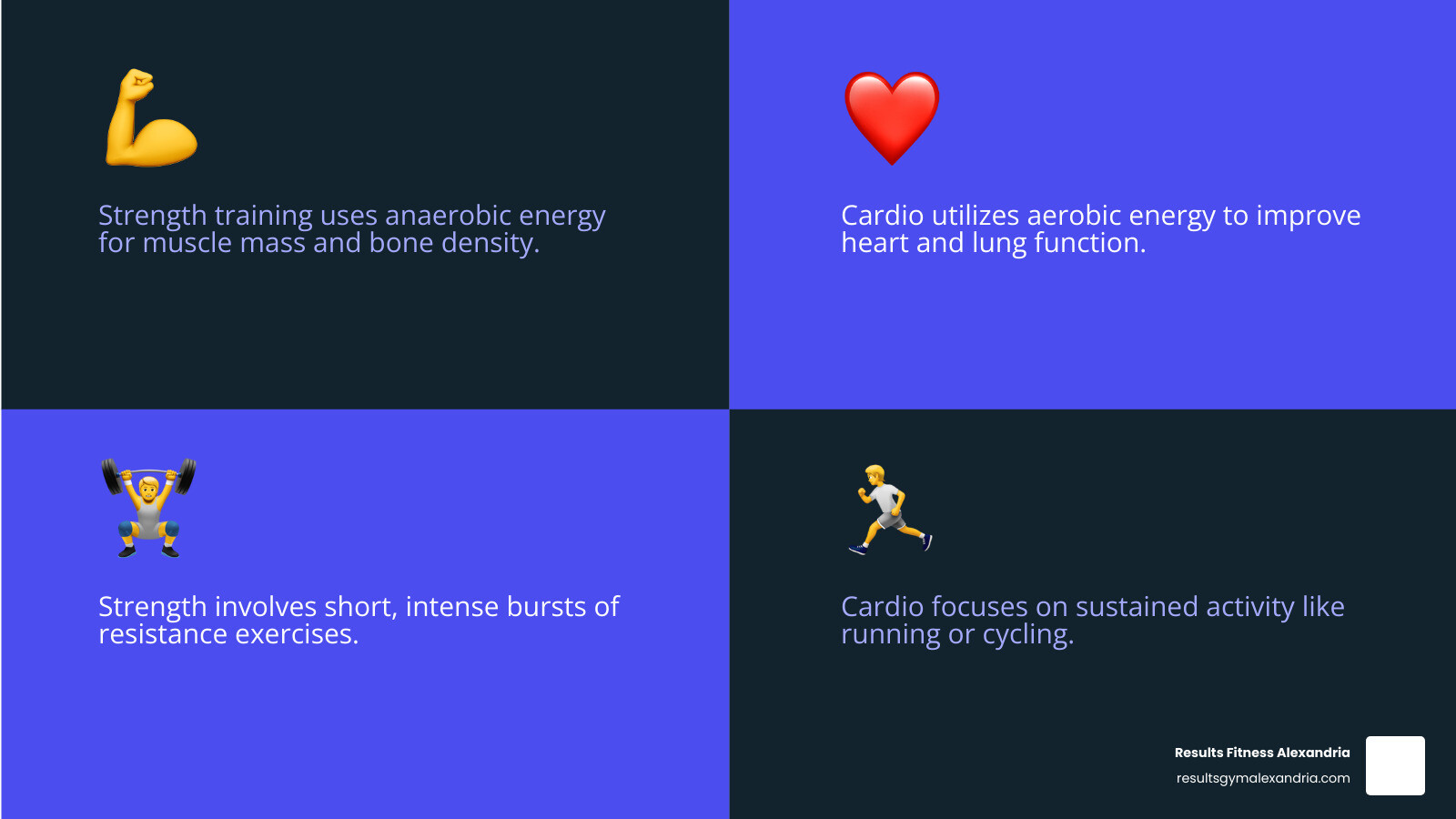
Cardiovascular (cardio) exercise, often called aerobic exercise, is any activity that gets your heart rate up and keeps it liftd for a sustained period. Think running, cycling, swimming, or rowing. The primary goal is to challenge and strengthen your heart and lungs, making them more efficient at delivering oxygen-rich blood to your muscles.
The benefits are truly heart-pumping:
- Improved Heart and Lung Function: Cardio is the undisputed champion of heart health. It helps improve the function, strength, and efficiency of your cardiovascular system. Research consistently shows that individuals who regularly engage in cardio have a lower resting heart rate and better lung capacity. This means your heart doesn’t have to work as hard to pump blood, and your lungs can take in more oxygen with each breath, improving your overall stamina and endurance. Learn more about how to Build Cardiovascular Endurance and achieve Better Heart Health.
- Reduced Risk of Chronic Diseases: A consistent cardio routine is one of the most effective ways to lower your risk of developing serious health conditions. It’s particularly effective in reducing the risk of conditions like type 2 diabetes, high blood pressure, and certain types of cancer. By improving insulin sensitivity and helping to manage blood pressure, cardio plays a vital role in long-term health.
- Weight Management and Calorie Burn: Cardio is a fantastic tool for burning a high number of calories in a single session. When you engage in aerobic activity, your body uses both fat and carbohydrates for energy. This makes it an excellent way to create a calorie deficit, which is essential for weight loss and maintaining a healthy weight.
- Stress Relief and Mood Boost: Feeling stressed? A good run or bike ride can be incredibly therapeutic. Exercise is a well-known stress reliever, and cardio, in particular, excels at this. The rhythmic, repetitive nature of many cardio activities can have a meditative effect, helping to clear your mind. This release of endorphins, often called the “runner’s high,” leads to a significant improvement in mood and a reduction in anxiety and depression symptoms. Research even suggests that aerobic exercise can be a powerful tool in managing stress and improving mental well-being.
The Muscle-Building Advantages of Strength Training
Strength training, also known as resistance training or anaerobic exercise, involves using resistance to induce muscular contraction. This resistance can come from free weights, machines, resistance bands, or even your own body weight (think push-ups or planks). The goal is to build muscle mass, strength, and endurance.
Here’s why strength training is indispensable:
- Builds Lean Muscle Mass: The most obvious benefit is, of course, building muscle! When you challenge your muscles with resistance, you create microscopic tears in the muscle fibers. Your body then repairs these tears, making the muscles bigger and stronger. This process, known as hypertrophy, is detailed in The Science of Building Muscle: Tips for Effective Strength Training.
- Metabolism Boost (EPOC and RMR): While strength training might burn fewer calories during a workout compared to a long cardio session, it offers a fantastic “after-burn” effect. This is known as Excess Post-exercise Oxygen Consumption (EPOC), and it means your body continues to burn calories at an liftd rate for up to 48 hours after a tough strength workout as it works to repair and rebuild muscle tissue. Beyond EPOC, increased muscle mass itself boosts your resting metabolic rate (RMR), meaning you burn more calories even when you’re just sitting around.
- Improved Bone Density: As we age, bone density naturally declines, increasing the risk of osteoporosis and fractures. Strength training is incredibly effective at stimulating bone growth and can help improve bone density and slow down age-related bone loss. This is a crucial benefit for long-term health, mobility, and independence.
- Improved Body Composition: By building lean muscle and burning fat, strength training helps you achieve a more toned and defined physique. It’s about losing fat while maintaining or increasing muscle mass, which leads to a healthier body composition and a more sculpted look, rather than just a smaller version of your current shape.
- Boosted Self-Esteem and Sleep Quality: Strength training doesn’t just make you physically stronger; it also offers a significant boost to your self-esteem. Seeing your progress, lifting heavier weights, and feeling more capable can be incredibly empowering. And for those nights when you’re counting sheep, a 2022 study gave a slight edge to resistance (strength) training for improving sleep quality and duration. For more insights, check out 10 Benefits of Strength Training for Women.

How to Combine Strength and Cardio for Optimal Results
Now that we understand the individual superpowers of strength and cardio, the real magic happens when we bring them together. Integrating both effectively requires a smart approach to scheduling, sequencing, and understanding your personal goals. If you’re just starting, our guide on Creating an Effective Workout Routine for Beginners can help.
Structuring Your Week: Frequency and Duration
The good news is that you don’t have to choose between cardio and strength training. In fact, official guidelines recommend both! A well-rounded fitness plan incorporates both modalities to maximize benefits and prevent plateaus.
- General Guidelines: The Physical Activity Guidelines for Americans recommend that adults get at least 150 minutes of moderate-intensity aerobic activity or 75 minutes of vigorous-intensity aerobic activity per week. Additionally, they recommend muscle-strengthening activities on 2 or more days a week. The American College of Sports Medicine (ACSM) and the CDC provide similar recommendations, suggesting at least 30 minutes of moderate cardio 5 days a week or 20 minutes of vigorous cardio 3 days a week, along with two full-body strength training sessions per week.
- Expert Recommendations: Fitness experts like Betina Gozo advocate for at least some form of strength or resistance training three times a week for 20 to 30 minutes, at a high intensity (a level of seven or more out of 10). For cardio, she suggests adding it on two or three additional days, even if it’s just a 30-minute walk. This approach ensures you’re building muscle and maintaining cardiovascular health without overtaxing your body.
- Alternating vs. Splitting: You can structure your week by alternating days (e.g., strength on Monday, cardio on Tuesday, strength on Wednesday, etc.) or by splitting your workouts (e.g., upper body strength + short cardio, lower body strength + short cardio). Alternating days is often ideal as it allows for full recovery between different types of workouts, maximizing performance in each session. For example, a Monday strength session is followed by a Tuesday run, allowing your muscles to recover before the next lifting day. Research suggests that performing endurance and strength training on separate days may optimize peak oxygen consumption (VO2max) adaptations compared to doing them in the same session. This separation gives your body the best chance to excel at both.
| Goal | Strength Training (per week) | Cardio (per week) | Example Schedule – |
|---|---|---|---|
| Fat Loss | 2-3 days (full body or split routine) | 3-5 days (mix of HIIT and steady-state) | Mon: Full Body Strength, Tue: 30-min HIIT, Wed: Rest or Active Recovery, Thu: Full Body Strength, Fri: 45-min Steady-State Cardio, Sat: Light activity (e.g., long walk), Sun: Rest. – |
| Muscle Gain | 3-5 days (split routine recommended) | 2-3 days (low-to-moderate intensity) | Mon: Upper Body Strength, Tue: 20-30 min LISS Cardio, Wed: Lower Body Strength, Thu: Rest, Fri: Full Body Strength, Sat: 20-30 min LISS Cardio, Sun: Rest. – |
| General Fitness | 2-3 days (full body) | 2-3 days (mix of moderate and high intensity) | Mon: Full Body Strength, Tue: 30-min Moderate Cardio, Wed: Rest, Thu: Full Body Strength, Fri: 20-min HIIT, Sat: Active Recovery (e.g., yoga, long walk), Sun: Rest. – |
Same-Day Sessions: Which Comes First?
It’s a classic gym debate: if you’re doing both cardio and strength in the same session, which should you do first? The answer depends entirely on your primary fitness goal.
-
For Strength and Muscle Gain: If your main objective is to get stronger or build muscle, lift weights first. Strength training is neurologically and physically demanding. You want to approach your heavy lifts with full energy stores to maximize your performance and reduce the risk of injury. Doing a long cardio session beforehand can fatigue your muscles, compromise your form, and limit the amount of weight you can lift, ultimately hindering your progress.
-
For Endurance and Fat Loss: If your primary goal is to improve your cardiovascular endurance or maximize calorie burn for fat loss, do cardio first. Your body will be fresh, allowing you to push harder, run faster, or go longer. Following up with strength training is still beneficial, as it will help preserve muscle mass while you’re in a calorie deficit. However, be aware that your strength performance might be slightly reduced.
This phenomenon is known as the interference effect, where combining both types of training in one session can slightly blunt the response to each. However, for most people aiming for general fitness, the effect is minimal. The most important thing is to be consistent. If your schedule only allows for one gym visit, doing both is far better than doing none. For more on this, check out our guide on Maximizing Results: Integrating Strength Training Into Your Cardio Routine.
The Role of Strength and Cardio in Fat Loss
When it comes to fat loss, both cardio and strength training are powerful allies. A common misconception is that you should only focus on cardio to burn calories, but this approach is shortsighted.
-
Cardio’s Role: Cardio is excellent for creating a calorie deficit, which is the fundamental requirement for losing weight. A 30-minute run can burn a significant number of calories.
-
Strength Training’s Role: Strength training builds muscle, and muscle is metabolically active tissue. The more muscle mass you have, the higher your resting metabolic rate (RMR), meaning you burn more calories throughout the day, even when you’re not exercising. Furthermore, intense resistance training creates an “afterburn effect” known as Excess Post-exercise Oxygen Consumption (EPOC). Your body continues to use energy to repair and rebuild muscle fibers for up to 48 hours after your workout, further increasing your total daily energy expenditure.
For optimal fat loss, a combination is best. Use strength training to build and maintain muscle mass, which keeps your metabolism high, and use cardio to increase your overall calorie burn. This two-pronged attack is far more effective and sustainable than relying on one method alone. For a detailed plan, explore our Fat Loss Gym Workout for Females.