
Endurance training tips: Next-Level 2025
Why Endurance Training Matters for Your Fitness Journey
Endurance training tips can transform how your body performs, whether you’re chasing a personal best, keeping up with your kids, or simply wanting to climb stairs without getting winded. Improving your endurance changes everything, strengthening your heart and lungs, boosting mental health, and reducing your risk of chronic diseases.
But how do you start, especially when life gets in the way? The good news is you don’t need to run marathons to see results. The American Heart Association recommends just 30 minutes of moderate activity, five days a week. If that sounds like too much, you can start with 10-15 minutes and build from there.
Quick Endurance Training Essentials:
- Start with moderate intensity – Aim for 150 minutes per week (30 minutes, 5 days)
- Build gradually – Begin with 10-15 minute sessions if you’re new to exercise
- Mix your training – Combine steady cardio with interval work
- Add strength training – 2x per week to prevent injury and improve performance
- Prioritize recovery – Rest days are when your body adapts and gets stronger
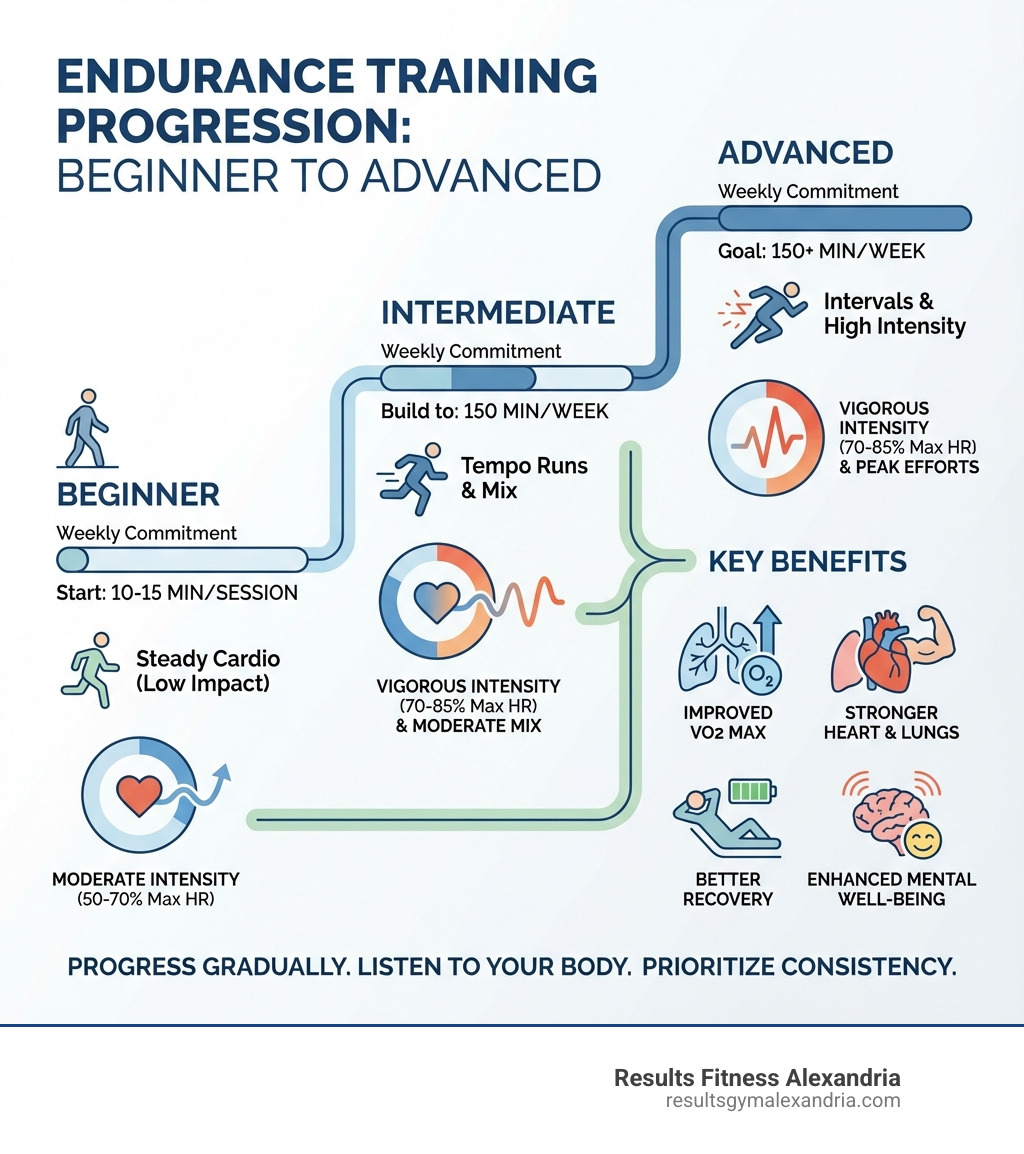
- Track your heart rate – Stay in 50-70% of max for moderate intensity, 70-85% for vigorous
As Jennifer Rapchak, Fitness Director at Results Fitness Alexandria with over 14 years of experience in personal training, I’ve helped countless members apply these Endurance training tips to transform their fitness levels and daily energy. In this guide, I’ll break down exactly how to build sustainable endurance using proven training principles and practical strategies that fit into your busy life.
What is Endurance and Why Does It Matter?
When we talk about endurance, we’re really talking about our body’s amazing capacity to sustain effort over time. It’s about making our bodies more resilient and capable. Often, people use the terms “endurance” and “stamina” interchangeably, but there’s a subtle yet important distinction. Think of it this way: endurance is your ability to sustain a lower-intensity effort for a long duration, while stamina is your ability to sustain or repeat higher-intensity efforts without succumbing to fatigue. The best endurance training tips will help you build both.
At the heart of endurance lies our body’s ability to deliver oxygen to working muscles. This involves two main types of endurance:
- Cardiovascular (aerobic) endurance: This is how efficiently our heart and lungs can supply oxygen to our muscles during sustained exercise. Good cardiovascular endurance means you can exercise for longer before getting tired.
- Muscular endurance: This refers to a specific muscle or group of muscles’ ability to repeatedly exert force or maintain tension over an extended period, like doing multiple push-ups or holding a plank.
For a deeper dive into how these two types of endurance work together, check out our Muscular Cardiovascular Endurance Ultimate Guide.
So, what are the real benefits of improving our endurance? The list is impressive:
- Reduced Risk of Heart Disease: Strong cardiovascular endurance contributes to a healthier heart and can improve blood pressure levels.
- Better Sleep Quality: Research shows that aerobic exercise can improve sleep duration and quality.
- Boosted Immune Function: Exercise is a valuable tool for boosting our immune function.
- Improved Mental Health: Endurance training has been shown to decrease anxiety and depression and improve self-esteem.
The Science of Endurance: VO2 Max Explained
If you’ve ever looked into endurance sports, you’ve probably heard the term “VO2 Max.” It’s the maximum amount of oxygen your body can use during intense exercise. A high VO2 Max indicates excellent aerobic capacity, showing how well your heart, lungs, and muscles work together. This makes VO2 Max a strong indicator of both cardiovascular and overall health. A low VO2 Max is associated with an increased risk of cardiovascular disease.
How do we improve this crucial metric? It’s not about magic, but consistent, varied training:
- High-intensity intervals (HIIT): Fantastic for boosting VO2 Max, these sessions involve short bursts of hard work (around 90% of your max heart rate) with short recovery periods.
- Long steady work: Long runs at an easy to steady intensity build more mitochondria (the “powerhouses” of your cells) in your muscles, making them more efficient.
- Tempo or “comfortably hard” runs: These efforts are sustained for 20-60 minutes at a challenging but maintainable pace, improving your lactate threshold.
For specific workouts and a deeper dive into optimizing your VO2 Max, we recommend checking out 6 Ways To Increase Your VO2 Max (Plus 6 VO2 Max Workouts!).
How Much Endurance Training is Recommended?
One of the most common questions we hear at Results Fitness Alexandria is, “How much endurance exercise do I really need?” The American Heart Association (AHA) provides clear recommendations for adults: aim for at least 150 minutes of moderate-to-vigorous activity per week. This breaks down to about 30 minutes a day, five days a week.
- Moderate-intensity activity: You’re working hard enough that you can talk, but not sing. Your target heart rate is typically 50 to 70 percent of your maximum.
- Vigorous-intensity activity: You’re breathing hard and fast, and can only speak a few words at a time. Your target heart rate is usually 70 to 85 percent of your maximum.
If 30 minutes feels daunting, start with 10-15 minute bouts of training and gradually work your way up. Consistency is more important than intensity when you’re just starting. For beginners, we have a fantastic resource: Building Cardio Endurance for Beginners.
Key Principles for Building Endurance
Building endurance isn’t just about clocking miles or hours; it’s about smart, strategic training. We rely on a few fundamental principles that guide our programs and ensure you see consistent progress.

First up, let’s talk about The SAID Principle, which stands for Specific Adaptation to Imposed Demands. Simply put, your body gets good at what you consistently ask it to do. If you primarily train your upper body, your upper body strength will improve, but your lower body might stay the same. In the context of endurance, if you want to improve your running endurance, a significant portion of your training needs to involve running. If you’re training for a cycling event, you’ll spend a lot of time on the bike. Your body adapts specifically to the stresses you place upon it.
Next, we have The Overload Principle. This means that for your body to get stronger or fitter, you need to gradually increase the demands you place on it. If you keep doing the same workout at the same intensity, your body will adapt to that level and stop improving. To continue making progress, you need to progressively overload – that means increasing the distance, speed, time, or resistance of your workouts. But remember, “gradual” is the key word here. We don’t want to do too much, too soon, which can lead to injury.
This brings us to the overarching theme of consistency. Your body needs regular stimuli to adapt. Sporadic workouts, no matter how intense, won’t yield the same results as consistent, even moderate, effort. This is why finding activities you genuinely enjoy is one of our top endurance training tips – it makes consistency so much easier! As we’ve seen from the American Heart Association, even 30 minutes, five days a week, can make a huge difference. For runners, understanding how to apply these principles over time is vital, as explored in How to build running endurance over time.
Finally, don’t forget the importance of variety. While the SAID principle emphasizes specificity, a well-rounded fitness routine includes all four types of exercise: endurance, strength, balance, and flexibility. Integrating different types of movement not only helps prevent overuse injuries but also keeps your body challenged in new ways and makes your fitness journey more engaging.
Your Blueprint for Success: Essential Endurance Training Tips
Now that we understand the “why” and the guiding principles, let’s dive into the “how.” Building endurance effectively involves a mix of different training methods, each targeting specific physiological adaptations. Here’s a look at some of the most effective strategies we use at Results Fitness Alexandria:
| Training Method | Intensity | Duration | Primary Benefit – – – – – – – – – – – – – – – — |
- Long Slow Distance (L-S-D): This involves exercising at a moderate, conversational pace (60-70% of max HR) for 30+ minutes. The goal is to build your aerobic base, improve your body’s ability to use fat for fuel, and strengthen your heart and lungs. For more on this, see our Aerobic Exercise Complete Guide.
- Pace/Tempo Training: This is a “comfortably hard” effort sustained for 20-60 minutes, typically near your lactate threshold. This type of training is excellent for improving your ability to maintain a faster pace for longer before fatigue sets in. Learn more about Aerobic Endurance Training Strategies.
Advanced Endurance Training Tips: Interval Training
Interval training is a powerful tool to boost your fitness to the next level by alternating between high-intensity work and recovery periods.
- High-Intensity Interval Training (HIIT): HIIT involves short, all-out bursts of effort followed by brief recovery. This method is incredibly efficient for boosting your VO2 Max and overall cardiovascular fitness. A typical session might involve 30-60 seconds of hard work followed by 1-2 minutes of rest, repeated several times. Learn more in our Circuit Training Cardio Complete Guide.
- Fartlek Training: Swedish for “speed play,” this is an unstructured form of interval training. Instead of fixed times, you vary your intensity based on how you feel or your surroundings—sprint to the next tree, jog to the corner, then run hard up a hill. It’s a fun way to improve your ability to change pace and push your limits.
Here are some excellent examples of endurance exercises you can incorporate into your routine:
- Running: A classic for a reason. Easily scalable from a brisk walk to a full sprint.
- Cycling: A fantastic low-impact option, whether outdoors or on a stationary bike.
- Swimming: A full-body workout that’s gentle on the joints.
- Rowing: A powerful, full-body workout that builds both cardiovascular and muscular endurance.
- Brisk Walking: An excellent and accessible way to build your aerobic base.
Beyond the Cardio: Supporting Your Endurance Goals
While cardio is king for endurance, it’s not the only piece of the puzzle. To truly reach your next level, you need to support your body outside of those long runs, rides, or swims.

The Role of Strength Training
Strength training is one of the most powerful endurance training tips for building a resilient, efficient body.
- Injury Prevention: Stronger muscles and a stable core help prevent common overuse injuries associated with endurance sports.
- Improved Economy: A stronger body uses less energy to perform the same movement, meaning you can go faster and longer before tiring. We explore this further in Does Cardio Build Endurance for Weight Training?.
- What to Do: Incorporate 2 days of strength training per week. Focus on compound movements like squats, deadlifts, and lunges. For muscular endurance, use lighter weights with higher repetitions (12-20+ reps). For more guidance, check out our Strength Training for Women Complete Guide.
Recovery: The Missing Piece of the Puzzle
Training breaks you down; recovery builds you back up stronger. Neglecting it can lead to burnout and injury.
- Sleep: Aim for 7-9 hours of quality sleep per night. This is when your body does most of its repair and adaptation.
- Rest Days: These are non-negotiable. They allow your muscles to heal and your energy stores to replenish.
- Active Recovery: On rest days, light activity like walking or stretching can help reduce muscle soreness by increasing blood flow.
- Listen to Your Body: Pay attention to signs of overtraining, such as persistent fatigue, irritability, or a lack of motivation. It’s okay to take an extra rest day when needed.
- Training While Sick: As a general rule, if symptoms are “above the neck” (runny nose, mild sore throat), light activity is usually fine. If you have a fever, body aches, or chest congestion, it’s best to rest completely. When you return, ease back into your routine gradually.
Frequently Asked Questions about Endurance Training
We get a lot of great questions about building endurance, and we’re here to provide clear, simple answers based on proven methods.
How long does it take to see improvements in endurance?
This is a common question, and the good news is that your body is remarkably adaptable! For beginners, you can often see noticeable improvements in your endurance in just 8-12 weeks of consistent training. This might mean being able to walk longer, run a bit further, or sustain an activity with less effort.
However, the timeline depends on several factors: your starting fitness level, the consistency of your training, and whether you’re applying progressive overload. For those with a solid base, optimizing stamina development can take 6-9 months, and building deep, long-term endurance can be a journey of several months or even years. The key is to celebrate the small victories and keep showing up!
How do I start endurance training if I have a sedentary lifestyle?
Starting from a sedentary lifestyle might seem daunting, but it’s absolutely achievable, and it’s one of the most impactful changes you can make for your health. Our top endurance training tips for beginners are all about making it manageable and enjoyable:
- Start Slow and Small: Don’t try to do too much too soon. The American Heart Association recommends beginning with 10-15 minute bouts of endurance training. This could be a brisk walk around your neighborhood.
- Brisk Walking is Your Best Friend: Brisk walking is an excellent, low-impact starting point. It strengthens your cardiovascular system and trains your body to sustain effort without excessive stress on your joints. As you get fitter, you can gradually increase your speed, distance, or even add hills. For more guidance, check out our Building Cardio Endurance for Beginners guide.
- Gradually Increase Duration Before Intensity: Focus on increasing the amount of time you spend moving before you worry about how fast or hard you’re going. Once you can comfortably walk for 30 minutes, then you can start adding short bursts of faster walking or gentle jogging.
- Find Activities You Enjoy: This is critical for consistency. If you hate running, don’t force it! Try cycling, swimming, dancing, or even hiking. The best exercise is the one you’ll actually do.
Can yoga and meditation improve my endurance?
Absolutely! While they might not be the first things that come to mind when you think of endurance training tips, yoga and meditation can play a surprisingly powerful role in enhancing your physical endurance, especially for the mental aspects.
- Stress Reduction and Recovery: Intense training can be stressful on the body. Yoga and meditation are fantastic tools for stress reduction, which in turn aids in recovery. When your body is less stressed, it can repair and adapt more efficiently.
- Improved Focus and Mental Fortitude: Endurance events often become a mental game long before they become a physical one. A 2016 study found that medical students who underwent six weeks of yoga and meditation had significant improvements in feelings of peace, focus, and endurance. This improved mental resilience helps you push through discomfort and maintain effort when your body wants to quit.
- Better Breathing Techniques: Many yoga practices emphasize deep, controlled breathing. By improving your respiratory efficiency and lung elasticity, you can take in more oxygen with less effort, directly benefiting your physical endurance.
- Mind-Body Connection: Yoga helps you become more attuned to your body’s signals, allowing you to listen to it more effectively – knowing when to push and when to back off. This “mind-body wisdom” is invaluable for sustainable endurance training.
Start Your Endurance Journey Today
We’ve covered a lot of ground today, from understanding what endurance truly means to breaking down the science of VO2 Max and exploring practical endurance training tips. The journey to next-level endurance is built on a few core principles: consistency, progressive overload, smart recovery, and integrating strength training.
The journey of a thousand miles begins with a single step. Whether you’re taking your first steps towards a more active lifestyle or pushing for a new personal best, every effort counts. It’s about finding what works for your body and your goals, and building from there.
At Results Fitness Alexandria, we provide the equipment and support for every step of your fitness journey. Our top-of-the-line cardio machines, expert personal trainers, and motivating group classes are all designed to help you build the endurance you need to live life to the fullest. We believe fitness should be accessible and enjoyable for everyone, which is why we offer a free 1-day pass to try our amenities.
Ready to go the distance? Come visit us and Explore Our Cardio Amenities. We can’t wait to help you open up your full potential!