Dive Into Fitness: Why Low Impact Water Aerobics is Perfect for You
Why Low Impact Water Aerobics Deserves a Spot in Your Fitness Routine
Low impact water aerobics is a pool-based exercise style that uses water’s natural buoyancy and resistance to give you a full-body cardio and strength workout — without stressing your joints.
Quick answer: What is low impact water aerobics?
- Exercise performed in waist-to-chest-deep water, with feet on or near the pool floor
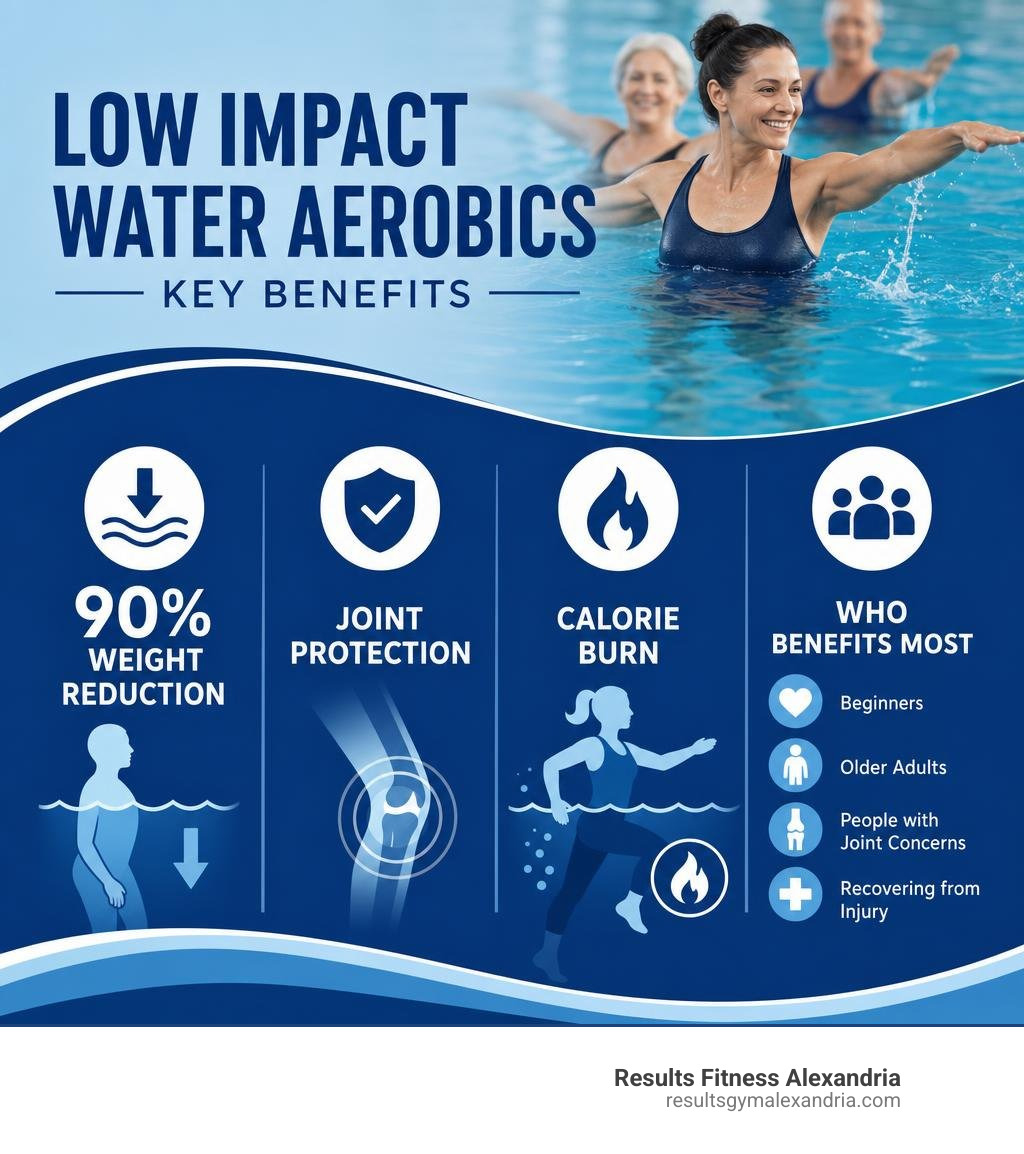
- Buoyancy reduces your effective body weight by up to 90%, taking pressure off joints and bones
- Water provides 12–14% more resistance than air, so muscles still work hard
- No swimming ability required
- Suitable for beginners, older adults, people with arthritis, and anyone recovering from injury
- Burns roughly 120–178 calories per 30-minute session depending on body weight
Here’s the thing most people don’t realize: low impact does not mean low intensity. You can genuinely challenge your cardiovascular system and build muscle strength in the pool — all while your knees, hips, and back stay comfortable.
Research backs this up. Studies show that 10 or more weeks of water aerobics can reduce body weight by nearly 3 kg and trim waist circumference by around 3 cm, particularly in women and adults over 45. A 12-week program has also been shown to improve upper body explosive strength, reduce body fat, and lower systolic blood pressure.
Whether you’re just starting out, managing a chronic condition, or simply tired of high-impact workouts that leave you sore, the pool offers a surprisingly powerful fitness environment.
I’m Jennifer Rapchak, Fitness Director at Results Fitness Alexandria, and with over 14 years of experience as an ACE-certified personal trainer, I’ve seen how low impact water aerobics can transform fitness for people who thought joint pain or a hectic schedule had closed the door on exercise. Let’s break down exactly how it works and how you can get started.
Understanding Low Impact Water Aerobics
To truly appreciate why water is such a magical training partner, we have to look at the physics of the pool. When you exercise on land, your body constantly fights gravity, resulting in repetitive shock waves traveling up through your ankles, knees, hips, and spine. In the water, those rules are rewritten.
At its core, low impact water aerobics leverages the unique properties of water to create a safe, highly efficient exercise environment. One of the most powerful forces at play is hydrostatic pressure. When you submerge your body in water, the liquid exerts an equal, gentle pressure on all sides of your body. This pressure acts like a built-in compression sleeve for your entire system.
Hydrostatic pressure assists your cardiovascular system by encouraging blood flow back to your heart, reducing swelling in lower extremities, and lowering your resting heart rate while you work out. This means your heart can pump blood more efficiently than it does on land, allowing you to achieve a high-quality cardio session with less cardiovascular strain.
Simultaneously, the pool provides natural joint decompression. When you are standing in chest-deep water, the upward force of buoyancy relieves the constant downward compression on your spine and lower-body joints. If you have spent years dealing with compressed discs or worn-down knee cartilage, this decompression feels like an instant sigh of relief. It allows you to move through a full range of motion that might feel completely impossible on dry land. Understanding this makes it clear why shifting some of your routine to the pool is a smart choice for long-term health, as detailed in our guide on Low Impact Exercise.
For a complete breakdown of how these forces combine to protect your body while challenging your endurance, you can also explore WebMD’s overview of Water Aerobics: Low-Impact Pool Workout.
Buoyancy vs. Gravity
To put the power of buoyancy into perspective, consider this: when you stand in water up to your chest, your body weight is reduced by approximately 90%. If you weigh 150 pounds on land, your joints only have to support and absorb the impact of about 15 pounds in the pool!
This drastic weight reduction virtually eliminates the harsh landing impacts associated with traditional cardio. When you perform a jumping jack on a gym floor, your joints absorb an impact force of up to three times your body weight. In the pool, that landing is slowed down and cushioned by the water. You get all the cardiovascular benefits of jumping, running, and skipping without the wear and tear on your skeletal system. This makes pool sessions one of the most sustainable forms of Low Impact Cardio available today.
Bidirectional Resistance
On land, resistance is unidirectional—gravity only pulls things down. If you lift a dumbbell during a bicep curl, you are working against gravity on the way up, but on the way down, gravity is doing the heavy lifting for you unless you actively resist it.
Water is different. Because of water’s viscosity, it offers bidirectional resistance. Every push, pull, scoop, and sweep you make is met with resistance in every single direction. When you push your arms down through the water, your triceps and lats work hard. When you pull your arms back up, your biceps and chest take over.
This creates a highly balanced workout dominated by concentric muscle actions—meaning your muscles are contracting as they shorten, with very little of the eccentric (lengthening) strain that typically causes severe muscle soreness the next day. Because water provides roughly 12% to 14% more resistance than air, simply moving your limbs through the water acts as a continuous, gentle strength-training session that tones your muscles while keeping you moving.
Health and Fitness Benefits of Pool Cardio

Many people look at a water fitness class and assume it is just a pleasant, leisurely splash. But when you look at the scientific data, the physiological benefits of aquatic training are incredibly robust. Incorporating Aquatic Exercise into your regular schedule is one of the most effective ways to build functional strength and endurance.
Cardiovascular Health and Blood Pressure
A common goal for many of our members in Alexandria is managing cardiovascular health. Because water aerobics requires continuous, full-body movement, it is a phenomenal way to strengthen your heart muscle.
The unique environment of the pool has a profound effect on blood pressure. A clinical study published in the Journal of Science in Sport and Exercise evaluated the Role of Exercise Intensity in Water Aerobics over a 24-week period. The researchers discovered that regular water aerobics significantly reduced systolic and diastolic blood pressure in adults and older adults.
Additionally, because of the hydrostatic pressure we discussed earlier, pool workouts trigger a healthy level of post-exercise hypotension (the temporary lowering of blood pressure after a workout), which helps keep resting blood pressure within a safer range over time.
Weight Management and Body Composition
If your goal is shedding body fat and toning up, water workouts are a highly effective tool. Because you are constantly pushing against the resistance of the water, your energy expenditure remains high throughout the entire session.
A comprehensive pooled analysis of clinical trials revealed that consistent water-based exercise (for 10 weeks or more) reduces overall body weight by an average of nearly 3 kg and trims waist circumference by an average of 3 cm in participants who are overweight or obese.
What makes this particularly exciting is that these changes in body composition occur without the high risk of joint injury that often derails land-based weight loss programs (such as running or heavy lifting). For a deeper dive into the science of shedding pounds in the pool, check out our article on How Aquatic Exercise Can Help You Lose Weight and Get in Shape.
Designing Your Pool Workout
To help you visualize how a pool-based routine stacks up against a standard land-based cardio routine, we have put together a quick comparison table:
| Feature | Land-Based Cardio (e.g., Jogging) | Low Impact Water Aerobics |
|---|---|---|
| Joint Impact | High (3x body weight per step) | Extremely Low (up to 90% unloaded) |
| Resistance Type | Unidirectional (gravity only) | Bidirectional (360-degree viscosity) |
| Primary Muscle Actions | Concentric & Eccentric (more soreness) | Primarily Concentric (less soreness) |
| Risk of Falling | Present (uneven surfaces, tripping) | Minimal (water supports balance) |
| Cooling Mechanism | Sweating (can cause overheating) | Conduction (water keeps body cool) |
Setting up a successful routine requires finding the right environment. For a safe and effective session, you want a pool depth that keeps the water between waist and chest height. If the water is too shallow, you lose the benefits of buoyancy and resistance; if it is too deep, you will struggle to keep your feet anchored, which reduces your ability to generate power. Designing a routine that balances these elements ensures that the pool remains an inviting space for Aquatics for All Levels and Ages.
Who Benefits Most from Low Impact Water Aerobics?
While anyone can get a fantastic workout in the water, certain groups will find it particularly life-changing:
- Older Adults: As we age, maintaining balance, muscle mass, and joint mobility becomes crucial. Water provides a fall-safe environment where seniors can train their balance and strength without fear.
- Individuals with Arthritis: The warm water and joint decompression work wonders for reducing arthritic stiffness and pain, allowing for comfortable movement.
- Those in Injury Recovery: If you are recovering from a lower-body injury (like plantar fasciitis, shin splints, or knee strains), the pool serves as the perfect bridge to maintain your fitness levels while you heal.
For a detailed look at how aquatic training specifically supports aging bodies and joint health, you can read more from Oak Street Health’s guide on Water Aerobics for Seniors: Health Benefits & 7 Exercises to Try.
Essential Equipment for Your Pool Routine
While you can get a great workout using nothing but your own body weight and the water, adding a few simple tools can dramatically increase the resistance and variety of your sessions:
- Webbed Gloves: These fit over your hands and increase the surface area of your palms, making every arm sweep significantly harder.
- Water Weights (Foam Dumbbells): Unlike land weights, these are incredibly light out of the water but provide immense resistance when you try to push them under the surface due to their buoyancy.
- Pool Noodles: Excellent for core stabilization exercises and floating support during leg work.
- Kickboards: Great for isolating the lower body and building leg strength.
- Water Shoes: Highly recommended for shallow-water workouts to protect your feet and provide traction on the pool floor.
A 30-Minute Low Impact Water Aerobics Workout Plan
Ready to jump in? Here is a highly effective, structured 30-minute routine designed to maximize cardio and core strength. For a printable version and further detail, you can refer to the 30-Minute Low-Impact Cardio Pool Workout Plan.
1. Dynamic Warm-Up (5 Minutes)
- Water Walking (2 mins): Walk forward and backward across the pool, swinging your arms naturally. Focus on rolling from heel to toe.
- Shoulder Rolls & Arm Sweeps (1.5 mins): Gently roll your shoulders back, then sweep your arms left and right through the water to warm up the upper body.
- Knee Lifts (1.5 mins): March in place, lifting your knees toward your chest while keeping your core braced and spine long.
2. Cardio Builder Block (8 Minutes)
- High-Knee Power March (2 mins): March with high intensity, driving your arms forward and back.
- Water Jacks (2 mins): Perform traditional jumping jacks, but focus on pushing and pulling the water with your arms.
- Side-to-Side Skaters (2 mins): Leap gently from side to side, sweeping your arms in the opposite direction for lateral core engagement.
- Butt Kicks (2 mins): Jog in place, bringing your heels toward your glutes to stretch the quads and engage the hamstrings.
3. Interval Block (8 Minutes)
- Format: 8 rounds of 40 seconds of high-intensity effort followed by 20 seconds of active recovery (easy water walking).
- The Move: Alternating Cross-Country Skiing (sliding your legs forward and back like a cross-country skier while pumping your arms) and Power Boxing (punching forward through the water as fast as possible with a wide, stable stance).
4. Cardio + Core Combo (6 Minutes)
- Noodle Tuck-Ins (3 mins): Hold a pool noodle in front of you. Float your legs out behind you, then pull your knees into your chest, rounding your back slightly to engage your lower abs, and push your legs back out.
- Pool Wall Push-Ups (3 mins): Place your hands on the pool edge. Step your feet back so your body is angled, and perform controlled push-ups against the wall.
5. Cool-Down and Reset (3 Minutes)
- Easy Water Walking (1.5 mins): Let your heart rate slowly descend.
- Static Chest & Hamstring Stretches (1.5 mins): Use the pool wall for balance as you gently stretch your calves, hamstrings, and chest muscles.
Safety, Intensity, and Progression
Just because you are surrounded by water does not mean safety and proper progression should take a backseat. In fact, because water naturally cools your body, it can be easy to forget that you are sweating and burning energy. Staying hydrated by keeping a water bottle at the pool edge is essential.
Additionally, pay close attention to your posture. Keep your spine long, your shoulders relaxed and down, and your core gently engaged throughout every movement to protect your lower back. For more tips on maximizing your safety and results in the pool, take a look at our article on Swimming for Fitness: How Aquatics Classes Can Transform Your Workout Routine.
Measuring Intensity (RPE and Talk Test)
Because water alters your heart rate dynamics (hydrostatic pressure naturally lowers your heart rate by about 10–15 beats per minute compared to land exercise at the same intensity), relying solely on a heart rate monitor can sometimes be misleading. Instead, we recommend using two highly reliable subjective measures:
- Rate of Perceived Exertion (RPE): On a scale of 1 to 10 (where 1 is sitting on the couch and 10 is an all-out sprint), aim to keep your steady-state cardio blocks around a 5 or 6, and your high-intensity intervals around a 7 or 8.
- The Talk Test: During moderate-intensity blocks, you should be able to speak in short sentences but not sing. During high-intensity intervals, you should only be able to gasp out a word or two.
For a deeper dive into adjusting your intensity levels using different aquatic physics, check out the Water Fitness Level Challenge.
4-Week Progression Strategy
To avoid plateauing, you want to gradually challenge your body over time. Here is a simple, highly effective 4-week progression plan:
- Week 1: Find Your Flow. Focus entirely on mastering your form. Keep your movements controlled, your spine long, and get used to the feel of the water’s resistance.
- Week 2: Increase the Range. Focus on making your movements larger. Push your arms deeper and kick your legs wider to displace more water, which naturally increases the resistance.
- Week 3: Add Resistance Tools. Introduce webbed gloves or water weights to your routine to challenge your muscles further.
- Week 4: Boost the Volume. Increase your high-intensity interval times (e.g., move from 40 seconds of work to 50 seconds of work) or add an extra 5 minutes to your total cardio block.
Frequently Asked Questions About Pool Cardio
Do I need to know how to swim?
Not at all! Low impact water aerobics is almost exclusively performed in shallow water (waist-to-chest deep) where your feet remain firmly planted on the pool floor. If you ever do a deep-water class, flotation belts are provided to keep you effortlessly upright and safe.
How many times a week should I do water aerobics?
For optimal results, we recommend starting with 2 to 3 sessions per week on non-consecutive days. This gives your muscles plenty of time to recover while building consistent cardiovascular endurance.
How does water aerobics compare to swimming laps?
While swimming laps is an incredible workout, it requires a high level of swimming technique and keeps your body in a horizontal position. Water aerobics is performed vertically, which translates more naturally to daily functional movements (like walking, climbing stairs, and lifting). It also allows for a wider variety of multi-directional movements, making it highly effective for targeting smaller stabilizing muscles in your hips and core. You can learn more about how different pool workouts stack up in our comparison of The 10 Best Aquatics Classes Compared.
Conclusion
At Results Fitness Alexandria, we believe that fitness should feel rewarding, sustainable, and—most importantly—completely pain-free. If you are ready to experience the incredible benefits of low impact water aerobics for yourself, we invite you to come splash around with us.
We offer a free 1-day pass for all fitness levels to try out our premium amenities, explore our classes, and meet our expert personal trainers. Whether you want to join a group class or work one-on-one with a trainer to build a custom aquatic routine, we have everything you need to dive headfirst into your health journey.
Ready to make a splash? Explore Aquatics Classes at Results Fitness Alexandria today and take the first step toward a stronger, happier, and joint-friendly lifestyle!