Aquatics for All Levels and Ages
Why Aquatics for All Levels Is One of the Smartest Fitness Choices You Can Make
Aquatics for all levels is exactly what it sounds like — water-based fitness and skill-building programs designed to meet you wherever you are, whether you’ve never put your face in the water or you’re already logging serious lap miles.
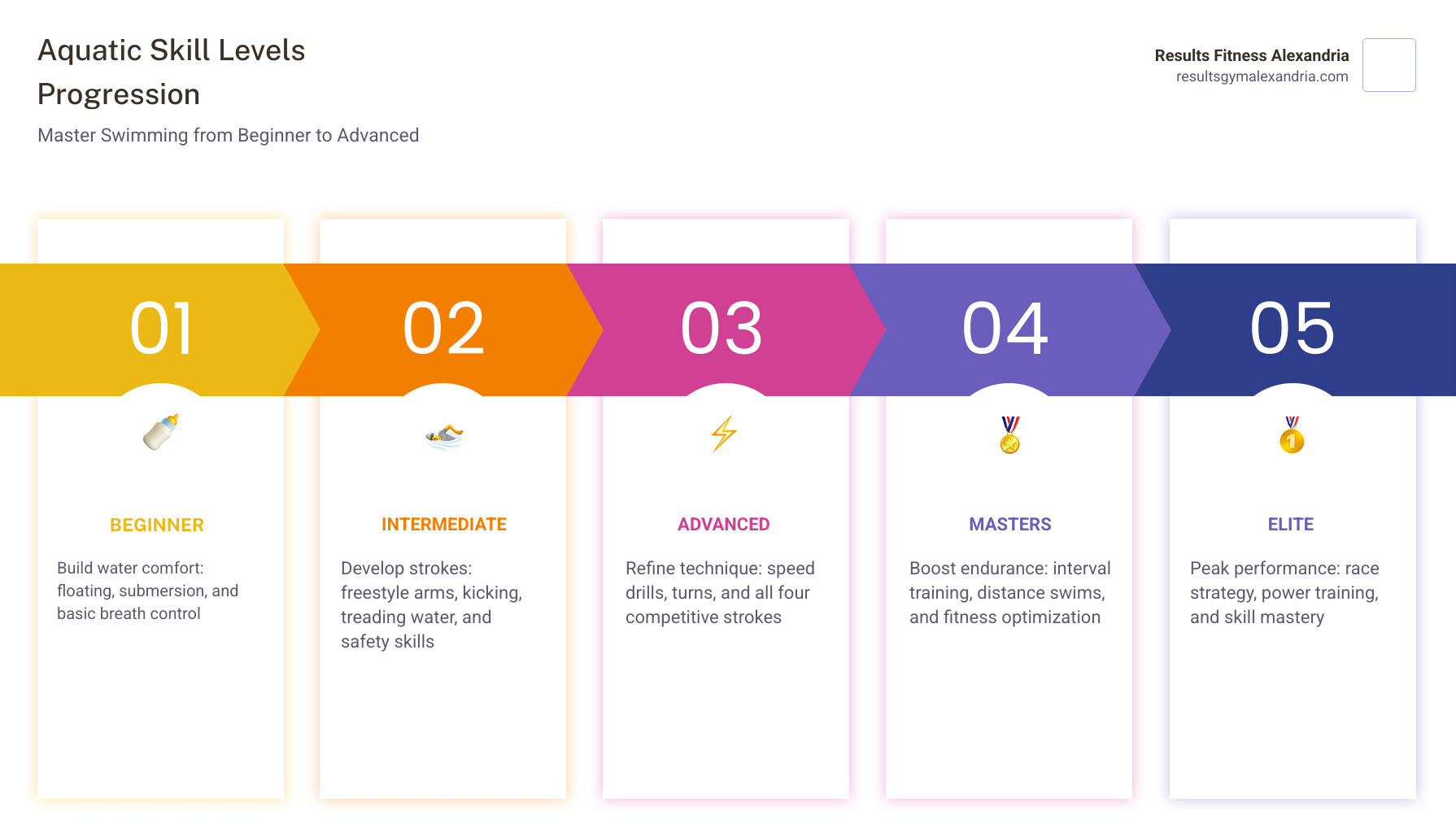
Here’s a quick look at how aquatic skill levels typically progress:
| Level | Who It’s For | Key Focus |
|---|---|---|
| Beginner | Non-swimmers, water-shy adults, young children | Water comfort, floating, breath control |
| Intermediate | Basic swimmers | Stroke development, endurance, safety skills |
| Advanced | Confident swimmers | Technique refinement, speed, competitive strokes |
| Masters/Fitness | Adults of any age | Endurance training, interval sets, overall fitness |
Swimming is genuinely one of the most complete forms of exercise available. It builds cardiovascular fitness, tones muscle, protects your joints, and can even reduce stress. And unlike many workouts, it scales perfectly — beginners and seasoned athletes can train side by side, each at their own pace.
The catch? A lot of people don’t know where to start, which level fits them, or how to build real skills without feeling lost in the water.
That’s exactly what this guide covers.
I’m Jennifer Rapchak, Fitness Director at Results Fitness Alexandria, and with over 14 years of experience designing fitness programs across strength, conditioning, and group exercise, I’ve seen how aquatics for all levels can transform a person’s health and confidence. Let’s break it all down so you can get in the water — and actually enjoy it.
The Core Benefits of Aquatics for All Levels
When we talk about aquatics for all levels, we aren’t just talking about learning to survive in the water. We are talking about a comprehensive fitness tool that addresses nearly every aspect of human health. Whether you are six months old or eighty-six years young, the water offers a unique environment that land-based training simply cannot replicate.
Cardiovascular Health and Weight Management
Swimming is a powerhouse for your heart. Because you are using almost every major muscle group simultaneously, your heart rate increases to supply oxygen to those muscles. This leads to significant calorie burn and improved aerobic capacity. If you’ve been looking for a way to shed pounds without the grueling impact of a treadmill, you should explore How Aquatic Exercise Can Help You Lose Weight And Get In Shape.
Low-Impact Exercise and Joint Mobility
One of the greatest advantages of aquatics is buoyancy. When you are submerged to your neck, you only experience about 10% of your body weight. This makes it the ideal environment for individuals with arthritis, chronic pain, or those recovering from injuries. It allows for a full range of motion without the jarring impact on joints that comes with running or jumping.
Mental Wellness and Stress Reduction
There is a meditative quality to swimming. The rhythmic nature of the strokes, the sound of the water, and the controlled breathing patterns combine to create a powerful stress-relief tool. Many of our members find that a session in the aquatics/swimming pool is the most effective way to “unplug” from the digital world and clear their minds.

Structured Progression: From Water Comfort to Advanced Technique
A common mistake is trying to swim laps before you are comfortable simply being in the water. Proper aquatics for all levels programs follow a logical, step-by-step progression to ensure safety and long-term success.
Water Acclimation and Buoyancy
The first step for any beginner is becoming “one with the water.” This starts with water acclimation—getting used to the sensation of water on the face and learning how the body floats. Understanding buoyancy is crucial; many adults struggle because they fight the water instead of letting it support them.
Breath Control
In most sports, you breathe whenever you want. In swimming, your breathing is dictated by your stroke. Mastering breath control is the “secret sauce” of aquatic fitness. This involves learning to exhale slowly and steadily underwater through the nose or mouth (blowing bubbles) so that when you turn to breathe, your lungs are ready to take in fresh air quickly.
Stroke Development and Endurance
Once you are comfortable and breathing correctly, the focus shifts to stroke development. This is where we break down the mechanics of the arms, legs, and core. As technique improves, endurance naturally follows. You stop fighting the water and start moving through it efficiently, allowing you to swim longer distances with less fatigue.
Youth Milestones and Safety Skills
For our younger swimmers, the focus is heavily weighted toward safety. We look for specific milestones that indicate water competency.
- Jump-Turn-Swim: A critical survival skill where a child jumps into deep water, turns back to the wall, and swims to safety.
- Treading Water: The ability to stay vertical with the head above water for 30 to 60 seconds.
- Independent Floating: Being able to roll onto the back to rest and breathe.
- Survival Skills: Knowing how to exit the pool safely and what to do if they fall in unexpectedly.
Adult Aquatics for All Levels: Overcoming Challenges
Learning to swim as an adult is a different psychological journey than it is for a child. Adults often carry years of “water baggage”—fear of the deep, negative past experiences, or simple embarrassment.
The key to adult learn-to-swim success is tension reduction. If you are tense, you sink. If you relax, you float. We focus on horizontal alignment—keeping the hips high and the head down—to reduce drag and make swimming feel less like a struggle and more like a workout.

Mastering the Four Competitive Strokes and Training Plans
To truly enjoy aquatics for all levels, it helps to understand the “Big Four” strokes. These are categorized by the axis of rotation:
| Stroke Type | Strokes | Key Mechanics |
|---|---|---|
| Long-Axis | Freestyle & Backstroke | Body rotates side-to-side around the spine; uses a flutter kick. |
| Short-Axis | Breaststroke & Butterfly | Body moves in an undulating, “up and down” motion; uses whip or dolphin kick. |
The Mechanics of the Catch and Pull
In all strokes, the most important part of the arm movement is the “catch.” This is the moment your hand enters the water and “grabs” a handful of it. From there, you pull your body past your hand. Think of it like climbing a ladder—you reach up, grab a rung, and pull yourself up.
Building Endurance with Aquatics for All Levels
If you are looking to move beyond basic laps and into serious fitness, you need a plan. Many swimmers find success using structured training series that incorporate intervals.
- Interval Training: Instead of swimming 500 yards straight, try 10 sets of 50 yards with 15 seconds of rest between each. This allows you to maintain better form at a higher intensity.
- Rate of Perceived Exertion (RPE): We use a 1-10 scale to measure effort. A level 3 is an easy recovery swim, while a level 9 is a near-sprint.
- 5K Swim Preparation: For those eyeing long-distance events, a 12-week plan is recommended. Start with building a base of 1,000 meters and gradually increase your volume and interval intensity until you are comfortable at the 3,500-meter mark.
Essential Equipment and Pool Etiquette for Success
Walking onto a pool deck for the first time can be intimidating if you don’t know the “rules of the road” or what all the plastic gadgets are for.
The Gear Bag
While you only need a swimsuit, certain tools can accelerate your progress:
- Goggles: Essential for seeing where you are going and protecting your eyes. Test the fit by pressing them to your face without the strap; they should suction for a second or two.
- Fins: These are great for beginners because they provide extra propulsion, allowing you to focus on your arm technique without sinking.
- Pull Buoys: A foam float you place between your legs. This keeps your hips high so you can isolate your upper body workout.
- Kickboards: Used to isolate the legs and build lower-body strength.
- Swimmers Snorkel: This allows you to keep your face in the water and focus on your stroke without having to turn your head to breathe.
Pool Etiquette and Safety
To ensure everyone has a great workout in our aquatics/spa area, follow these standard rules:
- Circle Swimming: If there are more than two people in a lane, everyone swims in a counter-clockwise circle (stay to the right).
- Lane Selection: Choose a lane that matches your speed (Slow, Medium, or Fast).
- Passing: If you need to pass, gently tap the foot of the person in front of you. They should pull over at the next wall to let you by.
- The Pace Clock: Use the big clock on the wall to time your intervals and rest periods. It’s the “stopwatch” of the pool.
Frequently Asked Questions about Aquatic Fitness
How do I choose the right swim level for my current ability?
The best way is to perform a simple self-assessment or “swim test.” Can you comfortably swim 25 yards (one length) without stopping? Can you tread water for 30 seconds? If the answer is no, start with a beginner water acclimation or “Level 1” class. If you can swim multiple laps but find yourself getting winded quickly, an intermediate stroke refinement class is usually the best fit.
What is the best way to improve breathing technique in the water?
Consistency is key. Practice “rhythmic breathing” by standing in the shallow end, putting your face in the water, and blowing bubbles until your lungs feel empty. Then, turn your head to the side to take a quick breath and repeat. The goal is to make the exhale twice as long as the inhale.
How often should I train to see significant fitness results?
For most people, 2 to 3 sessions per week for 30 to 45 minutes is the “sweet spot” for seeing improvements in both technique and cardiovascular fitness. If you are training for a specific event like a triathlon or a 5K swim, you may need to increase this to 4 or 5 sessions per week.
Conclusion
At Results Fitness Alexandria, we believe that aquatics for all levels is more than just a workout—it’s a life skill that opens doors to better health, safety, and recreation. Whether you are looking to lose weight, train for a competition, or simply find a low-impact way to stay active, our facilities and programs are designed to support your journey.
Don’t let another season go by wishing you were more comfortable in the water. We invite you to come see what makes our community special. Grab a free 1-day pass and experience our amenities for yourself. From our supportive instructors to our pristine pool, everything you need to reach your fitness goals is right here.
Start your journey with our premier aquatics programs today and discover the transformative power of the water.