
Build Up Cardio Endurance: Master 3 Proven Ways
Why Building Cardiovascular Endurance Is Your Key to a Healthier Life
To build up cardio endurance is to transform more than just your workouts—it’s to change your entire life. Here’s a quick guide to get you started.
Quick Answer: How to Build Up Cardio Endurance
- Start with steady-state cardio (walking, jogging, cycling) for 30 minutes, 3-5 times per week.
- Add high-intensity interval training (HIIT) 1-2 times per week for faster results.
- Gradually increase duration or intensity by no more than 10% each week.
- Stay consistent for 8-12 weeks to see measurable improvements.
- Track your progress using heart rate zones (60-80% of max heart rate).
Cardiovascular endurance is your heart and lungs’ ability to supply oxygen to your muscles during sustained activity. Think of it as your body’s engine. When you improve it, daily tasks like climbing stairs or playing with your kids become easier, leaving you with more energy at the end of the day.
The benefits are immense. Research shows aerobic exercise reduces your risk of heart disease, high blood pressure, type 2 diabetes, and some cancers, while also improving sleep and mental health.
As Jennifer Rapchak, Fitness Director at Results Fitness Alexandria, I’ve helped hundreds of people build up cardio endurance from scratch. The right plan transforms not just fitness levels, but entire lifestyles.
Common build up cardio endurance vocab:
Why Improving Cardiovascular Endurance Matters
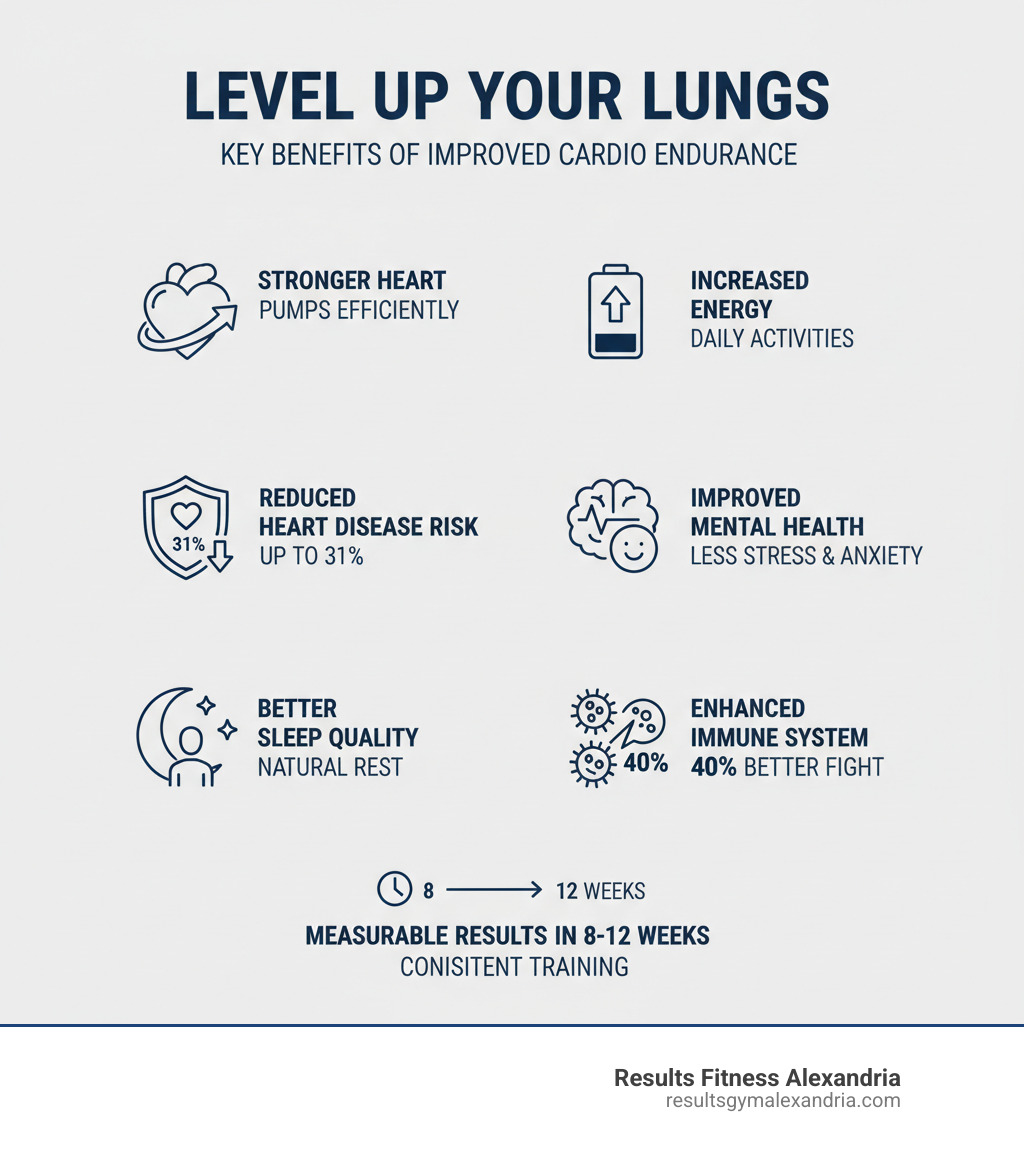
Your cardiovascular endurance isn’t just about fitness—it’s about living a fuller, more energetic life. When you build up cardio endurance, you’re investing in your long-term health.

Reduced Risk of Chronic Diseases
Consistent aerobic exercise makes your heart a more efficient pump, strengthening your entire circulatory system. The American Heart Association recommends at least 150 minutes of aerobic exercise per week. Doing so significantly lowers your risk of heart disease, type 2 diabetes, obesity, stroke, and some cancers. Studies show that good cardiorespiratory fitness can reduce the risk of death from heart disease by up to 31 percent.
Improved Mental Health
The link between cardio and mental health is undeniable. Aerobic exercise prompts your brain to release endorphins, which naturally lift your mood and reduce stress. Regular activity is a proven method for lowering rates of depression and anxiety.
Better Sleep Quality
Struggling with sleep? Better cardio endurance can help. Research shows that people with good cardiorespiratory fitness are less likely to need sleeping pills. Hitting a target of 75 minutes of vigorous activity per week can help regulate sleep cycles, leading to deeper, more restorative rest.
Increased Daily Energy
As your heart and lungs become more efficient at delivering oxygen, everyday tasks require less effort. Groceries feel lighter, stairs seem shorter, and you have the stamina to get through your day without feeling drained. This is a direct result of improved cardiovascular endurance.
Stronger Immune System
Regular moderate exercise is a powerful tool for your immune system. A 2019 review found that it strengthens your body’s defenses by reducing inflammation and activating virus-fighting immune cells. This can lead to a significant reduction in common illnesses like upper-respiratory infections.
When you build up cardio endurance, you’re building a more resilient version of yourself. Learn more about the Benefits of Endurance.
The Best Workouts to Build Up Cardio Endurance
The best workout is one you’ll do consistently. At Results Fitness Alexandria, we emphasize finding activities you enjoy, as consistency is more important than intensity for long-term results. Your goal is to challenge both your aerobic (oxygen-fueled) and anaerobic (short-burst) energy systems.

The Cornerstone: Steady-State Cardio
Steady-state training is the foundation of endurance. It involves maintaining a moderate, consistent pace where you can still hold a conversation. This teaches your body to deliver oxygen efficiently and burn fat for fuel.
- Running and jogging are classic choices for building heart and lung power. Our Treadmill Endurance Workouts can guide your sessions.
- Cycling provides a great cardio workout with less impact on your joints.
- Swimming is a low-impact, full-body workout that many find meditative.
- Rowing is a powerhouse that engages your legs, core, and upper body. Our Rowing Machine Workout guide helps with technique.
- Brisk walking is also highly effective. Your heart benefits from consistent work, regardless of the pace.
The Accelerator: High-Intensity Interval Training (HIIT)
Once you have a solid base, HIIT can accelerate your progress. This involves alternating short bursts of intense effort with brief recovery periods. A 2021 review on HIIT’s effect on the heart showed it makes the heart pump blood more efficiently. Due to its intensity, limit HIIT to 1-2 sessions per week. Our Circuit Training Cardio: Complete Guide shows how to integrate it safely.
How to build up cardio endurance with Cross-Training
Cross-training, or mixing different activities, is a smart strategy to prevent injuries, break through plateaus, and keep workouts interesting. By varying the stress on your body, you continue to adapt and improve.
Combining cardio with strength training creates a well-rounded foundation. Stronger muscles support your cardio efforts, making you more efficient. Consider these pairings:
- Running and swimming for endurance without constant joint impact.
- Cycling and strength training to build powerful legs and a strong core.
- Rowing and yoga for a balance of cardio intensity and flexibility.
Learn more about How to Create a Balanced Fitness Routine.
Measuring and Maximizing Your Progress
To effectively build up cardio endurance, you need to track your progress. This turns random workouts into a structured plan that delivers real results. Establishing a baseline and applying the progressive overload principle are key.
Simple Tests to Measure Your Endurance
Before you can improve, you need to know where you stand. Here are a few simple ways to gauge your fitness:
- The 1.5-mile run test: Run 1.5 miles as fast as you can. Your time provides a clear, objective snapshot of your aerobic capacity. Learn more about the 1.5-mile run test.
- The talk test: During a workout, try to talk. If you can speak comfortably, you’re at a moderate intensity. If you can only manage short phrases, you’re working vigorously.
- The Perceived Exertion Scale (RPE): Rate how hard you feel you’re working on a scale of 6 to 20. A moderate intensity is typically 12-14, while vigorous is 15-17.
These tests help track progress. For more inspiration, check out The Ultimate Endurance Challenge.
Training Smart with Heart Rate Zones
Your heart rate tells you how hard your body is working. First, estimate your Maximum Heart Rate (MHR) = 220 – Your Age. Then, use these zones to guide your training:
| Zone | % of MHR | Description |
|---|---|---|
| Zone 1 | 50-60% | Very light activity, warm-up and recovery |
| Zone 2 | 60-70% | Light activity, builds basic endurance |
| Zone 3 | 70-80% | Moderate activity, improves aerobic fitness |
| Zone 4 | 80-90% | Hard activity, increases performance capacity |
| Zone 5 | 90-100% | Maximum effort, develops speed |
For building endurance, spend most of your time in Zone 2 and Zone 3. The American Heart Association provides guidance on finding your target heart rate for aerobic exercise.
How to build up cardio endurance using Progressive Overload
Your body adapts to exercise, so you must gradually increase the challenge to keep improving. This is progressive overload. The FITT principle provides a simple roadmap:
- Frequency: How often you exercise.
- Intensity: How hard you work.
- Time: How long you exercise.
- Type: What kind of exercise you do.
To progress safely, follow the 10% rule: increase your total weekly training volume (like time or distance) by no more than 10% each week. This helps you avoid plateaus and injury. A structured Cardiovascular Fitness Program can help you apply these principles effectively.
Why Improving Cardiovascular Endurance Matters
When you build up cardio endurance, you’re investing in every aspect of your life. At Results Fitness Alexandria, we see members transform, gaining the energy to hike, play with their kids, and feel vibrant throughout their day.
Your Heart Gets Stronger (And So Does Everything Else)
Consistent cardio strengthens your heart and circulatory system, offering real protection against health problems. Following the American Heart Association’s recommendation of at least 150 minutes of aerobic exercise per week dramatically lowers your risk of heart disease, high blood pressure, type 2 diabetes, and obesity.
Your Mind Gets Clearer
The mental health benefits are just as significant. Exercise releases endorphins, which are natural mood-boosters that help your brain manage stress. Regular cardio is linked to lower rates of depression and anxiety, building mental resilience.
You’ll Actually Sleep Better
Cardiovascular fitness is linked to better rest. Research shows that people with good cardiorespiratory fitness are less likely to need sleep aids. Moderate to vigorous activity helps regulate your body’s sleep-wake cycle for more restorative sleep.
Daily Tasks Become Effortless
As your heart and lungs work more efficiently, everyday activities like walking up stairs or carrying groceries require less effort. This sustained energy is one of the most rewarding results of improved endurance.
Your Immune System Gets Backup
Regular cardio gives your immune system a serious boost. Studies show it helps your body fight off illness by reducing inflammation and activating immune cells, leading to fewer infections.
For more details, explore our article on the Benefits of Endurance.
The Best Workouts to Build Up Cardio Endurance
The best workout is the one you’ll actually do. Consistency is the most critical factor when you build up cardio endurance. A well-rounded routine should include both aerobic exercise (sustained, oxygen-fueled activity) and anaerobic exercise (short, intense bursts).
The Cornerstone: Steady-State Cardio
Steady-state cardio is your foundation. It involves maintaining a consistent, moderate pace that builds your aerobic base and teaches your body to work efficiently. Great options include:
- Running or jogging: A classic and accessible choice. Our Treadmill Endurance Workouts offer structured plans.
- Cycling: A powerful, low-impact cardio workout.
- Swimming: A full-body, joint-friendly endurance builder.
- Rowing: A highly effective workout for your entire body. See our Rowing Machine Workout guide.
- Brisk walking: An underrated but effective way to build your cardio base.
The Accelerator: High-Intensity Interval Training (HIIT)
Once you have a solid fitness base, HIIT can fast-track your results. It alternates maximum-effort intervals with recovery periods, delivering significant gains in short workouts. Research shows HIIT improves cardiovascular efficiency, but its intensity requires caution. Start slowly and limit HIIT to 1-2 times per week. Our Circuit Training Cardio: Complete Guide can help you start safely.
How to build up cardio endurance with Cross-Training
Cross-training, or mixing different exercises, prevents boredom, reduces injury risk, and breaks through plateaus. By combining activities like running, swimming, cycling, and strength training, you challenge your body in new ways, promoting continuous improvement. A balanced routine is key to long-term success. Learn How to Create a Balanced Fitness Routine.
Measuring and Maximizing Your Progress
To effectively build up cardio endurance, you need a plan. Tracking your starting point and consistently challenging yourself with progressive overload is what separates casual exercise from real fitness gains.
Simple Tests to Measure Your Endurance
Gauge your current fitness with these practical methods:
- The 1.5-mile run test: Time yourself running 1.5 miles for an objective measure of your aerobic capacity. Find details on the 1.5-mile run test.
- The talk test: A simple way to gauge intensity. If you can talk, you’re at a moderate pace. If you can’t, you’re working vigorously.
- The Perceived Exertion Scale (RPE): Rate your effort on a 1-10 scale. Moderate is 3-4, while vigorous is 5-7.
For goal-setting inspiration, see The Ultimate Endurance Challenge.
Training Smart with Heart Rate Zones
Using heart rate zones helps you train at the right intensity. First, estimate your Max Heart Rate (MHR) = 220 – Your Age. Then, target these zones:
| Zone | % of MHR | Description |
|---|---|---|
| 2 | 60-70% | Light to moderate intensity for building aerobic base. |
| 3 | 70-80% | Moderate to vigorous effort for improving cardiovascular fitness. |
For building endurance, focus on Zone 2 and Zone 3. The American Heart Association recommends 50-85% of MHR for aerobic exercise.
How to build up cardio endurance using Progressive Overload
To avoid plateaus, you must progressively challenge your body. Use the FITT principle to make gradual adjustments:
- Frequency: How often.
- Intensity: How hard.
- Time: How long.
- Type: What kind.
Follow the 10% guideline: increase your weekly workout time or distance by no more than 10% to adapt safely. A well-designed Cardiovascular Fitness Program can help structure your progress.
Supporting Your Training: Nutrition, Hydration, and Recovery
What you do outside the gym is just as important as your workouts. To truly build up cardio endurance, you need to focus on proper fuel, hydration, and rest. At Results Fitness Alexandria, we emphasize this holistic approach for achieving the best results.
Eating for Endurance
Fuel your body correctly to perform at its best. Your nutrition plan should include:
- Complex carbohydrates: For sustained energy (oats, brown rice, sweet potatoes).
- Lean protein: For muscle repair and growth (chicken, fish, legumes, eggs).
- Healthy fats: For overall health and long-term energy (avocados, nuts, olive oil).
Eat a carb-rich snack 1-2 hours before your workout. Afterward, have a meal with both carbs and protein within 60 minutes to replenish energy and start muscle repair.
The Critical Role of Hydration
Dehydration can ruin your performance. Drink water consistently throughout the day—don’t wait until you’re thirsty. Your urine should be pale yellow. For workouts over 60 minutes, especially in the heat, consider a sports drink to replace lost electrolytes like sodium and potassium. Watch for signs of dehydration such as headache, dry mouth, or fatigue.
Avoiding Burnout: Recognizing Overtraining
Enthusiasm is great, but too much can lead to overtraining, which reverses your progress. Watch for these warning signs:
- Persistent fatigue despite adequate sleep.
- Decreased performance or inability to maintain intensity.
- Irritability and unusual mood swings.
- An liftd resting heart rate upon waking.
- Chronic muscle soreness that doesn’t go away.
- Decreased motivation for workouts.
If you experience symptoms like fever or deep fatigue, rest is non-negotiable. Building endurance is a marathon, not a sprint—listen to your body.
Frequently Asked Questions about Building Cardio Endurance
At Results Fitness Alexandria, we get a lot of questions about how to build up cardio endurance. Here are answers to the most common ones.
How long does it take to see improvements in cardio endurance?
If you’re starting out, you can expect measurable improvement in eight to 12 weeks with consistent training (30 minutes, 3+ times per week). You’ll likely feel a difference in daily activities even sooner. Your progress depends on several factors, including your consistency, intensity, starting fitness level, and genetics, but everyone can improve with a dedicated effort.
Can I build cardio endurance with low-impact exercises?
Yes, absolutely! Low-impact exercises are excellent for building endurance without stressing your joints. Great options include:
- Swimming
- Cycling
- Elliptical training
- Rowing
- Brisk walking
These activities are perfect for building a strong aerobic base and can be combined with other forms of training for a well-rounded routine. For more ideas, check out our guide on Low Impact Cardio.
How often should I do cardio to improve endurance?
The American Heart Association provides clear guidelines. Aim for at least:
- 150 minutes of moderate-intensity aerobic activity per week (like brisk walking or casual cycling).
OR
- 75 minutes of vigorous-intensity aerobic activity per week (like running or HIIT).
For even greater benefits, you can increase your activity beyond these minimums. The key is to spread your workouts throughout the week for consistent progress. As the American Heart Association’s guidelines on endurance exercise suggest, more activity generally leads to greater health benefits. Start where you are and gradually increase your volume as you get fitter.
Start Your Endurance Journey Today
Building cardiovascular endurance is a marathon, not a sprint. It requires consistent effort, smart training, and a focus on nutrition, hydration, and recovery. The rewards are life-changing, giving you more energy, better health, and a clearer mind.
Progress happens one workout at a time. Whether you’re taking your first step or breaking through a plateau, each session brings you closer to a stronger, healthier you. You’ll feel the difference when you take the stairs without getting winded or have the energy to play with your kids after a long day.
At Results Fitness Alexandria, we’re a community that cares about your success. Our certified personal trainers, led by Fitness Director Jennifer Rapchak, meet you where you are. We’ll help you find the best workouts to build up cardio endurance, from steady-state sessions on our top-tier cardio equipment to effective HIIT routines.
Our supportive environment makes all the difference. When you’re surrounded by people who celebrate your victories, staying motivated is easier.
Ready to transform your fitness? We invite you to try us out with a free 1-day pass. Explore our facility, meet our community, and find how enjoyable building endurance can be. There’s no pressure—just an opportunity to start your journey.
Visit our cardio equipment page to see what’s waiting for you. Let’s take this first step together.