Weight lifting for beginners female weight loss: Quick 4-Week Plan
Why Weight Lifting for Beginners Female Weight Loss Works Better Than Cardio Alone
Weight lifting for beginners female weight loss is a highly effective strategy, yet many women still default to endless hours on the treadmill. If you’re ready for a change that delivers real results, here’s what you need to know.
Quick Answer: How to Start Weight Lifting for Fat Loss
- Frequency: 2-3 days per week of full-body strength training.
- Focus: Compound movements like squats, deadlifts, rows, and presses.
- Weight Selection: Choose a weight you can lift for 8-12 reps with good form.
- Key Benefit: Builds muscle that boosts your metabolism 24/7.
- Expected Results: Feel stronger in 2-4 weeks; see visible changes in 6-8 weeks.
While old advice pushed cardio for weight loss, modern science tells a different story. Strength training changes your body composition by building lean muscle while burning fat. Unlike cardio, which primarily burns calories during the workout, weight lifting boosts your metabolism long after you leave the gym. This makes it a superior tool for fat loss, while also improving bone density and creating the toned, strong look many women desire.
Worried about “getting bulky”? Don’t be. Women’s physiology makes that nearly impossible. Instead, you’ll build lean muscle that gives you shape and burns more calories at rest. Since women can lose 3-8% of muscle mass per decade after age 30, strength training is essential for long-term health.
I’m Jennifer Rapchak, Fitness Director at Results Fitness Gym in Alexandria, Virginia. With over 14 years as a certified personal trainer, I’ve seen that weight lifting for beginners female weight loss is not intimidating—it’s empowering, and it works.
Know your weight lifting for beginners female weight loss terms:
Why Lift Weights for Fat Loss? The Science-Backed Benefits for Women
When it comes to fat loss, the type of exercise you choose makes a world of difference. Weight lifting isn’t just about getting strong; it’s a metabolic powerhouse that helps women shed fat, reshape their bodies, and boost overall health in ways cardio alone can’t.
Here are the science-backed benefits that make weight lifting for beginners female weight loss a game-changer:
-
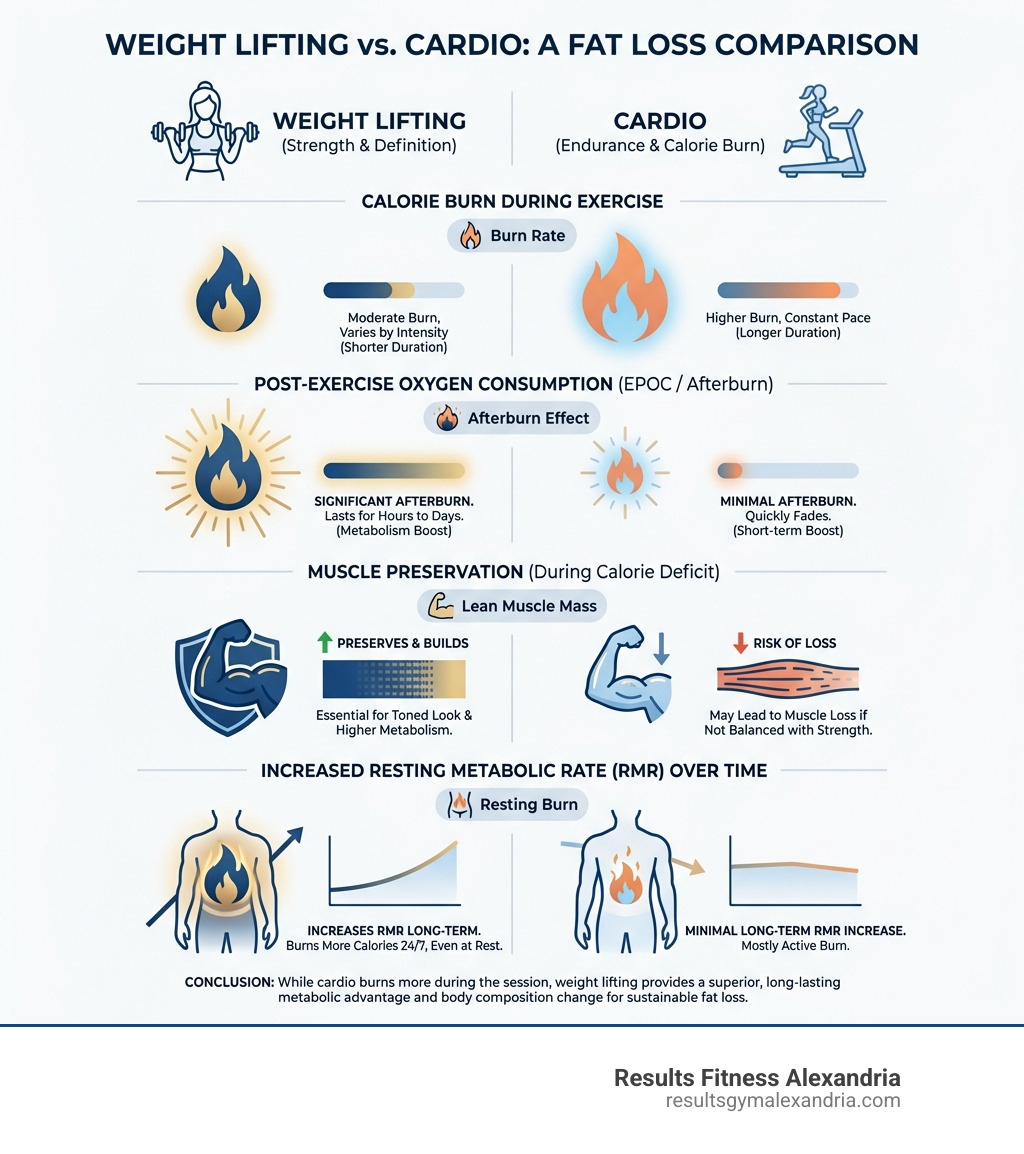
Boosts Metabolism 24/7: Unlike cardio, weight training creates an “afterburn effect” known as EPOC (Excess Post-exercise Oxygen Consumption). Your body continues to burn extra calories for hours after your workout as it repairs and builds muscle. More muscle means a higher resting metabolic rate (RMR), so you burn more calories even at rest.
-
Changes Body Composition: Weight training builds muscle while burning fat. This means that even if the scale doesn’t move dramatically, you’ll lose inches, your clothes will fit better, and you’ll achieve a leaner, more toned physique. The goal is fat loss, not just weight loss.
-
Builds and Preserves Lean Muscle: Muscle is metabolically active tissue. Lifting weights is the best way to build and maintain it, which is crucial for a healthy metabolism, especially during a calorie deficit when muscle loss is a risk.
-
Improves Bone Density: Strength training puts stress on your bones, signaling them to become stronger and denser. This is a critical benefit for women, as it helps prevent osteoporosis. It “does wonders for your bones and body composition.”
-
Offers Hormonal Advantages: Intense cardio can sometimes spike the stress hormone cortisol, which can hinder fat loss. Resistance training is generally “not quite as taxing” and can help manage cortisol levels. It’s also proven to “reduce anxiety” and “improve mood.”
For a deeper dive, explore our article on Cardio vs Strength Training for Weight Loss. Research confirms that “ample evidence that various types of strength-training programs can assist with fat loss” and improve body composition.
The Myth of “Getting Bulky”
One of the biggest fears women have about lifting weights is “getting bulky.” Let’s put this myth to rest. Women do not produce enough testosterone to build large, bulky muscles like men. Achieving that look requires years of specific, high-volume training and diet protocols far beyond a typical fitness routine. What most women call a “toned” look is simply the result of having more muscle and less body fat. Since muscle is denser than fat, you’ll look smaller and firmer as you build it, even if your weight stays the same.
Cardio vs. Weight Lifting for Fat Loss
While cardio is great for heart health and burns calories during a workout, weight lifting offers unique advantages for sustainable fat loss.
-
The Afterburn Effect (EPOC): As mentioned, strength training keeps your metabolism liftd for hours post-workout, a benefit that is significantly less pronounced with steady-state cardio.
-
Sustainable Fat Loss: By increasing your resting metabolic rate, weight lifting turns your body into a more efficient, 24/7 calorie-burning machine. This makes it easier to maintain fat loss long-term.
-
Muscle Preservation: When you’re in a calorie deficit, weight lifting tells your body to burn fat for fuel while preserving precious, metabolism-boosting muscle. Cardio alone doesn’t send this signal.
The most effective approach for weight lifting for beginners female weight loss often combines both. For more on the benefits of strength training, check out our 10 Benefits of Strength Training for Women.
Getting Started: Your Guide to Weight Lifting for Beginners Female Weight Loss
Ready to start lifting? Fantastic! This guide will help you begin with confidence, focusing on proper technique and smart progression.
Here are the core principles for your weight lifting for beginners female weight loss journey:
-
Fundamental Principles:
- Progressive Overload: To get stronger, you must continually challenge your muscles by gradually increasing weight, reps, or sets. Learn more about The Power of Progressive Overload.
- Consistency: Regular workouts are more important than a single perfect session. Aim for consistency over intensity when you’re starting out.
- Proper Form: This is non-negotiable for preventing injury and ensuring effectiveness. If you’re unsure, “don’t be afraid to ask for help from a personal trainer.”
- Mind-Muscle Connection: Focus on the muscle you’re working. This simple mental trick can improve muscle activation.
-
Choosing the Right Weight: Select a weight that allows you to complete 10-12 reps with good form, where the last two reps are challenging. If you can easily do more, increase the weight. If your form falters before 10 reps, lighten the load. A personal trainer can be invaluable here; learn about the amazing benefits of working with a personal trainer.
Essential Full-Body Exercises for Beginners
Focus on compound movements that work multiple muscle groups at once. They are more efficient for burning calories and building strength.
- Squats: Works your glutes, quads, and hamstrings. A foundational movement for lower body strength.
- Dumbbell Romanian Deadlifts (RDLs): Targets your hamstrings, glutes, and lower back, strengthening your entire posterior chain.
- Push-ups: A classic for your chest, shoulders, and triceps. Start on your knees or an incline if needed.
- Bent-Over Dumbbell Rows: Builds a strong back and improves posture.
- Seated Dumbbell Overhead Press: Develops strong shoulders and triceps.
- Lunges: Improves balance and strengthens your legs one at a time.
- Glute Bridges: Isolates and strengthens your glutes and hamstrings.
Structuring Your Beginner Workout
A well-structured plan is key for weight lifting for beginners female weight loss.
- Frequency: Start with 2-3 full-body strength training days per week.
- Rest Days: Rest is when your muscles repair and grow. Incorporate active recovery like walking or stretching.
- Sets and Reps: Aim for 3 sets of 8-12 repetitions for most exercises. This range is ideal for muscle growth.
- Rest Periods: Rest for 60-90 seconds between sets to recover while keeping your heart rate up.
- Warm-ups and Cool-downs: Always start with a 5-10 minute warm-up (light cardio, dynamic stretching) and end with a cool-down (static stretching).
For more guidance, see our guide on Creating an Effective Workout Routine for Beginners.
Your 4-Week Beginner Full-Body Workout Plan
This 4-week plan is designed for weight lifting for beginners female weight loss. It focuses on compound movements and progressive overload. Remember to listen to your body.
Sample Weekly Schedule:
- Monday: Workout A
- Tuesday: Active Recovery (e.g., walking, stretching)
- Wednesday: Workout B
- Thursday: Active Recovery
- Friday: Workout A
- Saturday & Sunday: Rest
Progression and Tracking:
- Weeks 1-2: Focus on mastering form with a weight you can lift for 10-12 reps.
- Weeks 3-4: Aim to increase the weight. Your reps might drop to 8-10, which is a sign of progress.
- Track Your Workouts: Keep a log of your exercises, weights, sets, and reps. Seeing your strength increase is a huge motivator! “Record your exercises and weights in a journal to track gains.”
For more workout ideas, check out our Womens Beginner Gym Workout.
Workout A: Full Body Strength
Perform 3 sets of each exercise with 60-90 seconds rest between sets.
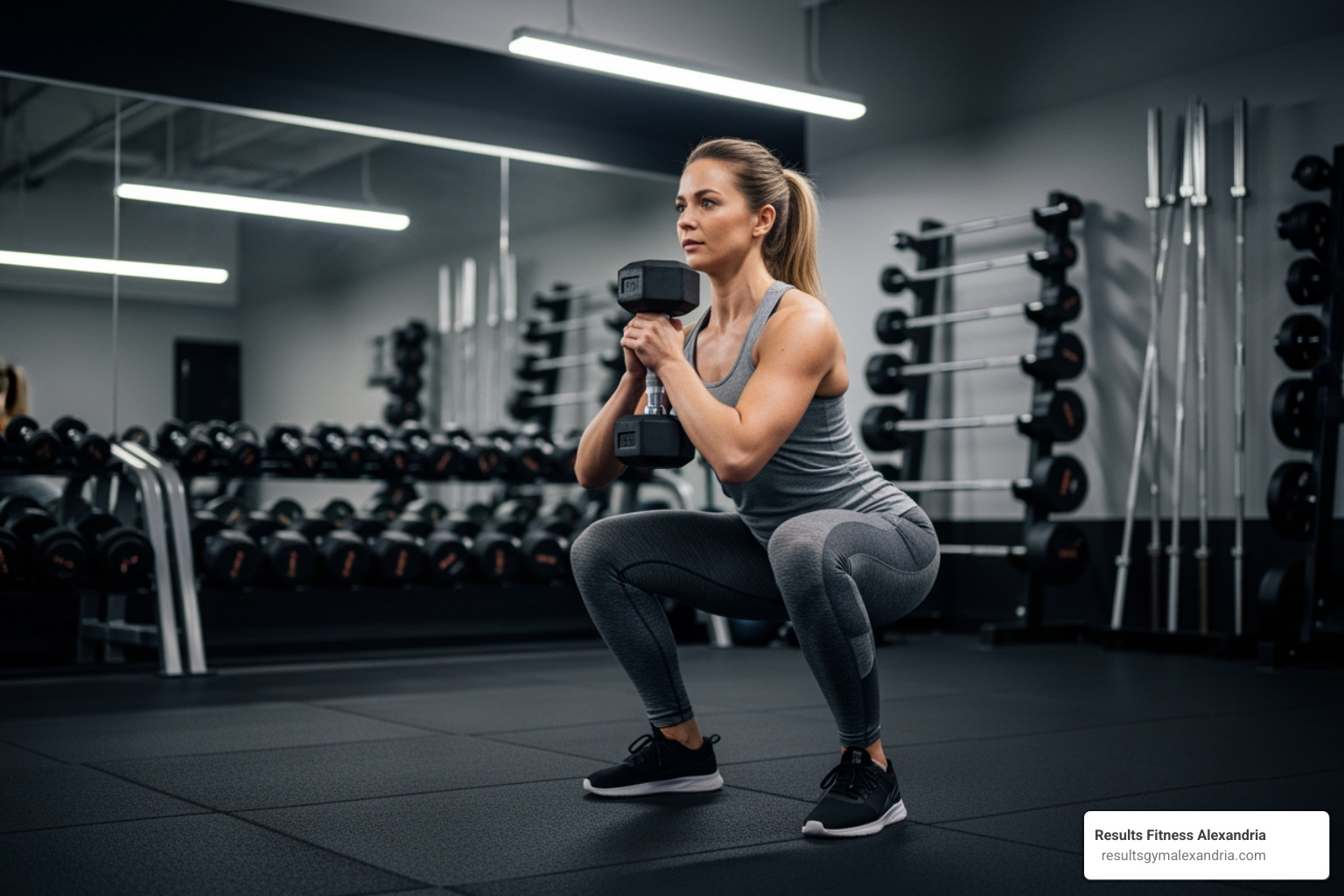
- Goblet Squat: 10-12 reps. Hold a dumbbell vertically against your chest and squat down, keeping your chest up.
- Dumbbell Bench Press: 10-12 reps. Lie on a flat bench and press dumbbells up from the sides of your chest.
- Bent-Over Dumbbell Row: 10-12 reps per arm. Hinge at your hips with a flat back and pull the dumbbell towards your hip.
- Lunges: 10 reps per leg. Step forward or backward, lowering your hips until both knees are at a 90-degree angle.
- Plank: Hold for 30-60 seconds. Keep your body in a straight line from head to heels.
Workout B: Full Body Strength
Perform 3 sets of each exercise with 60-90 seconds rest between sets.
- Dumbbell Romanian Deadlift: 10-12 reps. With a slight knee bend and flat back, hinge at your hips, lowering dumbbells along your legs.
- Seated Dumbbell Overhead Press: 10-12 reps. Sitting on a bench, press dumbbells overhead from shoulder height.
- Lat Pulldowns or Banded Pull-aparts: 12-15 reps. Use a lat pulldown machine or pull a resistance band apart, squeezing your shoulder blades.
- Glute Bridge: 15 reps. Lie on your back and lift your hips, squeezing your glutes at the top.
- Leg Raises: 15 reps. Lie on your back and slowly raise and lower your straight legs.
Fueling Your Success: Nutrition and Lifestyle for Optimal Results
Weight lifting is powerful, but it’s only half the equation. Proper nutrition and lifestyle habits are essential to fuel your workouts and maximize fat loss. As the saying goes, “80% of weight loss happens in the kitchen.”
- Calorie Deficit: To lose fat, you must consume fewer calories than your body burns. Weight training helps increase your daily energy expenditure, making it easier to achieve this deficit.
- Prioritize Protein: Protein is crucial for repairing and building the muscle you’re working so hard for. It helps you feel full and ensures you’re losing fat, not muscle. Aim for around 0.73 grams of protein per pound of body weight per day.
- Don’t Fear Carbs and Fats: Carbohydrates fuel your workouts, while healthy fats are vital for hormone production. A balanced approach to all macronutrients is key.
- Hydration is Key: Water is essential for metabolism, performance, and feeling full. Stay hydrated throughout the day.
- Prioritize Sleep: Muscles grow during rest, not in the gym. Aim for 7-9 hours of quality sleep per night to optimize recovery and results.
For more recovery tips, read our article on 10 Post-Workout Recovery Tips to Maximize Results.
Signs of Progress Beyond the Scale
Body composition changes from weight lifting aren’t always reflected on the scale. Look for these real signs of progress:
- Non-Scale Victories: Carrying groceries with ease, having more energy to play with your kids.
- Clothes Fit Better: Losing inches and dropping a clothing size is a clear sign of fat loss.
- Increased Energy: Feeling more vibrant and less sluggish throughout the day.
- Strength Gains: Lifting heavier weights or doing more reps is tangible proof you’re getting stronger.
- Improved Mood: Exercise is a powerful mood booster. Notice if you feel more confident and less stressed.
- Measurements and Photos: Taking body measurements and progress photos every 4-6 weeks can reveal changes the scale misses.
Overcoming Common Challenges in a female weight loss journey
Every fitness journey has obstacles. Here’s how to steer them:
- Gym Intimidation: Everyone was a beginner once. Focus on your own workout, and don’t be afraid to ask a trainer for help.
- Finding Motivation: Some days are harder than others. Focus on how great you feel after a workout and celebrate small wins. For more tips, check out these 15 Ways to Find Gym Motivation.
- Time Management: Consistency beats duration. Short, focused workouts 2-3 times a week are highly effective.
- Plateaus: If progress stalls, it may be time to adjust your routine (e.g., increase weight) or re-evaluate your nutrition.
- Listening to Your Body: Learn the difference between normal muscle soreness and pain. Never push through sharp pain, and prioritize rest.
Frequently Asked Questions about Women’s Weight Lifting for Fat Loss
We know you have questions about weight lifting for beginners female weight loss. Here are some clear, straightforward answers.
How much weight should a beginner woman start lifting?
Start light and prioritize form. For exercises like squats and lunges, begin with just your bodyweight to master the movement. When you add weight, choose an amount that allows you to complete 12-15 reps with good form. The last couple of reps should feel challenging but not impossible. If you can do more than 15 reps easily, increase the weight. If your form breaks down before 12, reduce it.
How quickly will I see results from weight lifting?
Results depend on consistency, diet, and individual factors, but you can expect to feel changes relatively quickly. Most beginners report feeling stronger and more energetic within 2-4 weeks. Visible changes in body composition, like muscle definition and clothes fitting better, typically appear around the 6-8 week mark. “Consistency is key.”
Can I lose weight just by lifting weights, without cardio?
Yes, you can absolutely lose fat with weight lifting as your primary form of exercise, provided you also maintain a calorie deficit through nutrition. Weight lifting builds muscle, which boosts your metabolism and helps your body burn more calories around the clock. While cardio isn’t strictly necessary for fat loss, combining it with strength training can accelerate results and improve cardiovascular health. As research shows, “there is ample evidence that various types of strength-training programs can assist with fat loss.”
Conclusion: Your Journey to a Stronger, Leaner You
We hope this guide has empowered you to accept weight lifting for beginners female weight loss as your path to a stronger, more confident you. By boosting your metabolism, reshaping your body, and strengthening your bones, this form of exercise offers benefits far beyond the scale.
Forget the fear of “getting bulky” and get ready to feel toned, energetic, and powerful. The journey is about celebrating strength gains and non-scale victories just as much as it is about fat loss.
At Results Fitness Alexandria, we provide a supportive environment for women of all fitness levels. Our certified personal trainers are here to guide you through proper form, help you progress safely, and create a sustainable routine that delivers lasting results.
Ready to experience the transformative power of weight lifting? Explore our women’s gym amenities and get your free pass today!