
Anaerobic endurance training: 1 Ultimate Edge
What Anaerobic Endurance Training Really Means
Anaerobic endurance training is your body’s ability to perform short, intense bursts of exercise without relying on oxygen. Here’s what you need to know:
Key Components:
- Energy Systems: Uses ATP-CP (up to 10 seconds) and glycolysis (10 seconds to 2-3 minutes)
- Intensity: High-intensity work at 80-100% of maximum heart rate
- Work-to-Rest Ratios: Typically 1:2 to 2:1, depending on fitness level
- Training Frequency: 2-3 non-consecutive days per week for most people
Common Exercises:
- Sprint intervals (running, cycling, rowing)
- High-Intensity Interval Training (HIIT)
- Plyometrics (box jumps, squat jumps)
- Heavy weightlifting with explosive movements
Primary Benefits:
- Greater speed, power, and agility
- Increased lean muscle mass
- Improved metabolism and fat burning
- Improved athletic performance in sports requiring bursts of effort
Ever wonder why you can’t sprint for more than 30 seconds or why your muscles burn during heavy squats? That’s your anaerobic system at work.
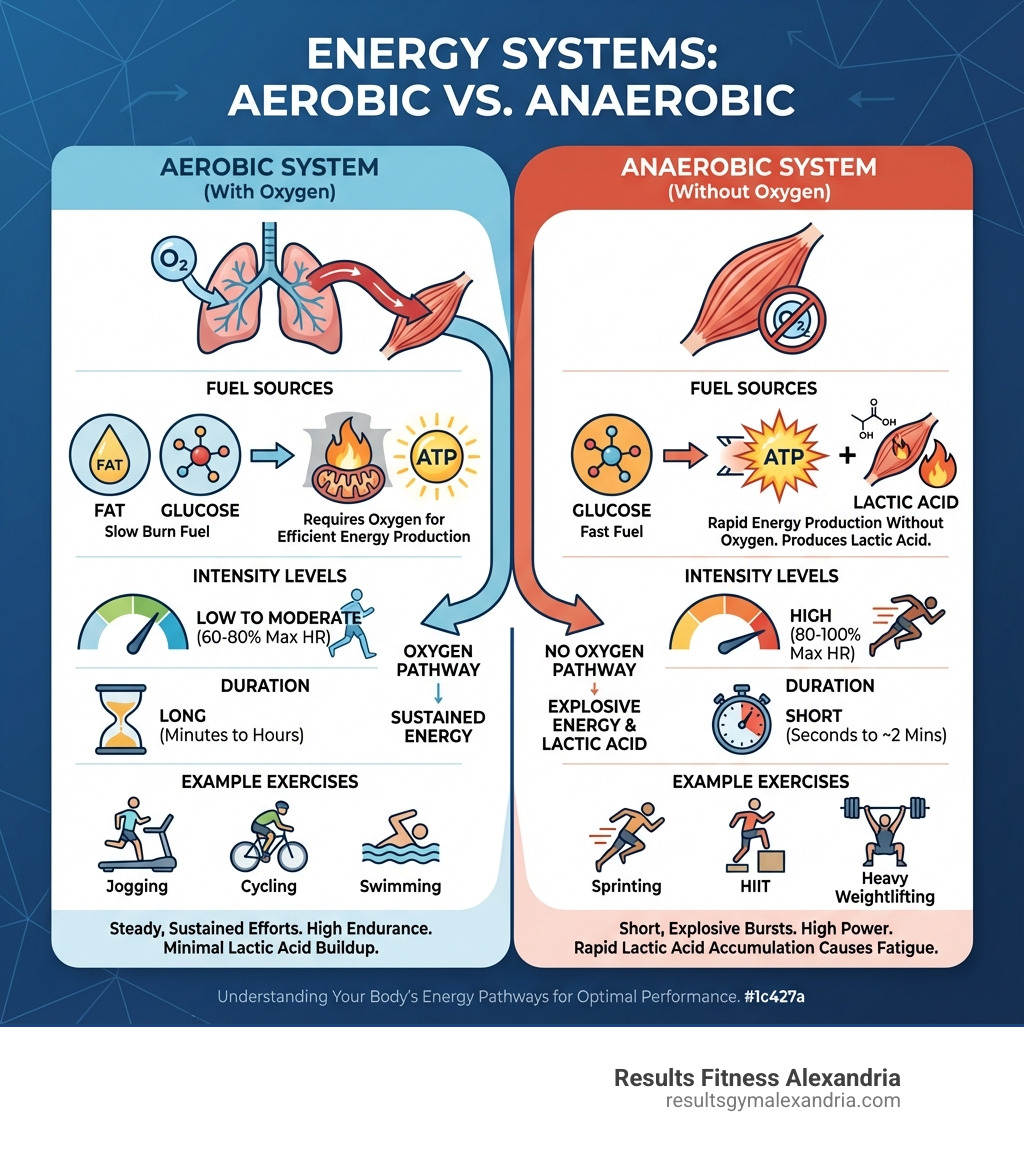
Unlike aerobic exercise (like jogging), which uses oxygen for long efforts, anaerobic training powers short, explosive movements. It breaks down glucose in your muscles for energy without oxygen. This process is fast but produces lactic acid, causing that familiar muscle burn that forces you to stop.
Research backs up this training approach. Individual differences in anaerobic capacity explained 31 percent of the differences in 5K running times among runners, according to researchers at Georgia State University. Even for endurance events, your ability to surge or sprint to the finish depends heavily on your anaerobic fitness.
Studies show it builds lean muscle more effectively than steady-state cardio and boosts metabolism for hours after your workout. A 2008 study found that division 1A baseball players who did just eight 20-to-30-second wind sprints three days a week saw their power increase by an average of 15 percent throughout the season.
Whether you want to break a fitness plateau, prepare for a sport, or get more results in less time, understanding how to train your anaerobic system is key.
I’m Jennifer Rapchak, Fitness Director at Results Fitness in Alexandria, Virginia, and I’ve spent over 14 years helping clients harness the power of high-intensity training. Throughout my career, I’ve seen how strategic Anaerobic endurance training transforms not just athletic performance, but overall fitness and confidence—and I’m excited to show you how to make it work for you.
Similar topics to Anaerobic endurance training:
Understanding Anaerobic Endurance: Beyond the Breath
The term “anaerobic” literally means “without oxygen.” Unlike aerobic exercise, which uses oxygen for sustained activity, anaerobic exercise involves intense, short bursts where energy demand outpaces oxygen supply. This forces your body to use its immediate energy systems.
This distinction dictates how you train. Aerobic training builds stamina for activities like jogging, while anaerobic training builds maximum power for brief, high-intensity efforts. It’s about pushing the limits of your body’s immediate energy reserves.
For more detailed insights into how cardio training can boost your overall stamina, explore our guide on cardio training for better endurance.
The Two Anaerobic Energy Systems
Our bodies have multiple energy systems that kick in depending on activity intensity and duration. For anaerobic endurance training, two primary systems are at play:
-
ATP-CP (Phosphagen) System: This immediate energy system fuels explosive, max-effort activities lasting up to 10 seconds, like a 100-meter sprint or a heavy lift. It uses stored adenosine triphosphate (ATP) and creatine phosphate (CP) for a rapid but short-lived burst of power.
-
Lactic Acid System (Glycolysis): When the ATP-CP system is depleted (after ~10 seconds), this system takes over. It breaks down stored glucose (glycogen) without oxygen to fuel high-intensity efforts for 30 seconds to 3 minutes (e.g., a 400-meter sprint). The byproduct, lactate, causes muscle burn and fatigue when it accumulates.
The point at which lactate begins to accumulate faster than your body can remove it is known as your lactate threshold. Training this threshold allows you to sustain higher intensities for longer before fatigue sets in.
These systems primarily recruit fast-twitch muscle fibers, which are designed for powerful, explosive movements.
Anaerobic vs. Aerobic Endurance
Understanding the fundamental differences between anaerobic and aerobic endurance is key to tailoring your training. While both are crucial for overall fitness, they challenge your body in distinct ways.
Here’s a quick comparison:
| Feature | Anaerobic Endurance Training | Aerobic Endurance Training |
|---|---|---|
| Oxygen Use | No (energy produced without oxygen) | Yes (energy produced with oxygen) |
| Fuel Source | Primarily glucose (stored as glycogen in muscles/liver) | Primarily fats and carbohydrates |
| Intensity | High to very high (e.g., 80-100% of max heart rate) | Low to moderate (e.g., 60-80% of max heart rate) |
| Duration | Short bursts (seconds) to a few minutes (up to 3 minutes) | Long (minutes to hours) |
| Energy Output | Rapid, powerful, explosive | Sustained, steady |
| Byproducts | Lactic acid accumulation | Carbon dioxide and water |
| Example Activities | Sprints, heavy weightlifting, plyometrics, HIIT, CrossFit | Jogging, swimming, cycling, long walks, steady-state cardio |
The Science-Backed Benefits of Anaerobic Training
The benefits of incorporating anaerobic endurance training into your routine extend far beyond just sprinting faster. This high-intensity work triggers physiological adaptations that can dramatically improve your health, body composition, and athletic performance.
Key Benefits of Anaerobic Endurance Training
- Greater Speed and Agility: Anaerobic training directly improves how quickly you can move and change direction. A 2021 study on college women found that an anaerobic exercise group achieved greater speed and agility compared to an aerobic group.
- Increased Power and Strength: By working your fast-twitch muscle fibers, anaerobic training builds explosive power. This is evident in the 2008 study of Division 1A baseball players, who increased their power by an average of 15% through wind sprints.
- Improved VO2 Max and Lactate Threshold: Pushing your limits with anaerobic training also boosts aerobic capacity (VO2 Max). It trains your body to deliver oxygen more efficiently and to tolerate and clear lactate, raising your lactate threshold. This allows you to work harder for longer before fatiguing.
- Better Muscle Health and Lean Muscle Mass: Anaerobic activity is a powerful stimulus for muscle growth. Studies show it helps maintain muscle health and is more effective at building lean muscle than aerobic activity, as noted in a 2019 study on postmenopausal women. This is particularly valuable for preserving muscle mass with age. For more on building muscle, check out our strength training for women complete guide.
- Boosted Metabolism and Weight Management: High-intensity workouts trigger Excess Post-exercise Oxygen Consumption (EPOC), or the “afterburn effect,” where your body burns extra calories for hours post-workout. Anaerobic training also helps reduce body fat, improve cholesterol, and, according to some studies, may help suppress appetite, aiding weight management.
Anaerobic Capacity in Sports
The role of anaerobic capacity is undeniable in sports demanding sudden bursts of power, speed, or a “finishing kick.”

Consider sports like:
- Basketball: Jumping, explosive sprints, and quick transitions from defense to offense.
- Soccer: Sprints to the ball, sudden direction changes, and powerful shots on goal.
- Wrestling: Intense, short bursts of power for takedowns, escapes, and exchanges.
- Track & Field: Events like the 400-meter run push the lactic acid system to its absolute limit.
- Endurance Sports: A strong anaerobic system is vital for surging up hills or a powerful finishing kick in events like a 5K. It can account for a significant portion of performance differences.
As the 2008 study on baseball players demonstrated, even short, focused wind sprints (eight 20- to 30-second sprints three days a week) can lead to a 15% increase in power throughout the season. This highlights how targeted anaerobic endurance training can translate directly to improved performance.
How to Structure Your Anaerobic Endurance Training
Effective anaerobic endurance training requires a structured approach. Using specific heart rate zones, work-to-rest ratios, and smart progression allows you to push your limits safely and maximize results.
If you’re curious about incorporating high-intensity methods, we’ve got a great resource on why you should give HIIT exercises a try.
Training in Heart Rate Zones 4 and 5
Heart rate zones are invaluable tools for guiding the intensity of your anaerobic workouts. These zones represent a percentage of your maximum heart rate (MHR) and indicate the primary energy system being used.

- Zone 4 (80-90% MHR) – Hard/Threshold Zone: In this “threshold” zone, you’re working at or near your lactate threshold. Training here improves your body’s ability to clear lactic acid, allowing you to sustain high-intensity efforts for longer. These workouts are strenuous and should be an impactful but small part of your training plan.
- Zone 5 (90-100% MHR) – Max Effort Zone: This is the “max effort” zone, pushing you to your absolute limit. Oxygen demand far exceeds supply, and you can only sustain this effort for very short bursts. Training here improves maximum power output but requires significant recovery due to its extreme intensity.
Calculating Your Max Heart Rate (MHR): A common approximation is 220 minus your age. For a 30-year-old, the estimated MHR is 190 bpm. Always consult a healthcare professional for a more accurate assessment before starting a new high-intensity program.
Important Note: Before training in Zones 4 and 5, build a solid aerobic base in Zone 2 (60-70% MHR). A strong aerobic engine is critical for supporting anaerobic efforts and improving recovery.
Mastering Work-to-Rest Ratios
The work-to-rest ratio is arguably the most critical component of effective anaerobic endurance training. It dictates how long you work versus how long you rest, directly impacting which energy system you’re targeting.
Here are common ratios and what they target:
- 1:3 Ratio (e.g., 10s work, 30s rest): Targets pure power and speed (ATP-CP system). The long rest allows for full recovery, ensuring maximum intensity for each interval. Ideal for beginners.
- 1:2 Ratio (e.g., 30s work, 60s rest): Develops power while allowing enough recovery to maintain high-quality efforts. Common in sprint training.
- 1:1 Ratio (e.g., 60s work, 60s rest): Directly challenges your lactate tolerance. With incomplete recovery, your body learns to perform under fatigue and clear lactate more efficiently.
- 2:1 Ratio (e.g., 60s work, 30s rest): A highly advanced ratio that pushes anaerobic endurance to its limit. Minimal recovery forces your body to adapt to significant lactate buildup.
Practical Examples:
The U.S. Army uses drills like the 30:60s (run hard for 30 seconds, walk/jog for 60 seconds) and 60:120s (run hard for 60 seconds, walk/jog for 120 seconds) to build anaerobic endurance.
Importance of Recovery Periods: The rest period is critical. It’s when your body clears metabolic byproducts and replenishes energy. Sticking to your rest intervals is crucial for improving your anaerobic system and avoiding overtraining.
Effective Exercises for Anaerobic Endurance
Let’s put the science into practice. The key to anaerobic exercise is performing it with maximum intensity for short bursts, followed by appropriate rest. This builds power, speed, and resilience.
For strategies on combining different training types, check out our guide on maximizing results: integrating strength training into your cardio routine.
Here’s a list of top anaerobic exercises:
- Sprints (running, cycling, rowing)
- High-Intensity Interval Training (HIIT)
- Plyometrics (jump squats, box jumps)
- Heavy weightlifting (Olympic lifts, powerlifting movements)
- Circuit training with minimal rest between exercises
HIIT and Sprint Intervals
High-Intensity Interval Training (HIIT) and sprint intervals are the superstars of anaerobic endurance training. They involve alternating short periods of intense anaerobic exercise with less intense recovery periods.
- Running Sprints: A classic anaerobic exercise. Perform 50-200m sprints on a track, field, or treadmill, followed by walking/jogging recovery. Hill sprints add natural resistance and are highly effective.
- Cycling Sprints: Push maximum wattage for 15-30 seconds on any bike, followed by 30-90 seconds of easy pedaling.
- Rowing Sprints: The rower provides a full-body anaerobic workout. Aim for 200-500m all-out efforts followed by 1-2 minutes of rest.
- Tabata Protocol: This popular HIIT protocol involves 20 seconds of max effort and 10 seconds of rest, repeated for 8 rounds (4 minutes). Apply it to exercises like burpees or jump squats.
For more dynamic and varied workouts, consider how circuit training can incorporate these intense intervals.
Plyometrics and Power-Based Weightlifting
Plyometrics and power-based weightlifting are indispensable for developing explosive power and building lean muscle for anaerobic endurance training.
- Plyometrics: These exercises increase power through rapid, forceful movements.
- Squat Jumps: Explode upward from a squat, landing softly back into the squat position.
- Box Jumps: Jump onto a sturdy box with a powerful leg drive and soft landing. Start with a lower height and progress.
- Lunge Jumps: Perform an explosive jump from a lunge, switching legs in mid-air.
- Hurdle Drills: Perform quick, repetitive bounds over low problems.
- Power-Based Weightlifting: Focus on moving heavy loads explosively for a few reps, not high-rep training.
- Kettlebell Swings: This powerful hip-hinge builds explosive strength in the glutes and hamstrings.
- Olympic Lifts (Cleans, Snatches): These complex lifts build immense full-body power and require good technique.
- Deadlifts: This foundational exercise builds total-body strength and power.
For weightlifting, fewer reps with heavier weights (e.g., 3-6 reps) are more effective for anaerobic power. Learn more about the principles behind effective muscle building in our guide on the science of building muscle: tips for effective strength training.
Progressing Safely and Mitigating Risks
The high intensity of anaerobic endurance training offers rapid results but also carries risks of injury and overtraining. Approaching it with a smart, cautious plan is crucial for safe and sustainable progress.
Recovery is just as important as the workout itself. Dive into our 10 post-workout recovery tips to maximize results for more insights.
Designing Your First Anaerobic Endurance Training Workout
Starting your journey into anaerobic training should be methodical. Here’s a simple framework to design your first workout:
- Start Slowly: Start with 1-2 sessions per week, as they are very taxing.
- Choose One Modality: Pick one exercise type (e.g., running sprints) to master the movement before adding more.
- Focus on Form: Prioritize perfect technique over speed or weight. Poor form is a fast track to injury.
- Implement Appropriate Work-to-Rest Ratios: Beginners should use a 1:2 or 1:3 work-to-rest ratio (e.g., 20s sprint, 40-60s rest) to ensure adequate recovery.
- Gradually Increase Intensity or Volume: Once comfortable, progressively increase work duration, sets, or intensity, or decrease rest time.
For those just getting started with fitness, we have an excellent resource on creating an effective workout routine for beginners.
Potential Risks and How to Avoid Them
The high-intensity nature of anaerobic endurance training makes it highly effective but also carries certain risks. Being aware of these and taking preventative measures is key.
- Muscle Strains and Joint Stress: High-impact movements can stress muscles, tendons, and joints.
- Mitigation: Always perform a dynamic warm-up and a cool-down. Prioritize proper form and stop if you feel sharp pain.
- Overtraining: These demanding workouts can easily lead to overtraining if you do too much too soon, causing fatigue and decreased performance.
- Mitigation: Limit sessions to 2-3 non-consecutive days per week. Listen to your body; constant fatigue or dropping performance means you need more rest.
- Exertional Rhabdomyolysis: This rare but serious condition involves rapid muscle breakdown from extreme exertion. It’s often linked to insufficient rest, especially when new to high-intensity training.
- Mitigation: Prevention is key: allow at least 48 hours of recovery between intense sessions, stay hydrated, and eat well. Seek immediate medical attention for severe muscle pain, dark urine, or extreme swelling.
- Lack of Proper Form: Poor technique during explosive movements can cause injury.
- Mitigation: Master the movement with lighter loads or simpler variations. Consider working with a certified personal trainer for guidance.
Speaking of personal trainers, the guidance of a professional can be invaluable. Find the amazing benefits of working with a personal trainer to ensure your training is both effective and safe.
Frequently Asked Questions about Anaerobic Training
We often get asked common questions about anaerobic endurance training. Let’s clear up some of the most frequent queries to help you on your fitness journey.
How often should I do anaerobic endurance training?
For most people, 2-3 non-consecutive days per week is optimal. This frequency allows your body sufficient time to recover and adapt, which happens during rest. Beginners should start with one session per week and gradually add more as their fitness and recovery capacity improve.
Can beginners do anaerobic training?
Yes, but beginners must be cautious. We recommend:
- Starting Slowly: Begin with fewer sets and shorter work intervals.
- Longer Rest Periods: Use a 1:3 work-to-rest ratio (e.g., 15 seconds of intense work followed by 45 seconds of rest) to ensure adequate recovery.
- Focus on Form: Prioritize mastering proper exercise technique over intensity to minimize injury risk.
- Build an Aerobic Base: Having a reasonable level of aerobic fitness will aid in recovery and overall cardiovascular health.
Will anaerobic training help with weight loss?
Yes, anaerobic endurance training is a highly effective tool for weight loss for several reasons:
- Boosts Metabolism (EPOC): The high intensity causes a significant “afterburn effect” (EPOC), where your body continues to burn calories at an liftd rate for hours after the workout.
- Builds Lean Muscle Mass: Anaerobic exercises are excellent for building and maintaining metabolically active lean muscle, which burns more calories at rest.
- Appetite Suppression: A 2020 study found that combining anaerobic exercise with a reduced-calorie diet led to greater appetite suppression, which can help manage calorie intake.
- Healthier Lipid Profiles: A 2017 review noted that anaerobic activity helps reduce fatty acids, leading to healthier cholesterol levels and a reduced body mass index.
Conclusion
Anaerobic endurance training is a game-changer for boosting speed, power, and metabolism. By using structured workouts with HIIT, sprints, and powerlifting, you can build lean muscle and improve athletic performance. We’ve armed you with strategies for structuring your workouts, mastering work-to-rest ratios, and selecting the right exercises.
The intensity is high, so smart progression, proper form, and adequate recovery are essential to mitigate risks. Respecting your body’s limits is the key to safely pushing past plateaus and reaching new levels of fitness.
At Results Fitness Alexandria, our certified trainers are experts in high-intensity training and can help you safely and effectively incorporate anaerobic endurance training into your routine, custom to your fitness level and goals.
Explore our cardio and training amenities and let us help you achieve your peak performance!