A Practical Guide to Yoga for Beginners: Learn Basic Poses Safely
Why Yoga for Beginners Is Worth Starting Today
Yoga for beginners doesn’t have to be complicated, expensive, or time-consuming. If you’re a complete beginner, here’s what you need to know right now:
Quick-start guide:
- You only need 3–20 minutes to get started
- No special equipment is required — a mat or even a bed works fine
- Focus on breathing and simple floor poses first
- Consistency matters more than perfection
- Yoga builds flexibility, reduces stress, and eases back pain — even in short sessions
Many people put off starting yoga because they think they need to be flexible already, or that classes are too expensive or intimidating. They’re not. In 2026, you can follow a free 10-minute routine from your living room floor and still get real results.
The core idea is simple: move with your breath, listen to your body, and show up consistently. That’s it.
Whether you have 3 minutes or 30, yoga meets you where you are — no prior experience needed.
I’m Jennifer Rapchak, Fitness Director at Results Fitness Alexandria and a certified personal trainer with over 14 years of experience helping beginners find movement routines that actually stick, including yoga for beginners programs designed to build real strength and flexibility from the ground up. In this guide, I’ll walk you through everything you need to start safely and confidently.
Why Yoga for Beginners Is Essential for Every Fitness Routine
When people think about building a balanced fitness routine, they often prioritize high-intensity cardio or heavy resistance training. While lifting weights and elevating your heart rate are vital for health, skipping mobility and recovery creates a major gap in your overall physical blueprint. Integrating yoga for beginners into your existing workout schedule provides the structural foundation your body needs to stay resilient, injury-free, and strong.
At Results Fitness, we see how adding even short yoga practices enhances every other aspect of fitness. Yoga isn’t just about bending into pretzel shapes; it develops core stability, posture alignment, and active range of motion. When you practice intentional movement, you learn how to engage deep stabilizing muscles around your spine, hips, and shoulders. This translates directly to better form during squatting, deadlifting, running, or carrying daily groceries.
Posture alignment is another major advantage. Modern lives involve endless hours sitting at desks, driving, or scrolling on phones, leading to tight hip flexors and rounded upper backs. Beginner yoga systematically unlocks these tight areas while strengthening weak posterior chain muscles. Furthermore, by taking your joints through controlled, mindful ranges of motion, you significantly reduce the risk of strain and overuse injuries. To learn more about unlocking tight joints, check out our guide on How Yoga Can Help Improve Your Flexibility.
Beyond the physical structure, yoga regulates your internal recovery systems. Chronic stress keeps your body in a sympathetic “fight-or-flight” state, which impairs muscle repair and elevates cortisol levels. Gentle movement paired with rhythmic breathwork activates your parasympathetic nervous system, speeding up post-workout recovery and clearing mental fatigue. For an in-depth look at managing stress through practice, read The Ultimate Guide to Yoga for Anxiety and Stress Relief.
Key Physical Benefits of Yoga for Beginners
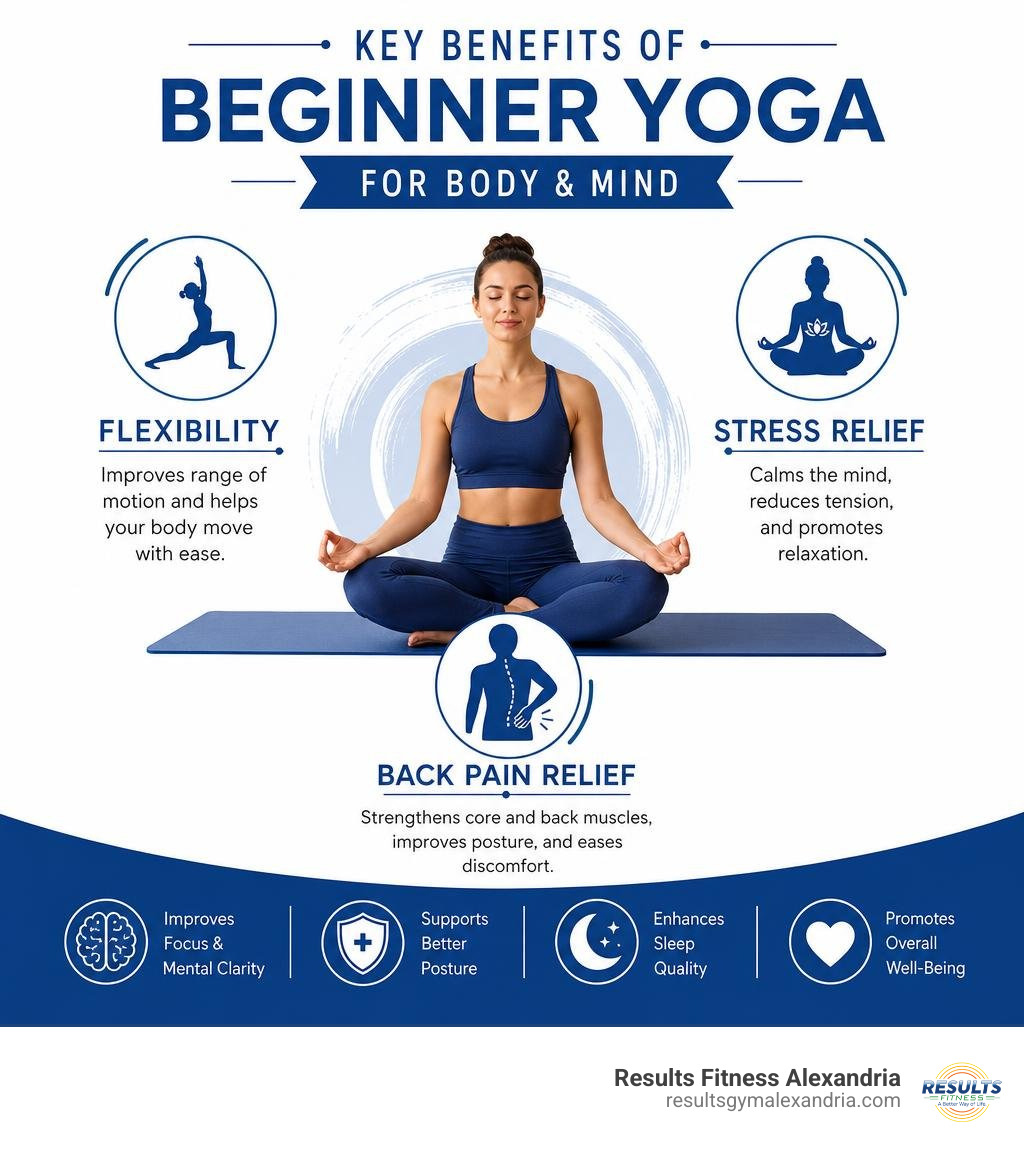
The physical advantages of starting a beginner yoga practice are immediate and cumulative. You don’t have to wait months to feel a difference; even a few minutes of daily movement releases muscle tightness and improves circulation.
- Flexibility Improvement: Beginner yoga gently lengthens tight hamstrings, calves, quadriceps, and chest muscles without forcing your body past its natural limits.
- Spinal Mobility: Flowing through gentle spinal flexion, extension, and rotation keeps your intervertebral discs hydrated and healthy, preventing stiffness.
- Back Pain Relief: By strengthening the deep core and stretching the lower back and hips, yoga alleviates common lumbar tension caused by prolonged sitting.
- Full-Body Strength: Static holds like Downward-Facing Dog, Planks, and Bridge Pose build functional, endurance-based strength using your own body weight.
If you are eager to balance building strength with increasing mobility, explore The Best Beginner Yoga Routine for Strength and Flexibility.
Mindful Movement and Stress Reduction
Physical fitness is only half the equation; true wellness requires mental resilience. Yoga for beginners introduces you to Pranayama—the ancient practice of conscious breath control. Linking breath directly with movement anchors your attention firmly in the present moment, turning physical exercise into a moving meditation.
When you take slow, deep diaphragmatic breaths during a yoga pose, you send direct signals to your brain that it is safe to relax. This down-regulates heart rate, lowers blood pressure, and reduces mental chatter. Over time, practicing mindful movement on the mat translates into better stress management in everyday life. For more tips on combining mindfulness with physical movement, check out How Meditation and Yoga Can Lower Your Stress Levels.
Essential Poses and Sequences for Complete Mat Practice

Starting your physical practice is easiest when you focus on foundational postures that deliver high rewards with minimal risk. You don’t need to master complex inversions to experience full-body relief. A well-rounded beginner sequence links simple floor poses with basic active postures.
Here is a step-by-step look at five primary poses that form the backbone of a solid practice:
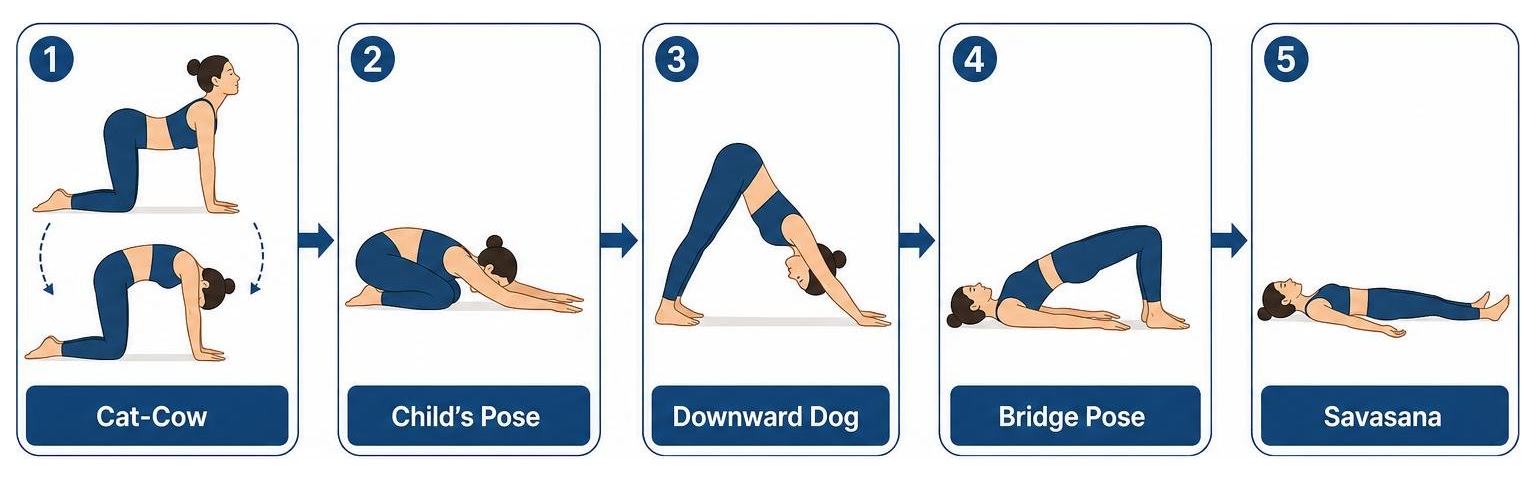
- Cat-Cow Pose (Marjaryasana-Bitilasana): Performed on hands and knees, this gentle dynamic movement warms up the entire spine. Inhale as you drop your belly and lift your chest (Cow), then exhale as you round your spine toward the ceiling and tuck your chin (Cat).
- Child’s Pose (Balasana): A foundational resting position. Kneel on the floor, bring your big toes together, sit back on your heels, and fold forward, resting your torso between your thighs and forehead on the mat.
- Downward-Facing Dog (Adho Mukha Svanasana): An active pose that stretches the shoulders, calves, and hamstrings while building upper-body strength. From hands and knees, lift your hips high, pressing back to form an inverted “V” shape.
- Bridge Pose (Setu Bandha Sarvangasana): Lying on your back with knees bent and feet flat on the floor, lift your hips toward the ceiling. This posture strengthens the glutes, hamstrings, and lower back while opening the chest.
- Corpse Pose (Savasana): The ultimate relaxation pose performed at the end of practice. Lie completely flat on your back, close your eyes, and allow your body to absorb the physical benefits of movement in total stillness.
To help you decide which type of practice fits your current energy level and goals, here is a quick comparison:
| Feature | Floor-Based Gentle Yoga | Active Standing Flows |
|---|---|---|
| Primary Focus | Relaxation, joint mobility, deep stretching | Muscle strength, balance, cardiovascular heat |
| Pacing | Slow, grounded, held postures (1–3 minutes) | Dynamic, rhythmic movement linked with breath |
| Standing Required? | No — fully seated, kneeling, or lying down | Yes — includes lunges, warriors, and balances |
| Ideal Time of Day | Early morning or right before bed | Mid-morning, afternoon, or workout warm-up |
| Equipment Needed | Yoga mat, pillow or block (optional) | Yoga mat, yoga blocks for stability |
Foundational Floor Poses for Beginners
If standing poses feel daunting or if you’re dealing with balance issues, floor-based yoga offers an exceptionally accessible entry point. Floor routines allow you to stretch deeply without fighting gravity, making them perfect for absolute beginners or end-of-day tension relief.
Key floor postures include Easy Pose (Sukhasana), a simple cross-legged seated position focused on tall posture; Seated Side Stretch, which expands the ribcage and side body; Tabletop Stretch, extending one arm and opposite leg to build core balance; and Toe Squat, kneeling with toes tucked under to release tight arches and plantar fascia.
You can read more about gentle floor sequencing in 10-Minute Gentle Yoga for Beginners (No Standing Required). Focusing on proper joint alignment in these lower-intensity poses ensures you build safe habits before progressing to standing routines.
Quick Micro-Routines: 3-Minute to 10-Minute Yoga for Beginners
One of the biggest hurdles beginners face is feeling like they lack time. However, exercise science demonstrates that consistency trumps duration every time. Micro-routines lasting anywhere from 3 to 10 minutes eliminate cognitive friction and make daily practice attainable.
A simple 3-minute sequence might look like this:
- Minute 1: Seated Neck Stretch & Cross-Legged Forward Fold. Sit tall, tilt your ear toward your shoulder, then gently fold forward over your crossed shins to stretch your back.
- Minute 2: Revolved Head to Knee Pose. Extend one leg outward, bend the opposite knee, and reach toward your outstretched toes while rotating your torso upward. Repeat on the other side.
- Minute 3: Cat-Cow to Child’s Pose. Transition to hands and knees for three cycles of Cat-Cow, then sink back into Child’s Pose for 30 seconds of calm breathing.
For a complete breakdown of ultra-short routines, explore Basic Yoga Routine for Beginners (or Literally Anyone) in 3 Minutes. Small micro-practices fit seamlessly into work breaks or morning wake-up schedules.
How to Practice at Home and on YouTube
Practicing at home gives you complete freedom over your schedule, environment, and pace. Free platforms like YouTube offer thousands of guided sessions suitable for all fitness levels. In fact, standard home workouts ranging from 10 to 20 minutes are widely considered the ideal duration for establish lasting habits without physical or mental burnout.
When practicing at home, keep these actionable tips in mind:
- Set Up a Calm Space: Clear a small area on the floor wide enough to stretch your arms out wide.
- Use Props Wisely: You don’t need fancy gear, but keeping two yoga blocks nearby is immensely helpful. Blocks elevate the floor to meet your hands, preventing strain in forward bends or lunges.
- Listen to Your Body: Adopt a mindset of “finding what feels good.” Never push into sharp pain; backed-off variations are always encouraged.
- Ditch Perfectionism: Focus on breath and awareness rather than matching how a pose looks on screen.
For an expert guide on structuring your digital learning, read How to Master the Mat The Best Way to Learn Yoga Online.
Frequently Asked Questions
How can a complete beginner start practicing yoga at home?
Starting at home requires minimal setup. Begin by picking a short, guided 10- to 20-minute video designed specifically for complete beginners. Wear comfortable, stretchy clothing that allows full range of motion. Clear a comfortable spot on a carpeted floor or unroll a standard yoga mat. Focus on following the instructor’s breathing cues rather than achieving aesthetic posture perfection.
Can you practice yoga without standing up?
Yes! Entire yoga routines can be performed seated on the floor, lying down on a mat, or even resting in bed. Floor-based routines focus on gentle hip openers, spinal twists, shoulder rolls, and hamstring stretches without requiring standing balance or knee strain. These non-standing flows are perfect for mobility constraints, injury recovery, or nighttime wind-down routines.
How often should beginners practice to see results?
For noticeable improvements in flexibility, stress reduction, and posture, aim to practice 2 to 3 times per week. Short, frequent sessions (such as 10 to 15 minutes) are far more effective for building joint mobility and mental consistency than doing one long 60-minute session every couple of weeks.
Conclusion
Embarking on a yoga for beginners practice is one of the most rewarding investments you can make in your physical longevity and mental clarity. By mastering foundational floor movements, embracing micro-routines, and prioritizing breath over intensity, you lay down a sustainable wellness foundation that serves you for years to come.
Whether you practice at home or integrate movement into a broader fitness routine, consistency is your greatest ally. If you live near Alexandria, Virginia, and want hands-on instruction in an encouraging environment, come move with us at Results Fitness! We invite you to claim your free 1-day pass to explore our amenities, experience supportive community fitness, and join one of our accessible Group Fitness Yoga classes today.