Sculpt Your Abs Fast with These Intense Anaerobic Core Exercises
Why Anaerobic Core Exercises Belong in Every Serious Training Plan
Anaerobic core exercises are short, high-intensity movements that force your core muscles to work without relying on oxygen — burning through glucose stored in your muscles for fast, explosive energy.
Here are the most effective anaerobic core exercises to get you started:
- Plank — full core engagement, isometric hold
- Hollow body hold — targets rectus abdominis and obliques under sustained tension
- Dead bugs — builds stability and coordination with limb movement
- Bird dog — activates deep stabilizers and posterior chain
- Glute bridges — fires up glutes and posterior core
- Mountain climbers — dynamic, high-intensity core drive
- Russian twists — rotational power and oblique strength
- Leg lift pulse — lower ab endurance through constant tension
- Seated ab pike compression — deep core and hip flexor strength
- Weighted plate pass reverse crunch — progressive overload for lower abs
Most people do endless crunches and wonder why their core stays weak. The problem? Crunches are low-intensity, aerobic-style movements. They don’t build the explosive strength or functional stability your body actually needs — especially if you play sports, lift heavy, or want visible definition.
Research on elite athletes backs this up. A randomized controlled trial found that progressive core stabilization training — a structured, anaerobic-focused approach — produced significantly greater improvements in maximum anaerobic power and early-phase explosive capacity compared to standard core strengthening alone.
And the stakes get higher with age. After 27, you lose roughly 1% of your muscle mass per year. Anaerobic strength training, including targeted core work, is one of the most effective ways to slow that loss.
I’m Jennifer Rapchak, Fitness Director at Results Fitness Alexandria and an ACE-certified personal trainer with over 14 years of experience designing anaerobic core exercise programs for clients at every fitness level. In this list, I’ll walk you through the most effective movements, the science behind them, and how to put it all together in a training plan that actually works.
Anaerobic core exercises word list:
The Science Behind Anaerobic Core Exercises

To understand why anaerobic core exercises are so effective, we have to look at how your body produces energy during high-intensity movement. When you are lifting heavy weights, sprinting, or performing explosive isometric holds, your body can’t deliver oxygen to your muscles fast enough to keep up with the energy demand.
Instead of relying on cardiovascular oxygen delivery, your muscles pivot to anaerobic pathways.
Defining Anaerobic Core Exercises
An anaerobic exercise is any physical activity that breaks down glucose for energy without using oxygen. This process, known as anaerobic glycolysis, utilizes glucose already stored in your muscles. It is incredibly fast and efficient for short bursts of effort, but it has a built-in time limit.
Because glycolysis produces lactic acid as a byproduct, your muscles eventually hit that familiar, intense “burn” and temporary fatigue. This metabolic stress is exactly what triggers muscle hypertrophy, explosive power, and functional endurance. If you want to dive deeper into how these pathways function, check out our comprehensive guide on No Oxygen Required: The Ultimate Guide to Anaerobic Exercises.
When applied to your midsection, an anaerobic exercise workout targets both the superficial “mirror muscles” (like the rectus abdominis) and the deep structural stabilizers (like the transverse abdominis, multifidus, and pelvic floor).
Aerobic vs. Anaerobic Core Training
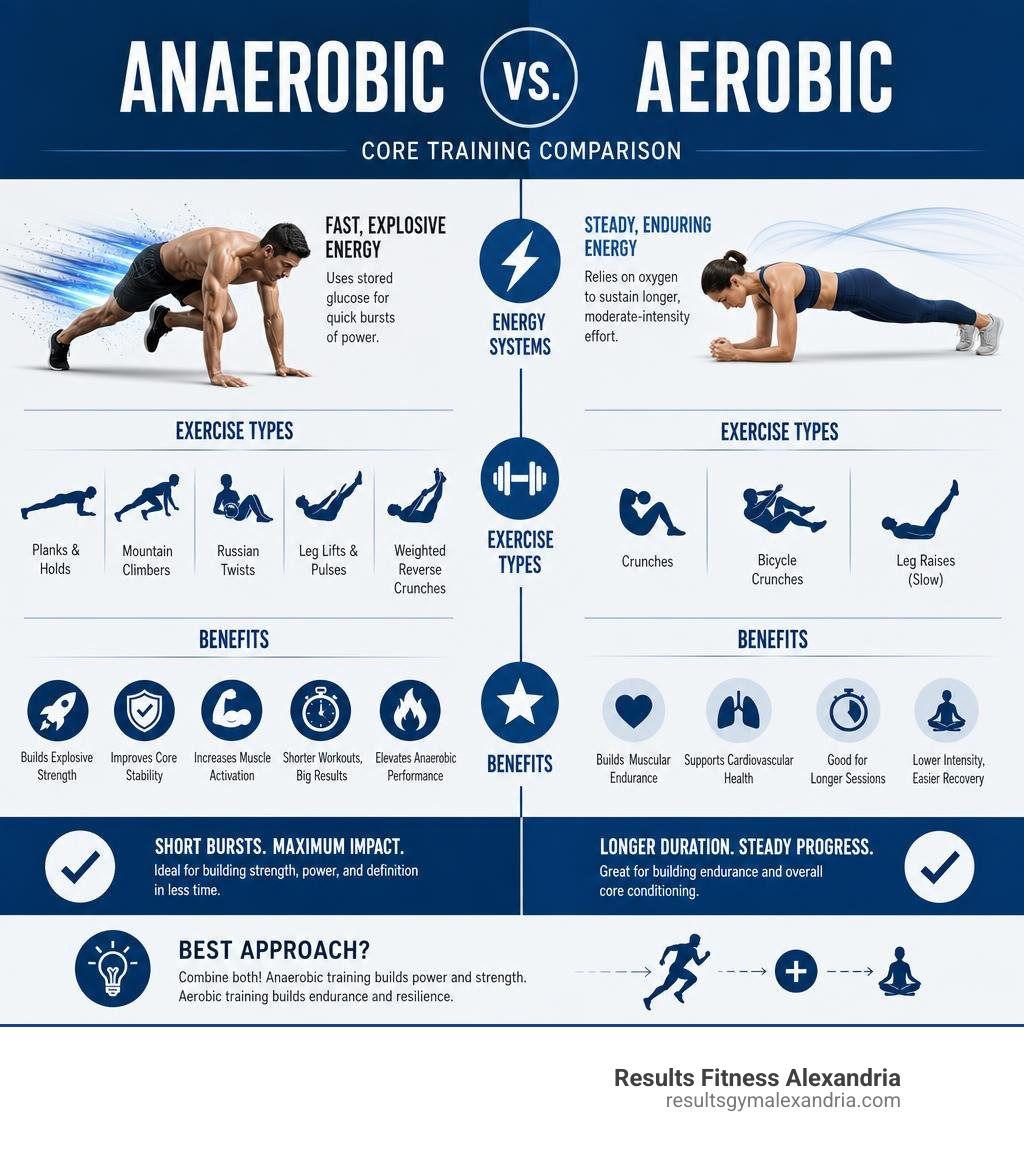
Most traditional ab routines are essentially aerobic. Doing 100 fast, low-tension crunches or casual standing twists relies on slow-twitch muscle fibers and aerobic energy pathways. While this is fine for basic muscular endurance, it does very little to build true core stability, power, or athletic performance.
Anaerobic core training, on the other hand, utilizes high-tension isometric holds, heavy resistance, and explosive movements to recruit fast-twitch muscle fibers. These are the fibers responsible for power, definition, and structural strength.
Here is a quick look at how the two styles compare:
| Feature | Aerobic Core Training | Anaerobic Core Training |
|---|---|---|
| Primary Energy System | Aerobic (with oxygen) | Anaerobic Glycolysis (without oxygen) |
| Intensity Level | Low to moderate | High to maximal |
| Primary Muscle Fibers | Slow-twitch (Type I) | Fast-twitch (Type II) |
| Typical Exercises | High-rep crunches, casual cardio core | Heavy carries, high-tension isometric holds, weighted lifts |
| Primary Goal | Local muscular endurance | Explosive power, strength, deep structural stability |
By focusing on anaerobic training, you build a core that acts like a solid, protective shield for your spine. To understand why this structural foundation is so vital for overall health and daily movement, read our article on Beyond the Abs: Why Core Classes Are Your Fitness Foundation.
Progressive Core Stabilization vs. Standard Strengthening
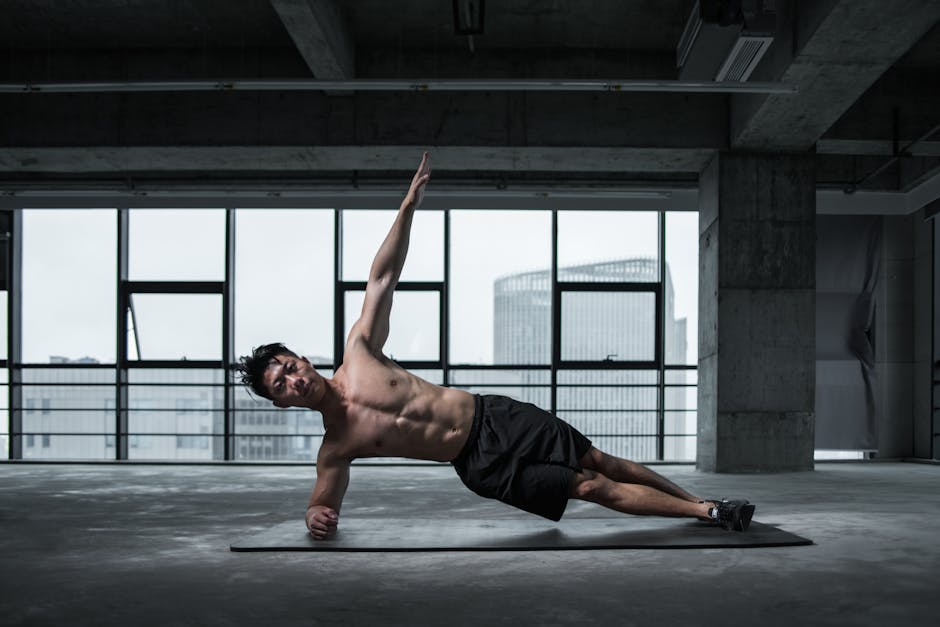
When designing a fitness routine, many people confuse standard abdominal strengthening with progressive core stabilization. While standard exercises focus on moving a joint through a range of motion (like flexing the spine during a sit-up), progressive core stabilization training (PCST) focuses on resisting movement to protect the spine while transferring power between the lower and upper body.
In a landmark randomized controlled trial, researchers compared the effects of PCST against standard core strengthening exercises (SCSE) in elite athletes across sports like taekwondo, weightlifting, volleyball, and badminton. The results were eye-opening.
Key Findings from Elite Athlete Research
The study divided elite athletes into an intervention group performing PCST and a control group performing SCSE. Over a 9-week period, both groups trained three days per week. The researchers measured their anaerobic capacity and power using the gold-standard 30-second Wingate test and vertical countermovement jump (CMJ) assessments.
- Explosive Power Gains: The PCST group showed a significantly greater increase in maximum anaerobic power and early-phase power (specifically from 0 to 5 seconds).
- Moderate to High Effect Sizes: The delta values for anaerobic power at the 5th second showed a moderate-to-high effect size of d: 0.67 in the intervention group compared to the control group.
- Vertical Jump Performance: The PCST group achieved a notable increase in vertical countermovement jump power, with a moderate effect size of d: 0.54.
- Anaerobic Capacity: Overall anaerobic capacity from 0 to 30 seconds was significantly higher in the progressive stabilization group.
- Standard Exercise Limitations: Interestingly, standard core strengthening (SCSE) only showed superior gains in late-stage anaerobic power (at the 20th and 25th seconds of the Wingate test), meaning standard exercises are decent for late-stage fatigue resistance but fail to build explosive, early-phase power.
What are the practical takeaways? For athletes and lifters in Alexandria, VA, who need explosive power — whether you are spiking a volleyball, lifting a heavy barbell, or sprinting up a hill — progressive core stabilization is vastly superior to standard crunches.
However, current research does have limitations. Most studies focus on elite, young athletes, so more research is needed to track long-term retention of these gains in recreational lifters and older adults.
Top Bodyweight and Weighted Movements for Core Power
Building a powerful core doesn’t require a room full of fancy machines. In fact, some of the most brutal and effective anaerobic core exercises use nothing but your body weight, a simple weight plate, or a pair of dumbbells.
To build a complete core, you must target all sides of the midsection like a box: the front, back, sides, top, and bottom. This comprehensive approach is why movements like planks, bird dogs, and glute bridges are so vital. Planks build rigid, front-to-back tension; bird dogs teach coordination and deep spinal stabilization; and glute bridges activate the posterior chain. After all, weak glutes equal a weak core.
For a routine that targets both your deep abdominals and your pelvic floor, take a look at this guide on No, not kegels — this deep core routine will strengthen your abs and pelvic floor | Tom’s Guide. To explore how to balance your anterior and posterior muscle development, check out our breakdown on Abs and Glutes.
Let’s explore the top movements to build elite core power.
Seated Ab Pike Compression
The Seated Ab Pike Compression is a high-tension, low-movement drill that acts as an L-sit progression, a hollow-body hold, and a deep mobility test all in one. It targets your transverse abdominis, rectus abdominis, hip flexors (specifically the rectus femoris), and obliques.
- How to Do It: Sit on the floor with your legs fully extended in front of you. Place your hands on the floor beside your thighs (or closer to your knees for a harder challenge). Keep your spine tall and neutral. Engage your quads to lock your knees, drive your shoulder blades down, and compress your ribs toward your hips. Keeping your feet together, lift your heels 1 to 3 inches off the ground. Hold for 3 to 10 seconds, then slowly lower.
- Common Mistakes: Leaning back to cheat the lift, using momentum, or bending your knees. Keep your posture rigid.
- Programming: Perform 2 to 4 sets of 6 to 10 reps (or timed holds) with 60 seconds of rest between sets.
For more setup details and advanced progressions, read the full breakdown on Master the Seated Ab Pike Compression: The Ultimate Deep Core and Hip Flexor Exercise for Serious Lifters – Muscle & Fitness.
Leg Lift Pulse
Standard leg raises are great, but they often allow you to “cheat” by using momentum or resting at the top of the movement. The Leg Lift Pulse solves this by keeping your muscles under continuous time under tension (TUT), inducing maximum metabolic stress.
- How to Do It: Lie flat on your back and press your lower back firmly into the floor (eliminating any space between your back and the mat). Lift your legs to a 90-degree angle. From this position, use your lower abs to pulse your hips 2 to 3 inches straight up toward the ceiling. Lower your hips back down under control without letting your legs swing.
- Pro Tip: If your lower back starts to hurt, it means your hip flexors are taking over. Fix this by placing your hands under your glutes or folding your mat for extra tailbone padding.
- Programming: Add 3 sets of 20 seconds of continuous pulsing to the end of your next workout.
If you struggle with lower back pain during traditional ab work, check out our guide on No Crunches No Problem: Your Go To Starter Ab Workout for safer alternatives, and learn more about pulsing techniques in this article on How to Torch Your Lower Abs With the Leg Lift Pulse.
Weighted Plate Pass and Drags
Many lifters fail to see ab definition or build real core power because they never apply progressive overload to their core training. Your abs are muscles just like your biceps or chest — they need resistance to grow and get stronger. This weighted routine, popularized by top trainers like Jeff Cavaliere, uses a single weight plate to torch the entire midsection.
- Plate Pass Reverse Crunch: Lie on your back, holding a weight plate (5, 10, or 25 lbs) over your chest. Perform a reverse crunch, lifting your tailbone off the floor, and “pass” the plate to your shins. Lower your torso while balancing the plate on your shins, then reverse the movement to retrieve the plate.
- Plate Drags: Start in a push-up plank position with a weight plate on the floor just outside your left shoulder. Reach under your body with your right hand, grab the plate, and drag it across to your right side. Repeat with the left hand. Keep your hips completely level.
- Programming: Perform each exercise for 60 seconds, resting for 30 seconds between moves. Complete 3 rounds.
For a detailed look at this highly efficient weighted routine, check out Jeff Cavaliere Shares 9-Min Weighted Ab Workout That Actually Works – Fitness Volt and explore Top Trainer Shares 9-Minute Core Workout to Build Ripped Abs – Men’s Journal.
Compound Core Annihilators
You don’t always need direct abdominal movements to build a bulletproof core. In fact, some of the highest-intensity anaerobic core work happens during heavy, compound, non-abdominal exercises that force your core to stabilize under extreme loads.
- Bottom-Start Zercher Squats: Holding a barbell in the crooks of your elbows forces your anterior core and transverse abdominis to fire like crazy to keep you from folding forward. Starting each rep from the bottom safety pins in a power rack eliminates momentum and builds massive starting power.
- Pass-Under Bulgarian Split Squats: Hold a single dumbbell in one hand. As you lower into a Bulgarian split squat, pass the dumbbell under your front leg to the opposite hand. This forces your obliques and deep stabilizers to work dynamically to keep your torso perfectly upright.
- Programming: Combine these into a high-intensity metabolic conditioning circuit. Perform 3 to 5 rounds of 3 to 5 reps of Zercher squats and 4 to 6 reps per leg of Bulgarian split squats, resting for 3 minutes between rounds.
To learn more about how to construct these brutal metabolic conditioning workouts, read The Core Annihilator…Build Functional Core Strength and Power in a MetCon Workout.
How to Program Your Anaerobic Core Workouts
To get the most out of your training without burning out, you need a smart, structured program. The Centers for Disease Control and Prevention (CDC) recommends that adults get at least 150 minutes of moderate-intensity aerobic activity per week, along with 2 or more days of strength training (which includes your high-intensity anaerobic work).
For beginners, we recommend starting with 2 to 3 sessions of deep core stabilization training per week. Because anaerobic training is highly fatiguing to the nervous system, you should prioritize quality and proper form over speed or excessive volume.
To see how specialized, coach-led workouts can help you build this foundation safely, explore our guide on Strengthen Your Center: Exploring the Benefits of Core Focused Group Workouts.
How to Progress Your Anaerobic Core Exercises
As your core gets stronger, you must continue to challenge it. You can progress your training by applying three key variables:
- Add Instability: Perform exercises on unstable surfaces (like balance pads, stability balls, or suspension trainers) to force your deep stabilizers to work harder.
- Add Resistance: Gradually increase the weight of your plates, dumbbells, or medicine balls during movements like Russian twists and plate passes.
- Increase Complexity: Move from simple static holds to dynamic, multi-planar movements (like adding contralateral limb movements to a plank or bird dog).
To see how we structure these progressions in a class environment, check out our breakdown of an Abs Class Workout.
Frequently Asked Questions about Anaerobic Core Training
What is the difference between aerobic and anaerobic core exercises?
Aerobic core exercises are low-intensity, high-rep movements (like light crunches) that rely on oxygen to produce energy. Anaerobic core exercises are short, high-intensity, or high-resistance movements (like weighted carries, heavy compound lifts, or max-effort isometric holds) that burn stored glucose without using oxygen, building explosive power and deep stability.
How often should I perform anaerobic core exercises?
For most people, performing dedicated anaerobic core training 2 to 3 times per week is ideal. Because these movements place high metabolic stress on your muscles and central nervous system, they require proper rest and recovery to yield the best results.
Can anaerobic core exercises help prevent age-related muscle loss?
Yes! After age 27, you naturally begin to lose about 1% of your muscle mass each year. Incorporating anaerobic strength training and progressive core stabilization into your routine is one of the most effective, science-backed ways to slow this decline, protect your joints, and maintain your functional mobility as you age.
Conclusion
Building a truly strong, functional, and defined midsection requires moving beyond the basic, low-intensity crunches of the past. By integrating high-intensity anaerobic core exercises and progressive core stabilization training into your weekly routine, you will build explosive athletic power, protect your spine from injury, and fight off age-related muscle loss.
At Results Fitness Alexandria, we are dedicated to helping our community in Alexandria, Virginia, reach their peak physical potential. Whether you want to work one-on-one with our expert personal trainers, join our high-energy fitness classes, or find your center in a yoga session, we have everything you need to succeed — and we even offer childcare to make your gym visits stress-free.
Ready to experience the difference for yourself? We invite you to claim a free 1-day pass to try out our premium amenities, meet our coaches, and kickstart your fitness journey.
To learn more about how to optimize your high-intensity training, check out our guide on Anaerobic Endurance Training and stop by Results Fitness Alexandria today!