
Lat Pulldown Standards: How Do You Stack Up?
What Every Woman Should Know Before Grabbing That Bar
Lat pulldown women is one of the most searched back exercises online — and for good reason. It’s one of the most effective moves for building upper body strength, improving posture, and working toward your first pull-up.
Here’s a quick answer if that’s all you need:
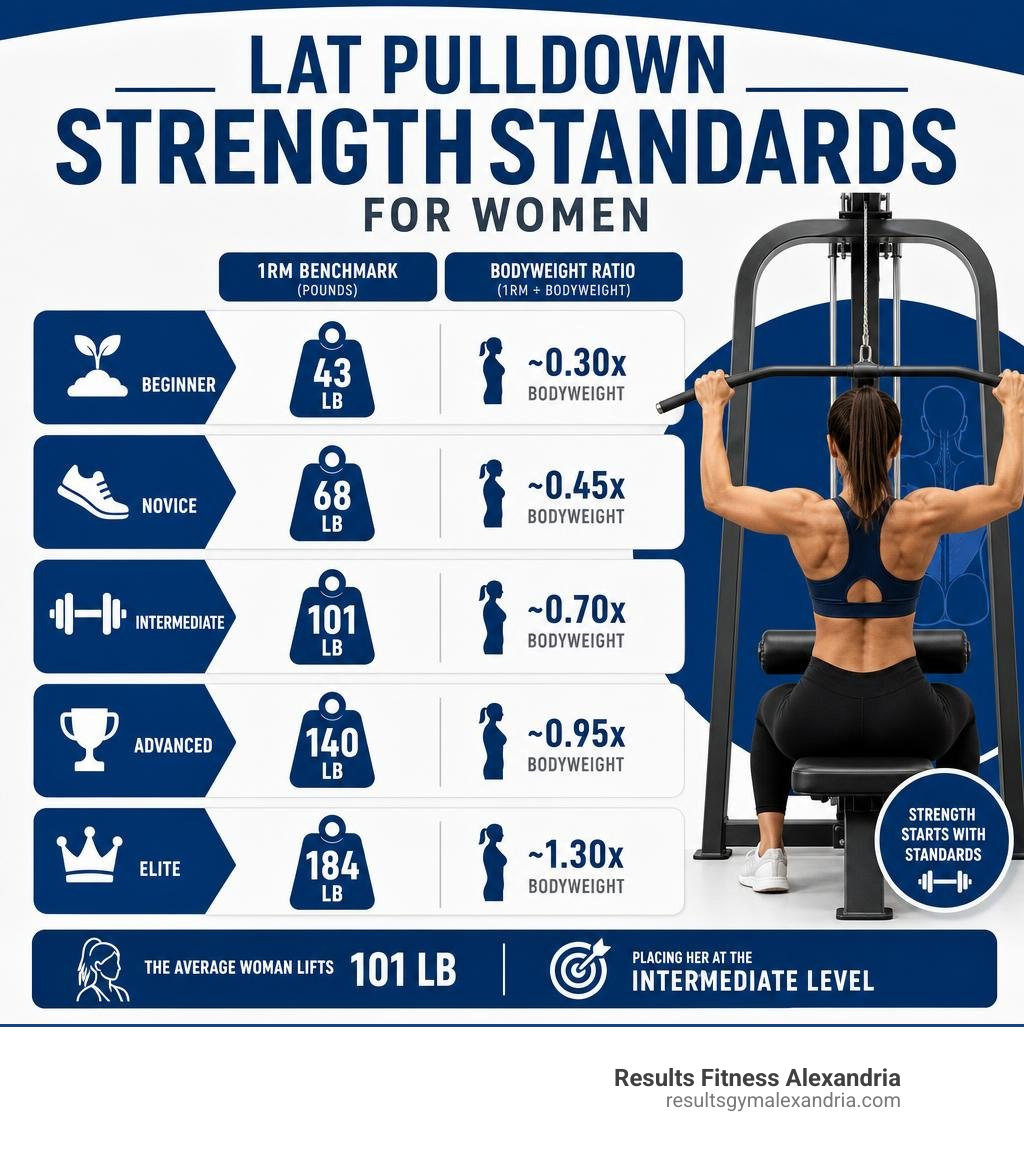
| Experience Level | 1RM (lb) | Bodyweight Ratio |
|---|---|---|
| Beginner | 43 lb | ~0.30x bodyweight |
| Novice | 68 lb | ~0.45x bodyweight |
| Intermediate | 101 lb | ~0.70x bodyweight |
| Advanced | 140 lb | ~0.95x bodyweight |
| Elite | 184 lb | ~1.30x bodyweight |
The average woman lifts 101 lb (1RM) — placing her at the Intermediate level.
To do a lat pulldown correctly:
- Sit with thighs secured under the pad
- Grip the bar slightly wider than shoulder-width
- Keep your torso upright with a slight lean back
- Pull the bar to your upper chest, leading with your elbows
- Control the weight slowly back to the start
Whether you’re brand new to the gym or trying to level up your back training, the details below will help you lift smarter and safer.
I’m Jennifer Rapchak, Fitness Director at Results Fitness Alexandria and an ACE-certified personal trainer with over 14 years of experience — including helping women of all fitness levels master compound movements like the lat pulldown. The rest of this guide covers everything from proper technique to strength standards so you know exactly where you stand and where to go next.
Know your Lat pulldown women terms:
Lat Pulldown Women Strength Standards: How Much Should You Lift?
When you first sit down at the cable machine, it is completely normal to look at the weight stack and wonder, “How much should I actually be pulling?”
Strength is highly individual, but having reliable benchmarks can help you set realistic goals and track your progress over time. To understand how your strength compares to other female lifters, we look at both absolute numbers (the total weight on the bar) and relative numbers (how much you lift relative to your body weight).
According to data from nearly 2 million logged lifts, the average female lifter sits at an intermediate level with a one-rep max (1RM) of 101 lb. However, your ideal target depends heavily on your own body weight and training age. To get a precise estimation of your personal strength curve, we highly recommend using a Lat Pulldown Strength Standards Calculator.
To help you visualize where you stand, we have compiled a comprehensive breakdown of Lat Pulldown Strength Standards for Men and Women. If you are looking to build a well-rounded foundation, combining these benchmarks with a structured program like The Ultimate Guide to Womens Strength Training is the absolute best way to ensure safe, continuous progress.
Below is a detailed look at how these standards translate to your actual workouts.
Starting Weights for Lat Pulldown Women by Experience Level
Your training experience dictates where you should start and how you should structure your expectations. Let’s break down the five primary strength tiers for lat pulldown women:
- Beginner: If you are brand new to strength training, a standard starting point is roughly 0.30x your body weight. For a 140 lb woman, this translates to a 1RM of about 43 lb. If you are training with working sets of 10 to 12 reps, your working weight will likely be around 25 to 30 lbs. Focus entirely on feeling the muscles in your mid-to-upper back engage rather than trying to move a heavy stack.
- Novice: After a few months of consistent training, you will likely progress to the novice tier, which averages 0.45x your body weight (about 68 lb 1RM for a 140 lb lifter). At this stage, your neuromuscular coordination has improved, meaning your brain is getting better at telling your back muscles to fire.
- Intermediate: Reaching the intermediate standard of 0.70x your body weight (around 101 lb 1RM) typically takes one to two years of consistent, structured workouts. At this level, you have built noticeable muscle definition and have mastered the mind-muscle connection.
- Advanced: Advanced lifters can pull 0.95x their body weight (about 140 lb 1RM). If you have reached this stage, you are stronger than roughly 80% of gym-goers and possess excellent upper-body pulling power.
- Elite: Elite lifters pull 1.30x their body weight or more (184+ lb 1RM). This level of strength is typically reserved for competitive strength athletes who have dedicated years to serious training.
If you are still wondering where to begin on day one, consult our detailed resource on How Much Lat Pulldown Weight Should I Use? to dial in your starting numbers. Starting light is never a sign of weakness; it is the smartest way to build a resilient foundation. For a deeper dive into establishing your baseline, check out our Strength Training for Women Complete Guide.
How to Progress Your Lat Pulldown Women Workouts
To keep getting stronger, you must introduce your muscles to a concept known as progressive overload. Your body is incredibly smart; if you lift the exact same weight for the exact same reps every single week, your muscles will adapt and stop growing.
Progressive overload doesn’t just mean adding weight to the stack. You can progress by:
- Increasing Resistance: Adding 5 lbs to the machine when you can successfully complete all your sets with perfect form.
- Increasing Volume: Adding an extra set or performing more repetitions with the same weight.
- Improving Execution: Slowing down the tempo, adding a pause at the bottom of the movement, or controlling the stretch (eccentric phase) more effectively.
In terms of programming, the most popular and highly effective rep schemes for women include:
- 3 sets of 10 reps (used in 22% of logged female workouts) — fantastic for a balance of strength and muscle tone.
- 3 sets of 12 reps (12% of workouts) — excellent for muscular endurance and hypertrophy.
- 3 sets of 8 reps (10% of workouts) — ideal for focusing on building raw strength.
To learn more about how to systematically apply these principles to your routine, read our guide on The Power of Progressive Overload How to Keep Getting Stronger.
Proper Lat Pulldown Form and Technique

Mastering the mechanics of the lat pulldown is the difference between building a strong, sculpted back and simply giving your biceps an exhausting, inefficient workout.
To execute the standard cable lat pulldown with flawless form, follow this step-by-step checklist:
- Adjust the Machine: Before you grab the bar, adjust the thigh pad so it sits snugly over your laps. Your feet should be flat on the floor, and your knees should be bent at a 90-degree angle. This anchor point is critical; if the weight is heavy, a loose pad will cause your body to rise off the seat.
- Set Your Grip: Reach up and grip the bar. For a standard pulldown, your hands should be slightly wider than shoulder-width. Use an “open grip” (thumbs on the same side of the bar as your fingers) to help reduce grip tension and prevent your forearms from taking over.
- Position Your Torso: Sit down with your thighs secured under the pad. Keep your chest lifted high, pull your shoulders down away from your ears, and lean back very slightly (about 10 to 15 degrees). This minor lean creates a clear path for the bar to clear your face without you having to duck your head.
- Initiate the Pull (Scapular Depression): Do not start by bending your elbows. Instead, initiate the movement by pulling your shoulder blades down and squeezing them together.
- Drive the Elbows: Pull the bar down toward your collarbone by driving your elbows down toward your back pockets. Think of your hands simply as hooks; the power should come entirely from your back.
- Squeeze and Control: Stop when the bar is just above or gently touching your upper chest. Pause for a split second to maximize muscle contraction, then slowly resist the weight as it returns to the starting position. The upward (eccentric) phase should take 2 to 3 seconds.
For a complete breakdown of this movement, check out How to do the Lat Pulldown: Master the Pulldown Technique Today!. Understanding the underlying physiology of how muscles grow will also elevate your training, which you can explore in The Science of Building Muscle Tips for Effective Strength Training.
Key Benefits of the Lat Pulldown for Women
Why should lat pulldown women be a non-negotiable staple in your weekly gym routine? The benefits extend far beyond just aesthetics:
- Improves Posture: Many of us spend hours hunched over computers, steering wheels, or phones. This leads to tight chest muscles and weak, overstretched back muscles (often resulting in a forward shoulder roll). Strengthening your latissimus dorsi, rhomboids, and trapezius pulls your shoulders back into natural, healthy alignment.
- Enhances Shoulder Health and Stability: The lats play a massive role in stabilizing the shoulder girdle. By strengthening these muscles, you protect the delicate rotator cuff muscles from injury during overhead movements.
- Creates a Beautiful “V-Taper”: Developing your lats creates the illusion of a smaller, more tapered waist. Because the lats run down the sides of your back, adding subtle tone to this area creates gorgeous upper-body symmetry.
- Functional Strength for Daily Life: Whether you are lifting groceries, carrying children, or pulling open heavy doors, a strong back makes everyday tasks feel effortless.
To discover more about how lifting weights transforms your body and mind, explore our articles on 10 Benefits of Strength Training for Women and the Benefits of Strength Training for All Ages.
Common Form Mistakes to Avoid
Even seasoned gym-goers fall victim to bad habits on the pulldown machine. Keep an eye out for these common errors:
- Using Momentum (The “Rocking Chair” Effect): If you have to violently swing your torso backward to get the bar down, the weight is too heavy. This shifts the focus away from your lats and puts unnecessary stress on your lower back. Keep your torso quiet.
- Pulling the Bar Too Low: Pulling the bar down to your stomach or belly button forces your shoulders to roll forward, which can cause shoulder impingement. Stop the bar at your collarbone or upper chest.
- Letting the Weight Slam: The eccentric (lowering) phase of the lift is highly effective for building muscle. Letting the weight stack slam back up without control misses out on half the exercise and risks muscle strain.
- Relying Solely on Grip Strength: Often, a woman’s back muscles are much stronger than her grip. If your hands or forearms give out before your back is tired, consider using wrist straps to eliminate grip strength as a limiting factor.
For a visual guide on correcting these common pitfalls, watch this excellent video: Lat Pulldown – Modern Woman’s Guide to Strength Training.
Grip Variations and Home Alternatives

One of the best things about the lat pulldown is its versatility. By simply swapping out the attachment or changing your hand position, you can target different areas of your back and arms.
Here are the four primary grip variations and what they do:
- Wide Grip (Pronated/Overhand): This is the classic variation. Your hands are placed well outside shoulder-width with your palms facing away from you. This variation maximizes latissimus dorsi activation and is the absolute best option for building upper back width and that coveted V-taper.
- Close Grip (Neutral): Using a V-bar attachment where your palms face each other. Because your arms are tucked close to your sides, this variation places a heavy emphasis on the lower lats, rhomboids, and the middle back, while also engaging the biceps.
- Reverse Grip (Supinated/Underhand): Grasping the bar with your palms facing toward you at shoulder-width. This variation recruits your biceps heavily, allowing you to lift slightly more weight. It is fantastic for targeting the lower portion of the lats. Learn how to master this with the Reverse-Grip Lat Pulldown: Ultimate Guide & Tips (Female).
- Neutral Grip (Wide or Shoulder-Width): Using a multi-grip bar where your palms face each other. This is incredibly friendly on the shoulder joints and provides a highly comfortable, natural pulling path.
To see how these variations fit into a complete back routine, check out our Ultimate Guide to Gym Back Exercises.
Home Alternatives to the Cable Machine
Don’t have access to a full cable machine? No problem! You can still build an incredibly strong back using resistance bands at home.
The band bent over lat pulldown is a phenomenal home alternative. To perform it:
- Anchor a resistance band securely to a high point (like a sturdy door frame or a high hook).
- Step back, hinge forward at your hips with a straight spine, and hold the band with arms extended.
- Pull your hands down and back toward your shoulders, driving your elbows down and squeezing your shoulder blades together.
- Slowly return to the starting position under control.
For a step-by-step visual demonstration of this home setup, refer to the Female Band Bent Over Lat Pulldown: Video Guide & Tips. To learn more about how to design effective workouts with minimal gear, read How to Build Muscle with Good Strength Training Workouts.
Frequently Asked Questions about Lat Pulldowns
What is the average lat pulldown weight for a female lifter?
The average lat pulldown weight for a female lifter is 101 lb for a single repetition (1RM). This milestone typically classifies a lifter as “Intermediate.” If you are performing standard working sets of 8 to 12 repetitions, an average intermediate female will typically train with working weights between 65 and 80 lbs, depending on her exact body weight and fatigue levels.
How do lat pulldown standards differ between men and women?
Men generally possess higher absolute upper-body strength due to a higher concentration of muscle mass in the shoulders and thoracic region. On average, a beginner male starts at about 50% of his body weight, while a beginner female starts at roughly 30% of her body weight.
However, when looking at relative strength (strength relative to lean muscle mass), women can build extraordinary pulling power that rivals or exceeds their male counterparts. Both men and women benefit equally from the postural and structural advantages of vertical pulling.
Can lat pulldowns help me get my first pull-up?
Absolutely! In fact, the lat pulldown is one of the single best tools for pull-up progression.
A pull-up requires you to lift 100% of your body weight against gravity, which can be an incredibly high barrier to entry. The lat pulldown uses the exact same vertical pulling motion but allows you to select a lighter load. By gradually increasing your lat pulldown weight until you can pull close to your body weight with strict form, you are directly building the specific muscle groups and neural pathways required to nail that very first unassisted pull-up.
Conclusion
The lat pulldown is a foundational movement that belongs in every woman’s fitness routine. By focusing on strict form, avoiding momentum, and systematically applying progressive overload, you will unlock incredible upper-body strength, stand taller with radiant posture, and take a massive step toward your personal fitness milestones.
At Results Fitness Alexandria, we are incredibly passionate about helping women master the art of strength training in a welcoming, supportive environment. Whether you want to work one-on-one with an expert personal trainer or join our vibrant fitness community in Alexandria, Virginia, we are here to support your journey.
Ready to see how you stack up? We invite you to claim your free 1-day pass to experience our state-of-the-art amenities, try out our elite cable machines, and take the first step toward a stronger back.
To help you get started on your back-building journey today, dive into our comprehensive Womens Back Workout template and come visit us at the gym!