The Ultimate Guide to Women’s Strength Training
Why Every Woman Should Be Strength Training
Women’s strength training is one of the most effective things you can do for your health, your body, and your long-term independence — at any age.
Here’s a quick summary of what it involves and why it matters:
- What it is: Using weights, resistance bands, or bodyweight exercises to build muscle strength and mass
- Key benefits: Stronger bones, faster metabolism, better body composition, improved mood, and reduced disease risk
- How often: At least 2-3 days per week, per CDC guidelines
- Will it make you bulky? No — women produce 15-20 times less testosterone than men, making significant bulk extremely unlikely
- When to start: Now — women begin losing 3-8% of muscle mass per decade after age 30
Despite these benefits, many women still feel uncertain about where to begin, worried they’ll do it wrong or end up looking a certain way they don’t want. That hesitation is completely understandable — and also very common.
The good news? Strength training is far more approachable than most people think, and the science behind it is clear: it works.
I’m Jennifer Rapchak, Fitness Director at Results Fitness Alexandria and ACE-certified personal trainer with over 14 years of experience designing women’s strength training programs. This guide covers everything you need — from your very first workout to long-term programming for lasting results.
Understanding Women’s Strength Training and Its Core Benefits

At its heart, women’s strength training—also known as resistance training—is any exercise that requires your muscles to contract against an external resistance. This resistance can come from dumbbells, barbells, kettlebells, resistance bands, or even your own body weight.
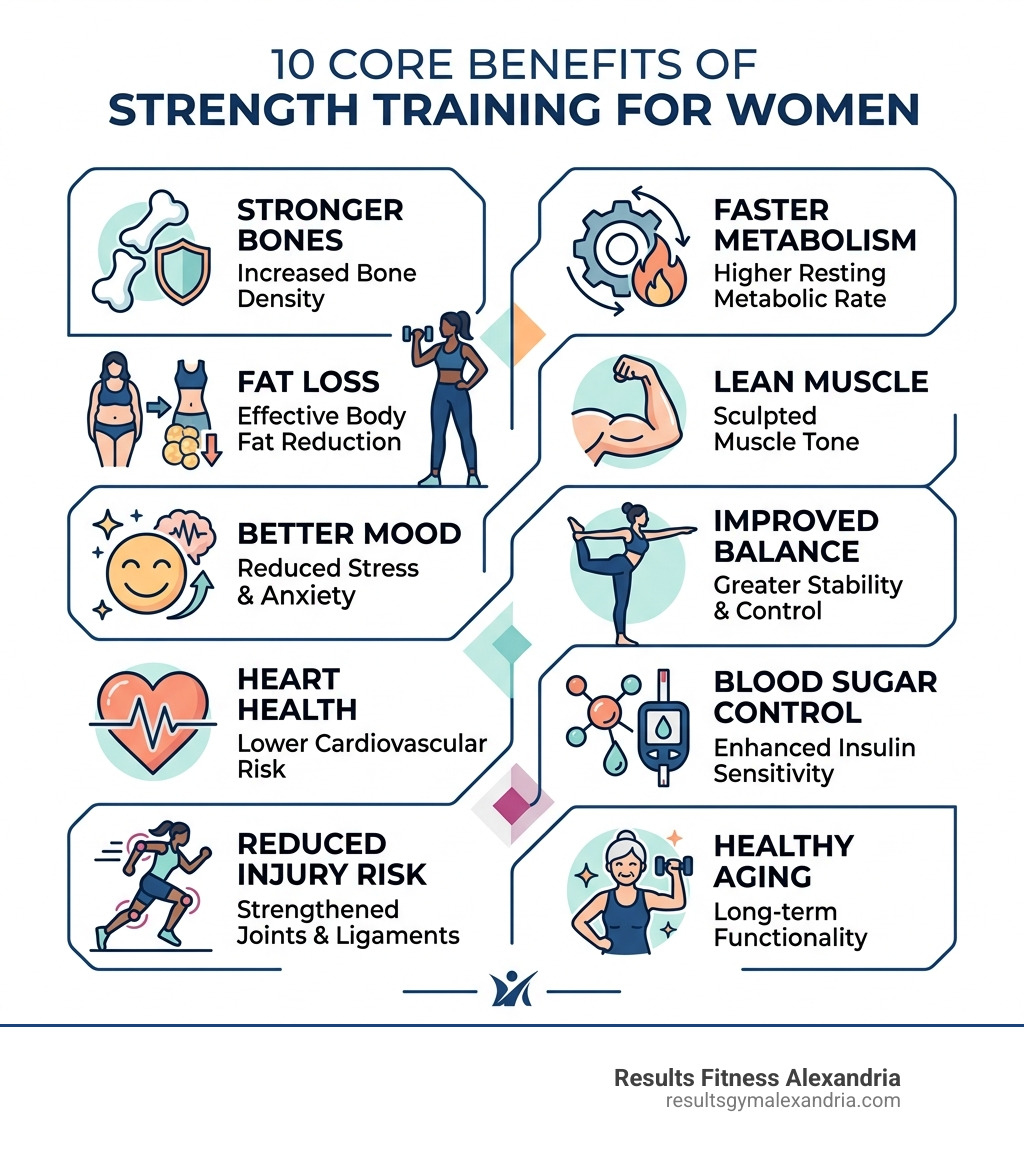
While many women are drawn to the gym for the aesthetic “toned” look, the internal benefits are even more profound. Research shows that 10 Benefits Of Strength Training For Women extend far beyond the mirror. One of the most critical advantages is the improvement of bone density. In the U.S., roughly 8 million women have osteoporosis. High-intensity resistance training creates a healthy “stress” on the bone, signaling the body to build more bone mineral. In fact, studies on postmenopausal women with low bone mass have shown significant improvements in bone structure with just 30 minutes of lifting twice a week.
Furthermore, lifting weights is your best defense against sarcopenia, the natural loss of muscle mass that occurs as we age. By maintaining muscle, you ensure you can carry your own groceries, lift your children, and stay mobile well into your 80s and 90s. For a deeper dive into the technical side of lifting, check out A Woman’s Guide to Weightlifting.
The Difference Between Strength, Weight Training, and Cardio
It is common to hear these terms used interchangeably, but they serve different physiological purposes. Cardio (aerobic exercise) focuses on your heart and lungs, improving your aerobic capacity. While cardio is great for burning calories during the session, it doesn’t do much for muscle mass.
Weight training is a subcategory of strength training that specifically uses weights. Strength training, however, is the broader umbrella. It focuses on improving anaerobic power and muscle fiber recruitment. When we talk about What Is Functional Strength Training A Simple Guide, we are referring to movements that mimic daily life—like squatting to sit in a chair or pulling a heavy door open.
Why Strength Training is Essential for Longevity and Aging
After the age of 30, women can lose between 3% and 8% of their muscle mass every single decade. This decline accelerates after age 60. This isn’t just about “getting soft”; it’s about your metabolic rate. Muscle is metabolically active tissue, meaning it burns more calories at rest than fat does.
By prioritizing Benefits Of Strength Training For All Ages, you are essentially “future-proofing” your body. You’re keeping your metabolism high, your joints stable, and your bones thick enough to withstand a fall. It is never too late to start; even women in their 90s have shown the ability to build strength and improve their quality of life through resistance training.
Getting Started: A Beginner’s Guide to Women’s Strength Training

Starting a women’s strength training routine can feel like walking into a foreign country where you don’t speak the language. Should you use the machines? The dumbbells? The scary-looking rack in the corner?
The first rule for any beginner is: Form First, Weight Second. It is much better to lift a light weight with perfect technique than a heavy weight with poor form that leads to injury. We always recommend starting with a Beginner Weight Training For Women program that focuses on mastering basic movements. If you’re looking for a supportive starting point, Welcome to Rainmaker offers great insights into the mindset shift required for lifting.
Debunking the “Bulky” Myth
This is the number one fear we hear at Results Fitness Alexandria: “I don’t want to look like a bodybuilder.” Let’s clear the air once and for all. Women do not have the hormonal profile to accidentally “bulk up.” Men have 15 to 20 times more testosterone than women, and even they have to work incredibly hard for years to build massive muscles.
When women lift heavy, they develop lean muscle definition. This is what most people mean when they say they want to look “toned.” You are simply replacing soft tissue with firm, dense muscle. For more on how this works, read A Guide to Weight Training for Women | ACE Blog.
Essential Equipment for Your First Workout
You don’t need a thousand-dollar home gym to start. In fact, many of our members start with just a few basics:
- Dumbbells: A light, medium, and heavy pair (e.g., 5lbs, 10lbs, and 15lbs).
- Resistance Bands: Great for glute activation and adding tension without heavy iron.
- Kettlebells: Excellent for functional movements like swings and goblet squats.
- Your Own Body: Never underestimate the power of a perfect push-up or air squat.
Finding the Best Beginner Weight Lifting Women tools is about choosing equipment that allows you to feel the muscle working without straining your joints.
Mastering the Best Women’s Strength Training Exercises
If you want the best results in the least amount of time, you need to focus on compound exercises. These are movements that use multiple joints and muscle groups at once. Think of them as the “biggest bang for your buck” in the gym.
Top Compound Lifts for Total Body Results
- Goblet Squats: Holding a weight at your chest while squatting. This targets the quads, glutes, and core. It’s a staple in Everything You Need To Know About Womens Lower Body Training.
- Deadlifts: Lifting a weight from the ground. This is the ultimate “posterior chain” builder, strengthening your back, glutes, and hamstrings.
- Overhead Press: Pushing weights toward the ceiling. This builds strong, stable shoulders. Check out our Shoulder Workout Gym Female guide for tips.
- Bent-Over Rows: Pulling weights toward your hips while hinged at the waist. This is essential for posture and is a key part of any Womens Back Workout.
Sets, Reps, and Progressive Overload Explained
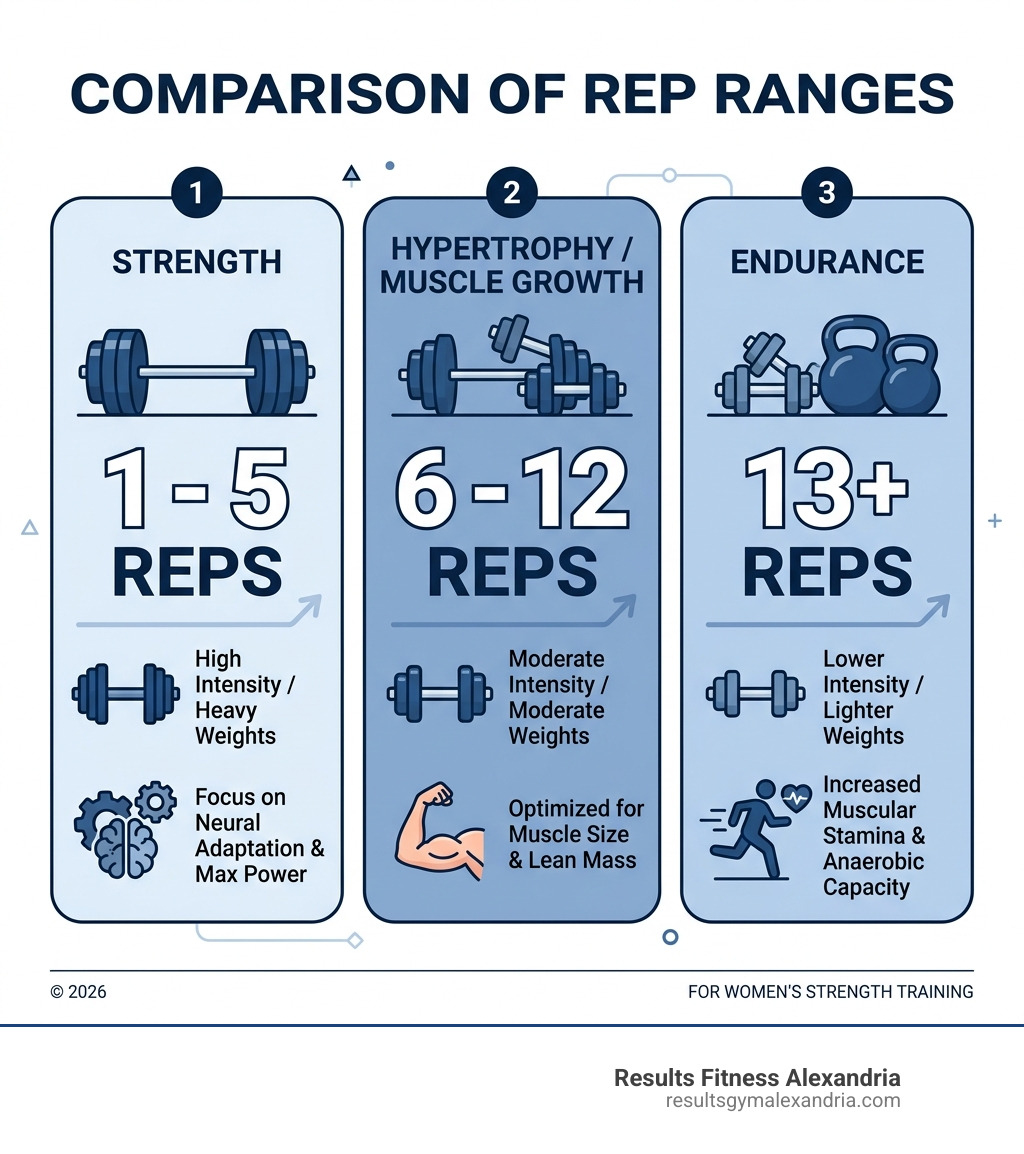
To keep getting stronger, you must apply the principle of progressive overload. This means gradually increasing the difficulty of your workouts so your body is forced to adapt. You can do this by adding more weight, doing more reps, or shortening your rest periods.
| Goal | Rep Range | Sets | Rest Period |
|---|---|---|---|
| Strength | 1 – 5 | 3 – 5 | 2 – 5 minutes |
| Muscle Growth (Hypertrophy) | 6 – 12 | 3 – 4 | 60 – 90 seconds |
| Endurance | 13 – 20 | 2 – 3 | 30 – 45 seconds |
For a complete breakdown of how to keep the gains coming, read The Power Of Progressive Overload How To Keep Getting Stronger.
Programming and Recovery for Long-Term Success
You don’t actually build muscle while you’re lifting weights; you build it while you’re resting. Lifting creates tiny micro-tears in the muscle fibers, and your body repairs them to be stronger than before during recovery. This is why The Science Of Building Muscle Tips For Effective Strength Training emphasizes rest just as much as work.
One “hidden” benefit of lifting is the EPOC effect (Excess Post-Exercise Oxygen Consumption). After a heavy session, your metabolism stays elevated for 14 to 48 hours as your body works to repair itself. You are essentially burning calories while sitting on the couch! To see how this fits into a schedule, look at our Strength Training Programs Complete Guide.
Balancing Strength and Cardio
You don’t have to give up your morning run to be strong. However, order matters. If your primary goal is fat loss or building strength, we recommend doing your weights before your cardio. This ensures you have the most energy for the heavy lifts.
If you’re wondering how to mix the two, our guides on Strength And Cardio and Maximizing Results Integrating Strength Training Into Your Cardio Routine will help you find the perfect balance for your schedule.
Nutrition and Sleep for Muscle Repair
You cannot out-train a poor diet or a lack of sleep. To repair muscle, your body needs protein. A good rule of thumb for active women is to aim for 0.7 to 1 gram of protein per pound of bodyweight. If you weigh 150 lbs, that’s roughly 105-150g of protein a day.
Sleep is also non-negotiable. Aim for 7–9 hours a night to allow your hormones to regulate and your muscles to recover. For those focused on weight loss, lifting is actually more effective than cardio alone. In a 2017 study, dieters who did strength training 4 times a week lost 18lbs of fat, compared to only 16lbs for those doing aerobic exercise. Learn more about this at Beyond Cardio Beginner Weight Lifting For Womens Fat Loss.
Strength Training for Specific Life Stages
Women’s strength training isn’t a one-size-fits-all approach. Your body has different needs during pregnancy, postpartum, and menopause. As we discuss in the Strength Training For Women Complete Guide, adapting your routine to your life stage is the key to longevity.
Training During Menopause and Beyond
During perimenopause and menopause, estrogen levels drop sharply. Since estrogen is “anabolic” (muscle-building), this drop can lead to rapid muscle and bone loss. Strength training becomes your most powerful tool to combat these hormonal shifts. Just 30 minutes twice a week of high-intensity resistance training has been shown to improve functional performance and bone structure in postmenopausal women. For more tips on getting started later in life, see Strength Training for Women: A Beginner’s Complete Guide – WellnessZing.
Pregnancy and Postpartum Considerations
If you were active before pregnancy, you can usually continue lifting with some modifications. Strength training helps manage pregnancy weight gain, reduces back pain, and prepares your body for the physical demands of labor. Postpartum, the focus shifts to core stability and pelvic floor health. Always consult with your doctor before starting, and check out our Womens Beginner Gym Workout for low-impact ideas. You can also find practical tips in the Beginner Strength Training for Women: Practical Guide.
Frequently Asked Questions about Women’s Strength Training
How many days a week should women lift weights?
The CDC and most fitness experts recommend at least 2 to 3 days per week. This frequency is enough to see significant strength gains while allowing for 48 hours of recovery between sessions for the same muscle groups. If you’re looking for a place to start in Alexandria, our Amenities/Strength Training section shows how we support this frequency.
Can I do strength training at home without a gym?
Absolutely. You can use bodyweight exercises like push-ups, squats, and lunges, or incorporate household items like water jugs as weights. Resistance bands are also an affordable, space-saving option. We cover these home-based movements in our Amenities/Functional Training guide.
How long does it take to see results from lifting?
You will feel results before you see them. Within 2 to 4 weeks, you’ll experience “neurological adaptations”—your brain gets better at talking to your muscles, making you feel stronger almost instantly. Visible muscle definition usually takes 8 to 12 weeks of consistent training and proper nutrition.
Conclusion
At Results Fitness Alexandria, we’ve seen how women’s strength training changes lives. It’s not just about the weights you lift; it’s about the confidence you gain when you realize what your body is capable of doing. Whether you are in your 20s or your 70s, there is a place for you in our Alexandria, Virginia community.
We offer everything from personal training to yoga and even childcare, so you can focus on your workout without worry. Ready to see what all the hype is about? We invite you to come in and try us out.
Start your journey with our Women’s Workout Program and take advantage of our free 1-day pass to try our amenities. Your future, stronger self will thank you!