
Shoulder Workout Gym Female: Top 5 Ultimate Moves
Why Strong Shoulders Matter for Every Woman
A shoulder workout gym female routine should target all three deltoid heads (front, side, rear) plus rotator cuff muscles for balanced strength and injury prevention. Here’s what an effective gym-based shoulder workout includes:
Key Components:
- Compound Movements: Overhead press, Arnold press, landmine press
- Isolation Exercises: Lateral raises, front raises, rear delt flies
- Rotator Cuff Work: Face pulls, external rotations, band pull-aparts
- Frequency: 1-2 times per week with 48-72 hours recovery between sessions
- Rep Range: 8-12 reps for muscle building, 12-15 for endurance
Strong shoulders do more than look good in a tank top. They’re the foundation of your upper body strength, supporting everything from carrying groceries to reaching overhead. The shoulder is one of the most complex joints in your body, made up of three deltoid muscles and four rotator cuff muscles working together to provide both mobility and stability.
When you neglect shoulder training, you miss out on improved posture, reduced neck pain, and the functional strength needed for daily activities. Women who train their shoulders consistently report feeling more confident and capable in both athletic pursuits and everyday life.
The reality? Building defined shoulders takes consistent effort, proper form, and a smart training approach. You won’t accidentally become “too bulky” – women’s lower testosterone levels make that extremely difficult. What you will develop is a balanced, athletic physique with better posture and reduced injury risk.
I’m Jennifer Rapchak, Fitness Director at Results Fitness Alexandria, and I’ve spent over 14 years as a certified personal trainer helping women develop effective shoulder workout gym female programs that deliver results without intimidation. My approach combines strength training fundamentals with personalized coaching to help you build functional, sustainable fitness.
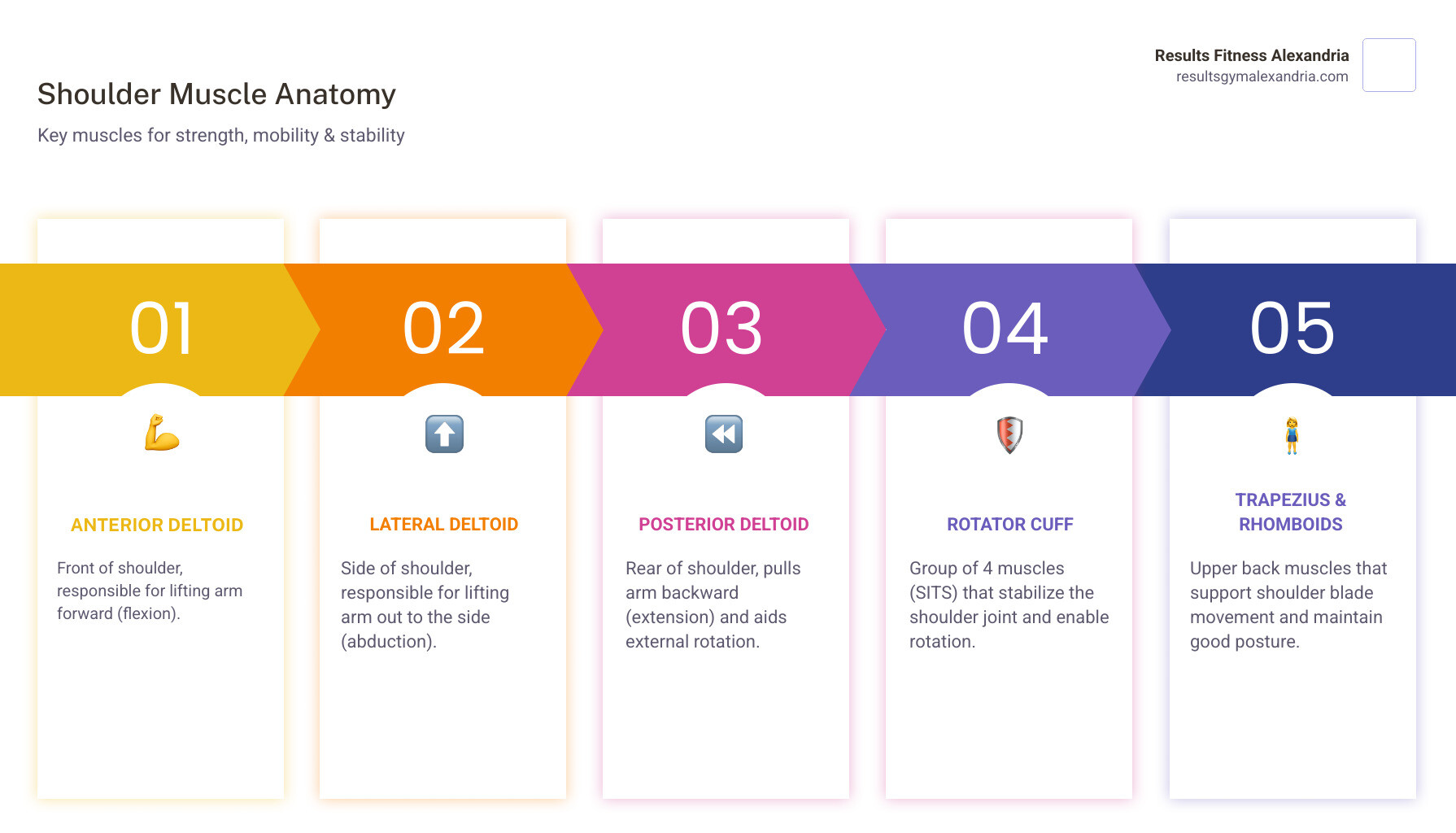
Shoulder workout gym female terms to remember:
Why Shoulder Strength is a Game-Changer for Women
The shoulder joint is the body’s most complex and mobile joint. However, this mobility comes at the cost of stability, making it highly susceptible to injury if not properly supported by strong muscles. The deltoid muscles, which give the shoulder its rounded shape, have three heads: anterior (front), lateral (side), and posterior (rear). For balanced strength, all three must be targeted. Beyond the deltoids, the four small rotator cuff muscles are critical for stabilizing the shoulder joint. Neglecting them is a recipe for injury.
Strong shoulders are a preventative measure against injury, improve athletic performance, and improve functional strength for daily activities like carrying groceries or a toddler. They also dramatically improve posture. Many of us spend hours hunched over devices, leading to rounded shoulders. Targeted exercises pull the shoulders back, creating a confident stance and alleviating related neck and back pain. This is just one of the many benefits we see when women accept strength training for women.
The Anatomy of a Strong Shoulder
To train effectively, we must understand the key muscles:
- Anterior Deltoid (Front): Lifts your arm forward (flexion). Essential for pushing movements like an overhead press.
- Lateral Deltoid (Side/Medial): Lifts your arm out to the side (abduction) and creates the shoulder’s “capped” look.
- Posterior Deltoid (Rear): Extends your arm behind you. Crucial for posture and balancing the front deltoids.
- Rotator Cuff Muscles (SITS): The Supraspinatus, Infraspinatus, Teres Minor, and Subscapularis stabilize the upper arm bone in the shoulder socket, making them vital for injury prevention.
- Trapezius (Traps): This large muscle runs from your neck to your upper back, helping shrug, turn your head, and stabilize your shoulder blades.
- Rhomboids: Located under the trapezius, these muscles pull your shoulder blades back, which is essential for good posture.
Balanced development across all these muscles is the goal. Over-emphasizing one area, like the front deltoid, can lead to imbalances and increased injury risk.
Benefits Beyond Aesthetics
While defined shoulders boost confidence, the advantages of a strong shoulder workout gym female routine extend far beyond aesthetics.
One of the most impactful benefits is correcting rounded shoulders. Strengthening the posterior deltoids and back muscles pulls the shoulders into proper alignment, which can significantly reduce neck and back pain.
Strong shoulders also provide increased stability for other lifts. A stable shoulder girdle allows us to squat, deadlift, and press more safely and effectively, contributing to overall functional strength, a cornerstone of the benefits of functional fitness.
Furthermore, building muscle through strength training helps boost metabolism, as muscle tissue burns more calories at rest than fat. This holistic approach to fitness is what we champion at Results Fitness Alexandria.
The Ultimate Shoulder Workout Gym Female Routine
An effective shoulder workout gym female routine is built on key principles to stimulate muscle growth safely:
- Progressive Overload: To keep getting stronger, you must continually challenge your muscles by gradually increasing weight, reps, or sets. It’s how we keep getting stronger.
- Compound Exercises: These multi-joint movements work several muscle groups at once, building overall strength. They should come first in your workout.
- Isolation Movements: These exercises target a single muscle group, helping to sculpt and define specific areas of the deltoid.
- Mind-Muscle Connection: Actively focusing on the muscle you’re working improves its activation and development.
Here are the top gym-based shoulder exercises we recommend to hit all three deltoid heads and support the rotator cuff:
Top 5 Gym-Based Shoulder Exercises
- Overhead Press (Dumbbell or Barbell): A powerhouse compound move for overall shoulder strength, targeting the front and side deltoids.
- Dumbbell Lateral Raises: An isolation classic for the lateral deltoid, creating that rounded shoulder look.
- Face Pulls (Cable Machine): Crucial for targeting the rear deltoids and strengthening the rotator cuff, which improves posture.
- Bent-Over Rear Delt Fly (Dumbbell or Cable): Another fantastic exercise to isolate and build the often-neglected rear deltoids.
- Arnold Press: A unique press that incorporates rotation to hit all three deltoid heads.
Beginner Shoulder Workout Gym Female Plan
For those new to shoulder training, safety and proper form are top priorities. Our women’s beginner gym workout often includes these foundational movements:
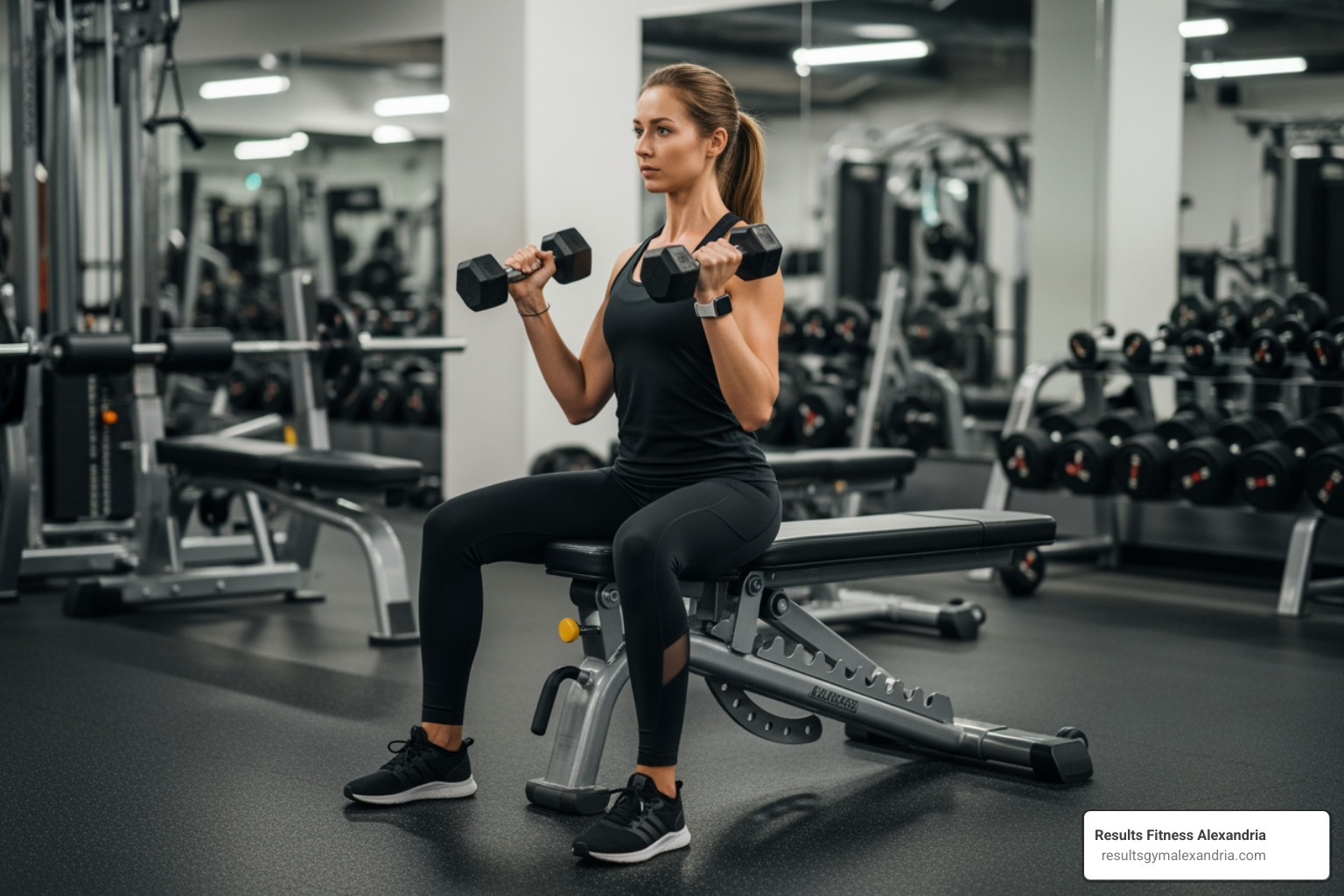
- Seated Dumbbell Press: A great starting point as the bench provides back support, helping you focus on form.
- How to do it: Sit on a bench with back support, holding dumbbells at shoulder height. Press the weights overhead until your arms are nearly straight, then slowly lower them.
- Sets & Reps: 3 sets of 10-12 repetitions.
- Machine Shoulder Press: The machine’s fixed path of motion is ideal for beginners to learn the movement safely.
- How to do it: Adjust the seat so the handles are at shoulder height. Press the handles overhead, then control the movement as you lower them.
- Sets & Reps: 3 sets of 10-12 repetitions.
- Dumbbell Lateral Raise: Key for shaping the side deltoids.
- How to do it: Stand or sit, holding a light dumbbell in each hand at your sides. With a slight bend in your elbows, raise your arms out to the sides until parallel to the floor. Lower slowly.
- Sets & Reps: 3 sets of 12-15 repetitions.
- Face Pulls (Cable Machine): Essential for rear deltoid development and rotator cuff health.
- How to do it: Set a cable pulley to chest height with a rope. Grab the rope, step back, and pull it towards your face, separating the ends and squeezing your shoulder blades together.
- Sets & Reps: 3 sets of 12-15 repetitions.
Beginners should start with light weights (e.g., 3-5 lb dumbbells) and focus on form. The weight is right when the last few reps are challenging but possible with good technique.
Advanced Shoulder Workout Gym Female Variations
Once you’ve mastered the basics, introduce more challenging exercises to continue stimulating growth, aligning with the science of building muscle.
- Arnold Press: This exercise, named for Arnold Schwarzenegger, targets all three deltoid heads.
- How to do it: Sit on a bench holding dumbbells with palms facing you. As you press overhead, rotate your wrists so your palms face forward at the top. Reverse the motion on the way down.
- Sets & Reps: 3-4 sets of 8-12 repetitions.
- Upright Row: Use dumbbells or a cable for a more natural path of motion to avoid impingement.
- How to do it: Stand holding a barbell or dumbbells. Pull the weight straight up towards your chin, leading with your elbows and keeping the weight close to your body.
- Sets & Reps: 3 sets of 10-12 repetitions.
- Landmine Press: A joint-friendly alternative to the traditional overhead press.
- How to do it: Place one end of a barbell in a landmine attachment. Hold the other end with one hand at shoulder height. Press the barbell up and forward in an arc, engaging your core.
- Sets & Reps: 3 sets of 8-10 repetitions per arm.
- Bent-Over Rear Delt Fly: A crucial isolation exercise for the posterior deltoids.
- How to do it: Bend at your hips until your torso is nearly parallel to the floor, holding light dumbbells. With a slight bend in your elbows, raise the dumbbells out to the sides, squeezing your shoulder blades.
- Sets & Reps: 3-4 sets of 12-15 repetitions.
Advanced trainees can use heavier weights for lower reps (6-8) or incorporate techniques like supersets (two exercises back-to-back) or drop sets to intensify the workout.
Crafting Your Weekly Fitness Schedule
Integrating a dedicated shoulder workout gym female routine into your weekly schedule is key for progress. We recommend targeting shoulders directly 1-2 times per week on non-consecutive days to allow for adequate recovery, which is when muscle growth occurs. For hypertrophy, aim for a total of 9-15 challenging sets for the week, spread across your sessions.
A sample workout split might look like this:
- Monday: Lower Body
- Tuesday: Upper Body (including shoulders)
- Wednesday: Active Recovery or Cardio
- Thursday: Lower Body
- Friday: Upper Body (including shoulders) or Full Body
- Saturday/Sunday: Rest or Light Activity
This approach ensures your shoulders get enough stimulus without being overtrained. For a more detailed guide, check out our article on how to create a balanced fitness routine.
Warm-Ups and Cool-Downs
Never skip your warm-up or cool-down, especially for a complex joint like the shoulder. A proper warm-up should last 5-10 minutes and consist of dynamic stretches like arm circles, arm swings, and band pull-aparts. These movements increase blood flow and prepare the joint for work.
After your workout, a cool-down with static stretching (holding a stretch for 20-30 seconds) can improve flexibility and aid recovery. Gentle cross-body or overhead shoulder stretches are beneficial. Don’t forget other recovery methods, as outlined in our 10 post-workout recovery tips.
Common Mistakes and How to Avoid Them
Being aware of common pitfalls can help you maximize results and stay injury-free.
- Ego Lifting: Lifting a weight that’s too heavy by sacrificing form. This increases injury risk by forcing other muscles to compensate. How to avoid: Choose a weight that allows you to complete all reps with perfect form. Quality over quantity.
- Poor Form: Incorrect execution makes an exercise less effective and puts stress on your joints. Swinging weights or shrugging during presses are common examples. How to avoid: Watch videos, practice with light weights, and consider working with a certified personal trainer to ensure your technique is spot on.
- Neglecting Rear Delts: The front deltoids get plenty of work from pressing movements, but the rear deltoids are often overlooked, leading to imbalances and poor posture. How to avoid: Include dedicated rear delt exercises like face pulls and bent-over flies in every shoulder routine.
- Overtraining: More isn’t always better. Muscles need time to recover. Training shoulders too frequently can lead to fatigue and plateaus. How to avoid: Stick to 1-2 dedicated shoulder workouts per week and listen to your body.
- Improper Warm-Up: Jumping straight into heavy lifting without preparing the shoulder joint is a recipe for disaster. How to avoid: Always perform 5-10 minutes of dynamic stretches and activation exercises before your main workout.
These common errors are explored in more detail in our article on top 5 common mistakes at each fitness level.
Frequently Asked Questions about Female Shoulder Workouts
Won’t lifting weights make my shoulders too bulky?
This is a common concern, but it’s extremely difficult for women to accidentally become “bulky” from strength training for a few key reasons:
- Hormonal Differences: Women have significantly lower levels of testosterone, the primary hormone for large-scale muscle growth, than men.
- Training Style: Building massive muscles requires a very specific, high-volume training protocol and a significant caloric surplus. Most fitness-oriented training creates shape and tone, not extreme size.
- Nutrition’s Role: To gain significant mass, you must eat in a caloric surplus. Most women’s fitness goals don’t align with this.
- Creating Shape vs. Size: Consistent shoulder training creates an athletic shape, often called a V-taper, which can make the waist appear smaller. You’ll build strong, sculpted shoulders, not unwanted bulk. Our women’s weight loss guide further explains how strength training supports body composition goals.
What are the best at-home shoulder exercises?
You can get an effective shoulder workout at home with minimal equipment:
- Resistance Band Pull-Aparts: Excellent for rear delts and posture. Hold a band with arms extended and pull it apart, squeezing your shoulder blades.
- Pike Push-Ups: A great bodyweight overhead press. From a push-up position, walk your feet in, lifting your hips into an inverted “V.” Lower your head toward the floor, then press up.
- Dumbbell Front Raises: Stand holding light dumbbells or water bottles. Raise your arms straight in front of you to shoulder height, then lower with control.
- Isometric Towel Lateral Raise: Hold a towel taut and try to pull your hands apart, creating your own resistance. Hold the contraction for 15-20 seconds.
- Superman Y-Raises: Lie face down with arms in a “Y” shape. Lift your chest, arms, and legs, squeezing your upper back and rear delts.
These exercises can be part of a broader exercise for cardiovascular endurance at home routine.
How do I know what weight to start with?
Choosing the right starting weight is key to challenging your muscles safely. Here’s how to find it:
- Start Light: Always begin with a lighter weight than you think you need. For many women, 3-5 lb dumbbells for isolation exercises and 5-10 lbs for presses is a good starting point.
- Focus on Form: If you’re swinging the weight or feeling strain in your neck or back, the weight is too heavy. Perfect form is the priority.
- The “Last Reps Challenging” Rule: The right weight will make the last 2-3 reps of a set feel challenging but doable with good form. If it’s too easy, increase the weight; if you can’t finish, decrease it.
- Progressive Overload: Once a weight becomes easy, it’s time to increase it slightly, add a rep, or add a set. This is how you continue to make progress.
Our personal trainers at Results Fitness Alexandria can help you choose appropriate weights for your beginner weight training for women program.
Conclusion
Embracing a targeted shoulder workout gym female routine is a game-changer, offering a multitude of benefits far beyond what we might initially imagine. We’ve seen how strong shoulders contribute to improved posture, reduce the risk of injury, and improve our performance in everyday activities and other lifts. We’ve also demystified the concern about “bulking up,” understanding that women naturally build shape and definition rather than excessive size.
By understanding the anatomy of our shoulders, implementing smart training principles like progressive overload, and prioritizing proper form, we can build strong, confident shoulders that empower us in every aspect of our lives. Consistency, a thoughtful approach to exercise selection, and proper warm-ups and cool-downs are our keys to success.
At Results Fitness Alexandria, we believe in empowering every woman to find her strength. We provide a supportive environment, expert guidance, and state-of-the-art amenities designed to help you achieve your fitness goals, whatever they may be.
Ready to sculpt your shoulders and open up your full upper body potential? We invite you to explore our women-centric gym amenities and start your journey with us today.