
Muscular and Cardiovascular Endurance: 2 Crucial Secrets
Why Understanding Endurance Types Transforms Your Fitness
Muscular and cardiovascular endurance are the two pillars of physical stamina that determine how well your body performs during exercise and daily activities. Here’s a quick breakdown:
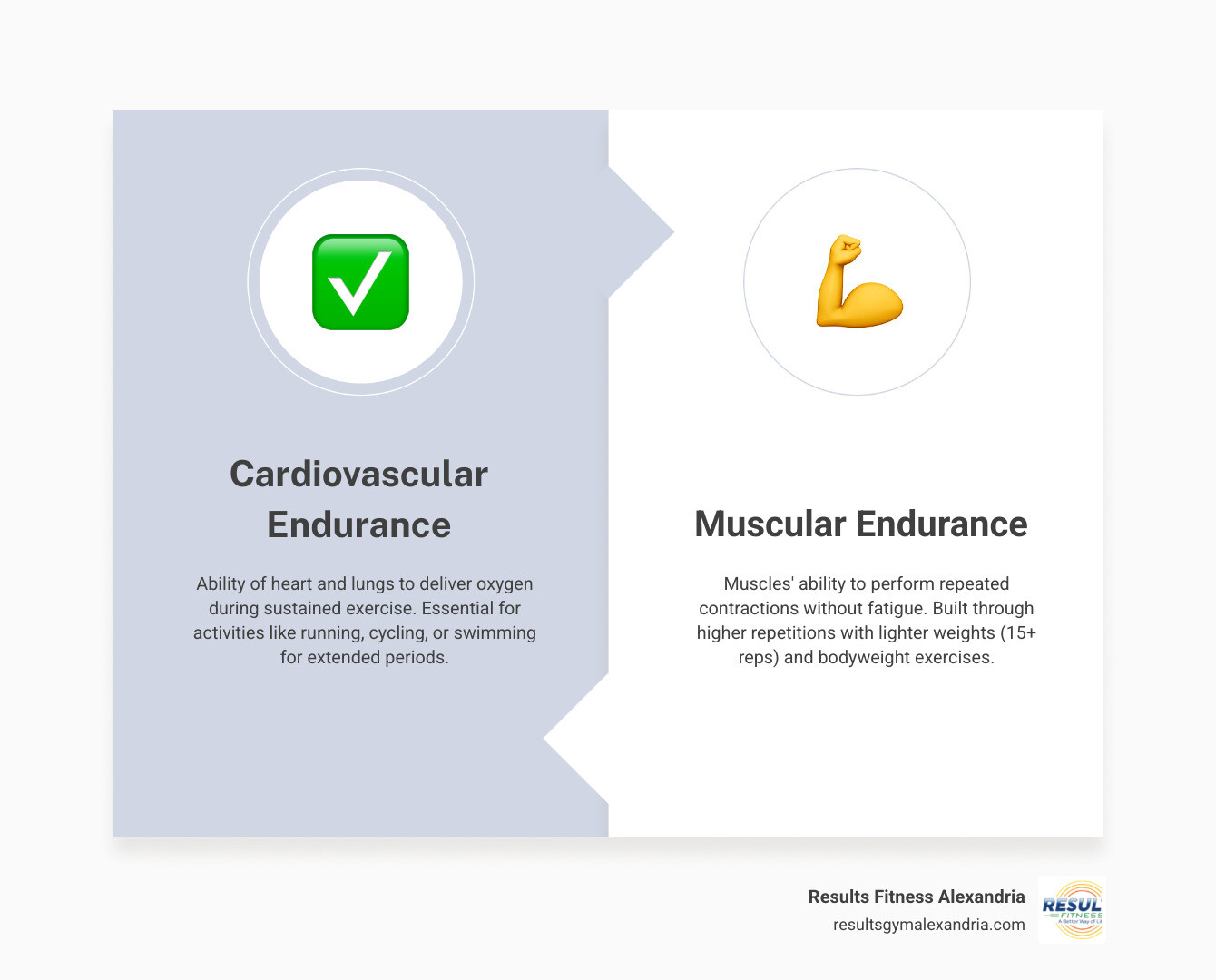
- Cardiovascular Endurance: Your heart and lungs’ ability to deliver oxygen during sustained exercise like running or cycling. The general guideline is 150 minutes of moderate or 75 minutes of vigorous activity weekly.
- Muscular Endurance: Your muscles’ ability to perform repeated contractions without fatigue, built through higher repetitions (15+) with lighter weights. Aim for 2-3 sessions per week.
Many people focus on just one type and wonder why their fitness stalls. Research highlights the importance of both. One study linked better cardiovascular endurance to a lower risk of death from any cause, while another showed muscular endurance training makes muscles more fatigue-resistant in just four weeks.
The truth is simple: you need both.
Circuit training is an efficient solution, combining strength exercises with minimal rest to challenge your heart and muscles simultaneously. This dual approach builds comprehensive fitness without a huge time commitment.
As Jennifer Rapchak, Fitness Director at Results Fitness Alexandria, I’ve seen how this integrated approach transforms busy individuals. Understanding these two types of endurance is your first step toward lasting results.
Muscular and cardiovascular endurance helpful reading:
Understanding the Two Pillars of Stamina
Endurance isn’t a single capability; it’s two distinct systems. Understanding the difference between muscular and cardiovascular endurance is key to effective training. You need both pillars to feel strong, capable, and energized.
What is Cardiovascular Endurance?
Cardiovascular endurance (or aerobic fitness) is how efficiently your heart and lungs deliver oxygen to your muscles during sustained activity. It’s why some people can run for miles while others feel winded after climbing stairs.
When your cardiovascular endurance improves, your heart becomes more efficient, pumping more blood with each beat. Your muscles get better at using that oxygen, allowing you to keep going longer without exhaustion. Activities like running, swimming, and cycling rely heavily on this system.
What is Muscular Endurance and Why is it Important?
Muscular endurance is about how long specific muscles can work before fatiguing. Can you hold a plank for a minute? How many push-ups can you do? That’s muscular endurance.
It’s not the same as muscular strength, which is the maximum force you can generate in one effort. Endurance is about repeating a movement or sustaining a contraction. It shows up in daily life when you carry groceries, maintain good posture, or play with your kids without needing constant breaks. It keeps muscles firing properly, which helps prevent injuries.
A study found that after just four weeks of muscular endurance training, muscles became significantly more resistant to fatigue.
While your cardiovascular system keeps oxygen flowing, your muscular endurance keeps individual muscle groups from giving up. Both cardiovascular and muscular endurance work together to make you feel capable.
Here’s how they compare:
| Feature | Cardiovascular Endurance | Muscular Endurance |
|---|---|---|
| Primary System | Heart, Lungs, Blood Vessels | Specific Muscle Groups |
| Goal | Sustain whole-body activity | Sustain repeated muscle contractions/holds |
| Focus | Oxygen delivery & utilization | Muscle fatigue resistance |
| Intensity | Moderate to vigorous, sustained | Lower weight/resistance, higher repetitions |
| Example Exercises | Running, Swimming, Cycling, Brisk Walking | Planks, High-rep Squats, Push-ups, Wall Sits |
| Feeling | Out of breath, lifted heart rate | Muscle burn, local fatigue |
Understanding these two types helps you train smarter, ensuring your workout program includes both cardio and high-repetition strength exercises to avoid gaps in your overall fitness.
Want to dive deeper into how endurance benefits your health? Check out our guide on the benefits of endurance.
Boosting Your Cardiovascular Endurance
Improving your cardiovascular endurance is fundamental to a healthier, more energetic life. The benefits extend far beyond athletic performance.
Key Health Benefits
Improving your cardiovascular endurance strengthens your heart, allowing it to pump more blood with each beat. This lowers your resting heart rate and reduces strain during daily activities. Regular cardio also aids in weight management by burning calories and regulating metabolism.
Most importantly, it significantly lowers your risk of heart disease, stroke, type 2 diabetes, and high blood pressure. A study of over 120,000 people found that better cardiovascular endurance was linked to a lower risk of death from any cause.
Beyond physical health, cardio releases endorphins that combat stress and anxiety. It also boosts daily energy levels and can improve cognitive function and memory. The CDC recommends at least 150 minutes of moderate-intensity or 75 minutes of vigorous-intensity aerobic activity each week as a baseline for building muscular and cardiovascular endurance.

Best Exercises for Cardiovascular Fitness
You have plenty of options for building cardiovascular fitness. Running and jogging are classics, while cycling offers a lower-impact alternative. Swimming provides a full-body, joint-friendly workout.
Don’t underestimate brisk walking—if you’re slightly out of breath but can still talk, you’re building endurance. For those short on time, High-Intensity Interval Training (HIIT) is highly effective, alternating intense bursts with brief recovery. A study found HIIT significantly improved cardiovascular endurance. Jump rope, rowing, and dance workouts are also excellent choices. The key is finding activities you enjoy.
For more strategies, check out our guide on Cardio Training for Better Endurance.
How to Measure and Improve Your Progress
Tracking your cardiovascular endurance keeps you motivated. While lab tests are precise, several practical methods work well.
- The Talk Test: During moderate exercise, you should be able to talk but not sing. During vigorous exercise, you can only speak a few words at a time.
- VO2 max: This is the maximum amount of oxygen your body can use during intense exercise. Many fitness trackers can estimate this metric.
- The Cooper 1.5-Mile Run Test: Time how long it takes you to cover 1.5 miles and compare your results to age and sex norms over time.
To improve, focus on consistency and progressive overload. Gradually increase the challenge as your body adapts.
- Find activities you enjoy. This is the most important factor for long-term success.
- Aim for the right intensity using the talk test or a heart rate monitor (typically 60-80% of your max heart rate).
- Be consistent. Aim for 3-5 cardio sessions per week. Gradually increase the duration or intensity of your workouts.
- Prioritize rest. Rest days are when your body gets stronger. Active recovery like light walking can aid this process.
Listen to your body and watch for signs of overtraining. Before starting a new program, consult your doctor. Our certified trainers at Results Fitness Alexandria can also design a safe, effective plan for you.
Building Lasting Power: How to Improve Muscular Endurance
While cardio gets your heart pumping, muscular endurance is what keeps your body moving. It’s the practical fitness that lets you power through a hike, carry a toddler, or hold a plank. It’s about teaching your muscles to keep going.
Training Principles for Muscular Endurance
Building muscular endurance is different from building pure strength. The secret is higher repetitions with lower weight. Use lighter weights (around 50% or less of your one-rep max) and aim for 15 or more repetitions per set. This trains your muscles to resist fatigue.
Focus on time under tension with controlled, deliberate movements rather than speed. Keep rest periods short—between 30 and 90 seconds—to teach your body to recover quickly. Compound movements like squats and push-ups are highly effective because they engage multiple muscle groups at once, translating directly to everyday activities.

Effective Exercises for Muscular Endurance
The great thing about muscular endurance training is that you can start with no equipment.
- Bodyweight Exercises: Squats (15-20 reps), Lunges (10-15 reps per leg), Planks (hold for as long as possible with good form), and Push-ups (on knees if needed) are excellent staples.
- Light Weight Training: When you’re ready, add resistance. Kettlebell swings build posterior chain endurance and boost your heart rate. Bicep curls, tricep extensions, and overhead presses work well when you drop the weight and aim for 15-20 reps.
Proper form is always the priority. It’s better to do 12 perfect squats than 25 sloppy ones. For more guidance, see our article on The Science of Building Muscle: Tips for Effective Strength Training.
Tracking Progress and Training Frequency
You don’t need to live in the gym to build impressive muscular endurance. Consistency is more important than frequency.
Track your progress with a workout log to see concrete improvements in your repetition counts over time. Also, notice real-world wins, like carrying groceries without getting winded.
The CDC recommends strength training at least 2 to 3 times per week. A 2018 metastudy found that total training volume is the most critical factor, but 2-3 sessions per week is a sweet spot for most people, allowing for adequate recovery.
Rest and recovery are when your muscles actually get stronger. Listen to your body and take extra rest days when needed. Alternating muscular endurance and cardio days is a great way to stay active while allowing specific muscle groups to recover.
At Results Fitness Alexandria, our personal trainers can help you design a program that builds lasting muscular endurance without overwhelming your schedule.
The Synergy of Muscular and Cardiovascular Endurance in Circuit Training
In real life, cardiovascular endurance and muscular endurance aren’t isolated systems; they’re dance partners. Understanding this relationship is key to building true, functional fitness.
How the Two Systems Work Together
Your cardiovascular endurance acts as the delivery system, pumping oxygen-rich blood to your working muscles. The more efficient this system, the better your muscles can perform. In turn, your muscular endurance determines how efficiently those muscles use that oxygen. Well-conditioned muscles work more economically, placing less demand on your cardiovascular system.
This partnership means improving one type of endurance often helps the other. When your heart works better, your muscles go longer. When your muscles resist fatigue, your heart doesn’t have to work as hard.
Risks of Neglecting One
Focusing on just one type of endurance creates imbalances. A runner who neglects muscular endurance may find their form breaking down late in a run. A lifter who ignores cardio may get winded during daily activities. This imbalance leads to performance plateaus and increases injury risk, as tired muscles can’t properly support joints.
This is why circuit training is such a powerful tool—it addresses both types of endurance in one efficient package.

How Circuit Training Builds Muscular and Cardiovascular Endurance Simultaneously
Circuit training involves moving through a series of exercises with minimal rest. This keeps your heart rate liftd, challenging your cardiovascular system continuously. At the same time, each exercise targets specific muscles, building their endurance.
The minimal rest is the secret sauce. Your heart keeps pumping at an liftd rate while different muscle groups take turns working. This high metabolic demand burns more calories and trains both your cardiovascular and muscular systems to handle sustained work more efficiently. It’s a two-for-one workout.
For more strategies, check out Maximizing Results: Integrating Strength Training into Your Cardio Routine.
Designing a Program for Muscular and Cardiovascular Endurance
Creating a circuit is simple. The key is variety and balance. Include exercises for different muscle groups: an upper-body push (push-ups), an upper-body pull (rows), a lower-body move (squats), a core exercise (plank), and a cardio burst (jumping jacks).
Adjust work and rest intervals to your fitness level. A beginner might work for 30 seconds and rest for 30 seconds. As you get fitter, increase work time and decrease rest time. After completing one full circuit, rest for 1-2 minutes, then repeat 2-3 times.
Here’s a sample beginner circuit:
- Bodyweight Squats
- Push-ups (on knees if needed)
- Plank Hold
- Jumping Jacks
- Alternating Lunges
- Mountain Climbers
Tailor the circuit to your goals. A runner might emphasize lower-body and core work. A 2024 study in Sports Medicine found strength training improves running economy. For general fitness, keep circuits balanced. Your program should evolve with you, applying the principle of progressive overload. Learn more in our guide on The Power of Progressive Overload: How to Keep Getting Stronger.
Our trainers at Results Fitness Alexandria can design circuits for any fitness level, helping you build both muscular and cardiovascular endurance efficiently.
Fueling Your Stamina: Nutrition, Recovery, and Special Considerations
What you do between workouts is just as important as the work itself. Fueling and recovery are what turn your efforts into real progress in muscular and cardiovascular endurance.
Role of Nutrition
Your body needs the right fuel to perform optimally.
- Carbohydrates: Your primary energy source. Complex carbs from whole grains, fruits, and vegetables provide sustained energy to prevent you from “hitting the wall.”
- Protein: Your repair crew. Lean sources like chicken, fish, and beans help rebuild muscle tissue after it’s been challenged during a workout.
- Healthy Fats: Provide sustained fuel for longer activities. Find them in avocados, nuts, and olive oil.
- Micronutrients: Iron, magnesium, and B vitamins are crucial for oxygen transport and energy production. A varied diet of whole foods usually covers these needs.
Hydration Importance
Even mild dehydration can hurt your performance. Drink water consistently throughout the day. During workouts longer than 30 minutes, sip regularly. For sessions over an hour, consider an electrolyte drink to replace lost minerals.
Recovery Strategies
Don’t skimp on recovery—it’s when you get stronger.
- Sleep: Aim for 7-9 hours of quality sleep. This is when your body releases growth hormone and repairs muscle tissue.
- Active Recovery: On rest days, gentle activities like walking or light cycling promote blood flow, which can reduce soreness.
- Stretching and Mobility: Foam rolling or yoga 2-3 times a week improves flexibility and range of motion, leading to more efficient movement.
Most importantly, listen to your body. Persistent soreness or fatigue are signs you may need extra rest. For more tips, see our guide on 10 Post-Workout Recovery Tips to Maximize Results.
Age and Population-Specific Priorities
Your endurance needs may shift with age and goals.
- For older adults, both endurance types are vital for independence. Cardiovascular health supports daily stamina, while muscular endurance helps with tasks like rising from a chair and preventing falls. The National Institute on Aging emphasizes that strength training for healthy aging is crucial for maintaining muscle mass and mobility.
- Athletes have sport-specific needs. Marathon runners need muscular endurance to maintain form, while team sport athletes need a blend of both for high-intensity bursts and recovery.
- For the general population, a balanced approach is ideal. The CDC’s recommendation of aerobic activity plus strength training 2-3 times per week is a great formula for overall well-being.
At Results Fitness Alexandria, our trainers design programs that match your specific stage of life and goals, creating the right balance of muscular and cardiovascular endurance for you.
Conclusion
We’ve explored the two fundamental types of stamina: muscular and cardiovascular endurance. They are the pillars that determine how well your body performs in the gym and in daily life.
Your cardiovascular endurance powers your heart and lungs, protecting you from chronic disease and boosting your energy. Your muscular endurance ensures your muscles can keep working without fatiguing, whether you’re holding a plank or carrying groceries.
Here’s the truth: you need both. Focusing on one creates imbalances that hold you back. When you train both together, you open up your body’s full potential.
Circuit training is a smart, efficient way to do this. By combining strength exercises with minimal rest, you challenge your heart and build muscular stamina simultaneously. It’s the perfect solution for busy lives.
What matters most is consistency. Find an approach you enjoy, fuel your body properly, and prioritize recovery. These are just as important as the workouts themselves.
At Results Fitness Alexandria, we’ve seen how powerful balanced endurance training can be. Our personal trainers are experts at designing programs that build both muscular and cardiovascular endurance in a way that works for your unique body and goals.
Ready to experience the difference? Explore our state-of-the-art cardio equipment and see how Results Fitness Alexandria can help you build the strength and stamina to live your best life. Let’s make it happen together.