
Endurance running program: 8 Ultimate Steps
Why an Endurance Running Program is Your Key to Better Performance
An Endurance running program is a structured training plan designed to systematically build your aerobic capacity, running efficiency, and stamina. An effective program includes:
- A mix of intensities: 80% easy runs at a conversational pace, with 10-15% dedicated to intense workouts like tempo runs and intervals.
- Progressive overload: Following the 10% rule to gradually increase weekly mileage.
- Variety and structure: A weekly schedule with long runs, speed work, recovery runs, and cross-training, often following a hard-easy pattern.
- Holistic training: Complementary activities like strength training and flexibility work.
- Strategic recovery: Prioritizing rest days and adequate sleep.
For beginners, this typically means 3-4 running days per week. The key is consistency over intensity. As one experienced coach noted: “Sometimes the simple workouts are the best ones” – focusing on gradual progression and listening to your body will yield better results than pushing too hard too fast.
I’m Jennifer Rapchak, Fitness Director at Results Fitness Alexandria. With an ACE certification and over 14 years of experience, I design Endurance running programs that combine structured progression with personalized coaching to help you build the stamina and speed you’re looking for.
Quick Endurance running program terms:
The Fundamental Principles of Endurance Training
A successful endurance running program is built on core principles that separate steady improvement from plateaus and injuries.
Progressive overload is the golden rule of adaptation. Your body gets stronger in response to stress, but you must gradually increase that stress over time. The 10% rule—increasing your weekly mileage by no more than 10% each week—is a proven method to prevent the overuse injuries that sideline many runners.
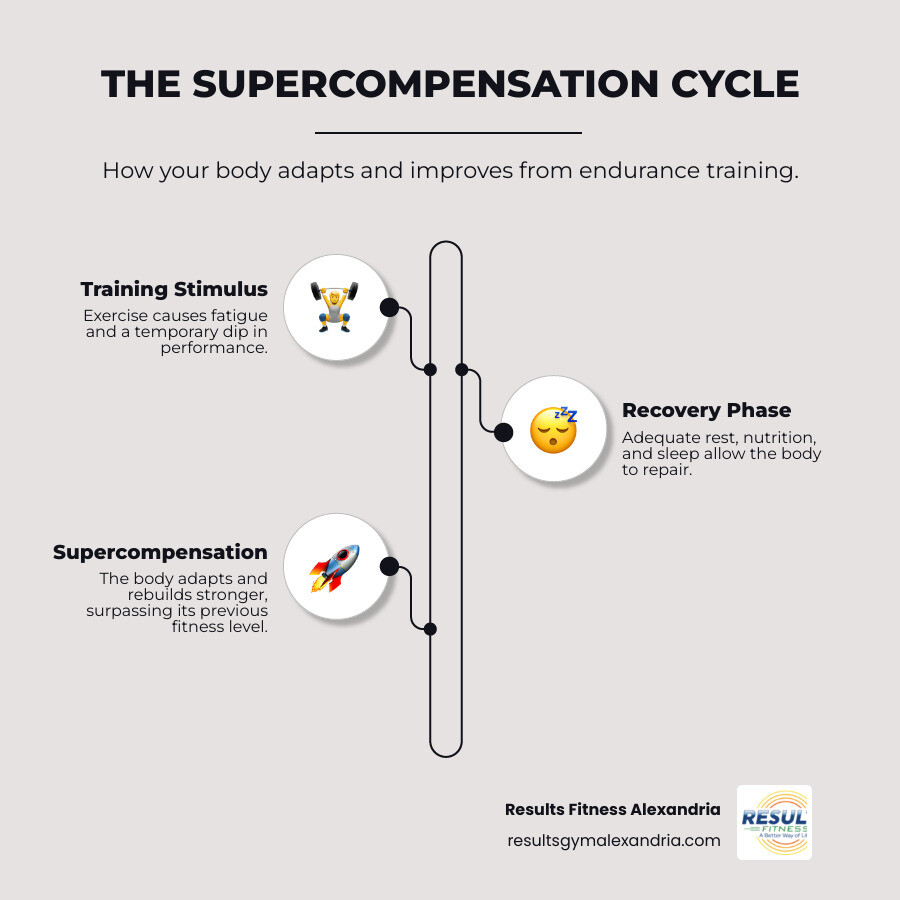
Adaptation happens through supercompensation. After a challenging run, you are temporarily weaker. During recovery, your body doesn’t just return to baseline; it overcompensates, building back stronger. This is why recovery is non-negotiable—it’s where the actual improvements happen as your muscles repair and energy stores rebuild.
Consistency trumps intensity every time. Three runs per week for six months will be far more transformative than sporadic bursts of intense running. Endurance running is a full-body sport. Your core stabilizes every stride, your arms provide balance, and your mental game is critical. For guidance on building this foundation, check out our resource on creating a balanced fitness routine.
The most important skill you’ll develop is listening to your body. Persistent aches or unusual fatigue are your body’s signals to adjust your training, not signs of weakness.
Understanding Training Intensity
One of the biggest mistakes is running every workout at the same pace. Understanding training intensity is key to open uping real improvement.
Rate of Perceived Exertion (RPE) is a simple 1-10 scale of self-assessed effort. A relaxed 5-6 RPE is a conversational pace, while a 9-10 RPE makes talking impossible.
Heart rate zones, calculated as percentages of your maximum heart rate, offer another window into your effort. Easy runs should be in zones 1 and 2 to build your aerobic base.
This highlights the difference between aerobic and anaerobic training. Your aerobic system uses oxygen for long-duration efforts, while the anaerobic system provides short bursts of power when oxygen demand is high. The point where these systems meet is your lactate threshold. A well-designed endurance running program systematically raises this threshold, allowing you to run faster for longer. Learn more about leveraging lactate threshold training.
Smart pacing strategies tie it all together. Learning to match your effort to your workout’s goal is the difference between random running and purposeful training.
Building Your Endurance Running Program: Key Workouts and Structure
Running the same pace every day leads to plateaus and aches. An effective Endurance running program avoids this ‘single-speed running’ trap by using smart, varied training to target different energy systems in your body.

The key is a hard-easy pattern. A challenging workout on Tuesday is followed by an easy run on Wednesday, allowing your body to recover and adapt. This strategic approach is how you get stronger.
The 8 Essential Running Workouts
A solid program is built around these fundamental workouts:
Easy runs are your foundation, making up 65-80% of your mileage at a conversational pace to build your aerobic base.
Tempo runs are “comfortably hard” (85-90% max HR), pushing your lactate threshold to help you sustain faster paces.
Interval runs are classic speedwork: hard-paced repeats with short rest periods to improve speed and aerobic capacity.
Progression runs start easy and gradually increase in pace, working both aerobic and anaerobic systems.
Hill repeats build explosive power and strength, making flat ground feel easier.
Fartlek runs, or “speed-play,” involve unstructured bursts of fast and slow running, adding fun to training.
Long runs are your most important weekly workout, building endurance, fat-burning efficiency, and mental toughness.
Recovery runs are short, very easy efforts that promote blood flow and aid recovery from harder workouts.
| Workout Type | Purpose | Intensity (RPE) | % of Weekly Mileage |
|---|---|---|---|
| Easy Run | Build aerobic base, recover, promote form | 5-6/10 (conversational) | 65-80% |
| Tempo Run | Increase lactate threshold, improve sustained speed | 7-8/10 (comfortably hard, short sentences) | 10-15% (part of intense) |
| Interval Run | Improve speed, VO2 max, running economy | 8-9/10 (hard, difficult to speak) | 10-15% (part of intense) |
| Long Run | Build endurance, mental toughness, practice fueling | 5-7/10 (easy to moderate) | Varies (often 20-35% of weekly total) |
How to Structure Your Training Week
Creating your weekly schedule is like putting together a puzzle. A sample structure for most runners:
- Monday: Rest or light cross-training.
- Tuesday: Speed workout (intervals, hills).
- Wednesday: Easy run.
- Thursday: Quality workout (e.g., tempo run).
- Friday: Rest or cross-training.
- Saturday: Long run.
- Sunday: Easy run or rest.
This pattern is flexible. Adapt the plan to your body and schedule. For more help, see our guide on creating an effective workout routine for beginners.
Starting Your First Endurance Running Program
Begin with the walk-run method: alternate short running intervals with walking. For example, run for one minute, walk for two, and repeat for 20-30 minutes. Gradually increase the running time as you get stronger.
Focus on time over distance initially. Aiming to be active for 30 minutes removes pressure and helps build consistency.
Set realistic goals, like running for 10 minutes straight or completing your first 5K. Celebrate these small victories as you progress.
Beyond the Run: Essential Components for Peak Performance
A successful Endurance running program goes beyond just running. It requires strength training, proper recovery, and smart nutrition to prevent injury and improve performance. Running creates an impact of 2-3 times your body weight with every step, so your body must be prepared.

Holistic training, including mental preparation and nutrition, is the difference between reaching your goals and being sidelined by injury or burnout.
The Role of Strength Training in an Endurance Running Program
Strength training is essential for runners. It prevents injuries, not adds bulk.
- Core strength stabilizes your body, maintaining form when you’re tired.
- Strong leg muscles (quads, hamstrings, glutes) provide power and endurance.
- Upper body stability helps with propulsion and balance.
Strength training addresses the muscle imbalances that cause common injuries like runner’s knee and shin splints. Aim for 2-3 sessions per week with higher reps (15+) to build endurance. Learn more about integrating strength training into your cardio routine and the benefits of functional fitness.
Recovery, Flexibility, and Cross-Training
Your body gets stronger during recovery, not during workouts.
- Active recovery like light walking or cycling on rest days promotes blood flow and healing.
- Stretching after runs can improve flexibility and relaxation.
- Foam rolling acts as self-massage to release muscle knots.
- Sleep is critical for muscle repair and growth hormone release.
- Cross-training (swimming, cycling) builds cardiovascular fitness while resting running muscles and preventing mental burnout. See how aquatics classes can transform your workout routine.
Fueling Your Endurance
Your body needs the right fuel to perform optimally.
- Hydration: Drink half your body weight in ounces of water daily, plus more on training days.
- Pre-run: For runs over an hour, eat a carb-rich meal 2-3 hours before. For shorter or early morning runs, a small snack like a banana 30-60 minutes prior is sufficient.
- During runs: For efforts over 60-90 minutes, consume 30-60 grams of carbs per hour from gels or chews.
- Post-run: Within 30-60 minutes after a hard run, have a meal with carbs and protein to replenish energy and repair muscles.
Carbohydrates for energy are your body’s preferred fuel source for endurance. Don’t fear them.
Tracking, Adapting, and Improving Your Performance
In endurance running, tracking progress is key to managing your training. It helps you understand what’s working and make informed decisions, using data to support your intuition.

Tools for Tracking Your Runs
There’s a wealth of tools available to help you track your runs:
- Running logs: A simple notebook or spreadsheet to log distance, time, pace, RPE, and how you felt.
- Fitness apps and GPS watches: Tools like Strava or Garmin automatically record pace, distance, elevation, and heart rate.
- Heart rate monitors: Provide objective data on your effort level to train in specific zones.
- Performance diagnostics: Occasional fitness tests, like the Cooper test, can benchmark your fitness and track long-term improvement.
Analyzing Your Progress and Adapting Your Plan
Collecting data is just the first step; the power is in analyzing it to adapt your plan.
Regularly reviewing your workout data helps you spot trends, like your easy pace getting faster at the same RPE. This feedback is invaluable.
Crucially, you must continue listening to your body’s feedback. If data says you should be fresh but you feel sluggish, your body is signaling a need for more rest or a lighter load. This blend of data and self-awareness is “intuitive training.”
Adjusting goals is a natural part of any long-term Endurance running program. Sometimes you’ll exceed expectations; other times, life requires you to scale back. Flexibility prevents burnout and injury. For example, sprint interval training can boost aerobic capacity but must be integrated carefully to avoid overtraining, as shown in this scientific review of sprint interval training effects.
This constant cycle of training, tracking, analyzing, and adapting is how you achieve long-term progress in your Endurance running program.
Frequently Asked Questions about Endurance Running
When building an effective Endurance running program, several questions come up frequently. Here are the most common ones we hear at Results Fitness Alexandria.
How much of my training should be easy running?
Here’s something that might surprise you: easy runs should make up 65-80% of your weekly mileage. These comfortable, conversational-pace runs are the foundation of endurance. They build your aerobic system, strengthen tissues, improve fat-burning efficiency, and aid recovery between hard sessions, all while minimizing injury risk.
What are the most common mistakes to avoid?
We see these mistakes all the time, and they can derail even the most motivated runners. The biggest culprits are:
- Increasing mileage too quickly: Violating the 10% rule often leads to overuse injuries and burnout.
- “Single-speed running”: Running every workout at the same moderate pace means you aren’t training different energy systems effectively. You go too hard on easy days and not hard enough on speed days.
- Neglecting strength training: Running is high-impact. Without a strong core, glutes, and stabilizing muscles, you are vulnerable to injury.
- Ignoring recovery: Adaptation and improvement happen during rest, not during the workout itself. Rest days are essential.
Is a 30-minute run effective for building endurance?
Absolutely! A 30-minute run is very effective for building endurance. For beginners, consistent 30-minute runs build an aerobic base and a sustainable habit. For more experienced runners, they can be used for focused tempo sessions, interval workouts, or crucial recovery runs. The key is the quality of the run and its place within your overall Endurance running program, not just the duration.
Conclusion
An Endurance running program is a journey of resilience and improvement that builds a stronger, more confident version of yourself.
Throughout this guide, we’ve covered the essential building blocks for success: fundamental principles like progressive overload, a variety of essential workouts, and the importance of listening to your body. We’ve also highlighted that running strong isn’t just about running. Strength training, proper recovery, and smart nutrition are non-negotiable components that prevent injury and fuel your performance. By tracking your progress and adapting your plan, you create a sustainable path to improvement.
Here’s what we want you to remember: consistency trumps intensity every single time, and a balanced approach is crucial. It’s better to run three times a week for months than to burn out after two weeks of all-out effort.
At Results Fitness Alexandria, we see runners at every stage of their journey. Whether you’re nervous about your first 5K or chasing a new marathon PR, we’ve got the equipment, expertise, and encouraging environment to support your goals. Our cardio equipment is perfect for those days when weather doesn’t cooperate, and our personal trainers understand how to build strength training that complements your running.
Ready to take your running to the next level? Check out our cardio amenities and start your free trial today! Your future self will thank you for taking that first step.