5 Simple Anaerobic Exercise Examples to Kickstart Your Fitness Journey
Why Anaerobic Exercises for Beginners Are Worth Your Attention
If you’re exploring anaerobic exercises for beginners, here are five simple options to start with today:
- Squat to Chair – builds lower-body strength with zero equipment
- Wall Push-Ups – an upper-body starter that protects your wrists and shoulders
- Low-Impact HIIT Intervals – short bursts of effort with built-in rest, no jumping required
- Dumbbell Goblet Squats – adds light resistance to accelerate strength gains
- Standing Knee Drives – builds core strength and explosive power simultaneously
You’ve probably heard of cardio — jogging, cycling, swimming. But there’s another type of exercise that most beginners overlook, and it might be the most effective tool for building strength, burning fat, and boosting your metabolism.
That’s anaerobic exercise.
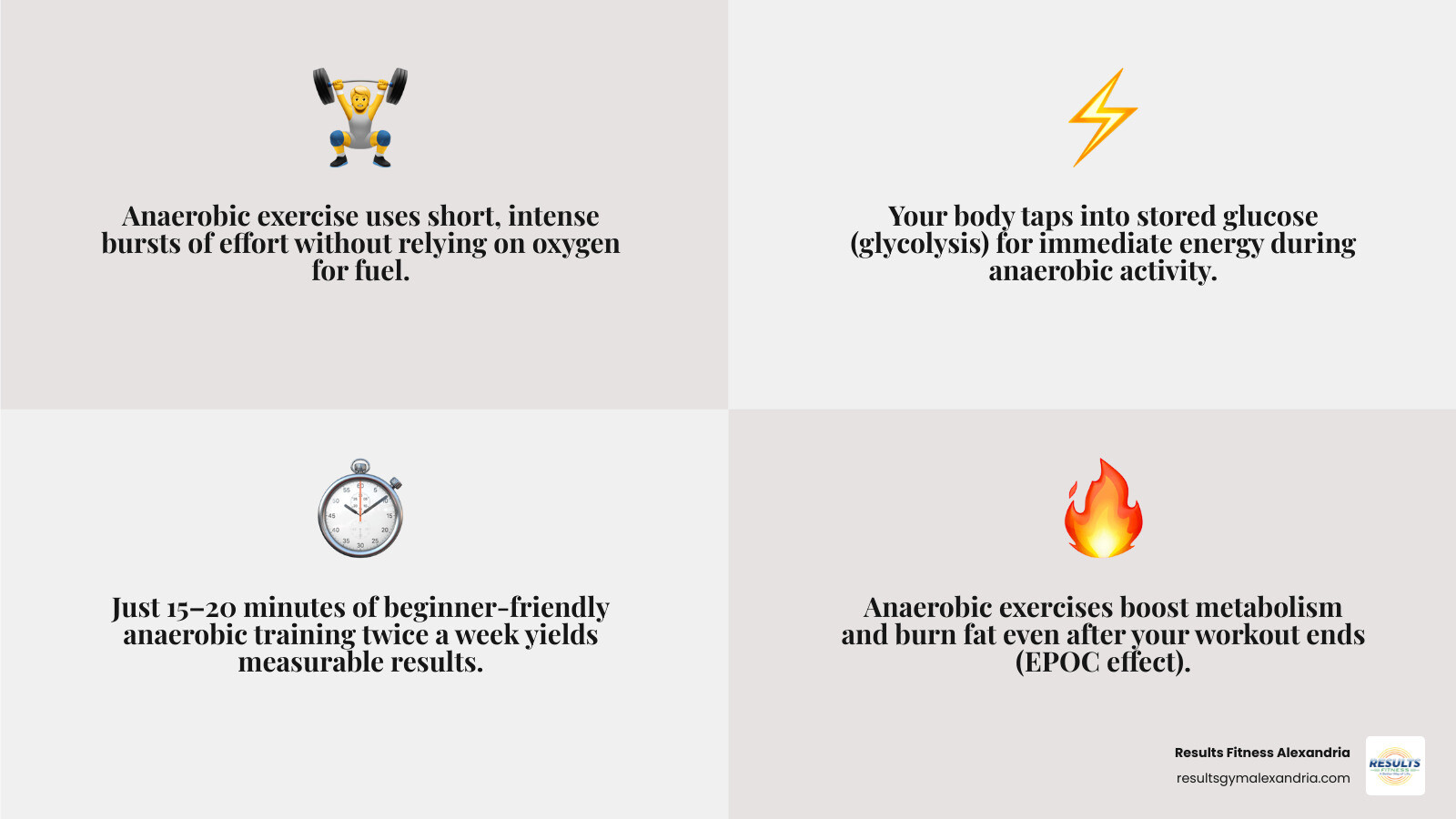
Unlike cardio, anaerobic exercise uses short, intense bursts of effort. Your body isn’t relying on oxygen for fuel — it’s tapping directly into glucose stored in your muscles. Think sprinting, bodyweight squats, or a quick round of push-ups.
The best part? You don’t need to be fit to start. You just need the right exercises and a smart approach.
Done consistently, even 15 to 20 minutes of beginner-friendly anaerobic training two days a week can produce real, measurable results — without burning you out or leaving you too sore to move.
I’m Jennifer Rapchak, Fitness Director at Results Fitness and an ACE-certified personal trainer with over 14 years of experience designing strength and HIIT programs — including anaerobic exercises for beginners who are starting from scratch. In this guide, I’ll walk you through exactly what to do, how to do it safely, and why it works.
Simple anaerobic exercises for beginners glossary:
What is Anaerobic Exercise and How Does It Differ From Aerobic?
To understand how to safely perform anaerobic exercises for beginners, we first need to look at what is happening inside your muscles. The word “anaerobic” literally translates to “without oxygen.”
During aerobic exercises (like a steady jog or a casual bike ride), your body has enough time to inhale oxygen, deliver it to your muscles, and use it to burn fat and carbohydrates for energy. This is a highly sustainable process, which is why you can jog for 30 minutes or more without stopping.
However, when you perform an anaerobic exercise, the intensity spikes. You are working so hard and so fast that your cardiorespiratory system cannot deliver oxygen to your muscles quickly enough to meet the demand.
To keep you moving, your body bypasses the oxygen pathway and relies on stored energy (glucose) inside your muscle tissue. This rapid breakdown of glucose is known as glycolysis. A natural byproduct of fast glycolysis is the accumulation of hydrogen ions and lactate (often referred to as lactic acid) in your muscles. This is what causes that temporary, healthy “burn” you feel during a tough set of squats or a short sprint.
Because this energy pathway is a rapid-response system, it cannot be sustained for long. In fact, maximum sprinting speed or explosive power generally cannot be sustained for more than 2 to 3 minutes before your muscles fatigue and force you to slow down.
To help you visualize the differences, let’s look at how these two training styles compare:
| Feature | Aerobic Exercise (Cardio) | Anaerobic Exercise (Strength/Power) |
|---|---|---|
| Primary Fuel Source | Oxygen, fats, and glucose | Stored glucose (glycogen) |
| Intensity Level | Moderate (4 to 6 out of 10 RPE) | High (7+ out of 10 RPE) |
| Duration | Sustained (20 to 60+ minutes) | Short bursts (10 seconds to 2 minutes) |
| Primary Goal | Cardiovascular endurance | Muscle strength, power, and metabolic boost |
| Examples | Brisk walking, cycling, swimming | Weightlifting, sprinting, plyometrics, HIIT |
To dive deeper into the physiological mechanics of working out without relying on immediate oxygen intake, check out No Oxygen Required: The Ultimate Guide to Anaerobic Exercises.
Aerobic vs. Anaerobic: The Energy Systems
When you perform anaerobic exercises for beginners, your body utilizes two primary anaerobic energy pathways:
- The Phosphagen System: This system fuels extremely short, explosive actions lasting under 10 seconds (like a single maximum jump or a heavy lift). It uses stored adenosine triphosphate (ATP) and creatine phosphate already present in your muscle cells.
- The Fast Glycolysis System: This pathway takes over for high-intensity efforts lasting between 10 seconds and 2 minutes. It rapidly breaks down glucose stored in your muscles to regenerate ATP, producing lactic acid in the process.
By incorporating these short, high-effort intervals into your training, you teach your body to become highly efficient at producing energy quickly. For a structured look at how to organize these energy pathways into your week, read through our Beginners Guide to Anaerobic Exercise Workouts.
Understanding the Anaerobic Threshold
The point at which your body transitions from relying primarily on aerobic energy to anaerobic energy is called the anaerobic threshold. This threshold varies significantly from person to person based on individual fitness levels.
For an absolute beginner, the anaerobic threshold might be reached at a relatively low heart rate or during a moderately fast walk up a steep hill. For an experienced athlete, it takes a much higher level of exertion to cross that line.
On a Rate of Perceived Exertion (RPE) scale of 1 to 10, anaerobic exercise lives at an intensity of 7 or higher. At this level, your breathing becomes heavy enough that talking in full sentences becomes difficult. Your target heart rate during these high-intensity intervals will typically reach 73% to 93% of your maximum heart rate.
As you progress, your anaerobic threshold will naturally increase, meaning you will be able to work harder and faster before fatigue sets in.
5 Simple Anaerobic Exercise Examples to Try
Many beginners avoid anaerobic training because they think it requires lifting heavy barbells or performing exhausting, high-impact jumps. This is a misconception! You can easily target your anaerobic energy systems using joint-friendly, low-impact movements right in your living room.
If you want to explore more home-friendly options, take a look at our guide on how to Sweat in Your Living Room with These Anaerobic Exercise Examples at Home.
Here are five beginner-friendly anaerobic exercises to help you get started.
1. Squat to Chair (Lower-Body Strength)
The squat is the ultimate functional movement, targeting your quadriceps, glutes, hamstrings, and core. Using a chair is an excellent way for beginners to learn proper squat mechanics while keeping the joints safe.
- How to do it: Stand in front of a sturdy household chair, facing away from it, with your feet hip-width apart. Keep your chest up and your core lightly braced. Bend your knees and push your hips back as if you are about to sit down. Slowly lower yourself until your glutes gently tap the seat of the chair. Press firmly through your heels to return to the standing position.
- Why it works: Using a chair builds confidence, ensures a safe range of motion, and prevents you from putting unnecessary stress on your knees.
- Beginner tip: Focus on controlled, slow movements on the way down. Don’t let your knees cave inward; keep them tracking in line with your toes.
To see how this move fits into a structured lower-body routine, explore the Best Lower-Body HIIT Workout for Beginners.
2. Wall or Counter Push-Ups (Upper-Body Calisthenics)
Push-ups are a fantastic anaerobic exercise for building upper-body strength in your chest, shoulders, triceps, and core. However, standard floor push-ups are often too intense for beginners, leading to compromised form and wrist strain. Elevating your hands on a wall or counter reduces the load, making the movement highly accessible.
- How to do it: Stand facing a sturdy wall, about arm’s length away. Place your hands flat on the wall at shoulder height and slightly wider than shoulder-width apart. Step your feet back so your body is at a slight angle. Keeping your body in a straight line from head to heels, bend your elbows to lower your chest toward the wall. Press through your palms to return to the starting position.
- Why it works: Performing push-ups at an incline allows you to build chest and core strength without overloading your joints.
- Beginner tip: Keep your elbows pointing slightly backward (at a 45-degree angle) rather than flaring them directly out to the sides to protect your shoulders.
For more secrets to mastering bodyweight movements without fancy gym gear, check out our guide on How to Master Your Body Weights Workout at Home.
3. Low-Impact HIIT Intervals (Cardio Circuit)
High-Intensity Interval Training (HIIT) is a highly efficient way to challenge your anaerobic system. By utilizing low-impact movements, you can elevate your heart rate and burn calories without putting stress on your knees, hips, or lower back.
- How to do it: Perform a 12-minute circuit alternating 30 seconds of work with 30 seconds of rest. Choose low-impact exercises like step-back reaches, shallow side-step squats, or standing fast punches.
- Why it works: You get all the cardiovascular and metabolic benefits of traditional high-impact HIIT without the joint pain associated with jumping or running.
- Beginner tip: Focus on continuous, controlled movement during the 30-second work intervals. The goal is to reach an intensity of 7 out of 10 on the exertion scale, where talking becomes challenging.
To learn more about joint-friendly interval training, read the Beginner Low-Impact 20-Min HIIT: Joint-Friendly Workouts That Burn Calories | Reshape App and discover Why You Should Give HIIT Exercises a Try.
4. Dumbbell Goblet Squats (Light Resistance Training)
Once you have mastered the bodyweight squat to a chair, you can introduce light resistance using a single dumbbell. This is an excellent introduction to progressive overload — the practice of gradually increasing the demands on your musculoskeletal system to build strength.
- How to do it: Stand with your feet slightly wider than shoulder-width apart. Hold a light dumbbell vertically in front of your chest, cupping the top end of the weight with both hands (like a goblet). Keep your elbows tucked in. Lower your hips back and down into a squat, keeping your chest upright and your core braced. Push through your heels to stand back up.
- Why it works: Holding the weight in front of your chest naturally acts as a counterweight, making it easier to keep your torso upright and maintain proper spinal alignment.
- Beginner tip: Choose a weight that allows you to comfortably complete 1 to 2 sets of 12 to 20 repetitions with perfect form.
Ready to add weights to your routine? Learn How to Get Strong with Just a Pair of Dumbbells.
5. Standing Knee Drives (Explosive Power)
Standing knee drives are a dynamic, low-impact exercise that builds explosive lower-body power, balance, and core strength without requiring you to jump.
- How to do it: Stand with your feet hip-width apart. Step your right foot back into a shallow lunge, extending both arms up and forward. In one explosive, controlled movement, drive your right knee up toward your chest while pulling both hands down to meet your knee. Return your right foot to the starting position and repeat. Complete your reps on one side before switching to the other.
- Why it works: This movement challenges your balance and forces your core muscles to contract rapidly to stabilize your torso, making it a highly effective core-strengthening exercise.
- Beginner tip: Exhale sharply as you drive your knee upward to help engage your deep abdominal muscles.
If you are looking to build a strong, stable midsection, explore these tips to Sculpt Your Abs Fast with These Intense Anaerobic Core Exercises.
How to Safely Start Anaerobic Exercises for Beginners Without Injury
Because anaerobic exercise involves high-intensity efforts, safety and proper technique must always be your top priorities. It is a common mistake to think you need to push yourself to absolute exhaustion on day one. In reality, building a consistent habit is far more important for long-term success.
To stay injury-free, always follow these three foundational rules:
- Never Skip the Warm-Up: Spend 3 to 5 minutes preparing your body for exercise. Use dynamic movements like marching in place, shoulder rolls, and gentle torso twists to increase blood flow to your muscles and lubricate your joints.
- Prioritize Form Over Speed or Weight: It does not matter how fast you move or how much weight you lift if your technique is compromised. Focus on controlled, deliberate movements.
- Include a Dedicated Cool-Down: Spend 2 to 3 minutes lowering your heart rate gradually with slow walking and gentle static stretches for your major muscle groups. This prevents blood from pooling in your lower extremities and kickstarts the recovery process.
For more advice on building a safe, sustainable exercise habit, read our guide on Creating an Effective Workout Routine for Beginners.
How to Modify Anaerobic Exercises for Beginners
If an exercise feels too difficult or causes joint discomfort, you should always modify it. Modifying an exercise is not a sign of weakness; it is a smart, strategic way to keep training consistently while protecting your body.
- Reduce the Range of Motion: If deep squats hurt your knees, perform shallow squats. You will still engage the target muscles while keeping your joints comfortable.
- Use External Support: Keep a stable chair, wall, or kitchen counter nearby to assist with balance during standing movements like knee drives or lunges.
- Adjust the Incline: For upper-body exercises like push-ups, the higher your hands are elevated (e.g., wall vs. kitchen counter vs. floor), the easier the movement will be.
To explore a joint-friendly, highly adaptable entry point to fitness, take a look at the Low Impact Exercises for Beginners: 4-Week Plan | Fit Chameleon.
Structuring Work-to-Rest Ratios for Beginners
The secret to a successful anaerobic workout lies in the rest intervals. Because your body cannot produce anaerobic energy indefinitely, you must allow your muscles time to partially recover between efforts.
As a beginner, you should start with a 1:2 work-to-rest ratio. This means your rest period is twice as long as your active work period. For example:
- Work for 30 seconds (at an intensity of 7+ out of 10)
- Rest for 60 seconds (complete rest or very light active recovery like slow walking)
- Repeat for 3 to 5 rounds to complete a set.
This structured recovery prevents your technique from breaking down due to excessive fatigue and keeps your heart rate in the target training zone. To see how to structure a simple bodyweight circuit using these recovery principles, read through the 15-Minute Cardio Workout for Beginners (No Equipment).
The Key Benefits of Anaerobic Exercises for Beginners
Why should you add anaerobic training to your routine in 2026? While steady-state cardio is fantastic for endurance, anaerobic exercise offers unique physical and metabolic benefits that cardio simply cannot match.
To learn more about how high-intensity training transforms your physical performance, explore our guide on Anaerobic Endurance Training.
Why Anaerobic Exercises for Beginners are Essential for Muscle Growth
As we age, we naturally begin to lose muscle mass and bone density. Anaerobic training — specifically resistance training and bodyweight calisthenics — is the single most effective way to combat this process.
When you challenge your muscles with high-intensity effort, you create microscopic tears in the muscle fibers. During rest periods, your body repairs these fibers, making them stronger and more resilient. This process is known as hypertrophy.
Furthermore, building lean muscle tissue has a profound impact on your metabolism. Muscle is metabolically active tissue, meaning it burns calories even when you are resting.
Anaerobic exercise also triggers Excess Post-Exercise Oxygen Consumption (EPOC), often called the “afterburn effect.” Because your body worked so hard during the high-intensity intervals, it must consume extra oxygen and energy for hours after your workout is over to restore your systems to their baseline state. This means you continue to burn calories at an elevated rate long after you have finished sweating!
Cardiovascular Health and VO2 Max
While cardio is famous for heart health, systematic reviews show that high-intensity anaerobic training (like HIIT) can be potentially superior to traditional moderate-intensity exercise for improving your VO2 max.
VO2 max is the standard scientific metric used to measure your cardiorespiratory fitness and how efficiently your body utilizes oxygen. By pushing your cardiovascular system into its upper limits during short intervals, you teach your heart to pump more blood per beat and make your muscles highly efficient at extracting oxygen from your bloodstream. This makes everyday tasks — like carrying groceries up a flight of stairs — feel incredibly easy.
Frequently Asked Questions about Anaerobic Exercises for Beginners
Starting a new fitness routine can bring up a lot of questions. Here are the answers to some of the most common questions beginners have about anaerobic training.
To avoid making the same mistakes as other fitness newcomers, take a look at our breakdown of the Top 5 Common Mistakes at Each Fitness Level and How to Avoid Them.
How often should beginners do anaerobic exercise and how long should sessions be?
As a beginner, less is truly more. The 8-week dropout rate for 60-minute beginner fitness programs hovers around 65 percent. However, for short 15- to 20-minute programs, that dropout rate drops to just 30 percent!
- Frequency: Start with just 1 to 2 sessions per week. This is plenty of stimulus to kickstart your progress while preventing overtraining.
- Duration: Keep your active sessions short — 15 to 20 minutes (excluding your warm-up and cool-down) is highly effective.
- Recovery: Always schedule at least 48 hours of rest between consecutive anaerobic workouts. Your muscles do not grow during the workout itself; they grow and adapt during rest periods!
What is the difference between low-impact and high-impact anaerobic exercises?
- High-impact exercises involve movements where both feet leave the ground simultaneously, such as jumping jacks, squat jumps, or sprinting. These exercises put a high amount of force through your joints when you land.
- Low-impact exercises keep at least one foot on the ground at all times, such as wall push-ups, squats to a chair, and standing knee drives. These movements drastically reduce joint stress while still allowing you to reach a high level of intensity.
For beginners, starting with low-impact options is highly recommended to build a baseline of joint strength and coordination before attempting high-impact movements.
When should a beginner consult a doctor before starting?
While exercise is incredibly beneficial, safety must always come first. You should always consult with a primary care physician before starting any high-intensity anaerobic training program if:
- You have been completely inactive for a long period.
- You are returning to fitness after a major injury or surgery.
- You have pre-existing medical conditions, such as heart disease, high blood pressure, asthma, diabetes, or chronic joint issues.
- You experience dizziness, chest pain, or shortness of breath during daily activities.
Conclusion
Starting your fitness journey with anaerobic exercises for beginners is one of the smartest decisions you can make for your long-term health, strength, and metabolism. By focusing on simple, low-impact movements, prioritizing proper form, and allowing your body plenty of time to recover, you can build a strong, resilient body without risking injury or burnout.
You do not have to figure this out alone. At Results Fitness in Alexandria, Virginia, we specialize in helping beginners safely navigate their fitness journeys. Our expert personal trainers are here to help you master your form, design a balanced routine, and stay motivated every step of the way.
To help you take that first step, we invite you to experience everything we have to offer with a free 1-day pass to our premier facilities, fitness classes, and amenities. Come meet our warm community, try a beginner-friendly workout, and let us help you reach your goals.
Ready to take your physical conditioning to the next level? Discover how we design high-yield, safe training routines by reading our guide on Anaerobic Endurance Training, or stop by our Alexandria location today to claim your free pass!