How to Get Strong with Just a Pair of Dumbbells
You Don’t Need a Full Gym to Get Strong
Dumbbell strength exercises are one of the most effective ways to build muscle, improve your fitness, and get stronger — with minimal equipment and maximum flexibility.
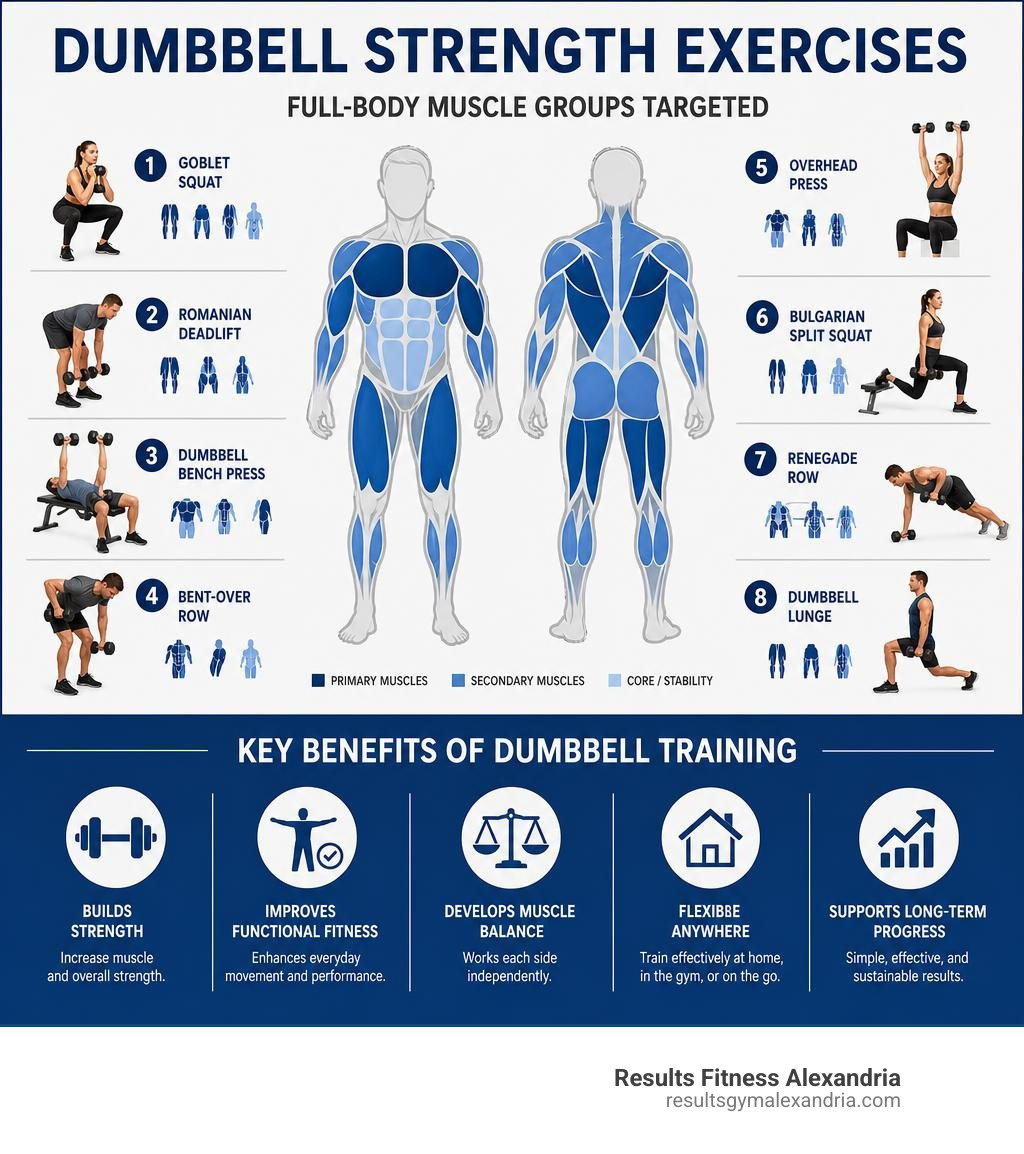
Here are the best dumbbell strength exercises for a full-body workout:
- Goblet Squat — lower body, quads, glutes, core
- Romanian Deadlift — hamstrings, glutes, lower back
- Dumbbell Bench Press — chest, shoulders, triceps
- Bent-Over Row — back, biceps, rear delts
- Overhead Press — shoulders, triceps, core
- Bulgarian Split Squat — quads, glutes, balance
- Renegade Row — back, core, anti-rotation stability
- Dumbbell Lunge — quads, glutes, hamstrings
Most people believe you need barbells, cable machines, or a fully loaded gym to see real results. That’s simply not true. Research shows that free-weight training with dumbbells produces similar gains in muscle strength and size as more complex equipment — as long as your weekly training volume is on point.
Dumbbells are also easier to pick up and use correctly, they work each side of your body independently, and they fit into a spare bedroom, hotel room, or home garage just as well as a commercial gym floor.
I’m Jennifer Rapchak, Fitness Director at Results Fitness Gym in Alexandria, Virginia, and with over 14 years of experience as an ACE-certified personal trainer, dumbbell strength exercises are a cornerstone of the programming I design for clients at every fitness level. In this guide, I’ll walk you through exactly how to use them to build real, lasting strength.
Essential dumbbell strength exercises terms:
Why Dumbbell Strength Exercises Outperform Barbells and Machines
When we look at the science of muscle growth and functional movement, dumbbells offer several distinct advantages over barbells and machines. While a barbell is excellent for moving maximum load, it can sometimes lock your joints into rigid, unnatural pathways. Fixed machines are even more restrictive, removing the need for balance altogether.
According to research outlined in The Science of Building Muscle: Tips for Effective Strength Training, the primary drivers of muscle growth are mechanical tension and metabolic stress. Dumbbells deliver both of these stimulus types exceptionally well while offering several unique benefits:
- Greater Range of Motion (ROM): During a barbell bench press, the bar stops when it hits your chest. With dumbbells, your hands can descend lower than your torso, creating a deep stretch at the bottom of the movement. This extended range of motion can lead to greater muscle activation and hypertrophy.
- Increased Stabilizer Muscle Demand: Because dumbbells move independently, your body must work twice as hard to keep them stable. Smaller stabilizing muscles in your shoulders, hips, and core must fire constantly to keep the weights on track.
- Correction of Strength Imbalances: We all have a dominant side. When you use a barbell or machine, your stronger side naturally compensates for the weaker side. Unilateral training with dumbbells forces each limb to carry its own weight, helping to correct side-to-side strength discrepancies and reduce injury risks.
- Joint-Friendly Freedom: Dumbbells allow your wrists, elbows, and shoulders to rotate naturally. For example, if a straight-bar military press irritates your shoulders, switching to a neutral-grip dumbbell press allows you to find a pain-free path that matches your natural anatomy.
As discussed in The ultimate full-body dumbbell workout – The Manual, incorporating these free-weight movements into your routine is highly efficient for boosting muscle strength, coordination, and daily functional performance.
The Best Compound Movements for a Full-Body Routine
If you want to maximize your time and get the best results in June 2026, compound exercises are your best friend. Compound movements are multi-joint exercises that recruit several major muscle groups at once. By focusing on these heavy hitters, you trigger a higher hormonal response, burn more calories, and build functional, real-world strength.
Whether you are designing a routine for men or exploring Beginner Weight Training for Women, compound dumbbell movements form the foundation of any successful program. They allow us to target the entire body in under 45 minutes, making them incredibly practical for busy schedules.
For a comprehensive approach at home, as highlighted in 30-Minute Beginner Full-Body Dumbbell Workout at Home – FED Fitness, focusing on these foundational patterns ensures you never miss a major muscle group.

Essential Lower-Body Dumbbell Strength Exercises
Your lower body contains some of the largest, most powerful muscles in your body, including your quads, glutes, and hamstrings (often referred to as the posterior chain). Training these muscles is essential for athletic performance, posture, and metabolic health.
Here are the key lower-body movements to master:
- Goblet Squats: Hold a single dumbbell vertically against your chest, keeping your elbows tucked. Lower your hips back and down as if sitting in a chair, keeping your chest proud and your heels flat on the floor. Goblet squats are fantastic for teaching proper squat depth while engaging your core.
- Dumbbell Romanian Deadlifts (RDLs): Stand with feet hip-width apart, holding dumbbells in front of your thighs. Slide the weights down your legs by hinging at your hips and pushing your glutes backward. Keep a slight bend in your knees and a perfectly flat back. You should feel a deep stretch in your hamstrings.
- Bulgarian Split Squats: Place one foot behind you on a bench or sturdy chair, and step your other foot forward. Holding dumbbells at your sides, lower your back knee toward the floor while keeping your front knee aligned over your ankle. This is an elite movement for building single-leg strength and balance.
- Dumbbell Lunges (Walking or Reverse): Step backward or forward into a lunge, lowering your hips until both knees form 90-degree angles. Reverse lunges are often gentler on the knees and place a fantastic emphasis on the glutes and hamstrings.
Core-Stabilizing and Upper-Body Dumbbell Strength Exercises
To build a balanced physique, your upper-body training should focus on equal parts pushing and pulling, while keeping your core braced to protect your spine.
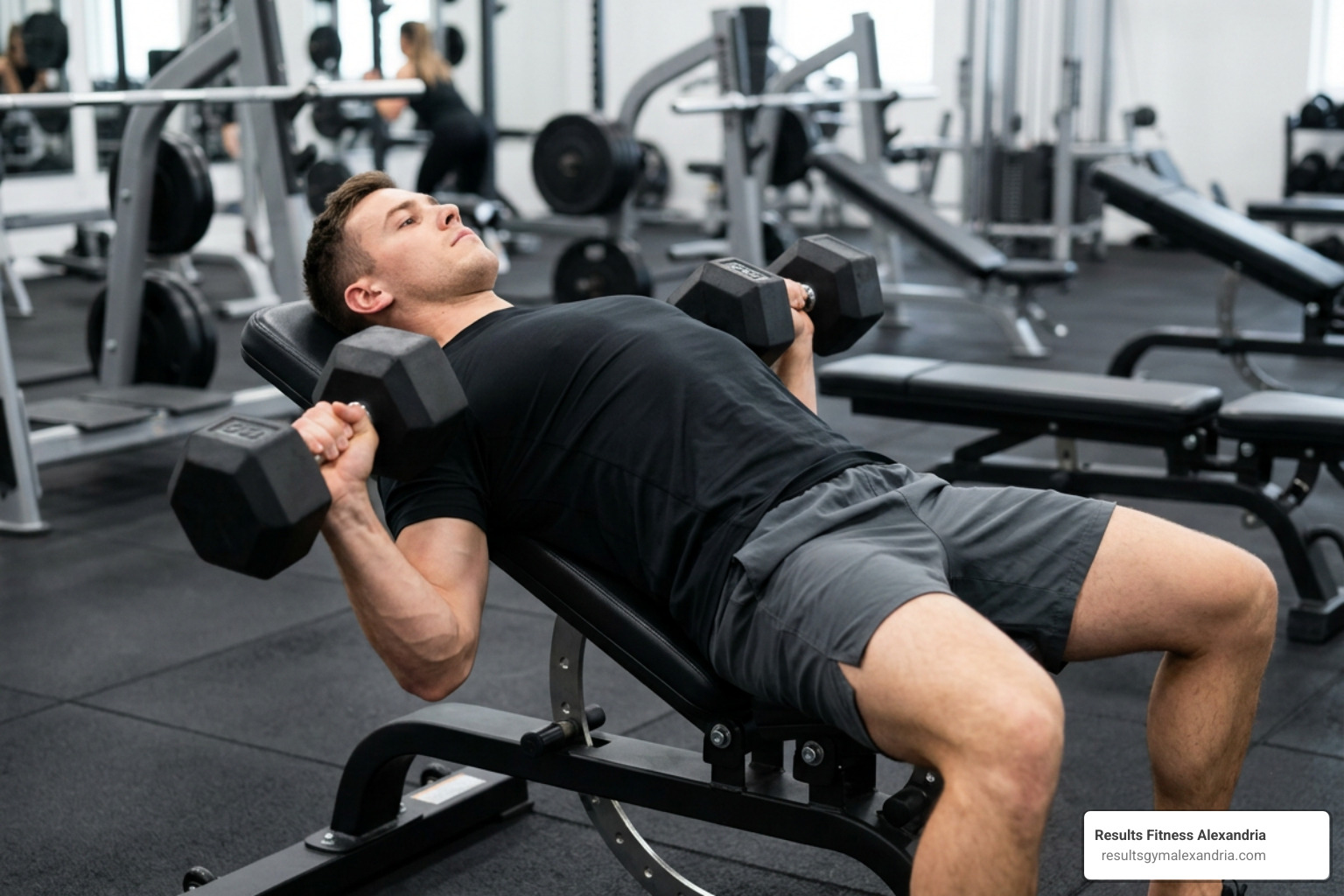
- Dumbbell Bench Press / Floor Press: Lie back on a bench (or the floor) with dumbbells at chest level. Press the weights straight up, keeping your elbows at a 45-degree angle to your torso to protect your shoulders. The floor press is a brilliant modification if you do not have a bench, as the floor naturally limits your range of motion to prevent over-stretching the shoulder joint.
- Dumbbell Bent-Over Rows: Hinge at your hips with a flat back, letting the dumbbells hang down. Pull your elbows up and back toward your hips, squeezing your shoulder blades together at the top. This targets your lats, upper back, and biceps.
- Standing Dumbbell Overhead Press: Stand tall with feet shoulder-width apart, holding dumbbells at shoulder height. Press the weights straight overhead without arching your lower back. Standing overhead presses engage your entire core and shoulder girdle to stabilize the weight.
- Renegade Rows: Start in a strong push-up plank position with your hands gripping hex dumbbells on the floor. Keeping your hips perfectly level, row one dumbbell up to your ribcage, place it down, and repeat on the other side. This is an advanced movement that tests your anti-rotation core stability.
The Ultimate 3-Day Full-Body Dumbbell Workout Program
To get the most out of your training, we recommend a 3-day full-body split. This structure allows you to train every major muscle group three times per week, which scientific reviews show is highly effective for muscle growth. It also guarantees a built-in rest day between sessions to allow your muscles to recover and grow.
This program is inspired by principles found in the Best Full-Body Dumbbell Workout (3-Day Plan) | Legion and our own comprehensive Strength Training Programs: Complete Guide. For a complete list of alternative routines, you can also explore the 40 Min Full Body Dumbbell Workout | Strength, Abs & Arms and the Full Body Dumbbell Workout: Complete Plan for Home or Gym | LoadMuscle.
Perform this workout on non-consecutive days (e.g., Monday, Wednesday, Friday). Warm up for 5 minutes before each session with light cardio and dynamic stretches.
| Day 1: Compound & Strength Focus | Day 2: Unilateral & Stability Focus | Day 3: Volume & Hypertrophy Focus |
|---|---|---|
| Goblet Squat 3 sets x 8-10 reps (Rest: 90s) |
Bulgarian Split Squat 3 sets x 8-10 reps/side (Rest: 60s) |
Dumbbell Romanian Deadlift 3 sets x 10-12 reps (Rest: 60s) |
| Dumbbell Bench Press 3 sets x 8-10 reps (Rest: 90s) |
One-Arm Dumbbell Row 3 sets x 10 reps/side (Rest: 60s) |
Dumbbell Incline Press 3 sets x 10-12 reps (Rest: 60s) |
| Dumbbell Romanian Deadlift 3 sets x 8-10 reps (Rest: 90s) |
Dumbbell Lunge 3 sets x 10 reps/side (Rest: 60s) |
Dumbbell Bent-Over Row 3 sets x 10-12 reps (Rest: 60s) |
| Standing Overhead Press 3 sets x 10 reps (Rest: 60s) |
Renegade Row 3 sets x 8 reps/side (Rest: 60s) |
Dumbbell Lateral Raise 3 sets x 12-15 reps (Rest: 45s) |
| Dumbbell Bicep Curl 2 sets x 12 reps (Rest: 45s) |
Overhead Triceps Extension 2 sets x 12 reps (Rest: 45s) |
Plank Hold 3 sets x 45-60s (Rest: 45s) |
How to Choose the Right Weight and Avoid Common Form Mistakes
Selecting the right weight is crucial for both making progress and avoiding injury. If you are new to lifting, check out How to Master Your First Weight Lifting Session Without the Stress to build your confidence before diving in.
To find your ideal starting weight, we use the Rate of Perceived Exertion (RPE) scale from 1 to 10:
- An RPE of 8 means you are using a weight where you can complete the target reps with perfect form, but you feel like you could only perform 2 more reps before your technique breaks down (2 reps shy of failure).
- If your form falters, or you find yourself swinging your body to move the weight, it is too heavy. Drop the weight and focus on control.
For more details on beginner weight selection, read through A 30-Minute Full-Body Dumbbell Workout for Beginners.
Common Form Mistakes to Avoid:
- Using Momentum: Avoid bouncing at the bottom of a squat or swinging your torso during rows and curls. Keep your movements slow and controlled.
- Arching the Lower Back: During overhead presses or chest presses, keep your core braced and your pelvis tucked. If your lower back arches excessively, the weight is too heavy.
- Flaring the Elbows: During push-ups, bench presses, and overhead presses, flaring your elbows out to 90 degrees puts immense stress on your shoulder joints. Keep them tucked at roughly a 45-degree angle.
- Rounding the Spine: When performing deadlifts or bent-over rows, keep your spine neutral from your tailbone to your neck. Rounding your back under load is a recipe for strain.
Frequently Asked Questions About Dumbbell Training
Can you build as much muscle with dumbbells as with barbells?
Yes, absolutely! Your muscles do not have eyes; they only respond to mechanical tension, metabolic stress, and progressive overload. While barbells are excellent for lifting absolute maximum weight, dumbbells allow for a greater range of motion, better joint alignment, and equal development of both sides of your body. When weekly training volume and intensity are matched, dumbbell-only routines produce comparable muscle growth and strength gains to barbell programs.
How do you progressively overload when you run out of heavier dumbbells?
If you train at home and don’t have access to heavier weights, you can still challenge your muscles using these simple progression strategies:
- Tempo Manipulation: Slow down the eccentric (lowering) phase of your lift to 3 or 4 seconds. This increases the muscle’s time under tension.
- Pause Reps: Add a 2-second pause at the bottom of your squats, chest presses, or RDLs to eliminate momentum.
- One-and-a-Half Reps: Perform a full rep, go halfway down, come back up, and then lower all the way. That is one rep.
- Increase Volume: Add more reps per set (up to 15-20) or add an extra set to your exercises.
Is a 3-day full-body dumbbell routine suitable for beginners?
Yes, a 3-day full-body dumbbell routine is one of the absolute best starting points for beginners. It is simple to learn, highly time-efficient, and provides plenty of rest days for proper recovery. Because dumbbells require you to balance the weights independently, they also help beginners build joint stability and coordination much faster than machines.
Conclusion
Getting strong, building muscle, and improving your health in June 2026 doesn’t require a complicated array of machines or heavy barbells. With a single pair of dumbbells, a structured full-body program, and a commitment to progressive overload, you can achieve incredible physical transformations from the comfort of your home or on our gym floor.
If you are looking for personalized guidance, custom workout plans, or a supportive community to keep you accountable, we are here to help. At Results Fitness in Alexandria, Virginia, we offer expert-led fitness classes, customized personal training, relaxing yoga sessions, and convenient childcare to make your fitness journey seamless.
Ready to experience our premium strength training amenities for yourself? We would love to welcome you. For more tips on structured training, check out The Ultimate Guide to Women’s Strength Training.
Start your fitness journey with our premium strength training amenities and claim your free 1-day pass today! We can’t wait to train with you!