No Pain, No Gain: How to Design the Perfect Women’s Gym Leg Workout
Why Most Women’s Leg Workout Gym Advice Gets It Wrong
If you’re looking for a women’s leg workout gym plan that actually works, here’s the short answer:
The most effective leg workouts for women focus on:
- Compound exercises — squats, Romanian deadlifts, hip thrusts, lunges
- Heavy weights — around 75–80% of your one-rep max (8–10 reps per set)
- Progressive overload — adding weight or reps each week over time
- Training frequency — 2 leg days per week is the sweet spot for most women
- Consistency — expect noticeable changes within 3–6 months of consistent effort
Most lower-body training advice aimed at women is built on outdated ideas. High reps tone your thighs. Light weights shape your glutes. Avoid barbells so you don’t bulk up. All of this is wrong.
The truth is simple: you can’t “tone,” “lengthen,” or “tighten” a muscle. You can only build muscle tissue and reduce the body fat covering it. That requires getting stronger over time — not just sweatier.
Heavy compound lifting isn’t just for athletes or bodybuilders. It’s the most effective tool any woman can use to build a firm, defined lower body — regardless of where she’s starting from.
I’m Jennifer Rapchak, Fitness Director at Results Fitness Alexandria and a certified personal trainer with over 14 years of experience designing women’s leg workout gym programs that deliver real, lasting results. In this guide, I’ll walk you through everything you need — from exercise selection and workout structure to recovery and nutrition — so you can stop guessing and start progressing.
The Science of Building a Strong, Sculpted Lower Body
To build a lower body that is both strong and visually defined, we must look at how muscle tissue actually adapts. The process of shaping your legs relies on two primary physiological mechanisms: muscle hypertrophy (growth) and fat loss.
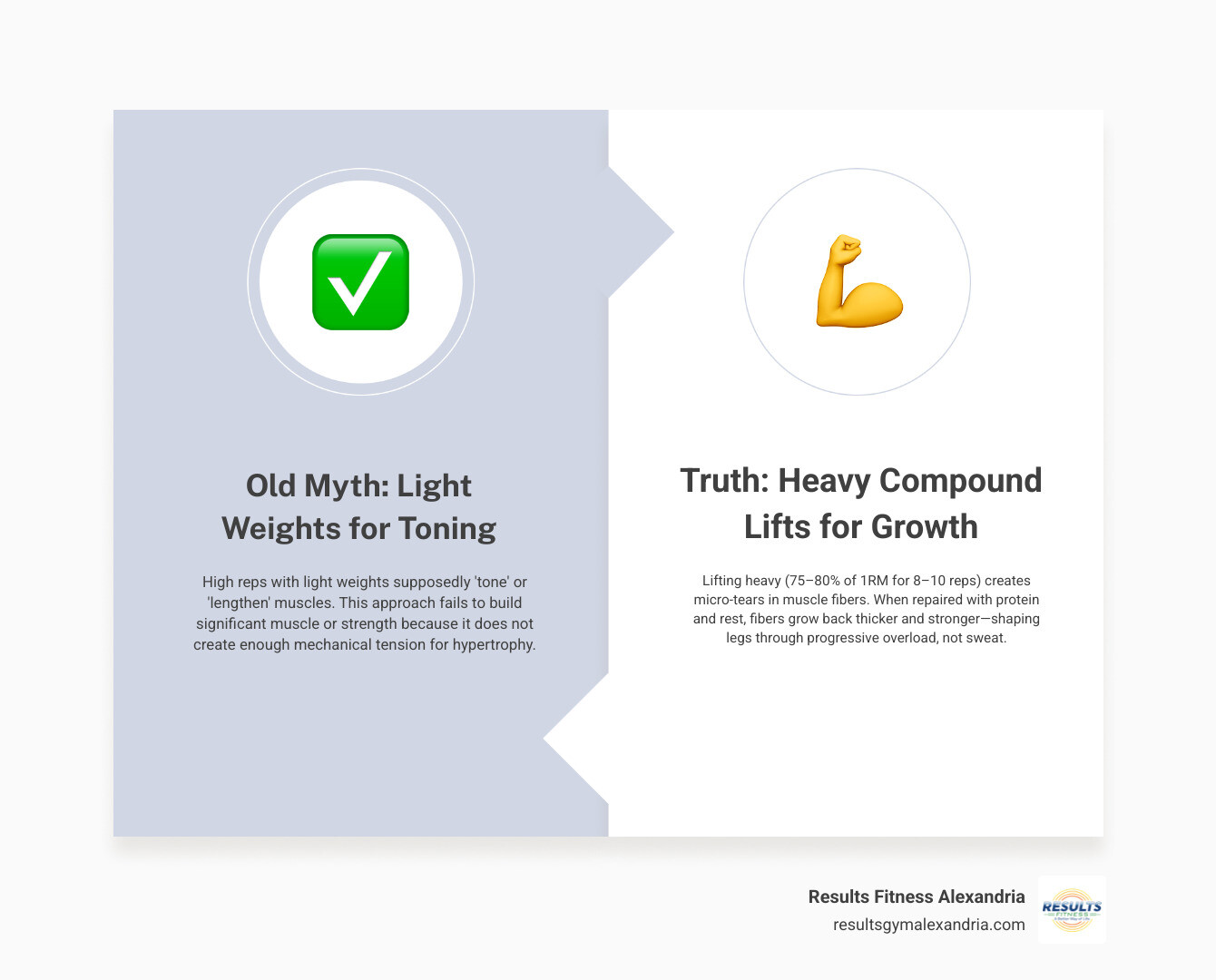
When you lift weights, you create microscopic tears in your muscle fibers. When your body repairs these fibers with the help of protein and rest, they grow back slightly thicker and stronger. This is hypertrophy. To make this happen, we must apply progressive overload. Progressive overload is the single most important driver of muscle growth. It simply means that you must challenge your muscles with a stimulus that is greater than what they are used to.
Getting a “pump”—that tight, swollen feeling in your muscles during a workout—can contribute to muscle growth, but it is far less important than getting progressively stronger over time. If you do the exact same exercises with the exact same weights for the same number of repetitions month after month, your body has no reason to adapt.
Many women are led to believe that high-rep, light-weight workouts designed to avoid sweat or strain are the key to a feminine shape. In reality, these routines are highly ineffective for body transformation. Because they do not challenge the muscles sufficiently, they fail to trigger the adaptation process. To understand the physiological foundation of how we build and shape these muscles, you can read our detailed breakdown in Everything You Need to Know About Women’s Lower Body Training.
By shifting our focus toward heavy, compound movements, we can stimulate more muscle fibers in less time, prompting the body to build lean, active tissue. For a deep dive into the scientific literature on lower-body muscle development, check out this comprehensive look at Scientific research on lower body training.
Debunking the Bulking Myth in a Women Leg Workout Gym Routine
“But won’t lifting heavy weights make my legs bulky?”
This is the single most common concern we hear at Results Fitness Alexandria, and it is time to put it to rest once and for all. Building bulky legs requires elite muscle-building genetics, high levels of testosterone, a massive caloric surplus, and years of extreme, dedicated bodybuilding effort.
Due to hormonal differences—specifically, much lower levels of testosterone compared to men—most women simply do not have the genetic makeup to build massive, bulky muscles easily. For the vast majority of women, heavy lifting does not create bulk; instead, it creates a firm, shapely, and highly defined look. Muscle tissue is dense and compact. When you build muscle and lose body fat, your legs actually become tighter and more sculpted, not larger.
To achieve this, we must train with sufficient intensity. We recommend lifting heavy weights that represent roughly 75% to 80% of your one-rep max (1RM). In practical terms, these are weights you can handle for 8 to 10 reps per set before your form begins to break down. You should take most of your working sets close to failure—specifically, leaving about 1 to 2 reps in reserve (RIR). If you finish a set of 10 squats feeling like you could have easily completed 10 more, the weight is too light to stimulate real change.
How Often Should You Train Legs?
How often should you step into our Alexandria gym and target your lower body? Training frequency is a crucial piece of the puzzle.
For the vast majority of women, two leg days per week is the absolute sweet spot. This frequency allows you to accumulate enough training volume to stimulate muscle growth while giving your muscles plenty of time to recover between sessions. Muscles do not grow while you are working out; they grow while you are resting and recovering.
Your training experience should dictate your exact weekly split:
- Beginners: If you are brand new to weightlifting, start with just one dedicated lower-body workout per week. This will allow your body to adapt to the new physical demands without leaving you so sore that you cannot walk for a week. A single session of 10 to 12 hard sets is plenty to kickstart your progress.
- Intermediate to Advanced: As you get more experienced and your recovery capacity improves, we recommend splitting your leg training across 2 to 3 sessions per week. This allows you to better manage fatigue. Instead of doing 18 sets in a single grueling workout (where your performance on the last few exercises will suffer due to exhaustion), you can perform 9 high-quality sets on Tuesday and another 9 on Friday. This keeps your training intensity high for every single exercise.
Designing Your Ultimate Women Leg Workout Gym Blueprint
To get the most out of your time on the gym floor, you need a structured plan. Randomly walking from machine to machine without a strategy is a recipe for frustration and plateaus. A great leg day should always follow a specific hierarchy: start with a dynamic warm-up, move into your heaviest compound lifts while your energy is highest, transition to target accessory movements, and finish with a recovery-focused cooldown.
To help you visualize how a balanced routine is structured, you can reference the complete breakdown in the Best Women’s Leg Workout Guide. For a great example of a structured routine that balances different lower-body muscle groups, check out this Complete Leg Day Workout (Glutes, Quads & Hamstrings) + Sets & Reps.
The Essential Warm-Up Routine
Before you even think about touching a barbell, you must prepare your body for the work ahead. A proper warm-up increases your core body temperature, lubricates your joints with synovial fluid, and prepares your central nervous system to lift heavy loads safely.
Skip the 20-minute boring treadmill walk. Instead, spend 5 to 8 minutes on a dynamic warm-up routine focused on mobility and muscle activation:
- World’s Greatest Stretch (5 reps per side): Opens up the hips, thoracic spine, and hamstrings.
- 90/90 Hip Switches (8 reps per side): Improves internal and external hip rotation, which is essential for deep squats.
- Bodyweight Squats (10-12 reps): Focus on keeping your chest up and tracking your knees over your toes.
- Glute Bridges (15 reps): Wake up your glutes by squeezing them hard at the top of the movement.
- Lateral Band Walks (10 steps each direction): Activates the gluteus medius to ensure proper knee tracking and pelvic stability during your lifts.
The Best Compound Exercises for Maximum Results
Compound exercises are movements that recruit multiple joints and large muscle groups simultaneously. They should form the foundation of any women’s leg workout gym routine because they deliver the greatest return on your investment of time and energy.
To perform these compound lifts safely and effectively, follow the structured progression outlined in How to Do Leg Workouts for Women in 5 Easy Steps.
Here are the four ultimate compound lifts you should master:
1. The Back Squat
The squat is the undisputed king of lower-body movements. It heavily recruits the quadriceps, glutes, and core.
- How to do it: Place a barbell across your upper back (resting on your traps, not your neck). Stand with feet shoulder-width apart, toes slightly flared. Push your hips back and bend your knees, lowering your body as if sitting in a chair. Keep your chest proud and drive through your entire foot to return to the starting position.
- Gym Tip: Barbells are often superior to dumbbells for heavy squats because they offer greater stability. This makes it much easier to control heavier weights and apply sustainable progressive overload without your grip strength giving out first.
2. The Romanian Deadlift (RDL)
The RDL is a premier posterior chain movement, targeting the hamstrings and glutes while strengthening the lower back.
- How to do it: Stand tall holding a barbell or dumbbells in front of your thighs. Keep your spine neutral and a very slight bend in your knees. Initiate the movement by pushing your hips straight back, sliding the weight down your shins. Go as low as your hamstring flexibility allows without rounding your back, then drive your hips forward to stand.
- Form Cue: Keep the weights close to your shins throughout the entire movement. If the bar drifts away from your body, it puts unnecessary pressure on your lower back.
3. The Hip Thrust
If your goal is glute development, the hip thrust is non-negotiable. Because it loads the glutes in their fully shortened position, it provides incredible glute activation.
- How to do it: Sit on the floor with your upper back resting against a sturdy gym bench. Place a padded barbell over your hips. Drive through your heels, extending your hips upward until your torso is parallel to the floor and your knees form a 90-degree angle. Squeeze your glutes hard at the top before lowering.
- Form Cue: Keep your chin tucked and your gaze looking forward throughout the movement. This prevents you from arching your lower back at the top.
4. The Leg Press
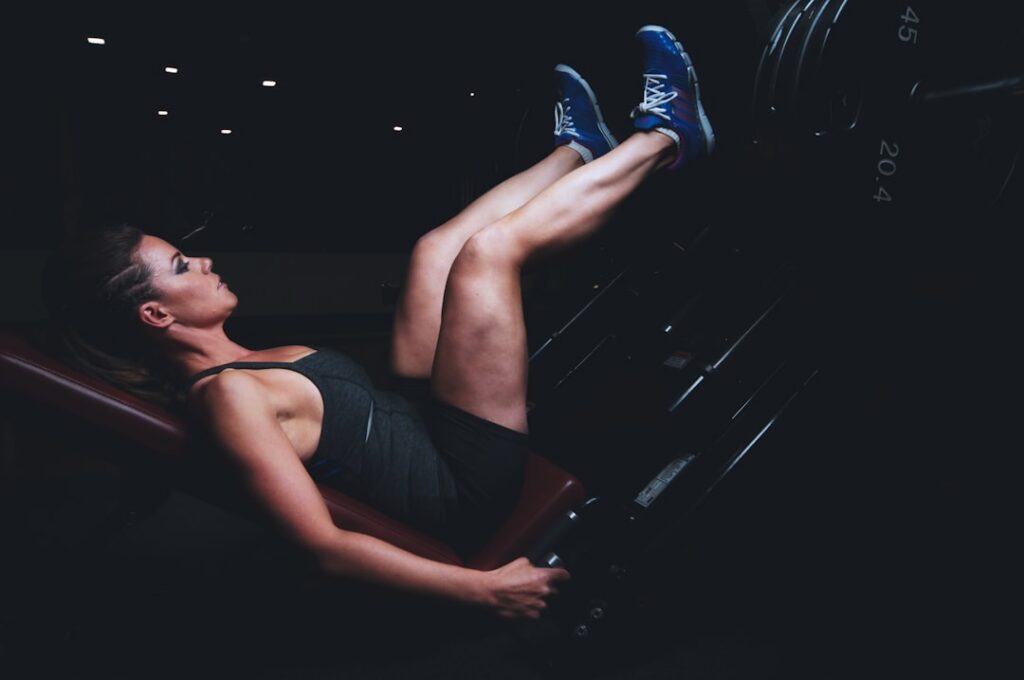
The leg press machine allows you to isolate your lower body and push heavy weights safely without being limited by core strength or balance.
- How to do it: Sit in the leg press machine and place your feet shoulder-width apart on the sled. Lower the platform slowly toward your chest, ensuring your lower back remains firmly pressed against the seat. Drive the weight back up, being careful not to lock out your knees at the top.
Targeting Specific Muscle Groups: Quads, Hamstrings, and Glutes
While compound movements are incredible, we can use specific setup tweaks and accessory exercises to target particular areas of the legs and glutes.
- Quads (Front of Thighs): To place extra emphasis on your quads, try the Elevated Goblet Squat. By elevating your heels slightly on a small plate or wedge, you allow your knees to travel further forward over your toes. This increases quad activation and allows for a deeper squat depth while keeping your torso upright.
- Hamstrings (Back of Thighs): Along with RDLs, include the Leg Curl (seated or lying). While RDLs train the hamstrings at the hip joint, leg curls train them at the knee joint, ensuring complete development.
- Glutes (The Behind): To isolate the glutes, incorporate Bulgarian Split Squats. This single-leg exercise exposes imbalances quickly. To make it more glute-biased, take a slightly longer stance and lean your torso forward at a 30-degree angle. If you want it to target your quads, keep a shorter stance and a perfectly upright torso. Another fantastic option is the B-Stance Bridge (or kickstand bridge), which allows you to isolate one glute at a time without needing heavy barbells.
- Inner & Outer Thighs: Use the Curtsy Lunge to target the gluteus medius (outer glute/hip) and the Standing Cable Abduction. For the inner thighs (adductors), the Wide-Stance Goblet Squat or dedicated adductor machine works wonders.
Gym-Based vs. At-Home Leg Workouts
Can you build a great lower body at home, or do you need to go to a gym? While home workouts are highly convenient, a well-equipped gym offers distinct advantages when it comes to long-term progress.
| Feature | Gym-Based Workouts | At-Home Workouts |
|---|---|---|
| Equipment Variety | High (Barbells, dumbbells, cables, specialized machines) | Low (Bodyweight, resistance bands, light dumbbells) |
| Progressive Overload | Highly sustainable (Easy to micro-adjust weight by small increments) | Limited (Hard to continue challenging muscles once bodyweight is too easy) |
| Stability & Safety | Excellent (Machines and racks provide built-in safety structures) | Moderate (Requires excellent balance and core control) |
| Targeted Isolation | Easy (Dedicated machines for hamstrings, quads, and glutes) | Difficult (Hard to isolate specific muscles without machine assistance) |
At home, you will eventually hit a wall with progressive overload. Once you can do 30 bodyweight squats easily, doing 40 or 50 reps does not build more muscle—it simply builds muscular endurance. In a gym environment, you can simply add a 5-pound plate to the barbell to keep challenging your muscles in the ideal 8 to 10 rep range.
If you are currently training at home, consider using your home workouts to build basic movement patterns and coordination before transitioning to a structured gym environment to unlock real strength gains.
For a deeper look at how to structure workouts that maximize fat burning while preserving lean muscle, check out our A Comprehensive Guide to Fat-Burning Leg Workouts.
Nutrition, Recovery, and Tracking Progress
You can lift as heavy as you want, but if you do not support your training with proper nutrition and recovery, you will not see the results you deserve.
- Protein is King: Muscle protein synthesis requires dietary protein. Aim to consume roughly 0.8 to 1.0 grams of protein per pound of body weight daily. Good sources include chicken breast, turkey, Greek yogurt, eggs, tofu, and high-quality protein powder.
- Caloric Balance: If your goal is to build significant muscle shape, you need to eat enough calories to support that growth (either a small caloric surplus or eating at maintenance if you are a beginner). If you are in an extreme caloric deficit, your body will struggle to build new tissue.
- Sleep and Hydration: Aim for 7 to 9 hours of high-quality sleep per night. This is when your body releases growth hormone to repair the damage done in the gym. Keep a water bottle with you and stay hydrated throughout the day.
- The Double Progression Method: This is the most sustainable way to progress. Let’s say your target is 3 sets of 8 to 10 reps of squats. If you can only do 8 reps with 100 pounds on week one, stay at that weight until you can do 3 sets of 10 reps with perfect form. Once you hit the top of your rep range (10 reps), increase the weight by 5 to 10 pounds for your next session. Keep the same exercises in your routine for 4 to 6 weeks before changing them.
- Post-Workout Recovery Tip: Try the “Legs Up the Wall” stretch for 3 to 5 minutes after your workout. Lie on your back with your hips close to a wall and your legs resting straight up against it. This simple pose helps shift your nervous system from “fight or flight” (sympathetic) to “rest and digest” (parasympathetic), kickstarting your recovery process immediately.
Do You Need Supplements for Your Women Leg Workout Gym Goals?
The short answer is no—you do not need supplements to build a strong, sculpted lower body. A solid training program and a balanced diet will do 95% of the work. However, the right supplements can help you get there a little faster and make your routine more convenient.
If you choose to use supplements, we recommend keeping it simple:
- Whey or Plant-Based Protein Powder: A convenient way to hit your daily protein targets, especially post-workout.
- Creatine Monohydrate: One of the most thoroughly researched supplements in the world. Taking 3 to 5 grams daily helps increase strength, power, and cellular hydration, allowing you to lift slightly heavier weights in the gym.
- Pre-Workout: Can provide a helpful energy and focus boost on days when you feel sluggish before your session.
For a complete guide on how to integrate nutrition and supplementation into your overall training plan, check out our Female Gym Workout Guide.
Frequently Asked Questions About Women’s Leg Workouts
How long does it take to see noticeable changes in leg shape?
If you train consistently 2 times per week, apply progressive overload, and eat sufficient protein, you can expect to see noticeable changes in your leg shape and muscle definition within 3 to 6 months. That strength gains will happen much faster—often within the first 2 to 3 weeks as your nervous system becomes more efficient at recruiting muscle fibers.
Will lifting heavy weights make my legs look bulky?
No. As discussed, women do not have the hormonal profile (specifically high testosterone levels) to easily build bulky muscles. Lifting heavy weights will make your legs look firmer, more athletic, and highly defined. Any initial “tightness” you feel in your jeans during the first few weeks of a new program is typically just temporary water retention in the muscles (inflammation from training), which subsides quickly.
How do I structure my first leg day workout safely as a beginner?
Keep it simple! Start with one lower-body workout per week. Focus on mastering the form of 3 to 4 exercises: a squat variation (like a goblet squat), a hinge variation (like a dumbbell RDL), a glute bridge, and a machine press. Keep your total volume low—about 10 to 12 hard working sets total for the workout. Focus on leaving 1 to 2 reps in reserve, and rest 90 to 150 seconds between compound sets to allow your muscles to recover fully.
Conclusion
Building a strong, sculpted lower body doesn’t require endless high-rep cardio sessions or complicated, flashy exercises. By focusing on heavy compound lifts, applying progressive overload, and staying consistent with your recovery and nutrition, you will unlock incredible results.
At Results Fitness Alexandria, we are dedicated to helping women in Alexandria, Virginia, cut through the fitness myths and build real, lasting strength. Our modern facility, expert personal training programs, and welcoming community are designed to support you at every stage of your fitness journey.
If you are ready to take your training to the next level, we invite you to come experience our gym firsthand. We offer a free 1-day pass so you can try our amenities, meet our coaches, and see why we are Alexandria’s premier fitness destination. For more tips on setting up your routine, check out our Best Women’s Leg Workout Guide and claim your pass today. Let’s build something strong together!