Lower Back Strength: 15 Minutes to a Pain-Free Spine
Why Lower Back Strength Is the Foundation of a Pain-Free, Active Life
Lower back strength is one of the most important — and most overlooked — parts of a complete fitness routine. If you’re short on time, here’s what you need to know right now:
Quick Answer: How to Build Lower Back Strength in 15 Minutes
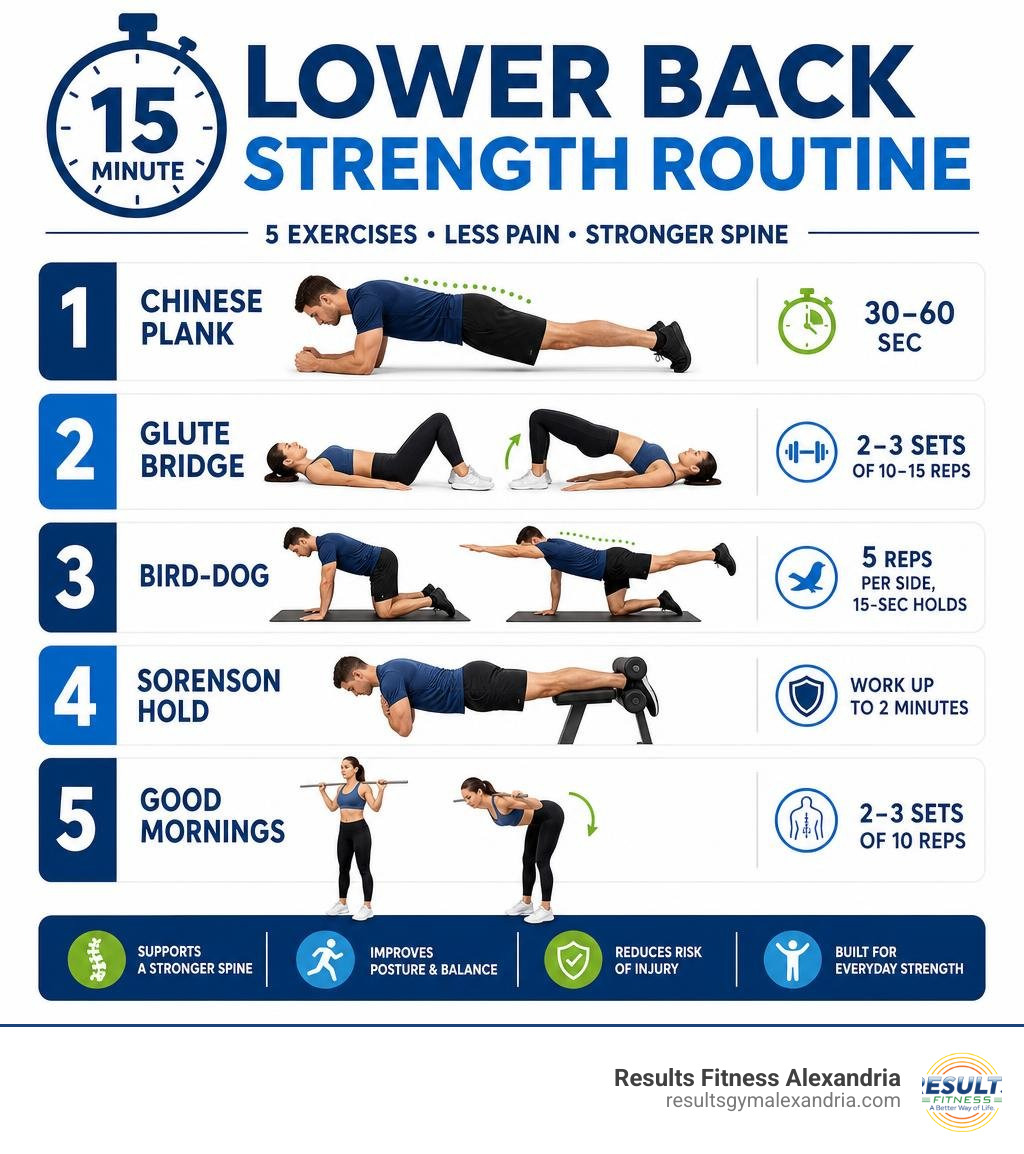
- Chinese Plank — isometric hold to activate the lower back safely (30–60 sec)
- Glute Bridge — targets glutes and lumbar stabilizers (2–3 sets of 10–15 reps)
- Bird-Dog — builds spinal control and balance (5 reps per side, 15-sec holds)
- Sorenson Hold — tests and builds dorsal endurance (work up to 2 minutes)
- Good Mornings — strengthens the erector spinae through hip hinge movement (2–3 sets of 10)
Between 60 and 80% of adults will experience low back pain at some point in their lives. Yet most people either ignore their lower back entirely — or only start paying attention after something goes wrong.
Here’s the thing: a weak lower back doesn’t just cause pain. It limits your posture, slows your athletic performance, and makes everyday tasks — like picking up groceries or tying your shoes — harder than they should be.
The good news? You don’t need hours in the gym to fix it. Just 15 focused minutes, done consistently, can make a real difference.
I’m Jennifer Rapchak, Fitness Director at Results Fitness Gym in Alexandria, Virginia, and a certified personal trainer with over 14 years of experience through the American Council on Exercise — and lower back strength is one of the areas I work on most with clients at every fitness level. In this guide, I’ll walk you through exactly what works, backed by research and real-world training experience.
Lower back strength terms to know:
The Biomechanics of Lower Back Strength
To build a resilient spine, we first need to understand how the lower back actually operates under load. Many people view the lower back as a fragile, easily damaged area that should be shielded from stress. In reality, the spine is incredibly adaptable and designed to transfer massive amounts of force when supported by strong surrounding muscles.

When we talk about lower back strength, we are looking at a complex network of muscles, tendons, and ligaments working in harmony. The primary active structures include the erector spinae (a group of muscles running vertically along your spine) and the quadratus lumborum (the deepest abdominal muscle, which connects your lowest rib to your pelvis). Together with your core and glutes, these muscles form a protective brace around your lumbar spine.
Understanding how these muscles adapt to stress is key to designing safe workouts. If you want to dive deeper into how muscle tissue responds to training, check out our guide on The Science of Building Muscle: Tips for Effective Strength Training.
Primary Functions of Lumbar Muscles in Strength Training
During compound movements like squats, deadlifts, and overhead presses, your lower back muscles rarely change length dynamically. Instead, their primary job is isometric contraction—they contract statically to resist unwanted spinal flexion, rotation, and lateral bending.
By maintaining a rigid, neutral spinal position, these muscles:
- Prevent Shear Stress: They keep the individual vertebrae from slipping forward or backward under load.
- Transfer Force: They act as a solid bridge, transferring the force generated by your powerful legs and hips up into your upper body.
- Distribute Loads Evenly: They ensure that external weight is distributed across the entire musculoskeletal system rather than concentrating stress on a single spinal segment.
When your lower back lacks endurance, it fatigues before your prime movers (like your glutes and hamstrings). This is why your squat might start looking like a “good morning” toward the end of a heavy set. To bust common myths about this area and learn more about how to keep your spine resilient, read Lower Back Strength Training: Training Myths, Best Exercises, and How to Build a Bulletproof Spine – Muscle & Fitness.
Passive Structures and the Thoracolumbar Fascia
It is not just muscle fibers doing the heavy lifting. Your body also relies heavily on passive structures, most notably the thoracolumbar fascia—a deep, thick layer of connective tissue that binds your lower back, hips, and shoulders.
The thoracolumbar fascia acts like an organic tensioning system. When you hinge at the hips, your glutes and hamstrings stretch, pulling on this fascia. This stretch creates elastic energy that helps support your spine, reducing the pure muscular effort required by your lumbar erectors. This mechanical synergy demonstrates why hip mobility and lower back resilience are permanently linked: tight hips prevent you from utilizing this passive support system, forcing your lower back muscles to work twice as hard.
Back Extension Variations: Joint Loading and Muscle Activation
The back extension (BE) is a staple exercise in both athletic conditioning and physical therapy. However, not all back extensions are created equal. Biomechanical research shows that slight changes in how you execute a back extension can drastically alter the forces placed on your spine, hips, and knees.
A landmark study on Loading conditions in the spine, hip and knee during different executions of back extension exercises | BMC Sports Science, Medicine and Rehabilitation | Springer Nature Link analyzed how different variations affect joint moments and muscle activation. Let’s break down these findings so you can choose the best variation for your goals.
Dynamic Hip vs. Dynamic Spine Executions
When performing a back extension on a Roman chair, you have two primary execution options:
- Dynamic Hip Execution (BEh): In this version, you keep your entire spine locked in a neutral position and pivot exclusively at your hip joint.
- Dynamic Spine Execution (BEs): In this version, you deliberately roll and unroll your spine segment by segment, creating dynamic flexion and extension throughout the movement.
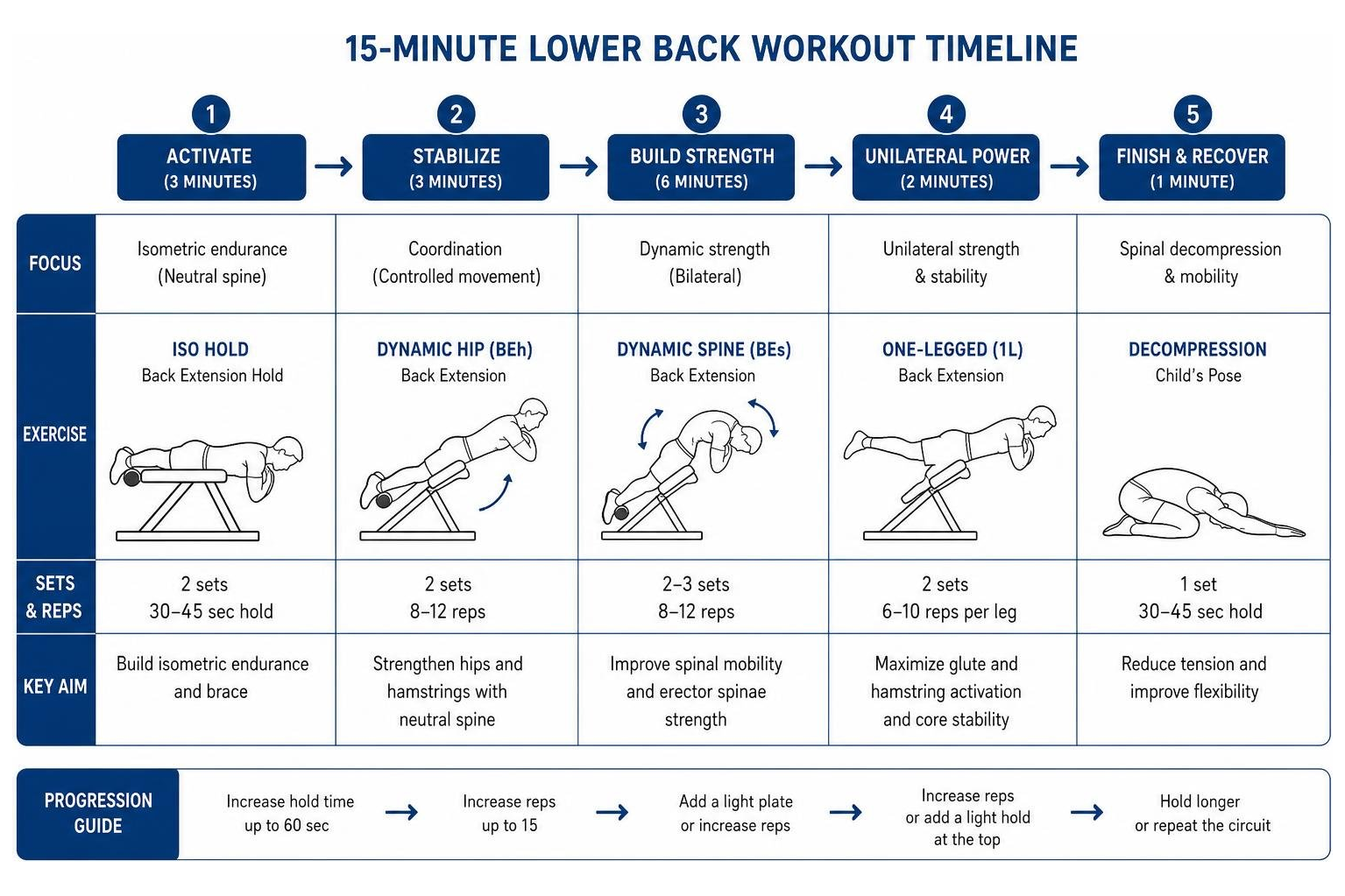
According to biomechanical data, the dynamic hip version (BEh) produces significantly higher external joint moments in the back, hip, and knee compared to the dynamic spine version (BEs). Specifically, the maximum bending moment at the L4/L5 spinal segment is higher during BEh because the lever arm of your upper body remains longer throughout the movement.
However, because the spine remains neutral during BEh, this movement is highly efficient for building functional strength in the hips and lower back while minimizing harmful shear forces on the spinal discs. On the other hand, while BEs targets the erector spinae through a larger range of motion, it requires careful control to avoid overloading the passive ligaments of the spine. For a complete breakdown of other movements you can use to target these areas, explore our Ultimate Guide to Gym Back Exercises.
One-Legged vs. Two-Legged Back Extensions
Another powerful variation analyzed in the research is the comparison between one-legged (1L) and two-legged (2L) back extensions.
If you want to maximize gluteal and hamstring activation without adding heavy external weights to your spine, the one-legged back extension is an exceptional tool. Unilateral (one-legged) execution significantly increases electromyographical (EMG) activity in the gluteus maximus and hamstrings of the working leg. Furthermore, it challenges your rotational stability, forcing your deep core stabilizers to fire to keep your hips level.
The table below summarizes the key biomechanical differences between these variations based on research data:
| Exercise Variation | Spinal Flexion Range | Hip Joint Moment | Glute & Hamstring EMG | Primary Target |
|---|---|---|---|---|
| Dynamic Hip (BEh) | Minimal (Spine remains neutral) | High (~0.2 Nm/kg higher than BEs) | Moderate-High | Glutes, Hamstrings, Isometric Lower Back |
| Dynamic Spine (BEs) | High (Segmental rolling) | Moderate | Moderate | Erector Spinae (Dynamic Range) |
| One-Legged (1L) | Minimal to Moderate | Very High (~0.3 Nm/kg higher than 2L) | Maximum | Gluteal and Hamstring Unilateral Strength |
| Two-Legged (2L) | Minimal to Moderate | Moderate | Moderate | General Posterior Chain Endurance |
The 15-Minute Workout: Safe Progressions for Lower Back Strength
We know you’re busy, which is why we’ve designed this highly efficient 15-minute lower back routine. This program is structured to build isometric endurance first, coordination second, and dynamic strength third.
By focusing on controlled progressions, we can safely apply the principle of progressive overload to strengthen your posterior chain without risking injury. To understand how to apply this principle across all your workouts, take a look at The Power of Progressive Overload: How to Keep Getting Stronger.
Step-by-Step Exercises to Build Lower Back Strength
Perform this routine 2 to 3 times per week. Start with the baseline versions and only progress to the next level once you can complete the recommended holds or repetitions with perfect form.
- Exercise 1: The Chinese Plank (Isometric Baseline)
- How to do it: Place your upper back on one bench (or chair) and your heels on another, keeping your body suspended in mid-air. Squeeze your glutes, engage your core, and maintain a perfectly straight line from your shoulders to your heels.
- Volume: Hold for 30 to 60 seconds. Repeat for 2 sets.
- Why it works: This is a fantastic starting point, especially if you have mild back irritability, because it builds isometric endurance without placing any bending or twisting stress on the spine.
- Exercise 2: The Bird-Dog (Spinal Control)
- How to do it: Start on your hands and knees. Slowly extend your right arm straight forward and your left leg straight backward until both are parallel to the floor. Hold for 15 seconds, return to the start, and switch sides.
- Volume: 5 repetitions per side. Repeat for 2 sets.
- Why it works: It teaches your brain to stabilize your spine while your limbs are moving, which is the definition of functional core stability. If you want to learn more about this approach, read What is Functional Strength Training: A Simple Guide.
- Exercise 3: The Glute Bridge (Hip Drive)
- How to do it: Lie on your back with your knees bent and feet flat on the floor. Squeeze your glutes and push through your heels to lift your hips toward the ceiling until your body forms a straight line from your knees to your shoulders. Hold for 2 seconds at the top.
- Volume: 2 to 3 sets of 10 to 15 repetitions.
- Why it works: Research links weak glutes to compensatory lower back strain. Strengthening your glutes directly reduces the workload on your lumbar spine.
- Exercise 4: The Sorenson Hold (Endurance Builder)
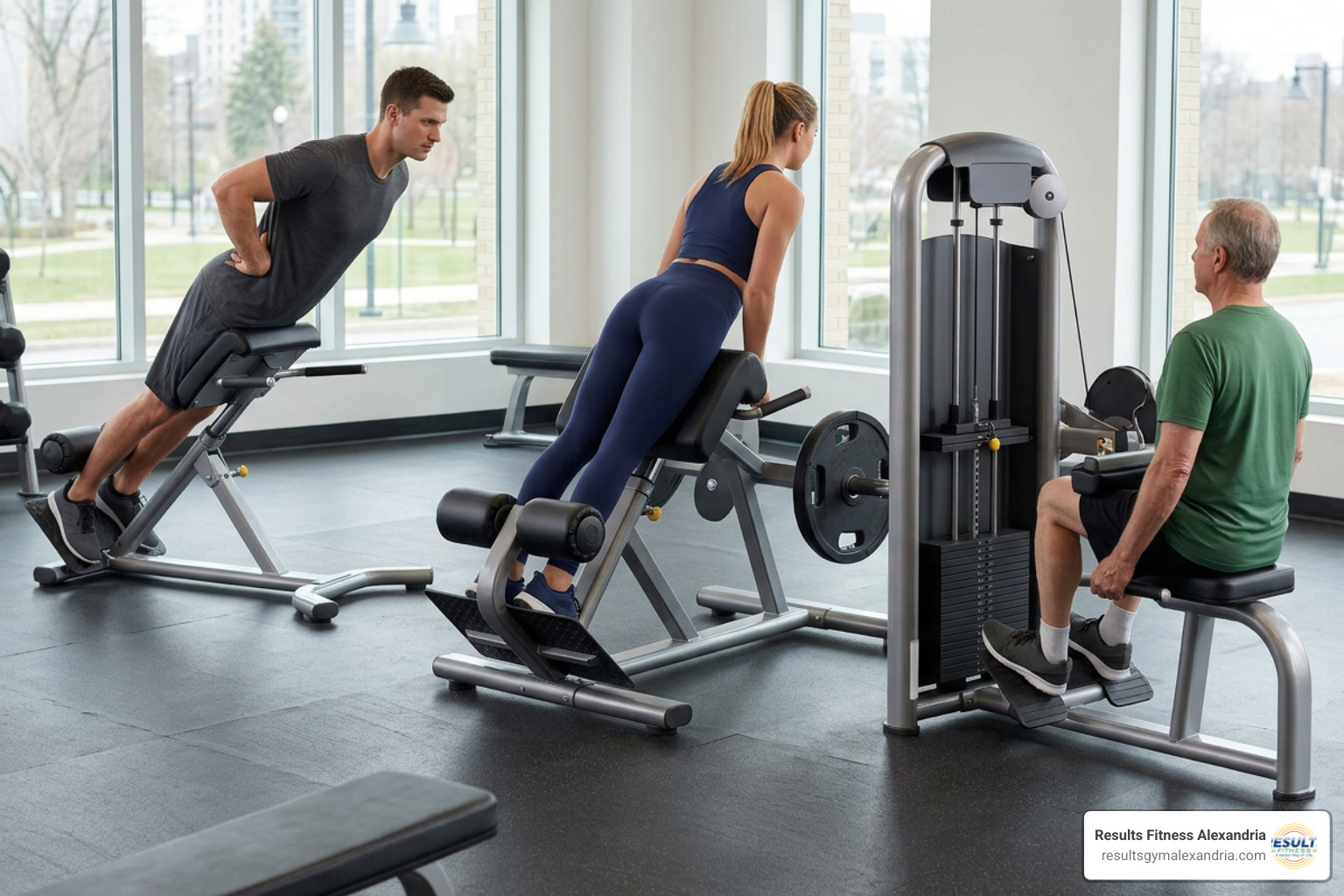
- How to do it: Lie face down on a Roman chair or back extension bench. Secure your legs and lower body, suspending your torso out parallel to the floor. Keep your hands crossed over your chest and hold this horizontal position.
- Volume: Work up to a continuous 2-minute hold.
- Why it works: This is the gold standard for testing and building dorsal muscle endurance.
Managing Posture, Neutral Lordosis, and Breathing Patterns
To maximize the safety of these exercises, you must manage your posture and breathing.
First, always aim to maintain neutral lordosis—the natural, slight inward curve of your lower spine. Avoid rounding your back (flexion) or excessively arching it (hyperextension) under load.
Second, utilize diaphragmatic breathing. Inhale deeply into your belly before you begin a movement to increase intra-abdominal pressure (IAP). This pressure acts like an internal airbag, supporting your spine from the inside out. Exhale slowly through the most difficult part of the movement (the sticking point), and never hold your breath for extended periods.
Training vs. Rehabilitation: Customizing Your Approach
Whether you are trying to set a personal record in the deadlift or simply trying to garden without pain, your approach to lower back strength should match your current physical condition.
In a rehabilitation setting, the focus is on restoring basic motor control and endurance. For instance, a clinical trial on the Impact of gluteus maximus–focused intervention using Powers’ program on chronic mechanical low back pain: A randomized controlled trial | BMC Sports Science, Medicine and Rehabilitation | Springer Nature Link demonstrated that a structured, progressive program targeting gluteal activation can significantly improve hip strength and reduce compensatory movement patterns in chronic low back pain patients.
For athletes, the focus shifts toward heavy, compound loading to build absolute force capacity. However, regardless of your age or fitness level, strength training is highly beneficial. To see how these principles apply across different stages of life, check out our article on the Benefits of Strength Training for All Ages.
Individual Factors: Experience, Flexibility, and Prior Injury
Your personal movement history dictates which exercises are safe for you. Consider these three factors before progressing your training:
- Hip Mobility: If your hips are stiff, your body will naturally force your lower back to bend to achieve depth during squats or hinges. Prioritize hip mobility to protect your spine.
- Hamstring Flexibility: Tight hamstrings pull down on your pelvis, which can flatten your natural lumbar curve and put your lower back at a mechanical disadvantage.
- Injury History: If you are recovering from a disc injury, you may be “flexion-intolerant” (bending forward hurts). In this case, stick to isometric exercises like the Chinese plank and avoid dynamic spine extensions. For detailed strategies on rebuilding your spine safely after an injury, read Lower Back Strength Training: Busting Myths & Building a Bulletproof Spine (2026).
Frequently Asked Questions about Lower Back Strength
What is the best starting exercise for lower back strength?
For most beginners or those recovering from mild back discomfort, the Chinese Plank is the absolute best starting exercise. Because it is an isometric hold, it requires zero movement of the spine or hip joints, which minimizes joint irritation while heavily activating the posterior chain. It builds the foundational endurance needed before you progress to dynamic movements. To learn more about how functional exercises like this improve your daily life, read 10 Benefits of Functional Fitness Exercises.
How do I know if my lower back is weak or just fatigued?
A simple way to evaluate this is by looking at your squat-to-deadlift ratio. Ideally, your deadlift maximum should comfortably exceed your back squat maximum (usually by about 15-20%). If your squat is nearly equal to or higher than your deadlift, or if your lower back consistently rounds and fails halfway up during a heavy lift, your lower back is likely the weak link in your kinetic chain. If your back simply feels tired or tight after a long day of standing, it is likely experiencing postural fatigue rather than a true strength deficit.
Is the Biering-Sørensen test a reliable measure of back endurance?
Yes, the Biering-Sørensen test is a highly validated, gold-standard scientific measure of lower back muscular endurance. Research has consistently shown that an individual’s ability to hold the Sorenson position for a full 2 minutes is strongly correlated with a significantly lower risk of developing low back pain. It is an excellent, low-tech way to assess your current spinal resilience.
Conclusion
Building a strong, resilient lower back doesn’t require hours of grueling workouts. By dedicating just 15 minutes a few times a week to targeted, biomechanically sound exercises like the Chinese plank, bird-dog, and glute bridges, you can build a spine that is ready for any challenge.
At Results Fitness Alexandria, we are dedicated to helping our community move better, feel stronger, and live pain-free. Whether you are looking for customized personal training, energizing fitness classes, or restorative yoga, our expert coaches in Alexandria, Virginia, are here to guide you every step of the way. Plus, we offer convenient childcare so you can focus entirely on your wellness.
Ready to experience the difference for yourself? We invite you to claim a free 1-day pass to try our amenities and meet our team.
Explore our Women’s Back Workout Guide or stop by our Alexandria gym today to start building your bulletproof spine!