
Full Body Hypertrophy Workouts That Actually Work
Why a Hypertrophy Full Body Workout Beats Training Six Days a Week
A hypertrophy full body workout is one of the most efficient ways to build muscle — hitting every major muscle group three times a week instead of once, without spending every day in the gym.
Here is what you need to know up front:
- Best frequency: 3 days per week (Monday, Wednesday, Friday)
- Optimal weekly volume: 10–20 sets per muscle group per week
- Rep ranges: 5×5 for strength, 4×10 or 3×10 for hypertrophy
- Rest periods: 2–3 minutes between strength sets, 45–60 seconds between hypertrophy sets
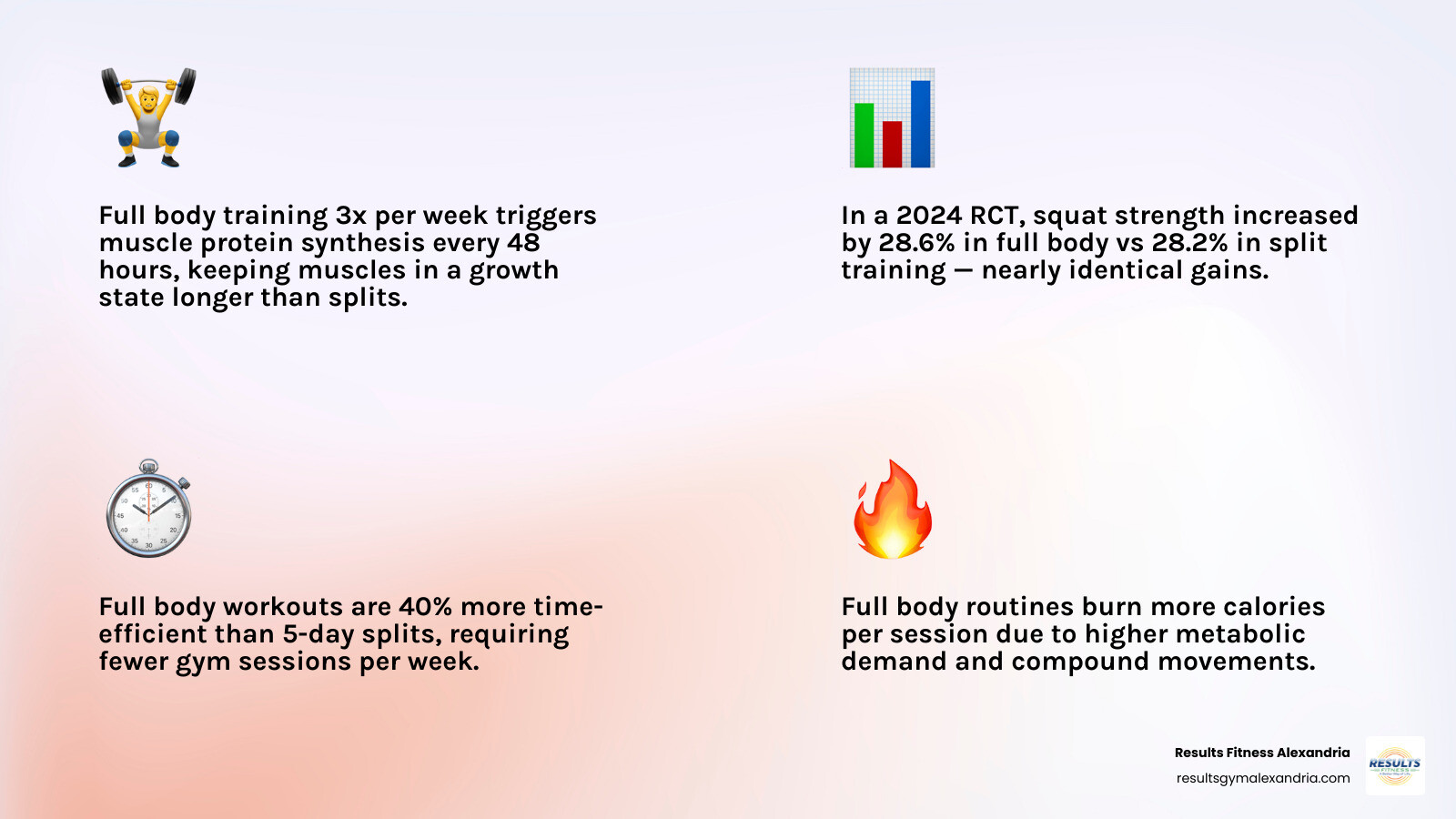
- Key advantage: Muscles stay in a growth state more consistently because protein synthesis is re-triggered every 48 hours
- Bottom line: Research shows full body and split routines produce equal muscle and strength gains when weekly volume is matched — but full body wins on time efficiency and fat loss
Most gym-goers assume they need a 5-day split to build serious muscle. But the science says otherwise.
A randomized controlled trial comparing split and full body training found that after 8 weeks, both groups gained nearly identical strength and muscle size. Squat strength increased by 28.2% in the split group and 28.6% in the full body group. Biceps thickness grew by 9.1% and 11.1% respectively. The difference? Negligible.
The real issue is not which routine is superior. It is whether you can stick to it and progress over time.
That is exactly what this guide is built around.
I’m Jennifer Rapchak, Fitness Director at Results Fitness Alexandria and a certified personal trainer with over 14 years of experience designing strength and hypertrophy full body workout programs for real people with busy schedules. In this guide, I’ll walk you through everything you need to structure, progress, and customize a full body routine that actually delivers results.
Handy hypertrophy full body workout terms:
The Science of the Hypertrophy Full Body Workout
To understand why a hypertrophy full body workout is so effective, we have to look at how muscles grow at a cellular level. When you lift weights, you trigger muscle protein synthesis (MPS) — the biological process where your body repairs and builds new muscle tissue.
For natural lifters, MPS remains elevated for only 24 to 48 hours after a workout. Once that window closes, your muscles stop growing. If you use a traditional “bro split” where you train chest on Monday and don’t hit it again until the following week, your chest is only in a growth state for two days out of seven. The other five days are wasted opportunities.
By utilizing a 3-day full-body split, you re-trigger muscle protein synthesis every 48 hours. Your muscles spend nearly the entire week in an active state of growth and recovery.
Many lifters worry that spreading their weekly training volume across multiple full-body sessions won’t build as much muscle as focusing on one or two body parts per workout. Fortunately, science has thoroughly debunked this myth.
A landmark study analyzed split versus full-body routines over an 8-week training intervention. The researchers matched the weekly training volume between the two groups. The split group trained twice weekly per muscle group (performing 8 sets per session, totaling 16 sets per week), while the full-body group trained four times weekly (performing 4 sets per session, totaling 16 sets per week).
The results showed virtually identical progress:
- 1RM Bench Press: Increased by 18.1% for the split group and 17.5% for the full-body group.
- 1RM Squat: Increased by 28.2% for the split group and 28.6% for the full-body group.
- Biceps Brachii Thickness: Increased by 9.1% in the split group and 11.1% in the full-body group.
- Triceps Brachii Thickness: Increased by 18.7% in the split group and 14.4% in the full-body group.
Additionally, a 2024 meta-analysis of 14 studies involving 392 participants found that full-body training produced greater overall fat mass loss than split routines in trained individuals. Because full-body workouts engage massive amounts of muscle mass in a single session — such as pairing squats with rows and presses — they create a significantly higher acute metabolic demand, burning more calories both during and after the workout.
To see how these styles compare, take a look at the differences in application:
| Feature | 3-Day Full Body Workout | 5-Day Body Part Split |
|---|---|---|
| Weekly Frequency | 3 days per week | 5 days per week |
| MPS Stimulation | 3 times per week per muscle | 1 time per week per muscle |
| Time Commitment | 3–4.5 hours total per week | 5–7.5 hours total per week |
| Metabolic Demand | Extremely high per session | Moderate per session |
| Recovery Window | 48 hours of full-body rest | Localized rest only |
| Adherence Flexibility | High (easy to make up missed days) | Low (missed days ruin the cycle) |
To dive deeper into the physiological mechanisms of muscle growth, check out our guide on The Science of Building Muscle: Tips for Effective Strength Training. If you’re looking for a highly structured template to get started, you can read more about this Full Body Workout Plan: Best Routine for Muscle & Fat Loss.
Designing the Ultimate 3-Day Full Body Routine
Designing a successful hypertrophy full body workout requires balancing volume, intensity, and recovery. The ultimate sweet spot for most lifters is a 3-day weekly frequency (such as Monday, Wednesday, and Friday), leaving at least 48 hours of rest between sessions. This schedule respects the body’s recovery limits while satisfying the latest ACSM 2026 guidelines, which recommend a weekly volume of 10 to 20 working sets per major muscle group to maximize hypertrophy.
If you try to hit all 10 to 20 sets in a single workout, the quality of your sets will drop off a cliff due to local and systemic fatigue. By utilizing a 3-day full-body split, you can perform 4 to 6 high-quality sets per muscle group each session. Every single set is performed when you are fresh, strong, and capable of generating maximum mechanical tension.
To learn more about setting up a structured multi-week training cycle, take a look at this detailed 12 Week Full Body Workout Plan for Muscle Gain. For general tips on maximizing your gym time, read our advice on How to Build Muscle with Good Strength Training Workouts.
Structuring Your Hypertrophy Full Body Workout Sessions
To prevent systemic burnout, we alternate between two distinct workouts: Day A and Day B. Instead of trying to train every single movement pattern in every session, we rotate them. This keeps your joints healthy and ensures you can train with maximum effort.
- Day A Focus: Squat + Horizontal Push + Vertical Pull + Accessory Work
- Day B Focus: Hinge + Vertical Push + Horizontal Pull + Accessory Work
By alternating these sessions across your three weekly training days (e.g., Week 1: Day A, Day B, Day A; Week 2: Day B, Day A, Day B), you hit every major muscle group multiple times per week while avoiding excessive fatigue.
The Strength Component vs. Hypertrophy Sets
Our full-body program uses a dual approach: we combine heavy strength work with moderate-load hypertrophy sets in the same session. This ensures you never have to choose between getting stronger or getting bigger.
We kick off each workout with a primary compound lift (like the Squat, Bench Press, or Deadlift) using a classic 5×5 rep scheme (5 sets of 5 reps). This heavy strength component targets mechanical tension, recruiting high-threshold motor units and building a solid foundation of power.
Once the heavy lifting is done, we transition to the hypertrophy component. Here, we target metabolic stress and muscular damage using a 4×10 rep scheme (4 sets of 10 reps) for large muscle groups and a 3×10 rep scheme for smaller, accessory muscle groups (like biceps, triceps, and calves).
To support these different training stimuli, we must adjust our rest periods:
- For 5×5 Strength Sets: Rest 2 to 3 minutes between sets. This allows your ATP-PC energy system to fully recover, ensuring you can lift heavy loads with perfect form on subsequent sets.
- For Hypertrophy Sets (4×10/3×10): Rest 45 to 60 seconds between sets. Keeping rest periods short limits muscular recovery, which drives metabolic stress and creates a powerful muscle pump.
For a deeper look at how to organize these variables across a long-term plan, explore our comprehensive resource on Strength Training Programs: Complete Guide.
Progressive Overload and Periodization for Muscle Growth
Without progressive overload, even the most scientifically perfect workout routine will fail to build muscle. Your body only adapts and grows when it is forced to handle a stimulus it isn’t used to. To trigger muscle hypertrophy, your workouts must consistently drive three primary mechanisms:
- Mechanical Tension: Created by lifting heavy loads through a full range of motion.
- Muscle Damage: Small micro-tears in the muscle fibers caused by novel exercises or controlled eccentric (lowering) phases.
- Metabolic Stress: The “burn” and pump created by high-repetition training with short rest periods.
To understand how to master these variables in your routine, read our guide on The Power of Progressive Overload: How to Keep Getting Stronger.
How to Progress Your Hypertrophy Full Body Workout Over Time
Progression doesn’t just mean throwing more weight on the bar every single time you walk into the gym. In fact, trying to force weight progression too quickly is the fastest way to stall out or get injured. Instead, use a systematic progression model:
- For Strength Lifts (5×5): Apply a simple linear progression. Add 5 pounds to the bar each week, or use a set-by-set progression. For example, add 5 pounds to each set during your workout, and then start the next week’s working sets using the second-lightest weight from the previous week.
- For Hypertrophy Lifts (4×10 or 3×10): Use a double progression model. Keep the weight the same and focus on adding repetitions within a target range (e.g., aiming to get all sets to 10 reps). Once you can successfully complete all sets at the target rep count with perfect form, increase the weight by 5 pounds and drop back to the bottom of the rep range.
- Reps in Reserve (RIR): To manage fatigue, stop most of your working sets with 1 to 3 reps in reserve (RIR). Training to absolute failure on every set of a full-body routine will quickly exhaust your central nervous system and hinder your recovery.
Regardless of which method you use, keeping an accurate training log is essential. Track your exercises, sets, reps, and loads in a dedicated notebook or mobile app so you can ensure you are truly progressing week over week.
Managing Recovery, Deloads, and Fatigue
Because a full-body routine stimulates your entire muscular system three times a week, managing fatigue is critical.
Every 4 to 5 weeks, you should schedule a structured deload week. During a deload, you reduce your overall training volume by roughly 30% to 40% while keeping the intensity (the weight on the bar) moderate. This temporary reduction in volume allows your joints, connective tissues, and nervous system to fully recover without losing your hard-earned strength gains.
Outside of the gym, your recovery habits will make or break your results:
- Sleep Optimization: Aim for 7 to 9 hours of high-quality sleep per night. Sleep is when your body releases the vast majority of its natural growth hormone. A study showed that individuals sleeping only 5.5 hours per night experienced 55% less fat loss and significantly higher muscle loss compared to those sleeping 8.5 hours on identical diets.
- Active Recovery: On your off days, perform 30 to 45 minutes of low-intensity cardio (like a brisk walk or light jog) followed by foam rolling. This keeps blood flowing to damaged muscle tissues to accelerate repair without adding joint stress.
- Protein Intake: To support muscle protein synthesis, consume 1.6 to 2.2 grams of protein per kilogram of body weight daily. If you are in a fat loss phase (caloric deficit), raise your protein intake to 2.2 to 3.1 g/kg to protect your lean muscle tissue from being broken down for energy.
For specialized recovery and training considerations, check out The Ultimate Guide to Women’s Strength Training.
Exercise Selection and Customization Strategies
An effective full-body program is built around fundamental movement patterns, not isolated muscles. To ensure your routine is balanced and complete, every session should select movements from the six core categories:
- Squat: Back squat, front squat, leg press, or goblet squat.
- Hinge: Deadlift, Romanian deadlift (RDL), kettlebell swing, or hip thrust.
- Single-Leg: Bulgarian split squat, lunge, or step-up.
- Upper Body Press: Bench press, overhead shoulder press, incline dumbbell press, or dips.
- Upper Body Pull: Pull-up, lat pulldown, barbell row, or seated cable row.
- Loaded Carry: Farmer’s walk, suitcase carry, or sandbag carry.
If you ever feel like your arms, shoulders, or calves are getting neglected by compound lifts, you can use the GAP workout concept. This involves adding an optional, short 4th session on the weekend. This “GAP session” is dedicated purely to low-fatigue, high-pump hypertrophy work for minor muscle groups (like biceps curls, triceps pressdowns, lateral raises, and calf raises). Because these smaller muscles recover quickly, a quick GAP session won’t interfere with your core 3-day full-body progression.
If you need to customize your routine due to joint discomfort, personal preference, or equipment availability, use this list of recommended exercise substitutions:
- Instead of Barbell Back Squat: Hack Squat, Leg Press, or Goblet Squat
- Instead of Barbell Bench Press: Incline Dumbbell Press, Weighted Dips, or Push-Ups
- Instead of Conventional Deadlift: Romanian Deadlift (RDL), Trap Bar Deadlift, or Hip Thrusts
- Instead of Pull-Ups: Lat Pulldowns or Assisted Pull-Up Machine
- Instead of Barbell Rows: Seated Cable Rows, Chest-Supported Dumbbell Rows, or T-Bar Rows
To keep your progress measurable, try to keep 70% to 80% of your program identical for at least 4 to 6 weeks before swapping exercises.
Frequently Asked Questions About Full Body Training
How long should rest periods be between sets?
For your heavy strength sets (like a 5×5 compound lift), rest for 2 to 3 minutes between sets. This allows your muscles’ ATP-PC energy system to fully recover so you can maintain high power output. For your hypertrophy and accessory sets (like 4×10 or 3×10), limit your rest to 45 to 60 seconds to maximize metabolic stress and build a powerful muscle pump.
Can beginners and intermediate lifters use the same program?
Yes, but they will experience it differently. Beginners have a lower overall work capacity and will experience rapid “newbie gains,” meaning they can build muscle and strength quickly with very basic progression. Intermediate lifters will need to manage their fatigue more closely, pay strict attention to recovery, and use systematic progression models (like double progression) to keep making consistent gains.
How do I customize or swap exercises without losing effectiveness?
The key is to replace an exercise with another movement that targets the same core movement pattern. For example, if back squats hurt your lower back, swap them for a hack squat or a leg press. Avoid swapping compound lifts for isolation movements (such as replacing squats with leg extensions), as this will significantly reduce the overall effectiveness of your session.
Conclusion
A structured hypertrophy full body workout is a highly effective, time-efficient, and scientifically proven way to build serious muscle and strength. By training your entire body three times a week, you maximize muscle protein synthesis, burn more fat, and free up your schedule so you don’t have to live in the gym.
Consistency is the ultimate key to physical transformation. Find a routine you enjoy, focus on progressive overload, log your lifts, and prioritize your recovery.
If you are ready to take your training to the next level, we can help. At Results Fitness in Alexandria, Virginia, we offer premium strength training equipment, expert-led fitness classes, personalized training, and supportive amenities designed for all fitness levels.
Come check out our facility and experience the difference for yourself. Start your fitness journey with our premium strength training amenities and claim your free 1-day pass today!