Core exercise classes: Unlock Your Stronger 2026
Why Core Exercise Classes Are More Than Just an Ab Workout
When you hear the term “core workout,” what’s the first thing that comes to mind? For many, it’s the endless pursuit of a six-pack, fueled by countless crunches and sit-ups. But what if we told you that your core is so much more than just your abdominal muscles? What if strengthening it could transform your entire body, improve your posture, and even reduce back pain? At Results Fitness in Alexandria, we’re here to show you that core exercise classes are the secret weapon you’ve been missing in your fitness journey. They are the foundation upon which all other strength and movement is built.
Core exercise classes offer a structured, guided approach to strengthening the muscles that stabilize your entire body—not just your abs. Here’s what you need to know:
- Full-body stability training targeting abs, back, hips, and glutes
- Multiple formats including athletic-style training and Pilates-based classes
- All fitness levels welcome with modifications provided by certified instructors
- Typical duration: 30-55 minutes per session
- Recommended frequency: 2-3 times per week for best results
- Equipment provided by the gym (resistance tubes, weight plates, stability balls)
Key Benefits:
- Improved posture and reduced back pain
- Improved athletic performance and balance
- Injury prevention through stronger stabilizing muscles
- Better functional strength for everyday activities
When you hear “core training,” you might picture endless sit-ups and marathon plank holds. But the reality is far more interesting—and far more useful. Your core isn’t just about getting visible abs. It’s the powerhouse that connects your upper body to your lower body, stabilizes your spine during movement, and makes virtually everything you do easier and safer. A strong core is the foundation for a strong body, and it’s a key component in preventing injuries, especially in the lower back. According to a study published in the Journal of Physical Therapy Science, core stabilization exercises are effective in decreasing pain and improving functional status in patients with chronic non-specific low back pain.
Core training isn’t just about abs—it’s about full-body strength and injury prevention. Every exercise can be a core exercise if performed with good form and proper activation of the muscles around your spine. That’s why dedicated core classes have become such a popular fixture in modern fitness programming.
I’m Jennifer R., Fitness Director at Results Fitness Alexandria, and I’ve been teaching core-focused classes for over 14 years as a certified Les Mills instructor in CXWORX and Advanced BodyPump. Through thousands of hours coaching members in core exercise classes, I’ve seen how this type of training transforms not just how people look, but how they move, feel, and perform in every aspect of their lives.
Core exercise classes terms to remember:
What is Your Core (and Why Does It Matter)?
When you think of core training, do you picture endless sit-ups? The truth is, your core is much more than just your abs. It’s a complex system of muscles—including your back, hips, and glutes—that acts as the central stabilizer for your entire body. A strong core is the foundation for almost every movement you make, from getting out of bed in the morning to hitting a new personal record in the gym. Understanding the anatomy of your core is the first step to training it effectively.
Your core is a sophisticated network of muscles that work together to provide stability and support for your spine. It’s not just the six-pack muscles (rectus abdominis) you see on the surface. Instead, it encompasses a wider range of muscle groups that wrap around your torso, from your shoulders down to your hips. We often refer to these as the inner and outer core.
The Inner Core acts as your body’s first line of defense, engaging automatically to protect your spine, even during simple movements like breathing. Think of it as your body’s natural corset, providing deep, inherent stability. This group includes muscles like the transverse abdominis, multifidus, and pelvic floor muscles. These muscles are crucial for maintaining posture and preventing lower back pain. A strong inner core is like having a built-in support system for your spine, reducing the strain on your vertebrae and discs during daily activities and exercise.
The Outer Core comprises the more well-known muscles, such as your rectus abdominis (the “six-pack” muscles), obliques (side muscles), erector spinae (back muscles), glutes, and hip flexors. These muscles work in conjunction with the inner core to provide both stability and power for dynamic movements. For example, when you lift a heavy object, your outer core muscles contract to generate force, while your inner core muscles stabilize your spine to prevent injury. This coordinated effort is what allows you to perform powerful, controlled movements safely and effectively.
As we learned from the insights provided, your core is a complex system of muscles that stabilize and support your spine. At its core (pun intended), your midsection acts as a stabilizer for the spine. When lifting heavy objects or performing dynamic movements, your core muscles stiffen, preventing excessive movement and reducing injury risk. This intricate system is what makes your core truly the central command center for all movement. Without a strong, functional core, our movements become less efficient, less powerful, and more prone to injury. A well-developed core is essential for everything from carrying groceries to excelling in your favorite sport.
Why a Strong Core is Your Secret Weapon for Overall Fitness
A powerful core translates to a more powerful you. Investing time in dedicated core training goes far beyond aesthetics; it improves your body’s overall function and resilience, making everyday activities easier and athletic pursuits more achievable. We’re not just talking about looking good; we’re talking about feeling good and performing better in all aspects of life. A strong core is the foundation of a healthy, active lifestyle, and it’s a key component of any effective fitness program.
Here’s why a strong core is so vital:
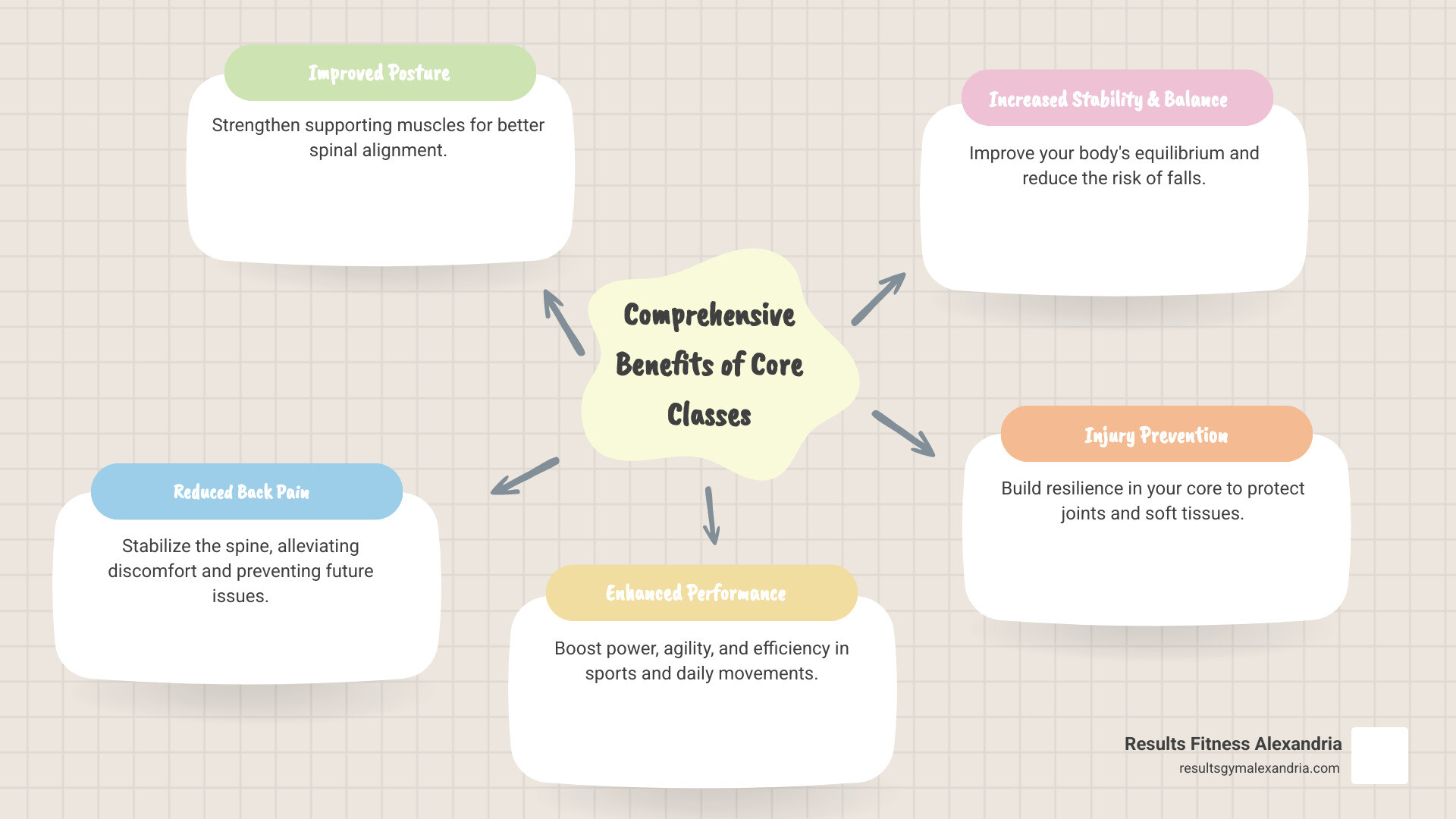
- Improved Posture: Have you ever noticed how some people stand tall and confident, while others slouch? Often, the difference lies in core strength. A strong core provides the necessary support for your spine, helping you maintain proper alignment whether you’re sitting at a desk, standing in line, or walking around Alexandria. Good posture not only makes you look better but also reduces strain on your joints and muscles. It can also help to alleviate neck and shoulder pain, which are common complaints for those who spend a lot of time sitting at a desk.
- Reduced Back Pain: For many, chronic back pain is a persistent issue. A stronger core significantly improves movement health and helps prevent back pain. When your core muscles are weak, other muscles (especially those in your back) have to work harder to compensate, leading to strain and discomfort. Strengthening your core helps distribute the load more evenly, alleviating pressure on your lower back. This is particularly important for those who have sedentary jobs or who engage in activities that put a lot of stress on the back.
- Improved Athletic Performance: Whether you’re a seasoned athlete or just enjoy recreational sports, a strong core is your secret weapon. As we know, a stronger core improves athletic performance, improves movement health, and helps prevent back pain. It acts as the stable base from which all powerful movements originate. Think of a pitcher throwing a ball, a golfer swinging a club, or a runner sprinting—all rely heavily on core stability and power. LES MILLS CORE, for example, is a scientific core workout for incredible core tone and sports performance, building strength, stability, and endurance in the muscles that support your core. A strong core can also improve your balance and coordination, which are essential for many sports.
- Increased Stability and Balance: From walking on uneven terrain to standing on one leg to put on your shoes, stability and balance are crucial for everyday tasks. Your core muscles are primarily responsible for keeping you upright and preventing falls. By strengthening these muscles, we improve our proprioception (our body’s sense of its position in space), leading to better balance and coordination. This is particularly beneficial as we age, helping to maintain independence and reduce the risk of injury. A strong core can also help to improve your reaction time, which can be crucial in preventing falls.
- Injury Prevention: This is a big one. Core training isn’t just about abs—it’s about full-body strength and injury prevention. A strong core provides a protective shield for your spine and internal organs. It helps stabilize your torso during movements, preventing excessive twisting or bending that could lead to sprains, strains, or more serious injuries. LES MILLS CORE specifically assists injury prevention and makes you better at everything you do by honing in on the torso and sling muscles that connect your upper body to your lower body. This is especially important for athletes and anyone who engages in physically demanding activities.
- Improved Functional Strength: Functional fitness is all about training your body for the movements you perform in daily life. From lifting groceries to picking up a child, to pushing a heavy door, these actions require a strong and stable core. As we highlight in our Functional Fitness: What Is It and How to Use It for Weight Loss guide, training your core improves your ability to perform these everyday tasks with ease and efficiency. Every exercise can be a core exercise if performed with good form and proper activation of the muscles around your spine. This means that you’ll not only be stronger in the gym, but you’ll also be better equipped to handle the physical demands of your daily life.
Exploring Different Types of Core Exercise Classes
Not all core exercise classes are created equal. They come in various formats, each with a unique focus and intensity. Understanding the different types can help you find the perfect fit for your fitness goals and preferences. Whether you’re looking for an intense athletic challenge or a more mindful, controlled approach, there’s a core class designed for you. At Results Fitness, we offer a variety of options to cater to different needs and fitness levels, ensuring that everyone can find a class that they enjoy and that helps them achieve their goals.
Here’s a comparison to help you differentiate:
| Feature | Athletic-Style Core Training – | Pilates-Based Core Classes – |
|---|---|---|
| Pace | Fast, often high-intensity – | Slower, controlled movements – |
| Primary Focus | Building functional strength, power, and endurance. – | Core stabilization, flexibility, and mind-body connection. |
| Equipment | Resistance bands, weight plates, medicine balls, and sometimes bodyweight exercises. – | Mats, stability balls, resistance bands, and sometimes specialized Pilates equipment like reformers. – |
Athletic-Style Core Training
This type of class is often inspired by sports performance principles. It’s dynamic, challenging, and focuses on building functional strength, stability, and endurance that translates directly to other physical activities. Think of it as a high-energy workout for your midsection. You’ll be doing a variety of exercises that engage your core in different ways, from planks and crunches to more dynamic movements like medicine ball throws and kettlebell swings. The goal is to build a strong, stable core that can support you in all your athletic endeavors, whether you’re a seasoned athlete or just looking to improve your overall fitness. Our Core Endurance Training Guide provides more in-depth information on this style of training.
- Functional movements: Exercises that mimic real-life movements, such as lifting, twisting, and bending.
- Power: Explosive movements that build strength and speed.
- Endurance: The ability to sustain effort over a longer period of time.
- Equipment: Resistance bands, weight plates, medicine balls, and your own body weight.
Pilates-Based and Mind-Body Core Classes
These classes emphasize control, precision, and deep muscle activation. The pace is often slower, with a strong focus on breathwork and connecting your mind to your muscles to build strength from the inside out. Pilates, in particular, is known for its focus on core strength and stability. It’s a low-impact workout that’s suitable for all fitness levels, and it can be a great way to improve your posture, flexibility, and overall body awareness. Our Pilates Circuit Class is a great example of this type of workout. We also offer other mind-body classes that can help you connect with your body and improve your core strength, such as yoga and barre. You can learn more about these classes on our Mind Body Fitness page.
- Mind-body connection: Focusing on the connection between your mind and your muscles to improve control and awareness.
- Flexibility: Improving your range of motion and reducing your risk of injury.
- Muscle control: Learning to activate and engage your core muscles correctly.
- Equipment: Mats, stability balls, resistance bands, and sometimes specialized Pilates equipment like reformers.