Best training for cardiovascular endurance: Crush 2025
Why the Best Training for Cardiovascular Endurance Matters for Your Health
The best training for cardiovascular endurance combines high-intensity interval training (HIIT), steady-state cardio, and strength work to build a powerful heart and lungs. Here’s a quick overview:
- HIIT: Short, intense bursts of effort improve endurance and save time.
- Steady-State Cardio: Moderate, continuous exercise builds your aerobic base and burns fat.
- Frequency: Aim for 3-5 cardio days per week, mixing both methods.
- Intensity: Use your heart rate (60-80% of max) or the talk test to gauge effort.
- Strength Training: Add 2 days per week to support cardio gains and prevent injury.
Cardiovascular endurance is your heart and lungs’ ability to supply oxygen to your muscles during sustained activity. Good cardio fitness makes daily tasks easier and reduces your risk of heart disease, diabetes, and stroke while improving mental well-being.
So, should you sprint hard or go for a long, steady jog? The best approach uses both. HIIT pushes your VO2 max (your body’s maximum oxygen use), while steady-state cardio builds the foundation that lets you sustain effort over time.
Adults need at least 150 minutes of moderate or 75 minutes of vigorous exercise weekly. This is achievable by breaking it into manageable chunks, like three 20-minute HIIT sessions or five 30-minute walks.
As Jennifer Rapchak, Fitness Director at Results Fitness Alexandria, I’ve seen how a balanced program transforms fitness, energy, and health. This guide will show you how to build your own endurance program, whether you’re a beginner or looking to break a plateau.
Understanding Cardiovascular Endurance and Its Importance
Cardiovascular endurance—also called aerobic fitness—is your heart and lungs’ ability to deliver oxygen to your muscles during sustained physical activity. A strong endurance system means you can handle more activity with less effort, whether that’s a tough workout or just playing with your kids.
A key metric is VO2 Max, which measures the maximum amount of oxygen your body can use during intense exercise. A higher VO2 Max indicates greater efficiency, and it’s a benchmark that improves with consistent training.
The health benefits are life-changing. A stronger cardiovascular system leads to better blood flow, lower blood pressure, and a lower resting heart rate. It also improves your cholesterol profile by raising HDL (good) and lowering LDL (bad) cholesterol. The Benefits of Endurance are clear: regular cardio dramatically reduces your risk of heart disease, type 2 diabetes, stroke, and even certain cancers. Beyond the physical, it’s a powerful mood booster that reduces stress, eases anxiety, and improves sleep. Better oxygen supply also improves brain function, leading to clearer thinking and an improved quality of life.
The Physical Activity Guidelines for Americans recommend 150-300 minutes of moderate activity per week, but you can achieve incredible results in less time by working smarter.
How to Measure Your Cardio Fitness and Intensity
Knowing your starting point is motivating. A simple benchmark is the 1.5-mile run test; time yourself running or walking the distance and aim to beat that time in a few months. Faster times are linked to better long-term health.
Once you start training, gauging intensity is crucial to avoid over- or under-training. Here are three simple methods:
Heart Rate Zones: The classic method. Estimate your max heart rate (220 minus your age) and aim for specific percentages. Moderate intensity is 60-70% of your max, while vigorous intensity is 76-96%. Most fitness trackers monitor this for you.

The Rate of Perceived Exertion (RPE) scale is a subjective scale from 0 (rest) to 10 (max effort). Moderate activity is a 3-4, while vigorous is a 5-7. It teaches you to listen to your body.
Finally, the Talk Test is wonderfully simple. Can you talk, but not sing? That’s moderate intensity. Can you only manage a few words? You’re in the vigorous zone.
These tools help you understand what different intensities feel like, allowing you to train effectively and safely. Understanding intensity is key to finding the best training for cardiovascular endurance for you.
The Contenders: High-Intensity Interval Training (HIIT) vs. Steady-State Cardio
When it comes to the best training for cardiovascular endurance, two styles dominate: High-Intensity Interval Training (HIIT) and Steady-State Cardio. Both are effective, but they work in different ways.

The Power and Punch of HIIT
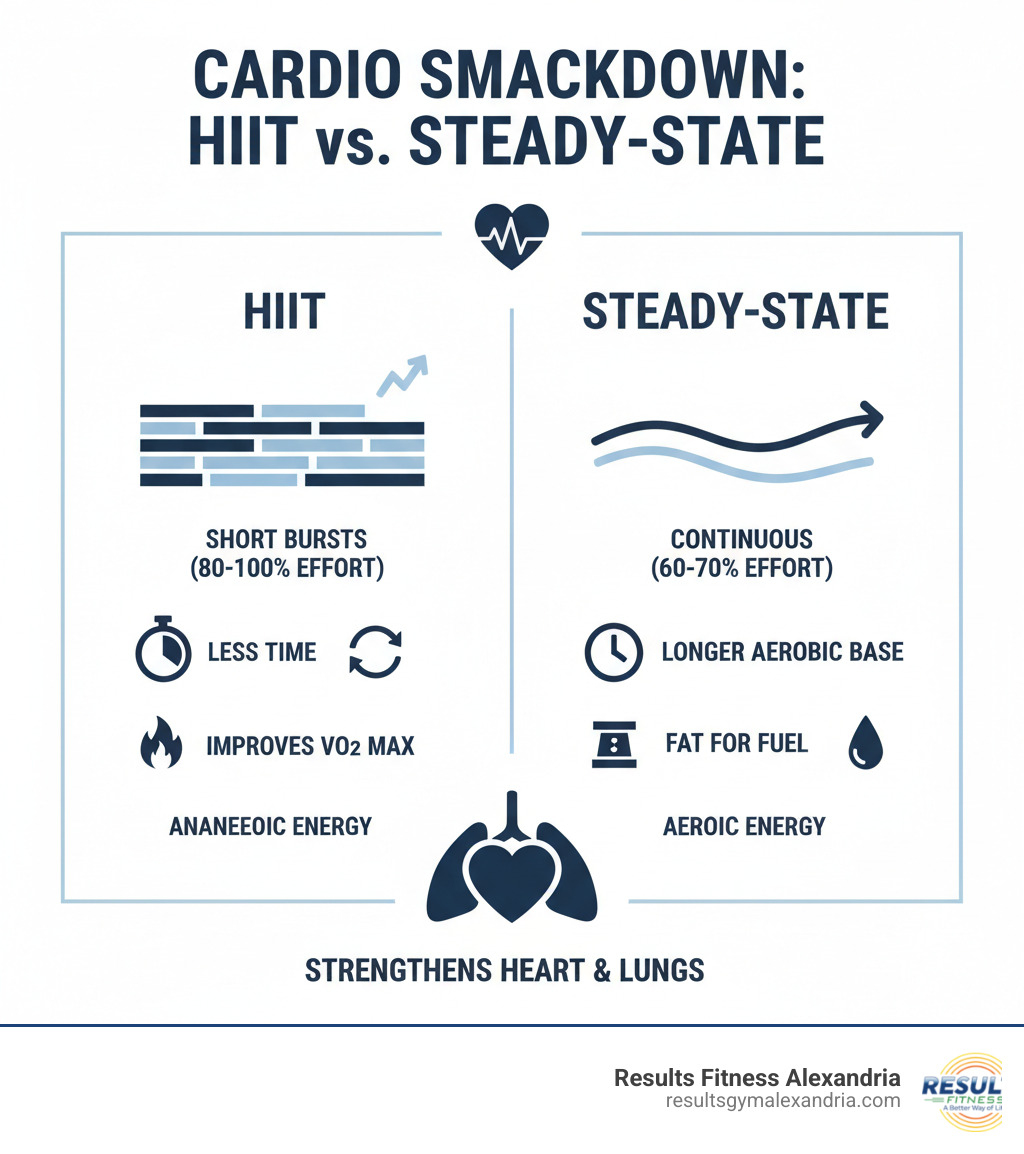
HIIT involves alternating between short bursts of all-out effort and periods of rest or active recovery. A session might involve sprinting for 30 seconds, then walking for 90 seconds, repeated for 15-20 minutes.
The primary benefit of HIIT is time efficiency. You can achieve significant cardiovascular gains in just 20-30 minutes. Harvard Health points out that this method accomplishes the same work in less time than traditional workouts. Research shows impressive improvements in VO2 max, with some studies reporting gains of 38% to 79%.
Another benefit is the afterburn effect (EPOC), where your metabolism stays liftd for hours post-workout, burning extra calories. HIIT is also versatile and can be applied to almost any activity, from swimming to cycling, making it a great choice for Cardio Exercise for Stamina.
The Marathon Method: Steady-State Cardio
Steady-State Cardio, or LISS (Low-Intensity Steady-State), involves maintaining a consistent, moderate intensity for 30 minutes or more. Think of a comfortable jog, brisk walk, or steady bike ride.
This method is the foundation of aerobic base building. It trains your cardiovascular system to deliver oxygen efficiently and teaches your body to sustain effort over time. A key benefit is improved fat utilization, as your body learns to use fat as a primary fuel source during longer workouts.
Steady-state training is also typically lower impact than HIIT, making it ideal for beginners, recovery days, or those with joint concerns. Many find its rhythmic nature meditative and stress-reducing. For ideas, check out our Treadmill Endurance Workouts guide.
Which is the best training for cardiovascular endurance?
Truthfully, you shouldn’t choose one over the other. The best training for cardiovascular endurance combines them strategically.
| Feature | High-Intensity Interval Training (HIIT) | Steady-State Cardio |
|---|---|---|
| Time | Shorter workouts (20-30 mins including warm-up/cool-down) | Longer workouts (30-60+ mins) |
| Intensity | Alternating brief bursts of vigorous to maximal effort with recovery | Consistent, moderate effort |
| Benefits | Significant VO2 max improvements, increased calorie burn post-workout | Builds aerobic base, improves fat utilization, lower impact |
| Best Use | Time-efficient, breaking plateaus, boosting performance | Foundation for endurance, active recovery, stress reduction |
HIIT pushes your top-end capacity, while steady-state cardio builds the foundation that supports all training. Combining them, a practice known as periodization, prevents plateaus and reduces injury risk. The most important factor is listening to your body and choosing the workout that feels right for you on any given day.
Building a Complete Cardiovascular Fitness Program
The best training for cardiovascular endurance is a holistic program. It’s structured around the FITT principle (Frequency, Intensity, Time, Type) and progressive overload—gradually increasing the challenge to keep making progress. Safety and injury prevention through proper form and adequate rest are always paramount.
The Role of Strength Training in Endurance
Strength training is crucial for cardiovascular fitness. Building lean muscle increases your resting metabolic rate, helping you maintain a healthy weight and taking pressure off your heart. It also improves cholesterol levels.
More importantly, stronger muscles support your joints, acting as shock absorbers during repetitive cardio movements and reducing injury risk. This leads to better performance, power, and stamina overall.
We recommend at least two nonconsecutive days of resistance training per week to allow for muscle recovery. Learn more in our guide on Maximizing Results: Integrating Strength Training into Your Cardio Routine.
The Best Training for Cardiovascular Endurance Starts with Nutrition
Proper nutrition is non-negotiable for fueling your workouts and supporting recovery. Carbohydrates are your body’s primary energy source for endurance activities. Protein is essential for repairing and rebuilding muscle after exercise. Healthy fats provide a concentrated energy source for longer, lower-intensity efforts.
Hydration is also critical. Even mild dehydration can impair performance. Make water a priority before, during, and after your workouts. Fueling with a pre-workout snack and a post-workout meal will optimize your energy and recovery.
Focus on clean eating: meats and vegetables, nuts and seeds, some fruit, little starch, and no sugar.
Don’t Forget Flexibility and Mobility
Flexibility and mobility are fundamental for an injury-free routine. Dynamic warm-ups (5-10 minutes of movements like leg swings and arm circles) prepare your muscles for activity and improve blood flow.
Static cool-downs (5-10 minutes of holding stretches for 15-30 seconds) help your body recover, improve flexibility, and reduce muscle soreness. Good flexibility improves your range of motion, allowing for proper exercise form and preventing overuse injuries.
Activities like yoga or Tai chi also improve musculoskeletal health, which supports all other forms of training. For more on this, explore our guide on How to Create a Balanced Fitness Routine: Combining Cardio, Strength, and Flexibility.
Your Weekly Plan: The Best Training for Cardiovascular Endurance in Action
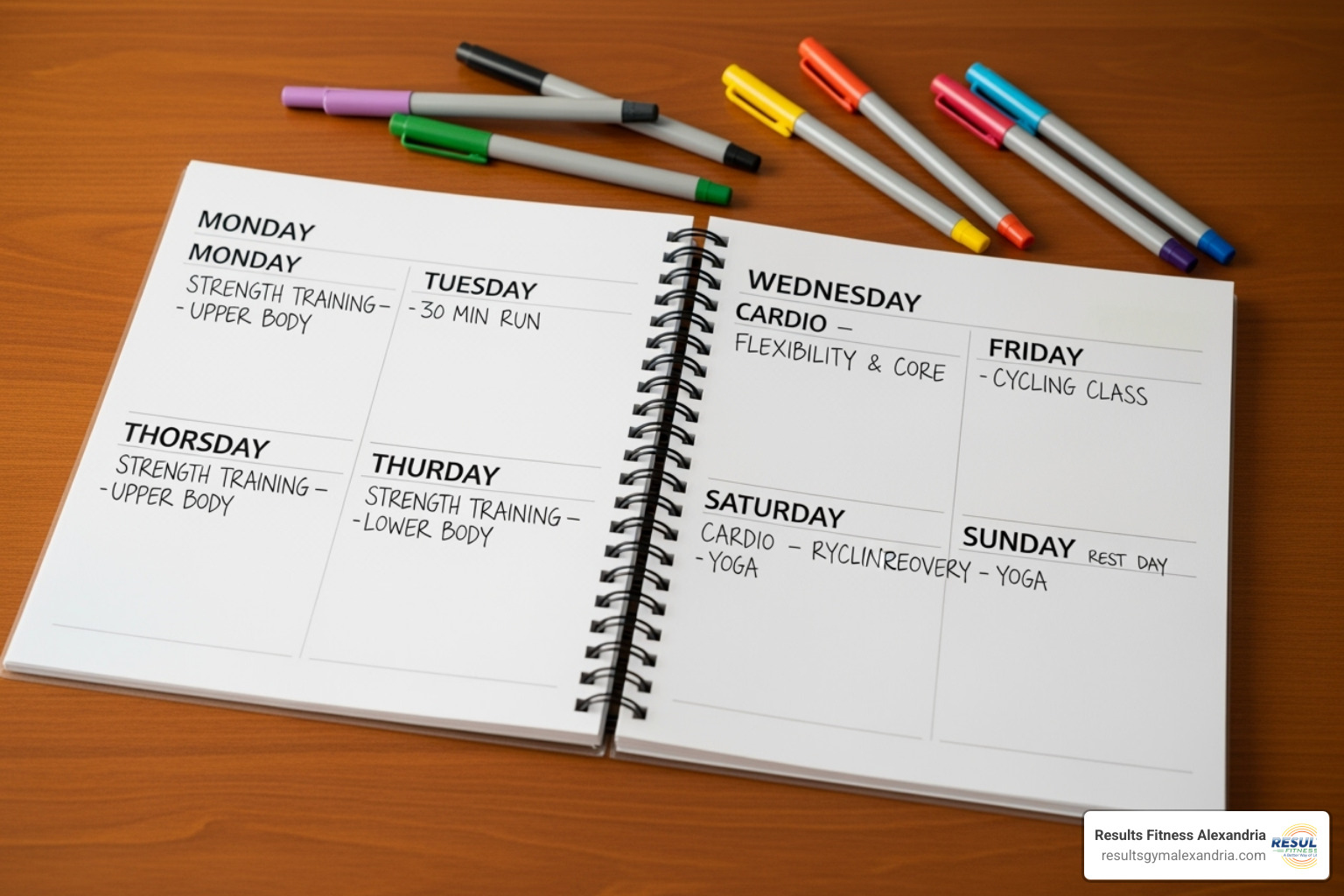
Putting it all together requires a practical weekly plan that balances consistency with rest. Rest days are when your body rebuilds and gets stronger.
Beginner’s Blueprint
If you’re just starting, the goal is to build a solid foundation and create lasting habits.
- Cardio: Start with 3 days per week of moderate-intensity cardio (brisk walking, light jogging) for 15-20 minutes, gradually working up to 30 minutes.
- Strength: Add 2 days of full-body strength training using bodyweight exercises (squats, lunges, push-ups) or light weights.
- Progression: Never increase your total weekly time or distance by more than 10-20% to prevent injury.
- Recovery: Include two rest days and always perform a 5-10 minute warm-up and cool-down.
Intermediate to Advanced Strategy
Once you have a solid base, you can introduce more intensity and variety to challenge your body.
- Cardio: Aim for 2 days of HIIT and 1-2 days of steady-state cardio. For HIIT, try the effective “4×4 interval method” (4 minutes hard, 3 minutes recovery, repeated 4 times). Your steady-state sessions can be longer (45-60 minutes).
- Strength: Increase to 2-3 days per week, focusing on progressive overload (increasing weight or reps).
- Recovery: Take at least one full rest day and one active recovery day (light walk, yoga). Warm-ups and cool-downs are non-negotiable.
This balanced approach develops multiple energy systems for both speed and stamina. For runners, our Endurance Running Program offers specialized guidance.
At-Home Cardio Workouts
No gym? No problem. You can get a great workout at home with these exercises. Create a circuit by performing each for 45-60 seconds, resting for 30 seconds, and repeating the full circuit 3-5 times.
- Jumping Jacks
- High Knees
- Burpees (use a modified version if needed)
- Mountain Climbers
- Squat Jumps
- Air Squats
Frequently Asked Questions about Cardiovascular Training
Here are answers to some of the most common questions about the best training for cardiovascular endurance.
How long does it take to improve cardiovascular endurance?
Most people notice initial changes within 2-4 weeks of consistent training, such as finding stairs easier to climb. Significant, measurable improvements in stamina and resting heart rate typically take 8-12 weeks. Your progress depends on your starting fitness level, genetics, and consistency. The key is to stick with it.
Should I do cardio before or after weights?
This depends on your primary goal.
- For endurance focus: Do cardio first when you’re fresh and have the most energy.
- For strength/muscle focus: Do weights first to lift heavier and with maximum effort.
Ideally, separate cardio and strength workouts on different days or by several hours. If you must combine them, a short cardio warm-up before weights is fine, or save your main cardio session for after lifting.
How do I avoid getting bored with cardio?
Boredom can kill a routine. Keep things fresh with these tips:
- Variety: Try different activities like swimming, cycling, rowing, or hiking (cross-training). This works different muscles and prevents overuse injuries.
- Entertainment: Listen to music, podcasts, or audiobooks to make the time fly by.
- Workout Partner: A friend adds accountability and makes workouts more fun.
- Go Outside: Take your workout to a park or trail for fresh air and new scenery.
- Try HIIT: The changing intensities naturally break up the monotony.
The best workout is one you enjoy and will do consistently. At Results Fitness Alexandria, we offer a variety of equipment and options to help you find what works for you.
Conclusion: Start Building Your Endurance Today
You now have the roadmap to building exceptional cardiovascular endurance. The best training for cardiovascular endurance isn’t about choosing one method over another; it’s about combining the challenge of HIIT, the rhythm of steady-state cardio, and the support of strength training.
You know how to measure your fitness, push your limits safely, and build a weekly plan that fits your life. The path is clear, whether you’re starting with moderate cardio or tackling intense intervals.
The rewards are immense: a stronger, more efficient heart, a sharper, more resilient mind, and more energy for your daily life. Consistency beats perfection. Showing up is what matters most. Some days will be intense, others will be light. Both are valuable parts of the journey.
If you’re looking for personalized guidance in a supportive environment, we’ve built that at Results Fitness Alexandria. Our expert trainers and top-tier cardio equipment—from treadmills and bikes to rowers and ellipticals—are here to help you succeed.
Ready to take the next step? We offer a free 1-day pass to try our facility with no commitment. Explore our cardio equipment and amenities and see how we can help you build the strong, healthy heart you deserve.