
The Best Strength and Hypertrophy Programs for Lifters Who Want It All
Build Strength and Size With a Hypertrophy Strength Program
A hypertrophy strength program combines heavy lifting for better strength with enough training volume to build visible muscle size. It is the practical middle ground for people who want to feel stronger, improve body composition, and make steady progress without choosing between a bigger bench press and bigger muscles.
| Goal | Main training emphasis | Typical result |
|---|---|---|
| Strength | Heavier loads and skill with major lifts | More force and a higher 1-rep max |
| Hypertrophy | Challenging sets, sufficient weekly volume, and work near failure | Larger muscle fibers and more muscle mass |
| Both | Heavy compound lifts plus moderate- to higher-rep accessory work | Strength gains and muscle growth |
Muscle size and strength overlap, but they are not identical. Bigger muscles can produce more force, while strength also depends on coordination, technique, and the nervous system’s ability to recruit muscle effectively. That is why an effective plan includes more than one rep range and more than one kind of exercise.
The good news: you do not need marathon workouts or a perfect routine. Consistent resistance training, gradual progression, enough protein, and recovery are the foundations. This guide explains how to put those pieces together in a way that fits real life.
I am Jennifer Rapchak, Fitness Director at Results Fitness Alexandria and an ACE-certified personal trainer with more than 14 years of experience in strength training, HIIT, and fitness programming. I help members use a hypertrophy strength program that is structured, approachable, and built around sustainable progress.
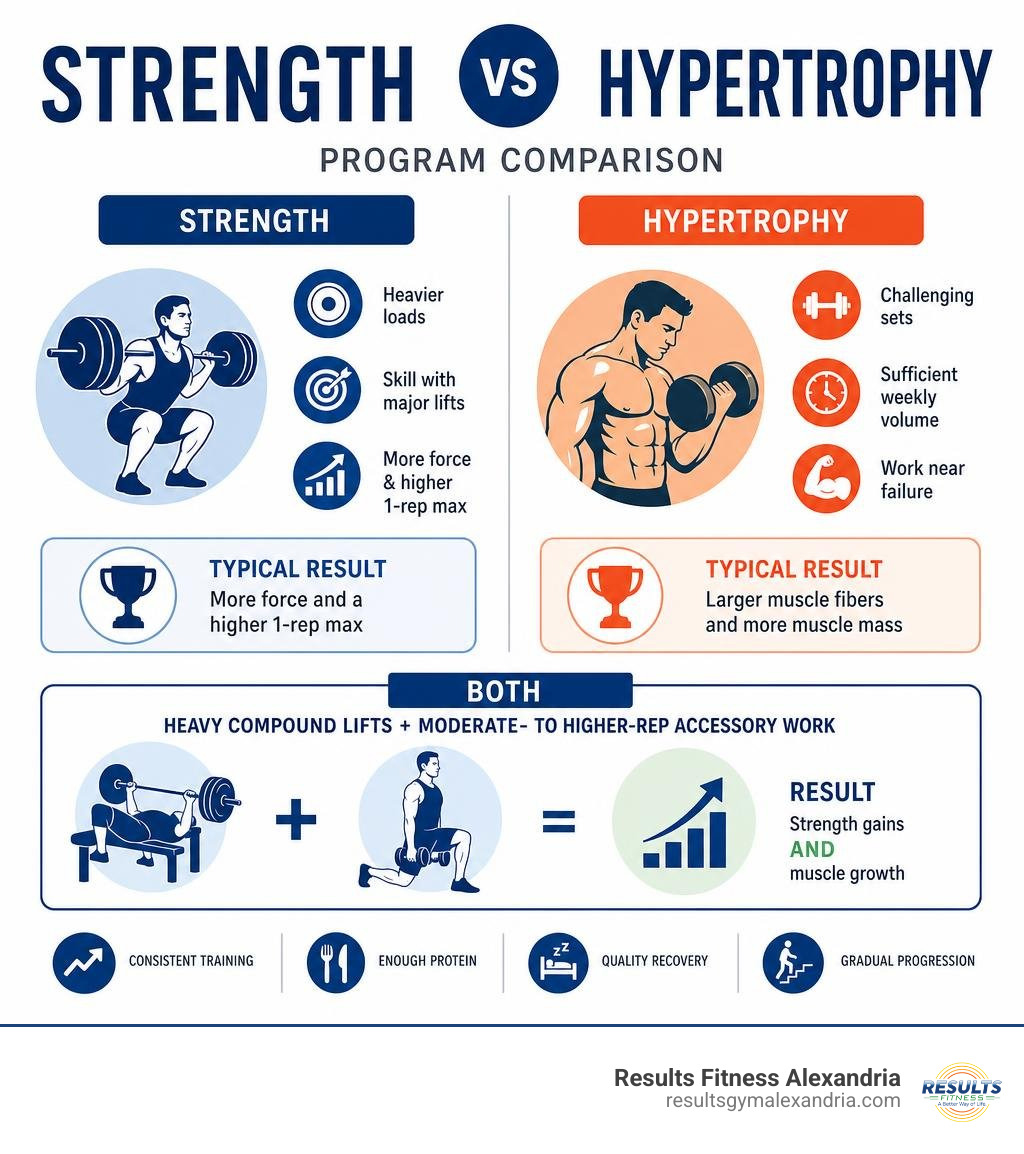
Hypertrophy strength program terms explained:
The Science of Muscle Growth: How Strength and Hypertrophy Differ
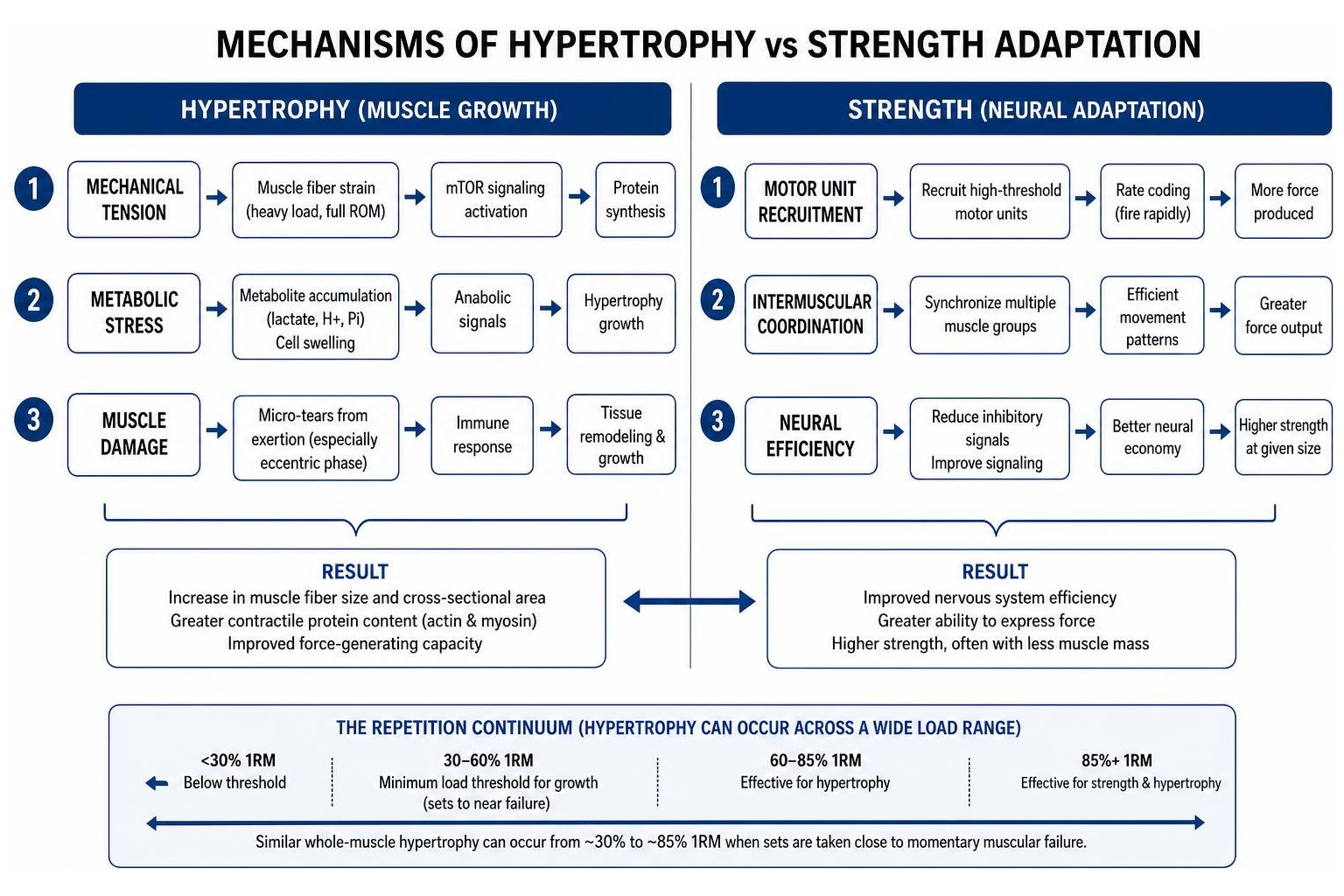
To maximize both strength and size, it helps to understand how your body adapts to resistance training. Muscular hypertrophy refers specifically to an increase in muscle mass and cross-sectional area, primarily driven by the expansion of individual muscle fiber size (myofibrillar hypertrophy). When muscle fibers expand, they accumulate more contractile proteins—actin and myosin—which directly increases the force-generating capacity of the muscle.
Maximal strength, on the other hand, is heavily dependent on neural adaptations. Your central nervous system must learn to fire motor units rapidly (rate coding) and coordinate multiple muscle groups seamlessly (intermuscular coordination). This is why a powerlifter can often lift significantly more weight than a bodybuilder of similar size: their nervous system is highly optimized to recruit high-threshold motor units under extreme heavy loads near their 1-rep max (1RM).
Understanding the science of building muscle tips for effective strength training allows us to organize workouts so that neural efficiency and tissue remodeling reinforce each other rather than conflict.
Primary Mechanisms Driving Muscle Growth
In exercise physiology, muscle growth is stimulated by three primary mechanisms:
- Mechanical Tension: This is universally recognized as the single most critical driver of hypertrophy. When a muscle contracts forcefully against resistance through a full range of motion, mechanical sensors within muscle fibers trigger intracellular signaling pathways (such as mTOR) that initiate muscle protein synthesis.
- Metabolic Stress: Produced by the accumulation of metabolites (such as lactate, hydrogen ions, and inorganic phosphate) during sustained muscle contractions. Metabolic stress leads to cell swelling, transient hypoxia, and altered hormonal responses that encourage structural growth.
- Muscle Damage: Microscopic tears in muscle tissue caused by strenuous exertion, particularly during controlled eccentric (lowering) phases of an exercise. While excessive damage impedes recovery, moderate disruption stimulates immune responses that remodel muscle tissue.
The Repetition Continuum and Minimum Load Thresholds
For decades, traditional fitness guidelines strictly separated training goals along a rigid “repetition continuum”: 1–5 reps for strength, 8–12 reps for hypertrophy, and 15+ reps for endurance. Modern exercise science has updated this view.
Meta-analytic data comparing high-load training (>60% 1RM) against low-load training (<60% 1RM) shows a negligible difference in whole-muscle hypertrophy (with a trivial effect size difference of 0.03). Similar whole-muscle growth can occur across a wide loading spectrum—from as high as 85% 1RM down to a minimum load threshold of approximately 30% 1RM—provided that lighter-load sets are pushed very close to momentary muscular failure to ensure full motor unit recruitment.
However, strength adaptations remain load-dependent. Meta-analyses demonstrate a moderate to large effect size difference (ES = 0.58) in 1RM strength gains in favor of high-load training (>60% 1RM) compared to light-load lifting. This finding, detailed in scientific comparisons like the Strength vs Hypertrophy Programming Guide, proves that while you can build muscle size across a broad rep range, heavy lifting is non-negotiable for maximizing absolute strength.
Designing an Effective Hypertrophy Strength Program
A well-designed hypertrophy strength program strikes a balance between neural drive and volumetric drivers. If you only lift ultra-heavy singles and triples, you will gain strength rapidly but miss out on the total volume required for optimal hypertrophy. Conversely, if you only pump light weights for 20 reps, you will build muscle size but lag behind in 1RM strength development.
Integrating both approaches creates a synergistic environment where heavy lifting expands your force potential, allowing you to use heavier weights during higher-volume hypertrophy work. For a broader overview of structuring your routine, check out our strength training programs complete guide.
Key Variables in a Hypertrophy Strength Program
To achieve consistent concurrent adaptations, we manipulate several key program variables:
- Intensity: Main compound lifts are typically trained at 75–85% of 1RM, while accessory exercises operate between 65–75% of 1RM.
- Repetition Ranges: Heavy multi-joint lifts thrive in the 3–6 rep range, whereas targeted isolation work fits best in the 6–12 or 10–15 rep range. Moderate loads (67–85% 1RM) yielding 6–12 repetitions per set strike the ideal sweet spot for volume accumulation and mechanical tension.
- Progressive Overload: Muscle growth requires systematically increasing the demands placed on your body over time. Discover practical methods to apply this principle in our guide to the power of progressive overload how to keep getting stronger.
| Variable | Strength Focus | Hypertrophy Focus | Hybrid Program Target |
|---|---|---|---|
| Load Intensity | 80–90%+ 1RM | 60–75% 1RM | 67–85% 1RM |
| Rep Range | 1–5 reps | 8–15+ reps | 3–6 reps (Main) / 6–12 reps (Accessories) |
| Weekly Volume | 3–6 sets per exercise | 10–20 sets per muscle group | 10–15 hard sets per muscle group |
| Rest Periods | 3–5 minutes | 60–90 seconds | 2–3 min (Main) / 90 sec (Accessories) |
Volume, Rest Intervals, and Exercise Selection
Volume is the total amount of work performed, measured as working sets taken close to muscular failure per muscle group per week. Science indicates that performing 10 or more hard sets per muscle group per week serves as an optimal baseline for driving hypertrophy.
Rest intervals also impact your total volume capacity. While older advice suggested short 30–60 second rest periods to maximize pump, modern research confirms that resting 90 seconds to 3 minutes allows full phosphocreatine recovery and reduces nervous system fatigue. Longer rest allows you to handle heavier loads for more repetitions on subsequent sets, driving greater long-term growth.
Exercise selection should blend multi-joint compound movements (squats, deadlifts, bench presses, overhead presses, rows) with targeted single-joint movements (leg extensions, lateral raises, biceps curls). Prioritize heavy multi-joint exercises at the beginning of your session when your central nervous system is fresh, followed by machine or dumbbell accessories.
Hybrid Periodization Models for Concurrent Gains
To build strength and muscle mass at the same time without burning out, lifters often rely on “powerbuilding”—a synthesis of powerlifting intensity and bodybuilding volume. Advanced programming frameworks, such as those detailed in research on Powerbuilding Program Design: Strength + Hypertrophy, utilize periodization models to manage fatigue and progression effectively.
Common models include:
- Daily Undulating Periodization (DUP): Alternating focus across training days within the same week (e.g., Heavy Strength on Monday, Hypertrophy on Wednesday, Explosive Power on Friday).
- Block Periodization: Devoting dedicated 4- to 6-week blocks to specific targets (e.g., a Hypertrophy Volume Block followed by a Strength Accumulation Block).
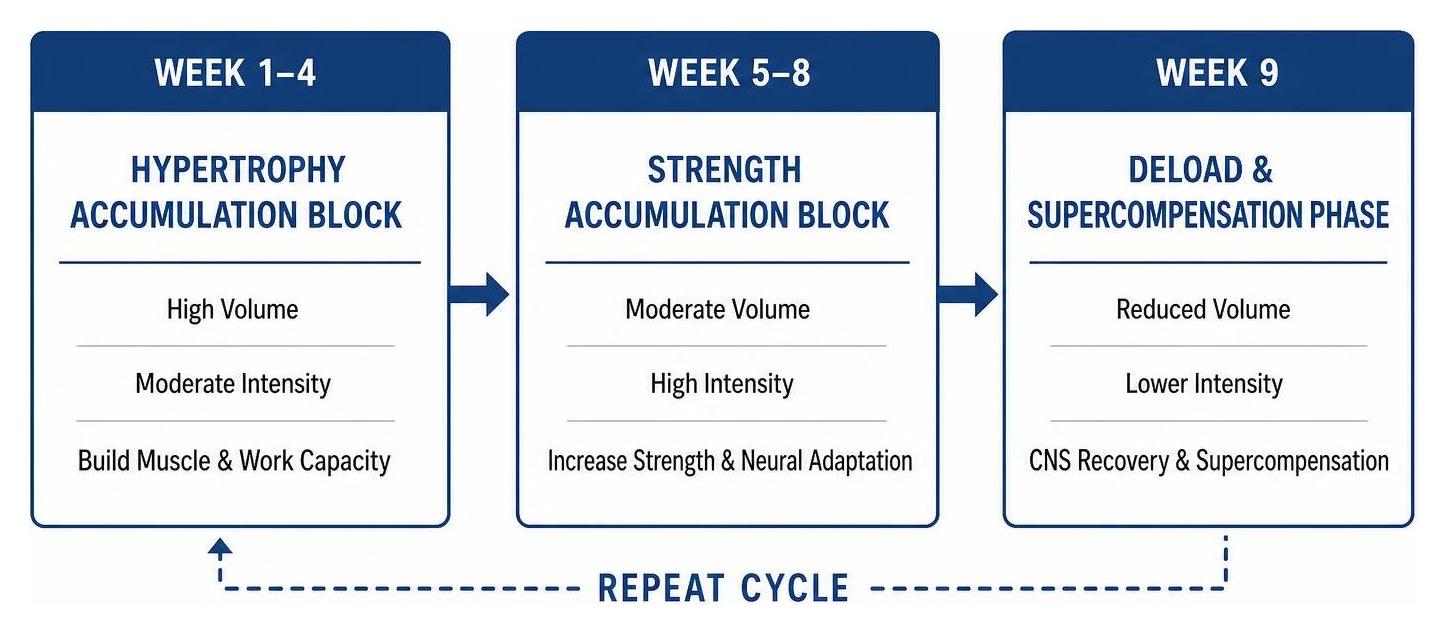
Structuring a Dual-Goal Hypertrophy Strength Program
A highly effective structure for concurrent gains is a 4-day Upper/Lower split or Push/Pull/Legs split. Each workout begins with 1–2 heavy strength lifts, followed by 3–4 moderate-load hypertrophy accessories.
Here is a sample training split layout:
Day 1: Upper Body (Bench Press Focus)
- Barbell Bench Press: 4 sets x 4–6 reps (3 min rest)
- Bent-Over Barbell Row: 4 sets x 6–8 reps (2 min rest)
- Incline Dumbbell Press: 3 sets x 8–10 reps (90 sec rest)
- Cable Lat Pulldowns: 3 sets x 10–12 reps (90 sec rest)
- Face Pulls & Triceps Pushdowns: 3 sets x 12–15 reps (60 sec rest)
Day 2: Lower Body (Squat Focus)
- Barbell Back Squat: 4 sets x 3–5 reps (3 min rest)
- Romanian Deadlift: 3 sets x 8–10 reps (2 min rest)
- Bulgarian Split Squats: 3 sets x 10–12 reps per leg (90 sec rest)
- Standing Calf Raises & Hanging Leg Raises: 4 sets x 12–15 reps (60 sec rest)
Day 3: Upper Body (Overhead Press Focus)
- Overhead Barbell Press: 4 sets x 4–6 reps (3 min rest)
- Weighted Pull-Ups or Lat Pulldowns: 4 sets x 6–8 reps (2 min rest)
- Dumbbell Chest Flyes / Incline Press: 3 sets x 10–12 reps (90 sec rest)
- Dumbbell Lateral Raises & Cable Biceps Curls: 3 sets x 12–15 reps (60 sec rest)
Day 4: Lower Body (Deadlift Focus)
- Conventional or Sumo Deadlift: 3 sets x 3–5 reps (3 min rest)
- Leg Press: 3 sets x 8–10 reps (2 min rest)
- Hamstring Lying Leg Curls: 3 sets x 10–12 reps (90 sec rest)
- Seated Calf Raises & Core Planks: 3 sets x 12–15 reps (60 sec rest)
For full-body options, explore our guide on full body hypertrophy workouts that actually work.

Training to Failure and Fatigue Management
Training to absolute momentary muscular failure (where no additional rep can be completed with good technique) maximizes acute motor unit recruitment. However, taking every set to total failure generates disproportionate central nervous system (CNS) and joint fatigue relative to the additional muscle growth stimulus provided.
A more sustainable approach uses RIR (Reps in Reserve) or RPE (Rate of Perceived Exertion) auto-regulation:
- Heavy Strength Lifts: Keep 1 to 2 reps in reserve (RIR 1–2 / RPE 8–9). This preserves neural efficiency and technical form while stimulating strength adaptations.
- Hypertrophy Accessories: Take your final working sets of machine or isolation exercises closer to failure (RIR 0–1 / RPE 9–10).
To prevent cumulative fatigue from stalling performance, implement a deload week every 4 to 8 weeks by reducing overall volume (number of sets) by 40–50% while maintaining moderate load intensity.
Essential Nutrition and Individual Factors for Maximum Growth
No hypertrophy strength program can deliver maximum results without nutritional support and adequate recovery. Muscle protein synthesis (MPS) must exceed muscle protein breakdown (MPB) over a sustained period to yield net muscle growth.
A small caloric surplus of 200 to 500 calories per day above maintenance provides the requisite energy to build new tissue without excess fat gain. Beginners and individuals returning from a training break may experience “body recomposition”—gaining muscle and losing fat simultaneously—at maintenance calories.

Protein Requirements and Meal Timing
Protein provides the amino acid building blocks required for structural repair. Current scientific consensus recommends a daily protein intake of 1.7 to 2.0 grams per kilogram of body weight (roughly 0.8 to 1.0 grams per pound) for lifters seeking hypertrophy.
Key protein considerations include:
- Daily Distribution: Divide your protein intake evenly across 3 to 5 meals throughout the day, spacing them roughly 3 to 5 hours apart.
- Leucine Threshold: Each meal should contain at least 2.5 to 3 grams of the essential amino acid leucine (found in roughly 25 to 40 grams of high-quality animal or blended plant protein) to stimulate the mTOR pathway fully.
- Post-Workout Nutrition: Consuming 20–25 grams of protein containing 3–4 grams of leucine within a few hours following a workout helps kick-start muscle protein synthesis and accelerates recovery.
Age, Genetics, and Individual Hypertrophy Potential
Individual rates of muscle growth and strength adaptation vary based on internal factors:
- Genetics and Fiber Type: Individuals born with a higher percentage of Type II (fast-twitch) muscle fibers generally exhibit greater potential for rapid power and explosive hypertrophy compared to those with predominantly Type I (slow-twitch) fibers.
- Anatomic Structure: Bone leverage, muscle insertion points, and tendon lengths heavily dictate joint moment arms, impacting leverage in heavy squats, bench presses, and deadlifts.
- Age and Adaptation: As we age, anabolic resistance can slow muscle protein synthesis in response to nutrition and exercise. Older adults benefit greatly from maintaining high-protein intakes and focusing on controlled loading to protect joint integrity while preserving muscle tissue.
Frequently Asked Questions About Building Strength and Size
Can you build strength and hypertrophy at the same time?
Yes! While pure strength and pure bodybuilding routines emphasize different extremes, a hybrid hypertrophy strength program successfully develops both. By starting sessions with heavy compound lifts (for neural strength) and finishing with moderate-load, higher-volume accessory exercises (for volumetric growth), you achieve both adaptations simultaneously.
What is the minimum load required to stimulate hypertrophy?
Research demonstrates that muscle hypertrophy can be effectively stimulated with loads as low as 30% of your 1RM, provided the sets are performed with high effort and taken close to muscular failure. However, loads below 60% 1RM are less effective for developing maximal 1RM strength, which is why hybrid programs rely primarily on loads between 67% and 85% 1RM.
How many weekly sets should I perform per muscle group?
A scientific baseline for muscle growth is 10 or more hard sets per muscle group per week. Beginners often make exceptional gains on 8–12 sets per week, whereas intermediate and advanced lifters may require 15 to 20 sets per week for stubborn muscle groups, distributed across two or more training sessions.
Conclusion
Combining strength and size goals into a structured hypertrophy strength program is one of the most rewarding ways to train. By pairing heavy, technical compound lifts with well-chosen accessory volume, you give your body the exact signals it needs to build power, increase bone density, and remodel muscle tissue effectively.
Progress comes down to consistency over time: managing fatigue through periodization, staying close to your target rep ranges, and supporting your hard work with proper nutrition and daily protein intake.
At Results Fitness in Alexandria, Virginia, we provide the expert coaching, supportive community, and comprehensive equipment needed to help you reach your physical potential. Whether you thrive in personalized 1-on-1 coaching or small group strength settings, our certified trainers are here to build a routine tailored directly to your life.
Ready to take your strength and muscle growth to the next level? Explore our full range of training solutions on the Results Fitness Strength Training Amenities page, or claim your free 1-day pass today to experience our gym firsthand!