How to Become a Beginner Workout Expert, Starting from Scratch
Your First Step to Fitness: What Every Beginner Workout Should Include
Starting a beginner workout is one of the most impactful decisions you can make for your long-term health. Research linked to the American Heart Association found that consistent exercise is associated with a 19-25% decrease in mortality. That’s a remarkable return on a small time investment each week.
Here’s what an effective beginner workout covers:
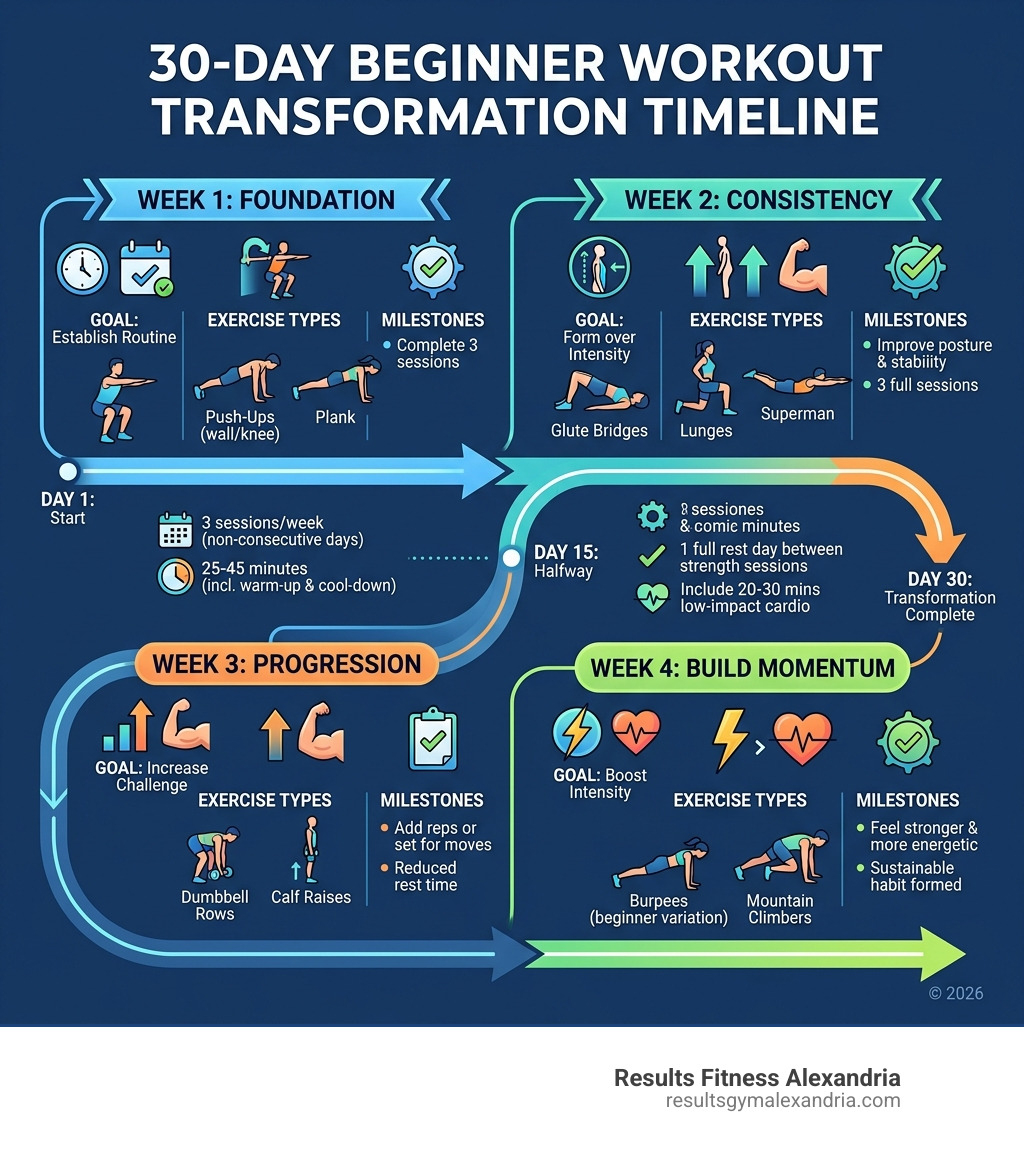
- Frequency: 3 days per week to start, on non-consecutive days
- Session length: 25-45 minutes including warm-up and cool-down
- Exercise types: Bodyweight movements like squats, push-ups, and planks
- Progression: Add reps, reduce rest, or increase weight every 2-3 weeks
- Recovery: At least one full rest day between strength sessions
- Cardio: 20-30 minutes of low-impact activity like walking or elliptical
You don’t need a lot of equipment or experience. You just need a plan and the willingness to show up.
Most people feel overwhelmed not because fitness is hard, but because no one told them where to start. This guide fixes that.
I’m Jennifer Rapchak, Fitness Director at Results Fitness Alexandria and ACE-certified personal trainer with over 14 years of experience designing beginner workout programs that build real, lasting results. I’ll walk you through everything you need to go from zero to confident — step by step.
The Science-Backed Benefits of a Beginner Workout
It is May 2026, and the data is clearer than ever: movement is medicine. When we talk about a beginner workout, we aren’t just talking about looking better in a mirror. We are talking about a fundamental shift in how your body functions. As mentioned in our intro, consistent exercise is linked to a significant 19-25% decrease in mortality. But the benefits start much sooner than your golden years.
One of the most immediate effects of starting a routine is a massive energy boost. It might seem counterintuitive—spending energy to get energy—but exercise improves the circulation of oxygenated blood and essential nutrients throughout your body. This conditions your muscles and cardiovascular system, reversing the “deconditioning” that happens when we are sedentary.
Furthermore, a well-structured beginner workout jumpstarts your metabolism and increases bone density. For those just starting out, building cardio endurance for beginners is a vital first step. By strengthening your heart and lungs, you make every other daily task—from carrying groceries to climbing stairs—feel significantly easier.
Essential Equipment and Exercises for Your Beginner Workout
One of the biggest myths we hear in Alexandria is that you need a garage full of fancy gadgets to get fit. In reality, your own body is the most advanced piece of gym equipment you will ever own.
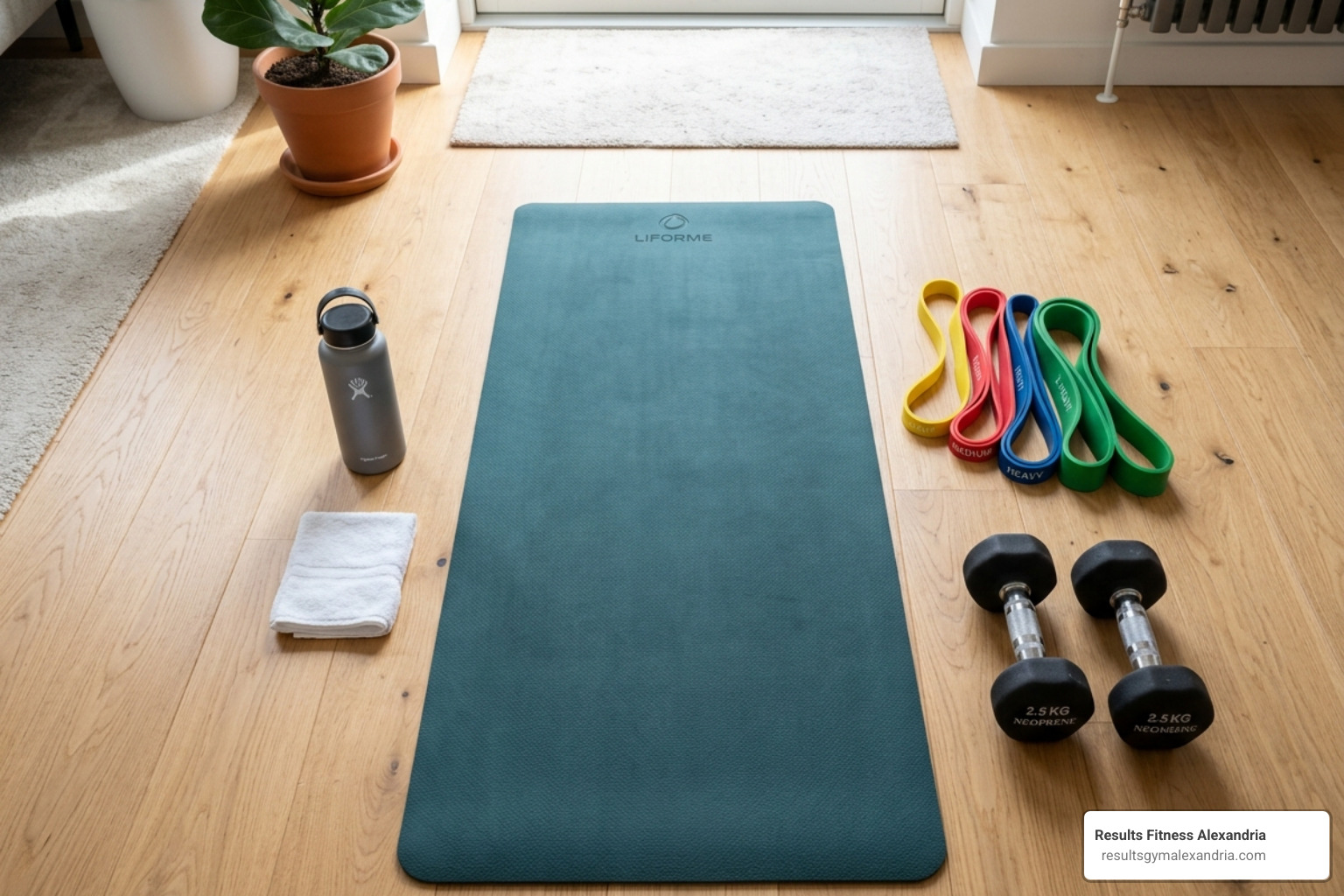
For a solid beginner workout, we recommend starting with these basics:
- Bodyweight Training: This is the foundation. If you can’t move your own weight with good form, you shouldn’t be adding external weight yet.
- Dumbbells: A pair of 5lb to 15lb dumbbells is perfect for introducing resistance.
- Resistance Bands: Great for mobility and adding “tension” without the bulk of iron.
We focus on “compound movements”—exercises that use more than one joint and multiple muscle groups at once. These give you the most “bang for your buck.” Key movements include:
- Squats: The king of lower body exercises.
- Push-ups: A total upper-body powerhouse.
- Planks: The ultimate core stabilizer.
For the ladies starting their journey, our guide on beginner weight training for women offers a deep dive into how to use these tools safely and effectively.
Mastering Form in Your Beginner Workout
Before you worry about how much weight you are lifting, you must master the “how.” Poor form leads to injury; good form leads to results. According to expert personal trainers, there are three pillars of beginner form:
- Neutral Spine: Keep your back straight, not arched or rounded. Imagine a straight line from your head to your tailbone.
- Core Bracing: Don’t just “suck in” your stomach. Imagine someone is about to poke you in the ribs and you are tightening your midsection to resist it.
- Knee Alignment: During squats or lunges, ensure your knees track over your toes rather than caving inward.
Beginner-Friendly Cardio and Pilates Integration
Cardio doesn’t have to mean running until you’re gasping for air. In fact, the elliptical is a “titan of the gym” for beginners because it provides a “squashed circle” motion that is low-impact on your joints. On an elliptical, you can burn between 300 to 600 calories per hour depending on your intensity.
We also love integrating Pilates into a beginner workout. Pilates originated from Joseph Pilates, who developed the system while in a POW camp during WWI. It emphasizes controlled breathing and deep muscle engagement. It’s like a “mini-meditation” for your muscles. If you are looking for pilates on a budget, there are many ways to start with mat-based movements that build incredible core stability.
Structuring Your First 30 Days for Success
The secret to fitness isn’t intensity; it’s consistency. We recommend the 3-3-3 Rule:
- 3 Workouts per week: Start with three days of full-body strength training.
- 3 Weeks of consistency: Commit to not missing a session for the first 21 days.
- 3 Progressions: Every three sessions, try to do one more rep or use a slightly heavier weight.
When creating an effective workout routine for beginners, you need to decide between a full-body approach or a “split.”
| Routine Type | Frequency | Best For… |
|---|---|---|
| 3-Day Full Body | Mon/Wed/Fri | Maximum recovery and simplicity. |
| 5-Day Split | Mon-Fri | Targeting specific muscle groups with more volume. |
For most beginners, the 3-day full-body routine is the gold standard because it allows for 48 hours of rest between sessions, which is when your muscles actually grow.
Progression and Progressive Overload
To keep seeing results, you must apply “progressive overload.” This just means making the workout slightly harder over time so your body has to adapt. You can do this by:
- Increasing Repetitions: If you did 10 squats last week, try 12 this week.
- Weight Adjustments: Moving from 10lb dumbbells to 12lb dumbbells.
- Reducing Rest: Instead of resting for 90 seconds between sets, try resting for 60 seconds.
A structured 4-week plan helps remove the guesswork, ensuring you are pushing just hard enough to see change without burning out.
Avoiding Common Mistakes and Staying Motivated
The biggest mistake beginners make is “ego lifting”—trying to lift heavy weights with bad form just to look impressive. Trust us, no one at the gym is judging your weights; they are busy focusing on their own sweat!
Another pitfall is ignoring nutrition. You cannot out-train a poor diet. Nutrition accounts for roughly 80% of your body composition results. Focus on high-quality protein intake (aiming for roughly 1.5g per kg of body weight) to help your muscles repair.

To master your first session without stress, “showing up” is the victory. If you’re tired, do a “micro-workout” of 10 minutes. Consistency beats intensity every single time.
Frequently Asked Questions about Beginner Workouts
How often should a beginner work out each week?
We recommend 3 to 5 days per week. If you are doing strength training, 3 days is plenty. You can fill the other days with “active recovery” like a 20-minute walk or a light yoga session. The key is to avoid working the same muscle groups two days in a row. Our women’s beginner gym workout guide details exactly how to space these sessions for the best results.
Is bodyweight training effective for building muscle?
Absolutely. You can build significant muscle mass using only bodyweight exercises by manipulating “time under tension” or trying harder variations (like moving from knee push-ups to full push-ups). A 30-minute total body boot camp is a perfect example of how high-intensity bodyweight movements can torch fat and build lean muscle simultaneously.
How do I warm up and cool down properly?
Never skip the warm-up! A 5-minute dynamic warm-up (marching in place, arm circles, leg swings) wakes up your nervous system and lubricates your joints. For the cool-down, focus on static stretches and foam rolling to reduce muscle stiffness. If you’re looking for a fun way to get moving, your first aerobics class often includes these elements built-in, making it a great low-impact entry point.
Conclusion
Becoming an expert at your own fitness doesn’t happen overnight, but it does happen one rep at a time. Whether you’re looking to boost your energy, lose weight, or simply feel stronger in your daily life, a beginner workout is the foundation of a new you.
At Results Fitness Alexandria, we believe everyone deserves a supportive environment to start their journey. We offer everything from high-energy fitness classes and personal training to restorative yoga and even childcare, so you have zero excuses.
Ready to see what we’re all about? We invite you to grab a free 1-day pass to try our amenities and meet our community. Start your fitness journey today and let us help you turn those first steps into a lifelong habit. We can’t wait to see you on the gym floor!