
The Ultimate Guide to Cardio Kickboxing Workouts
Start Your Cardio Kickboxing Journey Here
Looking for a fun and effective way to boost your fitness? A cardio kickboxing workout for beginners might be exactly what you need. It’s a dynamic, full-body exercise that combines martial arts techniques with aerobic movements.
If you’re wondering how to start your cardio kickboxing journey, here’s a quick guide for beginners:
- Find a beginner class or program: Look for classes that focus on foundational techniques and form, not just speed or power. Many gyms offer beginner-specific sessions.
- Learn the basics: Master the proper fighting stance, basic punches (jab, cross), and simple kicks (front kick).
- Start with shadowboxing: You don’t need equipment to begin. Practice movements in the air to build coordination and muscle memory.
- Listen to your body: Go at your own pace. Focus on technique first, then gradually increase intensity.
- Wear comfortable gear: Athletic clothes and supportive shoes are often all you need to start.
Cardio kickboxing is a fantastic way to improve your cardiovascular health, build strength, and relieve stress. It’s accessible for all fitness levels and doesn’t require prior experience in martial arts. This guide will show you everything you need to know to get started safely and effectively.
As Jennifer Rapchak, Fitness Director at Results Fitness Alexandria, I’ve guided countless individuals through their fitness journeys. My experience in designing effective fitness programs, including specialized cardio kickboxing workout for beginners sessions, ensures you’re in expert hands.
Basic cardio kickboxing workout for beginners glossary:
What is Cardio Kickboxing?
At its core, cardio kickboxing is a high-energy group fitness format that draws inspiration from martial arts but leaves the physical combat at the door. Unlike traditional competitive kickboxing, this is a non-contact fitness version designed to get your heart pumping and your muscles toning without the risk of taking a punch to the face. It emerged in the 1980s as a way to make the incredible conditioning of fighters accessible to the general public.
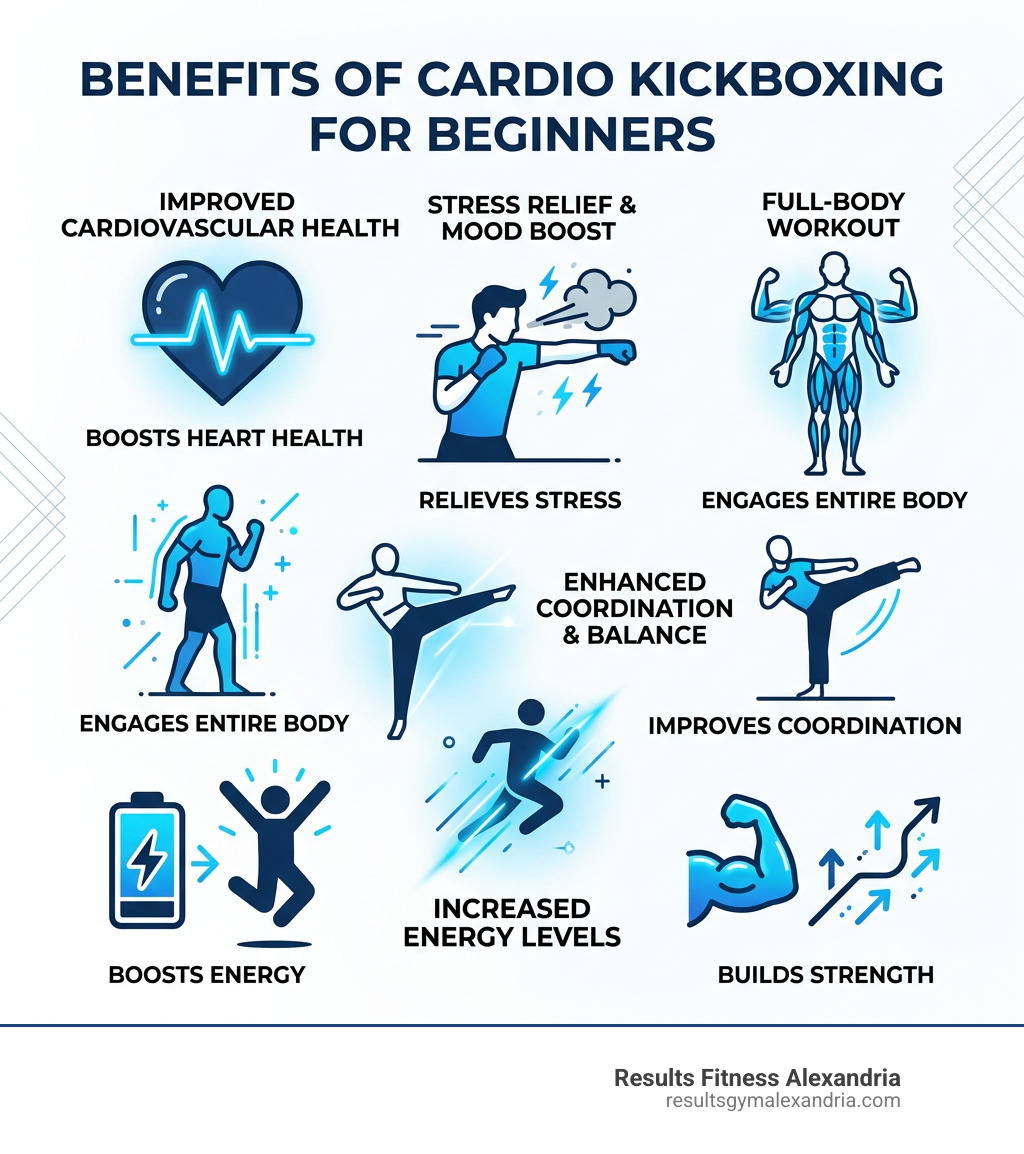
The health benefits of kickboxing are extensive. Because it involves constant movement and explosive strikes, it serves as a powerful aerobic exercise that enhances heart and lung strength. It is also a fantastic tool for stress relief; there is something uniquely cathartic about throwing a punch (even into the air) after a long day at the office.
Many people ask us how this differs from a standard boxing class. While both offer a great sweat, the primary difference lies in the “kick” part of the name. In a cardio kickboxing workout for beginners, you engage your entire lower body through various kicks and knee strikes, whereas boxing focuses almost exclusively on upper body movements and footwork.
Cardio Kickboxing vs. Traditional Boxing
| Feature | Cardio Kickboxing | Traditional Boxing |
|---|---|---|
| Primary Focus | Cardiovascular endurance & agility | Punching technique & head movement |
| Limbs Used | Hands, feet, shins, and knees | Hands only |
| Contact | Generally non-contact/bag work | Can involve sparring/contact |
| Muscle Groups | Full body (heavy leg focus) | Upper body and core |
Cardio Kickboxing Workout for Beginners: Key Differences
When you step into a cardio kickboxing workout for beginners, you’ll notice it feels more like a group fitness format than a gritty fight club. The goal isn’t to prepare you for a title bout in the ring; it’s to keep you in your target heart rate zones for maximum calorie burn.
Traditional kickboxing, such as Muay Thai or Japanese kickboxing, involves “clinching” and full-contact strikes. In contrast, the cardio version focuses on repetitive, rhythmic movements. It’s often set to upbeat music to keep the energy high and the pace consistent. This makes it a lower-impact alternative to many high-intensity sports, as you can control the force of your movements and avoid the joint stress associated with contact sports.
Essential Gear and Preparation
One of the best things about starting a cardio kickboxing workout for beginners is that you don’t need a massive investment in gear to get moving. However, being prepared will help you feel more confident during your first session.
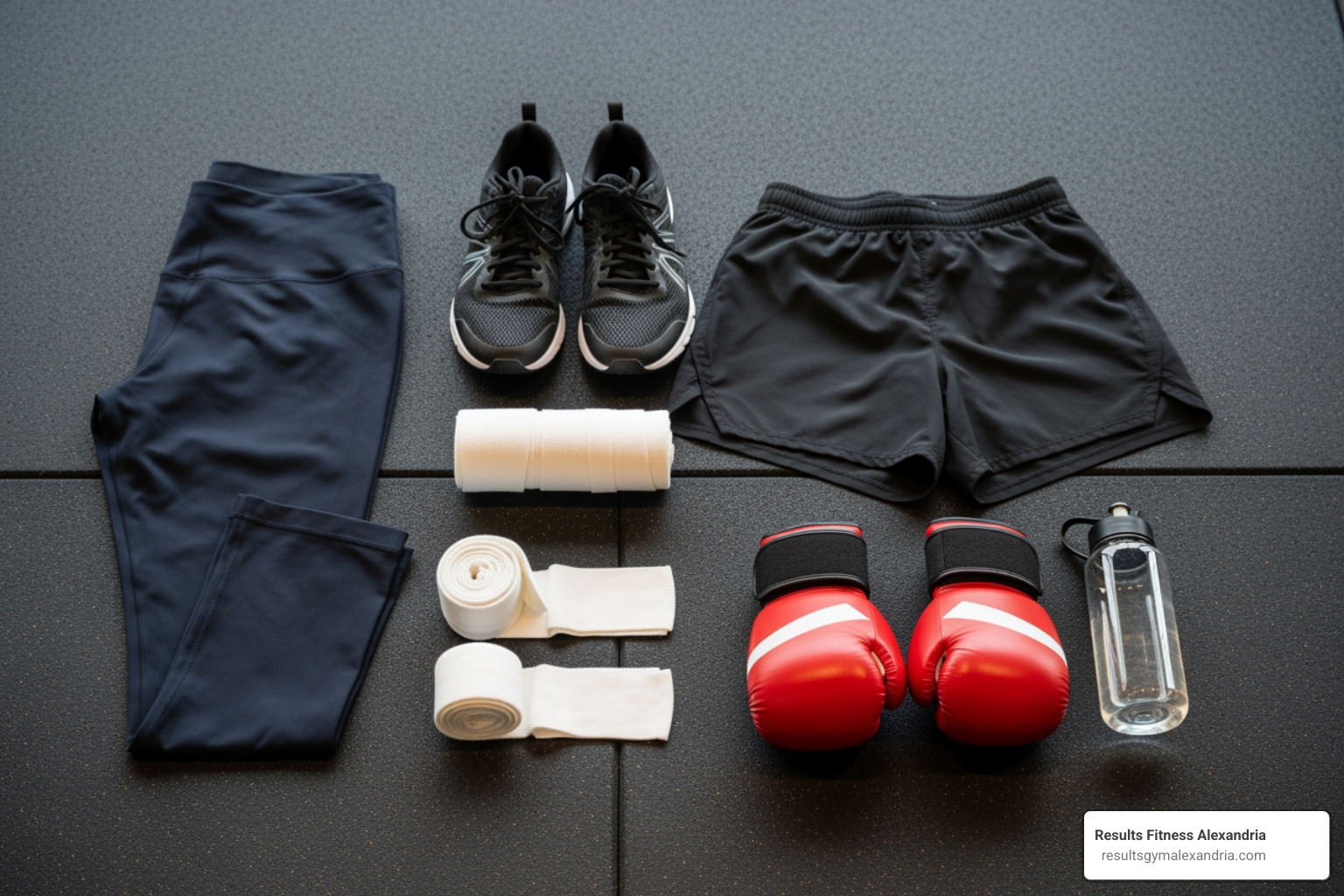
- Clothing: Wear breathable, moisture-wicking athletic wear. You’re going to sweat—a lot. Avoid overly baggy pants that might trip you up during kicks; leggings or athletic shorts are usually best.
- Footwear: Choose supportive cross-training shoes. While some martial arts are done barefoot, most cardio kickboxing classes require shoes for lateral support. Avoid standard running shoes if possible, as they are designed for forward motion and may not provide the stability needed for the side-to-side movements in kickboxing.
- Hand Wraps and Gloves: If your class uses heavy bags, you’ll need hand wraps to protect the small bones in your hands and wrists, along with a pair of boxing gloves. If you are shadowboxing at home, these are optional, though some beginners like using weighted gloves (usually 0.5 to 1 lb) to add a little extra challenge once they’ve mastered the form.
- Hydration: Bring a water bottle. High-intensity cardio requires constant rehydration to maintain performance and prevent cramping.
Choosing the right fitness class for your goals is key. If your goal is weight loss and fun, a high-energy cardio class is perfect. If you want to learn self-defense, you might look for a program with a more technical focus.
Choosing a Cardio Kickboxing Workout for Beginners Program
When searching for a program, look for instructors with reputable credentials, such as an AFAA Cardio Kickboxing Training Course certification. A good instructor will prioritize safety and form over speed.
Don’t be afraid to ask about the class environment. A beginner-friendly program should offer modifications for every move. For example, if a “jump kick” is too intense, you should be shown how to perform a standard power kick instead. Consistency is the most important factor in seeing results, so find a class that you actually enjoy attending. If you’re feeling a bit nervous, checking out a guide for your first aerobics class can help demystify the group fitness experience.
Mastering the Basics: Stance and Technique
Before you start throwing “knockout” punches, you need to build a solid foundation. Everything in kickboxing starts with your stance.
The Fighter Stance: Stand with your feet hip-width apart. If you are right-handed, step your right foot back (and vice versa for lefties). Your front foot should point forward, while your back foot is at a slight 45-degree angle. Keep a slight bend in your knees—never lock them! Your fists should be up by your chin to “protect your face,” with your elbows tucked close to your ribs. This stance provides the balance and stability needed to move in any direction.
Core Engagement: Your power doesn’t actually come from your arms; it comes from your core and your hips. When you punch, you should rotate your torso and pivot on the ball of your foot. Think of your body as a coiled spring. This not only makes your strikes more powerful but also protects your lower back.
Practicing these movements without a bag is known as shadowboxing. It’s an excellent way of building cardio endurance for beginners because it forces you to control your own limbs rather than relying on the bag to stop your momentum.
Fundamental Punches and Kicks
There are four basic punches you’ll encounter in almost every cardio kickboxing workout for beginners:
- Jab: A quick, straight punch thrown with your lead hand.
- Cross: A powerful, straight punch thrown with your rear hand, involving a rotation of the hips.
- Hook: A semi-circular punch aimed at the side of the “opponent,” keeping your elbow at a 90-degree angle.
- Uppercut: An upward-moving punch that starts low and aims high, powered by your legs and core.
The Four Phases of a Kick: To protect your knees and maximize efficiency, every kick should follow these four phases:
- Chamber: Lift your knee toward your chest. This is your “loaded” position.
- Strike: Extend your leg to deliver the kick (aiming with the shin or the ball of the foot).
- Re-chamber: Snap your leg back to the lifted knee position immediately.
- Return: Place your foot back on the floor in your original stance.
Sample 30-Minute Cardio Kickboxing Workout for Beginners
Ready to put it all together? This sample routine is designed to be done anywhere—at the gym with a heavy boxing bag or at home via shadowboxing.
This workout follows an interval structure, which is one of the top 5 cardio exercises to boost endurance. Intervals keep your metabolism elevated long after the workout is over.
Warm-Up, Main Circuit, and Cool-Down
Warm-Up (5 Minutes): The goal here is to increase blood flow and joint mobility.
- 1 minute: Light jogging in place or jumping jacks.
- 1 minute: Windmills (large arm circles) and torso twists.
- 1 minute: High knees and butt kicks.
- 2 minutes: Shadowboxing (slow jabs and crosses) to find your rhythm.
Main Circuit (20 Minutes): Perform each “Round” for 3 minutes, resting for 1 minute between rounds. This is an AMRAP (As Many Rounds As Possible) style—focus on quality of movement over quantity.
- Round 1: The Foundation. Jab – Cross – Front Kick. Repeat 10 times, then do 10 squats.
- Round 2: The Side Attack. Double Hook (Lead/Rear) – Side Kick. Repeat 10 times, then do 10 push-ups.
- Round 3: Speed and Agility. 4 Uppercuts – 4 High Knees. Repeat 10 times, then 30 seconds of “fast feet” (running in place as fast as possible).
- Round 4: Power Combo. Jab – Jab – Cross – Rear Kick. Repeat 10 times, then 10 lunges.
- Round 5: Burnout. Non-stop Jab-Cross punches for 30 seconds, followed by 30 seconds of jumping jacks. Repeat for the full 3 minutes.
Cool-Down and Recovery (5 Minutes): Never skip this part! It’s essential for muscle recovery and preventing soreness.
- Static Stretching: Hold a quad stretch, hamstring stretch, and shoulder stretch for 30 seconds each.
- Deep Breathing: Focus on lowering your heart rate with slow, controlled breaths.
Creating an effective workout routine involves balancing these high-intensity sessions with enough rest to let your muscles rebuild.
Safety, Nutrition, and Progression
Safety is paramount when starting a cardio kickboxing workout for beginners. The most common mistake is hyperextension—throwing a punch or kick so hard that you lock out your elbow or knee. Always keep a “micro-bend” in your joints at the end of a strike to prevent ligament strain.
Nutrition and Hydration: Kickboxing can burn between 350 and 600 calories per hour, depending on intensity. To fuel this, focus on a balance of complex carbohydrates for energy and protein for muscle repair. Electrolyte balance is also crucial; if you’re sweating heavily, water alone might not be enough. Consider a drink with added minerals to prevent cramping. For more on this, see our cardio endurance training guide.
How to Progress: Once the basic combinations feel like second nature, you can “kick it up a notch” by:
- Increasing Speed: Try to complete more reps within the 3-minute rounds.
- Adding Resistance: Use light hand weights or a heavy bag to provide impact resistance.
- Shortening Rest: Reduce your 1-minute rest periods to 30 seconds.
Frequently Asked Questions about Cardio Kickboxing
Is cardio kickboxing effective for weight loss?
Yes! Because it is a high-intensity interval training (HIIT) style workout, it burns a significant amount of calories during the session and increases your resting metabolic rate. However, for sustainable weight loss, it should be paired with a healthy diet.
Do I need a heavy bag to do these workouts at home?
Not at all. Shadowboxing (punching the air) is an incredible workout in its own right. In fact, many trainers recommend starting with shadowboxing to ensure your form is perfect before you start hitting a physical object.
How often should a beginner do cardio kickboxing?
For most beginners, 2 to 3 times per week is a great starting point. This allows your body enough time to recover between sessions while still building the consistency needed to see cardiovascular improvements.
Conclusion
Embarking on a cardio kickboxing workout for beginners is about more than just burning calories; it’s about building confidence, coordination, and mental toughness. Whether you are looking to shake up a stale gym routine or find a fun way to destress, kickboxing offers a total body transformation that few other workouts can match.
At Results Fitness Alexandria, we pride ourselves on creating an inclusive environment where everyone, from absolute novices to seasoned athletes, can thrive. We invite you to experience the energy for yourself with a free 1-day pass to try our amenities and classes.
Ready to take the first step toward a stronger, more empowered you? Start your journey at Results Fitness today, or check out more info about our boxing classes to see which format fits you best. We can’t wait to see you on the mat!