
Full Body Cardio: 5 Powerful Moves!
Why Full Body Cardio Changes Everything
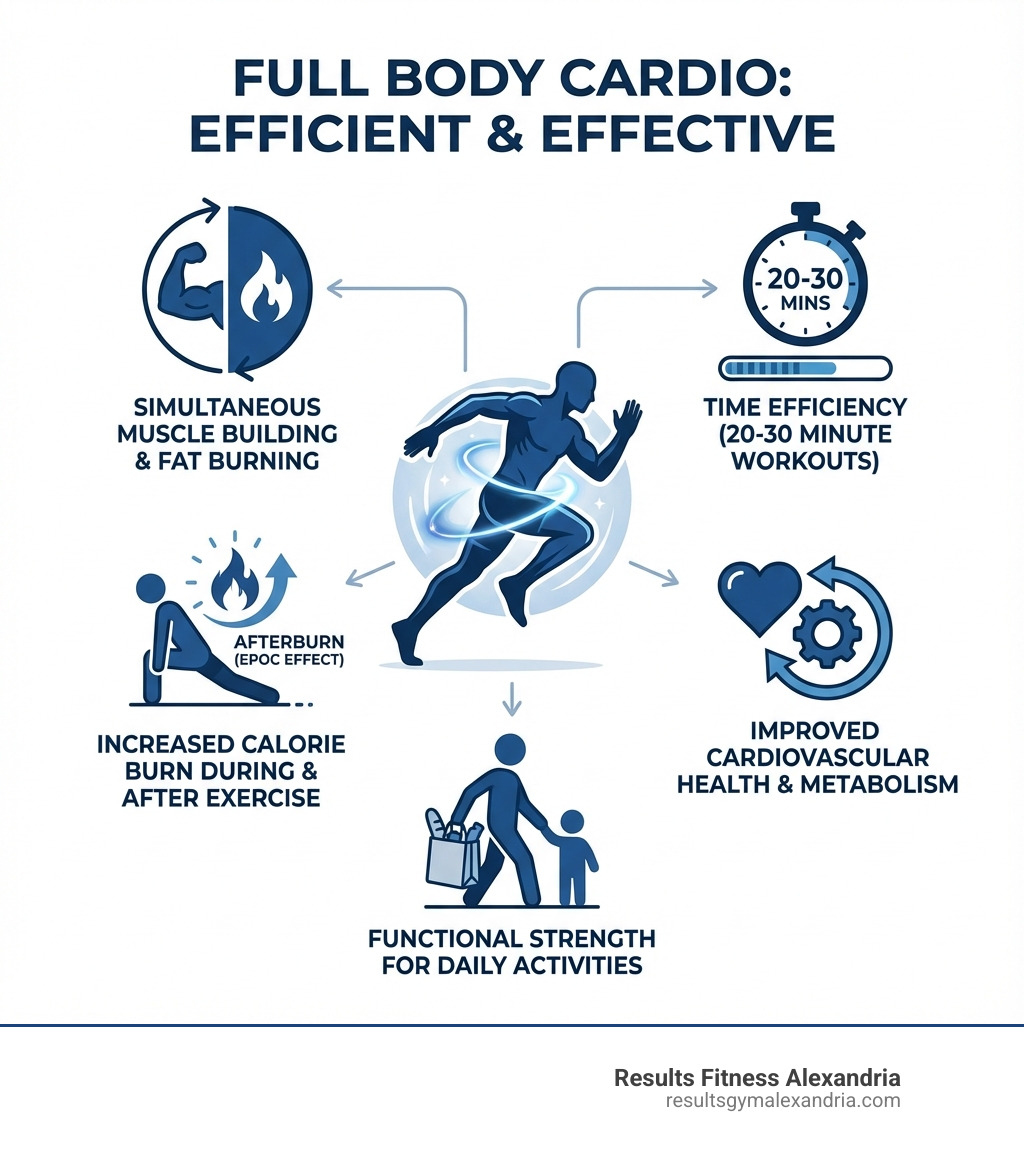
Full body cardio combines strength training and cardiovascular exercise into one efficient workout, allowing you to build muscle and improve heart health simultaneously. Here’s what you need to know:
What Full Body Cardio Includes:
- Compound movements that work multiple muscle groups at once (squats, burpees, kettlebell swings)
- Liftd heart rate throughout the workout for cardiovascular benefits
- Short rest periods between exercises to maintain intensity
- Circuit or HIIT-style formats for maximum efficiency
- 20-30 minutes of focused work can deliver significant results
One of the most common excuses for skipping workouts is lack of time. But as research shows, effective training doesn’t require long sessions or complicated routines. When time is limited, the goal shouldn’t be doing more exercises—it should be prioritizing the most important movement patterns that challenge your entire body while keeping your heart pumping.
Full body cardio workouts solve the time problem by training your body as a functional unit. Instead of isolating muscles or separating cardio days from strength days, you get both benefits in one session. This approach burns more calories, builds strength, improves cardiovascular health, and even boosts your metabolism for hours after you finish.
I’m Jennifer Rapchak, Fitness Director at Results Fitness Alexandria, and I’ve spent over 14 years designing strength and HIIT programs that maximize results in minimal time. My expertise in circuit training and high-intensity formats has helped countless members find how full body cardio can transform their fitness journey, even with the busiest schedules.
Basic Full body cardio glossary:
Why Combine Cardio and Strength in One Workout?
We all lead busy lives, and finding time for fitness can feel like a Herculean task. That’s where the magic of combining cardio and strength training in a full body cardio workout truly shines. It’s not just about saving time; it’s about maximizing every minute you spend exercising.
Here’s why this integrated approach is a game-changer:
-
Time-Efficiency: This is perhaps the most compelling reason. As the CDC notes, a lack of time is a major barrier to fitness. Full body cardio sessions, especially those incorporating High-Intensity Interval Training (HIIT), can be incredibly effective in just 20 to 30 minutes. You get a complete workout that addresses both endurance and strength, cutting down your gym time without cutting corners on results.
-
Increased Calorie Burn: Combining strength and cardio ignites your metabolism. During the workout, you’re building muscle and burning calories. But the benefits don’t stop there. Research indicates that HIIT, a common component of full body cardio, can increase your metabolism for hours after exercise, even more so than traditional jogging or weight training. This “afterburn effect” (scientifically known as EPOC, or Excess Post-exercise Oxygen Consumption) means your body continues to burn calories at an liftd rate long after you’ve finished your last rep.
-
Improved Cardiovascular Health: Regular full body cardio workouts are fantastic for your heart. Studies have shown that both HIIT and traditional moderate-intensity exercise can reduce weight and waist circumference. Furthermore, consistent training can lead to significant health improvements, including reduced blood sugar levels, lower resting heart rate, and decreased blood pressure in overweight and obese individuals. We’re talking about a healthier heart, which means a healthier you!
-
Building Functional Strength for Daily Life: Our bodies are designed to move as a cohesive unit, not as isolated muscle groups. Full body cardio emphasizes compound movements that mimic real-life actions, making you stronger and more resilient for everyday tasks – from carrying groceries to playing with your kids. This approach aligns perfectly with the principles of functional fitness, helping you move better and live more fully. It’s about building a body that performs, not just one that looks good.
-
Overall Health Benefits: Beyond the immediate physical changes, combining cardio and strength contributes to a host of long-term health advantages. From boosting bone density to improving mental well-being, the synergistic effects of these workouts are profound. We firmly believe in the benefits of strength training for all ages, and when paired with cardio, those benefits are amplified.
To learn more about the effectiveness of this combined approach, you can explore one review that looked at 13 different studies on 424 overweight and obese adults and found both HIIT and traditional moderate-intensity exercise can reduce weight and waist circumference.
The Ultimate Guide to Your Full Body Cardio Workout
Designing an effective full body cardio workout means intelligently weaving together cardiovascular challenges and strength-building exercises. It’s about getting the most bang for your buck, ensuring every muscle group is engaged and your heart rate stays liftd. This approach allows us to achieve significant fitness gains in a shorter timeframe, making it ideal for anyone with a packed schedule. We believe in maximizing your gym sessions with efficient workouts—and full body cardio is a prime example of how to do it right.
Structuring Your Full Body Cardio Routine
The secret sauce to an effective full body cardio routine lies in its structure. We often turn to circuit training and High-Intensity Interval Training (HIIT) to achieve that powerful combination of strength and cardiovascular benefits.

Here’s how we structure it:
-
Circuit Training Advantages: Imagine moving from one exercise to the next with little to no rest. That’s circuit training! This method keeps your heart rate up, burns more calories, and allows different muscle groups to recover while others are working. It’s incredibly efficient, keeps you focused, and prevents boredom in the gym. A 2021 study highlighted that circuit training can significantly reduce fat mass, increase muscle mass, improve strength, and boost your VO2 max. For a deeper dive into this dynamic training style, check out our complete guide to circuit training cardio.
-
Minimal Rest Periods: The key to maintaining intensity and maximizing the cardiovascular component of your full body cardio workout is to keep rest periods short. In a circuit, you might only rest briefly between exercises, or move directly from one to the next. This continuous movement keeps your heart pumping and muscles engaged.
-
HIIT Integration: High-Intensity Interval Training is a fantastic way to lift your full body cardio experience. HIIT involves short, intense bursts of exercise followed by brief recovery periods. The intense work periods should push you to 80-95% of your maximum heart rate. Work-to-rest ratios can vary:
- For aerobic fitness, a 1:1 or 1:2 ratio (e.g., 30 seconds work, 30-60 seconds rest) is effective.
- For anaerobic training, a ratio of at least 1:5 (e.g., 15 seconds work, 75 seconds rest) is often used.
- In many full body cardio circuits, we might use ratios like 40 seconds of work for strength exercises followed by 20 seconds of rest, and 30 seconds of work for cardio exercises with 10 seconds of rest. This keeps the intensity high and the workout moving. We encourage you to give HIIT exercises a try – they are truly transformative!
Full Body Workouts vs. Traditional Split Routines
When it comes to planning your fitness regimen, you might wonder whether a full body cardio approach is better than a traditional split routine (like training legs one day, chest another, etc.). Both have their merits, and the “best” choice really depends on your goals, experience level, and how much time you have.
Here’s a comparison to help you decide:
| Feature | Full Body Workouts | Traditional Split Routines |
|---|---|---|
| Frequency | Train each muscle group 2-3 times per week. | Train each muscle group 1-2 times per week. |
| Efficiency | Highly efficient. Get a full-body workout in 30-45 minutes. | Less time-efficient. Requires more days in the gym to hit all muscle groups. |
| Recovery | Requires careful planning to allow for adequate recovery between sessions. | Allows for more focused recovery on specific muscle groups between workouts. |
| Best For | Beginners, individuals with limited time, and those focused on general fitness and fat loss. | Bodybuilders, advanced lifters, or those with specific muscle-building goals. |
| Flexibility | Easy to adjust if you miss a day; you can just pick up where you left off. | Missing a day can throw off your entire week’s schedule. |
For a deeper dive into planning your workout frequency, check out our guide on How Often Should You Work Out Based on Your Goals?.
The Essential Warm-Up and Cool-Down
No workout is complete without a proper warm-up and cool-down. Before you jump into your full body cardio routine, spend 5-10 minutes preparing your body. This should include light cardio like jogging or cycling, followed by dynamic stretches such as arm circles and leg swings to increase blood flow and improve mobility. After your workout, dedicate a few minutes to a cool-down. This helps your heart rate return to normal gradually and can reduce muscle soreness. Focus on static stretching, holding each stretch for 20-30 seconds, to improve flexibility. Proper recovery is crucial for making progress and preventing injury. For more tips, check out our guide on 10 Post-Workout Recovery Tips to Maximize Results.