
Does cardio build endurance for weight training: 1 Myth
Why the “Cardio vs. Lifting” Debate Misses the Point
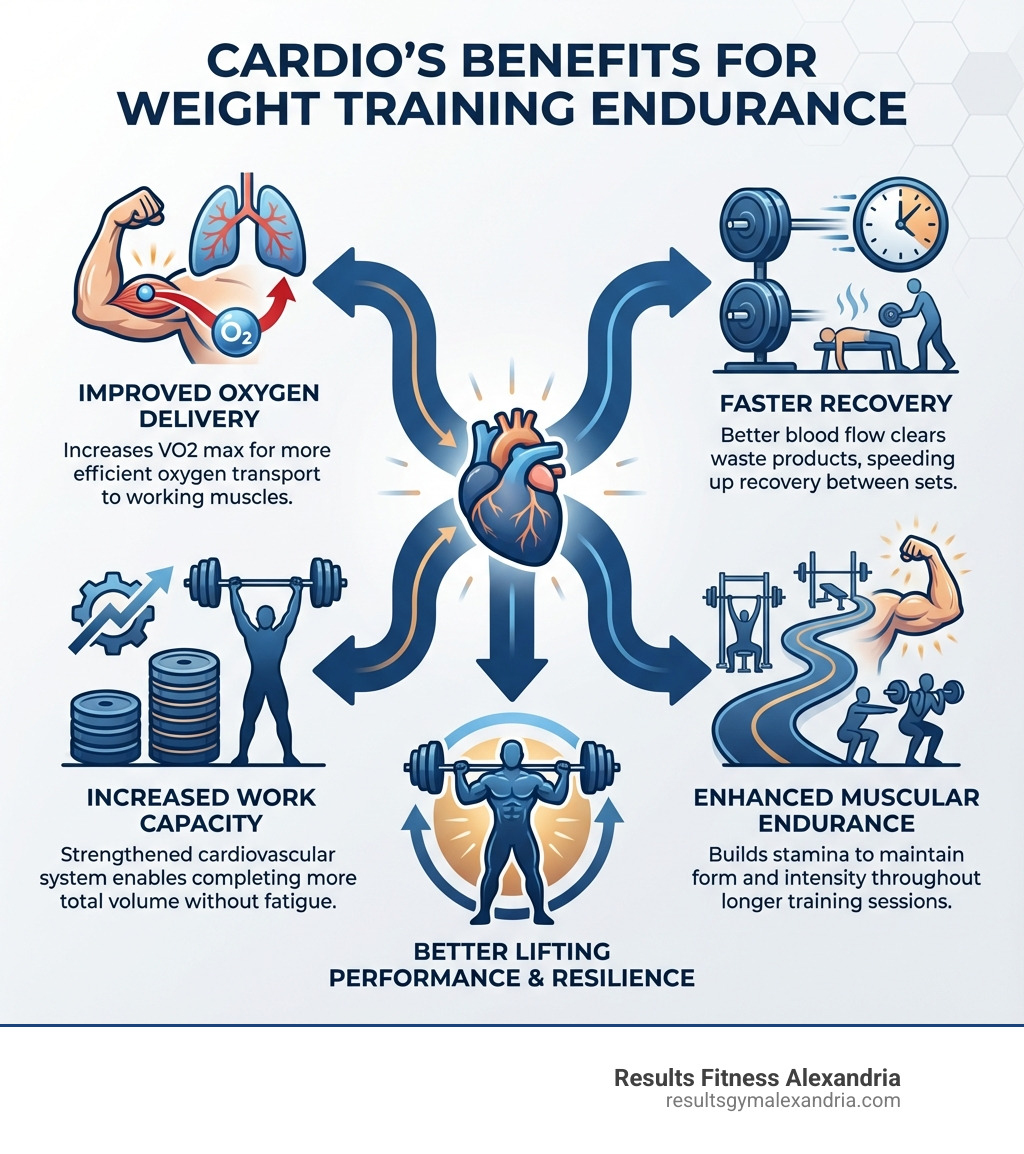
Does cardio build endurance for weight training? Yes, it does. Cardiovascular exercise improves your body’s ability to deliver oxygen to working muscles, improves recovery between sets, increases overall work capacity, and builds the stamina needed to sustain high-quality lifting sessions. Here’s what you need to know:
- Improved Oxygen Delivery: Cardio training increases VO2 max, allowing your muscles to work harder for longer during weight training.
- Faster Recovery: Better blood flow helps clear waste products between sets and speeds recovery between training sessions.
- Increased Work Capacity: A stronger cardiovascular system lets you complete more total volume in your workouts without fatigue.
- Improved Endurance: Aerobic conditioning builds the stamina to maintain proper form and intensity throughout longer training sessions.
In gyms across the country, you’ll still hear the old debate: lifters on one side, cardio enthusiasts on the other. Some guys believe a single cycling class will undo months of progress. Others think that if you’re serious about building muscle, you should avoid the treadmill entirely. But this “either/or” mentality is outdated. Modern research shows that cardio and strength training aren’t competing forces—they’re complementary tools that work together to build a more resilient, capable body.
The truth is, your cardiovascular system doesn’t exist in isolation from your muscles. When you lift weights, your heart pumps blood to deliver oxygen and nutrients to working muscles while removing waste products like lactate. If your cardiovascular system is inefficient, you’ll fatigue faster, recover slower between sets, and struggle to maintain intensity throughout your workout. That’s where strategic cardio comes in—not as a threat to your gains, but as a foundation for better lifting performance.
Recent studies support this synergy. A 2021 study found that cardio only impacted strength gains for trained individuals when resistance and endurance training were performed within the same session, less than 20 minutes apart—and even then, the impact was moderate. When the modalities were performed in separate sessions, there was no interference. Meanwhile, research shows that cardiovascular exercise activates key signaling pathways (such as Akt/mTOR and MAPK) that actually promote protein synthesis and muscle growth.
The rise of “hybrid athletes”—people who excel at both endurance and strength—proves this point. These individuals aren’t choosing between cardio and lifting; they’re strategically combining both to build comprehensive fitness. NFL players run for endurance. Long-distance runners lift to prevent injuries and strengthen their form. The old stereotype of the bodybuilder versus the marathon runner is a false binary that doesn’t reflect how our bodies actually adapt to training.
As Jennifer Rapchak, Fitness Director at Results Fitness Alexandria with over 14 years of experience designing strength and conditioning programs, I’ve seen how understanding whether does cardio build endurance for weight training transforms how clients approach their fitness. When people learn to integrate cardio strategically rather than avoid it, they build stronger, more resilient bodies that perform better in the gym and in everyday life.
Basic does cardio build endurance for weight training terms:
The Science Explained: How Cardio Fuels Your Lifts

When we talk about whether does cardio build endurance for weight training, we’re really asking how our body’s internal systems work together. Cardio, or aerobic exercise, significantly improves these systems, creating a more robust foundation for your strength workouts. It’s not just about a strong heart; it’s about efficient delivery and removal.
One of the primary ways cardio helps is by improving your body’s ability to deliver oxygen. This is often measured by your VO2 max—the maximum amount of oxygen your body can use during exercise. A higher VO2 max means your muscles receive more oxygen, allowing them to work harder for longer before fatigue sets in. This is crucial during weight training, especially when performing higher repetitions or shorter rest periods. As the National Strength and Conditioning Association (NSCA) points out, cardio increases your body’s [ability to deliver oxygen](https://www.nsca.com/education/articles/kinetic-select/oxygen-uptake-and-the-aerobic-and-anaerobic-contributions-to-exercise/) throughout your system, which is essential for any type of exercise.
Improved blood flow is another key benefit. Cardio strengthens your heart and lungs, making them more efficient at pumping blood. This improved circulation not only brings more oxygen and nutrients to your working muscles but also helps in the efficient removal of metabolic waste products, such as lactic acid. This quick cleanup means less muscle soreness and a faster return to peak performance.
This leads directly to faster recovery between sets. If your cardiovascular system is well-conditioned, your heart rate will return to baseline more quickly after an intense set, allowing you to be ready for the next one sooner and maintain the quality of your lifts throughout your session. Furthermore, cardio can improve your ability to [recover from high-intensity exercise](https://pubmed.ncbi.nlm.nih.gov/11219498/) by replenishing blood flow to sore muscles.
A more efficient cardiovascular system translates to increased work capacity. You’ll find yourself able to perform more repetitions, complete more sets, or even add an extra exercise to your routine without feeling completely drained. This increased volume, performed with good form, is a direct pathway to greater strength and muscle growth. To truly [Build Cardiovascular Endurance](https://resultsgymalexandria.com/build-cardiovascular-endurance/) is to build a stronger, more resilient body for all forms of exercise.
The Physiological Mechanisms at Play
Behind these practical benefits are fascinating physiological adaptations. Regular cardio training leads to significant cardiovascular adaptations. Your heart, being a muscle itself, becomes stronger and more efficient. This results in an improved stroke volume, meaning your heart pumps more blood with each beat, even at rest.
Inside your muscles, cardio also drives crucial changes. It increases mitochondrial density, which means your muscle cells have more of the “powerhouses” responsible for producing ATP, the energy currency of your cells. More mitochondria mean more efficient energy production and greater endurance. Additionally, cardio promotes capillary growth within your muscles. Capillaries are tiny blood vessels that deliver oxygen and nutrients to muscle fibers and remove waste. An increased capillary network means better exchange of these vital substances, further enhancing muscular endurance and recovery.
These adaptations work together to support not just your cardio workouts, but also your strength training. A body that can efficiently transport oxygen, remove waste, and produce energy is a body that can lift heavier, perform more reps, and recover faster, ultimately answering the question: does cardio build endurance for weight training? Yes, through these intricate and interconnected physiological improvements.
So, Does Cardio Build Endurance for Weight Training? The “Interference Effect” Debunked
For years, the fitness world was dominated by the “interference effect” theory, stemming largely from a 1980 study by Robert C. Hickson. This theory suggested that combining endurance and strength training would “interfere” with strength and muscle gains, implying you had to choose one or the other. This created a false dilemma for many athletes and fitness enthusiasts.
However, modern research, often referred to as concurrent training science, has largely debunked this notion, or at least refined it significantly. The current consensus is that for most individuals, concurrent training has minimal impact on hypertrophy (muscle growth) and negligible effect on strength gains, especially when programmed intelligently.
A 2022 meta-analysis, for example, found that “concurrent aerobic and strength training does not compromise muscle hypertrophy and maximal strength development.” This means that for the vast majority of us, incorporating cardio into our routine won’t hinder our ability to build muscle or get stronger. In fact, for some, combining these modalities may even boost muscle growth, particularly if you’re not pushing extreme volumes of both.
At Results Fitness Alexandria, we emphasize [The Science of Building Muscle: Tips for Effective Strength Training](https://resultsgymalexandria.com/the-science-of-building-muscle-tips-for-effective-strength-training/) and how it integrates with other forms of exercise. The key lies in understanding how to combine them effectively, rather than viewing them as opposing forces.
Does cardio build endurance for weight training without killing gains?
This is perhaps the most common concern: will cardio “kill your gains”? The short answer, as we’ve seen, is generally no. The fear often stems from misconceptions, such as the idea of excessive protein breakdown. It’s only after 90 minutes of cardio in a single session that your body is likely to start breaking down protein for energy, as exercise physiologist Heather Hart told LiveScience. For most cardio sessions, especially those integrated with weight training, you’re unlikely to hit this threshold.
To ensure cardio doesn’t negatively impact your muscle growth, focus on a few key areas:
- Caloric Surplus for Growth: If your goal is muscle gain, you need to consume enough calories to support both your strength training and your cardio. If you’re expending more calories through cardio, you need to eat more to compensate.
- Adequate Protein Intake: Protein is essential for muscle repair and growth. Aim for 1.4 to 2 grams of protein per kilogram of body weight per day to maximize muscle gains and maintenance.
- Nutrition’s Role in Recovery: Proper nutrition, including sufficient carbohydrates and fats, is crucial for fueling your workouts and aiding recovery. This becomes even more important when you combine modalities.
A 2021 study highlighted that cardio only moderately impacted strength gains for trained individuals when resistance and endurance training were performed within the same session, less than 20 minutes apart. However, this interference did not occur when the modalities were performed in separate sessions. This is a critical insight for those wondering does cardio build endurance for weight training effectively without hindering strength.
How does concurrent training impact power and explosive strength?
While general strength and hypertrophy are largely unaffected by concurrent training, there are specific considerations for power athletes. Power-focused athletes (like sprinters, Olympic lifters, or those training for explosive movements) might experience a slight attenuation in explosive strength gains if they perform cardio and strength training in the same session.
For these individuals, strategic programming is key:
- Keep cardio sessions short: Athletes concerned with power should aim to keep their endurance work under 20 to 30 minutes.
- Limit frequency: Less than three times a week for endurance work can help minimize any potential interference.
- Separate sessions: If possible, perform cardio and strength workouts on separate days, or at least separate them by several hours (e.g., 4-6 hours) if done on the same day. This allows your body to recover and adapt to each stimulus independently.
For the vast majority of people, however, the benefits of improved endurance, recovery, and overall health far outweigh any minimal, theoretical interference with power gains.
Smart Integration: Programming Cardio for Maximum Benefit
Now that we’ve established that does cardio build endurance for weight training, the next logical step is to figure out how to best integrate it into your routine. The good news is that there’s no single “right” way, but there are smart strategies to maximize benefits and minimize any potential downsides.
Timing Cardio Sessions
The timing of your cardio relative to your strength training can play a role, especially if you’re concerned about optimizing performance in either.
- Cardio after weights: Many experts suggest performing your strength training first, followed by cardio. This ensures your muscles are fresh for lifting, allowing you to maximize strength and hypertrophy gains. If you do cardio first, especially high-intensity cardio, it can pre-fatigue your muscles, potentially compromising your lifting performance.
- Cardio on separate days: This is often considered the ideal approach for minimizing any interference effects. By dedicating separate days to cardio and strength, your body has ample time to recover and adapt to each type of stimulus. If that’s not feasible, aim to separate the sessions by at least 4-6 hours on the same day.
- Light cardio warm-up: A brief, light cardio warm-up (5-10 minutes) before lifting is always beneficial. It increases blood flow, warms up your muscles, and prepares your cardiovascular system without causing significant fatigue.
Volume and Frequency Guidelines
For general health and fitness, official guidelines provide a great starting point. The Physical Activity Guidelines for Americans recommend 150 minutes of moderate-intensity aerobic activity or 75 minutes of vigorous-intensity aerobic activity per week, alongside muscle-strengthening activities two days per week. This provides a solid framework for [How to Create a Balanced Fitness Routine: Combining Cardio, Strength, and Flexibility](https://resultsgymalexandria.com/how-to-create-a-balanced-fitness-routine-combining-cardio-strength-and-flexibility/).
For those specifically focused on how does cardio build endurance for weight training, you might adjust these slightly. For example, if you’re doing intense strength training 3-4 times a week, you might aim for 2-3 cardio sessions of 30-45 minutes each. This allows you to reap the benefits of cardio without overtraining. Understanding [How Often Should You Work Out Based on Your Goals?](https://resultsgymalexandria.com/how-often-should-you-work-out-based-on-your-goals/) is key to tailoring these recommendations to your individual needs.
HIIT vs. LISS: Which Cardio Is Best for a Lifter?
When considering cardio, two main types often come up: High-Intensity Interval Training (HIIT) and Low-Intensity Steady-State (LISS). Both have their place, but one might be more beneficial depending on your goals and how it integrates with your weight training.
| Feature | HIIT (High-Intensity Interval Training) | LISS (Low-Intensity Steady-State) |
|---|---|---|
| Time Commitment | Shorter (10-30 minutes, including warm-up/cool-down) | Longer (30-60+ minutes) |
| Impact on Recovery | More demanding; can impact recovery if overdone or too close to lifting | Less demanding; low impact on recovery |
| Primary Energy Source | Primarily uses carbohydrates (glycogen) | Primarily uses stored fat for energy |
| Best Use Case for Lifters | Can promote muscle growth (especially for older adults); boosts metabolism | Strengthens heart & lungs; aids recovery; minimal interference with gains |
Low-Intensity Steady-State (LISS) cardio, such as swimming, cycling, or light jogging, is often recommended for lifters. It uses stored fat for energy, strengthens the heart and lungs, and has a low impact on recovery, interfering minimally with muscle gains. LISS can also be excellent for active recovery on rest days, promoting blood flow to aid muscle repair without adding significant stress.
High-Intensity Interval Training (HIIT) involves short bursts of intense exercise followed by brief recovery periods. While highly effective for calorie burning and improving cardiovascular fitness in a short amount of time, it is more demanding on your body and can impact recovery if overdone or performed too frequently. HIIT can promote muscle growth, especially for older adults or when used strategically. If you choose HIIT, consider limiting it to 1-2 sessions per week and separating it from your most intense lifting days.
Sample Weekly Schedules for Concurrent Training
Here are a few examples of how you might integrate cardio and strength training, keeping in mind that these are just starting points and should be adjusted to your fitness level, goals, and recovery needs.
Beginner Routine (3 days/week)
- Monday: Full Body Strength Training
- Tuesday: 30 minutes LISS Cardio (e.g., brisk walk, cycling)
- Wednesday: Rest
- Thursday: Full Body Strength Training
- Friday: 30 minutes LISS Cardio
- Saturday: Rest
- Sunday: Active Recovery (e.g., light stretching, gentle walk)
Hypertrophy-Focused Routine (4-5 days/week)
- Monday: Upper Body Strength
- Tuesday: Lower Body Strength
- Wednesday: 30-40 minutes LISS Cardio (separate session)
- Thursday: Upper Body Strength
- Friday: Lower Body Strength
- Saturday: 20-30 minutes LISS Cardio or Rest
- Sunday: Rest
General Fitness Routine (alternating days)
- Monday: Full Body Strength Training
- Tuesday: 45 minutes LISS Cardio or 20 minutes HIIT
- Wednesday: Full Body Strength Training
- Thursday: 45 minutes LISS Cardio
- Friday: Full Body Strength Training
- Saturday: 45 minutes LISS Cardio or Active Recovery
- Sunday: Rest
Consistency and listening to your body are paramount.
Beyond the Weight Room: The Holistic Benefits of a Hybrid Approach
While our focus has been on does cardio build endurance for weight training, the benefits of combining cardio and strength training extend far beyond gym performance. A hybrid approach to fitness offers a wealth of holistic health advantages that contribute to a longer, healthier, and more vibrant life.
One of the most significant benefits is comprehensive cardiovascular health. Aerobic exercises like running or cycling increase heart and lung efficiency. When combined with strength training, which builds and maintains muscle mass, you get a powerful synergy. A 2019 study found that combining aerobic and anaerobic exercise lowered the risk of cardiovascular disease more for study participants who did a combination of exercises. Eight weeks of combined cardio and strength training may provide more comprehensive CVD benefits compared to time-matched aerobic or resistance training alone for people with liftd CVD risk. This means a healthier heart and a reduced risk of heart disease, which is a leading cause of mortality.
Furthermore, combining cardio and strength training leads to improved body composition. Cardio burns calories during the workout, while strength training builds muscle mass, which boosts your metabolism. Muscle tissue burns more calories at rest than fat tissue. This combination accelerates fat loss while preserving lean muscle mass, giving you a leaner, stronger physique. If you’re curious about the specifics, our guide on [Cardio vs Strength Training for Weight Loss: Which is Better?](https://resultsgymalexandria.com/cardio-vs-strength-training-for-weight-loss/) digs deeper into this.
Better blood sugar control and improved insulin sensitivity are also key advantages. The synergy between the two forms of exercise can significantly aid in preventing or managing type 2 diabetes. The American Diabetes Association recommends combining both forms of exercise to optimize blood sugar control and improve insulin sensitivity.
Mental health also sees a boost. Research shows that cardio may be slightly more effective at reducing stress, while strength training offers a bigger boost to self-esteem. Blending both cardio and strength training brought the highest levels of health perception. This means a clearer mind, reduced anxiety, and a greater sense of well-being.
And let’s not forget about improved sleep quality. A good workout leaves you tired and ready for rest. A 2022 study gave a slight edge to resistance (strength) training when it comes to sleep quality and duration, but both contribute positively. Quality sleep is vital for recovery, hormone regulation, and overall health.
By embracing a hybrid approach, we’re not just optimizing our performance in the gym; we’re building a foundation for long-term health, vitality, and resilience. This integrated training model helps mitigate risks like overtraining by promoting better recovery and overall physical robustness. It’s about building a body that performs well, looks great, and feels amazing, supporting [Benefits of Strength Training for All Ages](https://resultsgymalexandria.com/benefits-of-strength-training-for-all-ages/) and a high quality of life.
Frequently Asked Questions about Cardio and Weight Training
We hear a lot of questions about how to best combine cardio and weight training. Here are some of the most common ones our trainers at Results Fitness Alexandria answer.
Can I do cardio and weights on the same day?
Yes, absolutely! You can do cardio and weights on the same day, and many people do successfully. The key is strategic timing. We generally recommend you [lift first to maximize strength performance](https://honehealth.com/edge/does-cardio-kill-gains/). This ensures your muscles are fresh for heavy lifting, allowing you to perform at your best. If possible, [separate sessions by at least 4-6 hours](https://honehealth.com/edge/does-cardio-kill-gains/) to give your body a chance to recover between stimuli. A light cardio warm-up (5-10 minutes) before your lifts, however, is always beneficial for preparing your body.
Will running make my legs weaker for squats?
This is a common concern, especially among those who love their leg days! The answer is: not if programmed correctly. Excessive running volume, particularly high-intensity running immediately before a heavy leg day, can certainly interfere with your squat performance by fatiguing your muscles and depleting glycogen stores. However, [moderate running builds work capacity and leg endurance](https://journals.lww.com/nsca-jscr/abstract/1993/05000/the_effect_of_endurance_running_on_training.5.aspx), which can actually benefit your squats. A stronger cardiovascular system means your legs can endure more sets and reps, and recover faster. The trick is to [focus on progressive overload in your lifting](https://resultsgymalexandria.com/the-power-of-progressive-overload-how-to-keep-getting-stronger/) and schedule your more intense runs on separate days from your heaviest leg workouts.
Does cardio build endurance for weight training if I’m a beginner?
Absolutely! For beginners, cardio is an incredibly important component for building a foundational fitness base. It improves your overall stamina, making it easier to tolerate and complete your weight training workouts. You’ll find yourself less out of breath between sets, able to maintain better form for longer, and recover more quickly. This improved recovery between exercises and sessions is crucial for consistent progress. Integrating cardio early on helps you build the resilience needed to push harder in your strength training. If you’re just starting out, check out our guide on [Creating an Effective Workout Routine for Beginners](https://resultsgymalexandria.com/creating-an-effective-workout-routine-for-beginners/) to see how to incorporate both effectively.
Conclusion: Build a Stronger, More Enduring You
We’ve explored the question does cardio build endurance for weight training from multiple angles, diving into the science, debunking myths, and offering practical strategies. The overwhelming evidence shows that cardio is not a threat to your strength or muscle gains; rather, it’s a powerful ally.
By improving oxygen delivery, enhancing recovery, increasing work capacity, and boosting overall health, cardio lays a vital foundation for more effective and sustainable weight training. The “interference effect” is largely a concern for highly specialized athletes pushing extreme limits, and for the vast majority of us, concurrent training offers synergistic benefits that amplify our fitness journey.
Embracing a balanced, hybrid approach means you’re not just building muscle; you’re building a more resilient cardiovascular system, improving your body composition, regulating blood sugar, reducing stress, and sleeping better. It’s about optimizing your entire well-being, not just one aspect of your physique.
At Results Fitness Alexandria, we believe in empowering our members with knowledge and effective training strategies. Our expert trainers are here to help you build a personalized plan that strategically integrates cardio and strength training, allowing you to achieve your fitness goals efficiently and sustainably.
Ready to experience the combined power of cardio and strength training? [Explore our state-of-the-art cardio amenities to start your journey](https://resultsgymalexandria.com/amenities/cardio/) today and find how we can help you build a stronger, more enduring you.