Benefits of endurance: Top 5 Surprising Perks!
Why Endurance Training Is Your Gateway to Better Health
Benefits of endurance encompass far more than just being able to run longer distances. From strengthening your heart and lungs to boosting your mood and energy levels, endurance training delivers transformative results that touch every aspect of your life.
Key Benefits of Endurance Training:
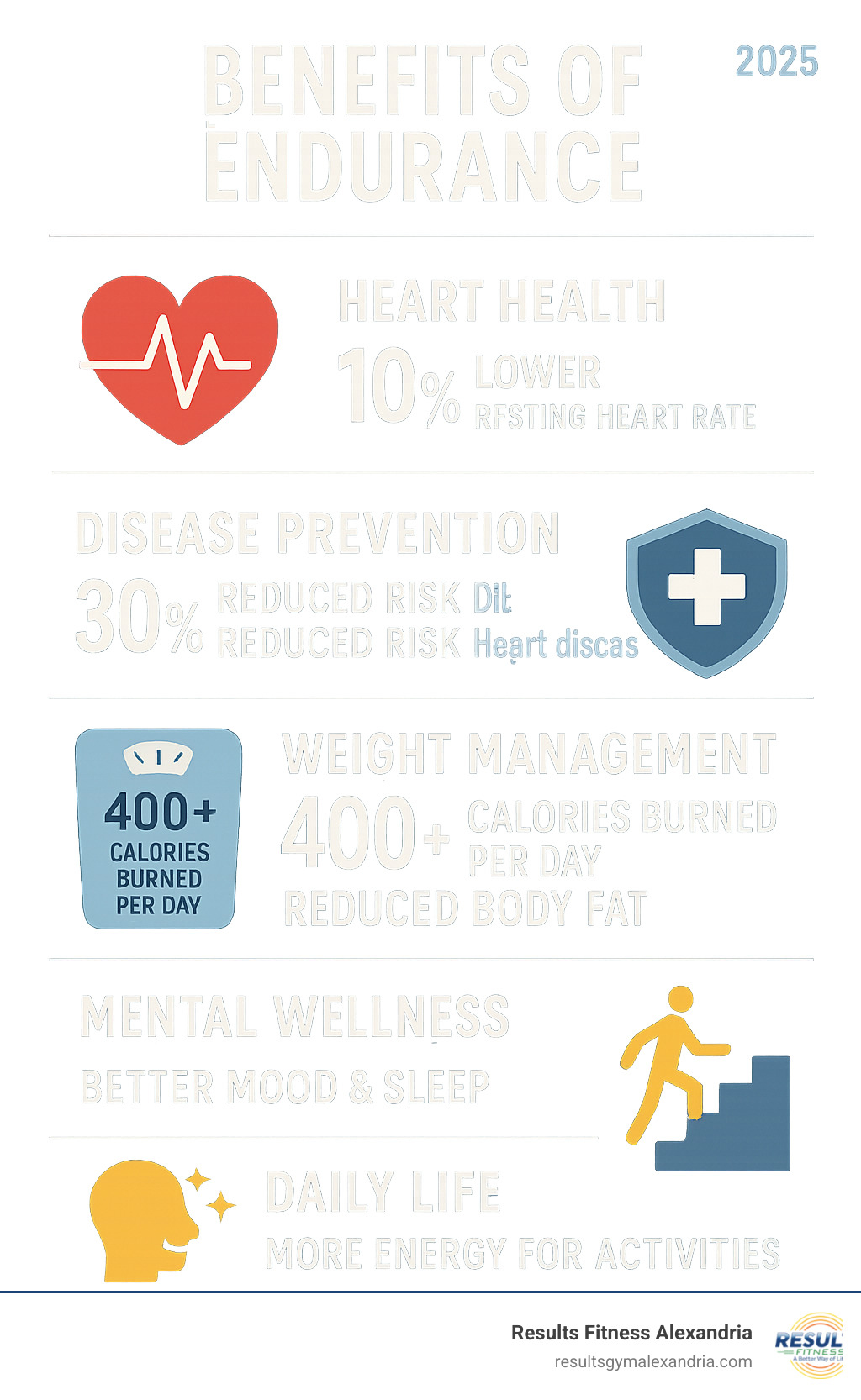
- Heart Health: Lower resting heart rate and blood pressure
- Disease Prevention: Reduced risk of diabetes, heart disease, and stroke
- Weight Management: Improved calorie burn and visceral fat reduction
- Mental Wellness: Improved mood, reduced stress, and better sleep
- Daily Life: More energy for stairs, groceries, and playing with kids
- Longevity: Better cardiovascular fitness linked to longer, healthier life
Cardiovascular endurance – also called aerobic fitness – measures how well your heart and lungs supply oxygen to your muscles during exercise. When you improve this capacity, your body becomes more efficient at delivering the fuel your cells need to function optimally.
The research is clear: adults who get at least 150 minutes of moderate aerobic activity per week see dramatic improvements in their health markers. Studies show that even first-time marathoners experience reductions in blood pressure and arterial stiffness equivalent to a four-year reduction in vascular age.
As Jennifer Rapchak, Fitness Director at Results Fitness Alexandria with over 14 years of personal training experience, I’ve witnessed how the benefits of endurance training transform lives through improved cardiovascular health and daily vitality. My expertise in high-intensity interval training and group fitness programming has shown me that endurance improvements are achievable for everyone, regardless of starting fitness level.
Benefits of endurance terms to remember:
The Core Physical Benefits of Endurance Training
Your heart is an amazing muscle, and like any muscle, it gets stronger with regular exercise. When you commit to endurance training, you’re giving your cardiovascular system the ultimate upgrade. Your heart learns to pump more efficiently, which means your benefits of endurance training start with a lower resting heart rate – your heart doesn’t have to work overtime just to keep you going.
But here’s where it gets really exciting: your blood pressure starts to drop too. A fascinating study on first-time marathoners found that training for just one marathon created changes equivalent to turning back the clock on your blood vessels by four years. That’s like getting a time machine for your arteries!
Beyond your heart, endurance training becomes your personal bodyguard against chronic diseases. It’s particularly powerful at reducing your risk of Type 2 diabetes by helping your body use insulin more effectively. Your cells become better at grabbing sugar from your bloodstream, which keeps your blood sugar levels stable. Heart disease risk drops significantly too, creating a protective effect that builds over time.
Weight management becomes so much easier when endurance training is part of your routine. These activities are calorie-burning champions, and the harder you work, the more you burn. But the real magic happens with visceral fat – that stubborn fat around your organs that’s linked to serious health problems. Endurance exercise targets this dangerous fat specifically, melting it away even with moderate activity levels.
Your metabolism gets a boost that keeps working long after your workout ends. As you build lean muscle and lose excess fat, your body becomes a more efficient calorie-burning machine, even when you’re binge-watching your favorite show.
Ready to experience these incredible changes? Check out The Top 5 Cardio Exercises to Boost Your Endurance to get started on your change.
How Endurance Builds a Stronger Heart and Body
The real magic of endurance training happens on the inside, where your body undergoes incredible adaptations that make you feel like you’ve been upgraded to a newer, better version of yourself.
Your VO2 max – basically how efficiently your body can use oxygen – becomes significantly higher. Think of it as upgrading your body’s engine. Most active people have a VO2 max between 35-50, but endurance athletes can reach an impressive 70-85. This means your body becomes a master at delivering oxygen to your muscles and using it to create energy.
Your muscles transform too, developing more Type 1 muscle fibers – the marathon runners of muscle fibers. These slow-twitch powerhouses are built for the long haul and resist fatigue like champions. They’re what allow you to keep going when others are gasping for breath.
Here’s something that might surprise you: endurance training actually helps keep your joints healthy. You’d think all that repetitive movement would wear them down, but research shows the opposite. Regular endurance activity acts like a therapeutic treatment for your cartilage, helping nutrients flow into joint tissues and reducing chronic inflammation. Your joints actually thank you for the movement!
All these changes add up to dramatically improved circulation throughout your entire body. Your blood vessels become more flexible, your heart pumps more effectively, and every cell in your body gets better access to the oxygen and nutrients it needs to thrive.
Want to take your results to the next level? Learn about Maximizing Results: Integrating Strength Training into Your Cardio Routine to build the perfect balanced program.
Special Considerations for Your Fitness Journey

While the benefits of endurance training are incredible for everyone, your personal journey might need some special attention depending on your health history. The most important first step? Have a chat with your doctor before diving into any new exercise program, especially if you have existing health conditions.
If you’re recovering from a cardiac event or stroke, here’s some encouraging news: exercise isn’t just helpful – it’s often prescribed as medicine. Regular physical activity can dramatically reduce your chances of another heart attack, and for stroke survivors, the American Heart Association strongly recommends exercise as part of recovery.
The improvements can be remarkable. Stroke survivors often start with very low oxygen consumption levels (around 8-23), but even modest aerobic exercise can boost this by 10-15%. That might not sound like much, but it represents a huge leap toward independence and better quality of life. Check out these AHA recommendations for exercise after stroke for specific guidance.
Starting slowly is crucial, no matter your situation. Your body needs time to adapt and build strength safely. Consulting with a personal trainer who understands your specific needs can make all the difference in building a program that challenges you appropriately while keeping you safe.
At Results Fitness Alexandria, our team has experience working with people at every fitness level and health situation. We believe everyone deserves to experience the transformative power of endurance training, and we’re here to help you find your perfect path forward.
Beyond the Physical: Mental and Everyday Perks
The benefits of endurance training reach far beyond what happens to your body during a workout. Your mind gets an incredible boost too, and these mental improvements ripple out into every corner of your daily life.
Let’s talk about that amazing feeling you get after a good cardio session. It’s not just in your head – it’s science! When you engage in endurance activities, your brain releases a powerful cocktail of feel-good chemicals including endorphins and dopamine. These natural mood elevators work like your body’s own happiness prescription, leaving you feeling more positive and relaxed.
But the mental benefits of endurance go deeper than just feeling good in the moment. Regular cardio exercise acts as a natural stress buster, giving you a healthy way to work through daily tensions and worries. Many of our members at Results Fitness Alexandria tell us their evening treadmill session helps them leave work stress behind and transition into family time feeling refreshed.
Your brain gets sharper with regular endurance training too. Improved cognitive function means clearer thinking and better problem-solving skills. Research shows that cardio exercise increases blood flow to your brain, delivering more oxygen and nutrients to keep your mental engine running smoothly. This translates to better memory and improved focus – whether you’re tackling a work project or helping kids with homework.
One of the most life-changing benefits many people find is better sleep quality. Regular endurance exercise helps you fall asleep faster and enjoy deeper, more restorative rest. Just remember to finish your workout at least a few hours before bedtime, or that energized feeling might keep you counting sheep instead of catching them!
Perhaps most importantly, endurance training gives you increased energy levels throughout your day. It might seem backwards – expending energy to gain energy – but that’s exactly how it works. As your cardiovascular system becomes more efficient, your body gets better at delivering oxygen and fuel to your tissues. The result? Less afternoon fatigue and more vitality for everything you want to do.
These mental and energy improvements create a positive cycle that improves your overall quality of life. You feel more resilient, more capable, and more ready to accept life’s adventures. Find how a well-rounded fitness approach can amplify these benefits with The Benefits of Functional Fitness: Why It’s More Than Just a Workout.
How the Benefits of Endurance Translate to Everyday Life
Here’s where the benefits of endurance training really shine – in those everyday moments that make up your real life. We’re not all training for the Olympics, but we all want to move through our days feeling strong and capable.
Picture this: you’re carrying groceries from the car to your kitchen, arms full of bags, and you’re not even breathing hard. Or you’re climbing stairs at work while your colleagues are huffing and puffing beside you. These might seem like small victories, but they represent a fundamental shift in how you experience your body.
For parents and grandparents, the change is especially meaningful. Playing with kids becomes pure joy instead of an endurance test. You can run around the playground, chase them through the backyard, or spend hours at the zoo without your energy flagging. One of our members recently told me she could finally keep up with her energetic five-year-old at the park – and even had energy left over for bedtime stories!
The reduced fatigue that comes with better cardiovascular fitness changes everything. Instead of feeling drained by mid-afternoon, you maintain steady energy levels throughout your day. This means you can be more present with your family, more productive at work, and more enthusiastic about your hobbies and interests.
Your improved quality of life shows up in countless small ways. You have increased stamina for daily chores like cleaning the house or working in the garden. Weekend activities that used to leave you exhausted become energizing. Even simple tasks like walking to your car or carrying laundry upstairs feel effortless.
This is what true fitness looks like – not just being able to perform in the gym, but having the physical capacity to fully engage with your life. When your cardiovascular system is strong and efficient, every day feels a little easier and a lot more enjoyable.
How to Build and Improve Your Cardiovascular Endurance
Ready to experience the amazing benefits of endurance for yourself? Building cardiovascular endurance is like nurturing a friendship – it takes time, patience, and consistency, but the rewards are absolutely worth it. The best part? You don’t need to transform into a marathon runner overnight.

The American Heart Association gives us a clear roadmap: aim for 150 minutes of moderate-intensity aerobic activity each week, or 75 minutes of vigorous activity if you prefer to push harder. Think of it as 30 minutes a day, five days a week. Feeling overwhelmed? No problem! You can break this into bite-sized pieces – three 10-minute walks throughout your day still count and deliver real results.
Here’s the secret sauce: gradual progression. If you’re just starting out, begin with 10-15 minutes of activity and add just a few minutes each week. Your body needs time to adapt, and rushing the process often leads to burnout or injury. Once those longer durations feel comfortable, then you can start increasing intensity. Maybe you’ll walk a bit faster, tackle some hills, or add short jogging intervals to your walk.
Consistency is key – this isn’t just fitness speak, it’s science. Your cardiovascular system responds to regular challenges by becoming more efficient. Even on days when motivation is low, a gentle 15-minute walk is better than skipping entirely. Your heart and lungs will thank you for showing up.
Looking for structured indoor options? Our Treadmill Endurance Workouts provide step-by-step guidance to build your stamina safely and effectively.
Effective Endurance Exercises to Try
The wonderful thing about building endurance is the incredible variety of activities that can get your heart pumping. The key is finding something you genuinely enjoy – because let’s be honest, you’re much more likely to stick with activities that bring you joy rather than dread.
Brisk walking is the unsung hero of endurance exercises. It’s accessible, free, and surprisingly effective at improving cardiovascular fitness. Plus, you can catch up with a friend, listen to podcasts, or simply enjoy the outdoors while you’re at it.
For those ready to pick up the pace, running or jogging remains a classic choice. Start with walk-jog intervals – maybe jog for one minute, then walk for two. Gradually increase your jogging time as your fitness improves.
Swimming offers a full-body workout that’s incredibly gentle on your joints. The rhythmic nature of laps can be almost meditative, while the water resistance provides an excellent cardiovascular challenge.
Cycling, whether outdoors or on a stationary bike, builds both leg strength and cardiovascular stamina. You can easily adjust intensity by changing speed or resistance, making it perfect for gradual progression.
Don’t overlook dancing – it’s cardio exercise disguised as fun! Whether it’s Zumba, ballroom, or just dancing in your living room, you’ll boost your heart rate while improving coordination and having a blast.
Rowing delivers an intense full-body workout that targets your cardiovascular system while building strength in your back, arms, and core. It’s efficient and effective.
Finally, stair climbing – whether on actual stairs or a machine – provides an excellent lower-body and cardiovascular challenge. It’s functional fitness that directly translates to everyday activities.
The goal is simple: make your heart beat faster and your breathing deepen for sustained periods. Our comprehensive guide to Cardio Training for Better Endurance offers even more strategies to help you find the perfect activities for your fitness journey.
HIIT vs. Continuous Training: What the Science Says
When it comes to maximizing the benefits of endurance training, you’ve probably heard the debate: should you go for steady, continuous exercise or high-intensity intervals? The good news is that science gives us clear answers about when each approach shines.
Continuous endurance training is exactly what it sounds like – maintaining a steady, moderate pace for extended periods. Think of a consistent 30-minute jog or a long bike ride at a comfortable intensity. This traditional approach has been building cardiovascular fitness for decades.
High-Intensity Interval Training (HIIT) flips the script with short bursts of intense effort followed by brief recovery periods. Sprint Interval Training (SIT) takes this even further with very short, all-out sprints followed by longer recovery periods.
Here’s what the research reveals about their comparative effectiveness:
| Metric | Continuous Endurance Training (CET) | High-Intensity Interval Training (HIIT) | Sprint Interval Training (SIT) |
|---|---|---|---|
| VO2 Peak Improvement | 5-15% increase | 10-20% increase | 15-25% increase |
| Visceral Fat Reduction | Moderate reduction (5-10%) | Significant reduction (10-20%) | High reduction (15-25%) |
| Time Commitment | 150-300 min/week | 75-150 min/week | 45-90 min/week |
The numbers tell an interesting story. While continuous training certainly delivers results, HIIT and SIT protocols often provide superior improvements in VO2 peak – your body’s ability to use oxygen efficiently. Studies show that HIIT can improve VO2 peak by 10-20%, compared to 5-15% for continuous training.
For visceral fat reduction – that dangerous fat around your organs – interval training again takes the lead. The intense bursts of activity seem to be particularly effective at targeting this type of fat storage.
Perhaps most appealing is the time efficiency factor. A Cleveland Clinic study highlights that HIIT can deliver comparable or superior results in roughly half the time commitment of traditional cardio.
However, this doesn’t mean continuous training is obsolete. It’s gentler on your body, easier to recover from, and builds an excellent aerobic base. The best approach? Many fitness professionals recommend combining both methods for optimal results and to prevent boredom.