
Ultimate endurance challenge: 3 Keys to Conquer Limits
What Defines an Ultimate Endurance Challenge?
An Ultimate endurance challenge pushes athletes beyond conventional limits through extreme distances, harsh environments, and multi-day competitions that test both physical stamina and mental fortitude.
Key characteristics of ultimate endurance challenges:
- Extreme distances: 100+ mile runs, 3000+ mile cycling races, or multi-day events
- Harsh environments: Desert heat, arctic cold, high altitude, or unpredictable weather
- Self-sufficiency: Carrying your own gear, food, and navigation tools
- Mental warfare: Managing pain, sleep deprivation, and psychological barriers
- Time demands: Events lasting 12+ hours to several weeks
These challenges go far beyond your typical marathon or triathlon. Take the Race Across America – a 3,000-mile coast-to-coast cycling race where lead competitors average just 90 minutes of sleep per day. Or consider the Marathon des Sables, where runners cover 155 miles across the Sahara Desert in six days while carrying all their food and gear.
What separates ultimate endurance challenges from regular fitness goals isn’t just the physical demand. It’s the complete change they require – mentally, physically, and emotionally. As one source puts it: “When it comes to these beastly events, suffering is a given. Crossing the finish line requires some serious grit and fitness, and more than a little luck.”
I’m Jennifer Rapchak, Fitness Director at Results Fitness Alexandria, with over 14 years of experience helping athletes build the foundational strength and mental resilience needed for any Ultimate endurance challenge. My expertise in progressive training and HIIT programming has guided countless members through their most ambitious fitness goals.
The Anatomy of an Endurance Athlete: Key Attributes for Success
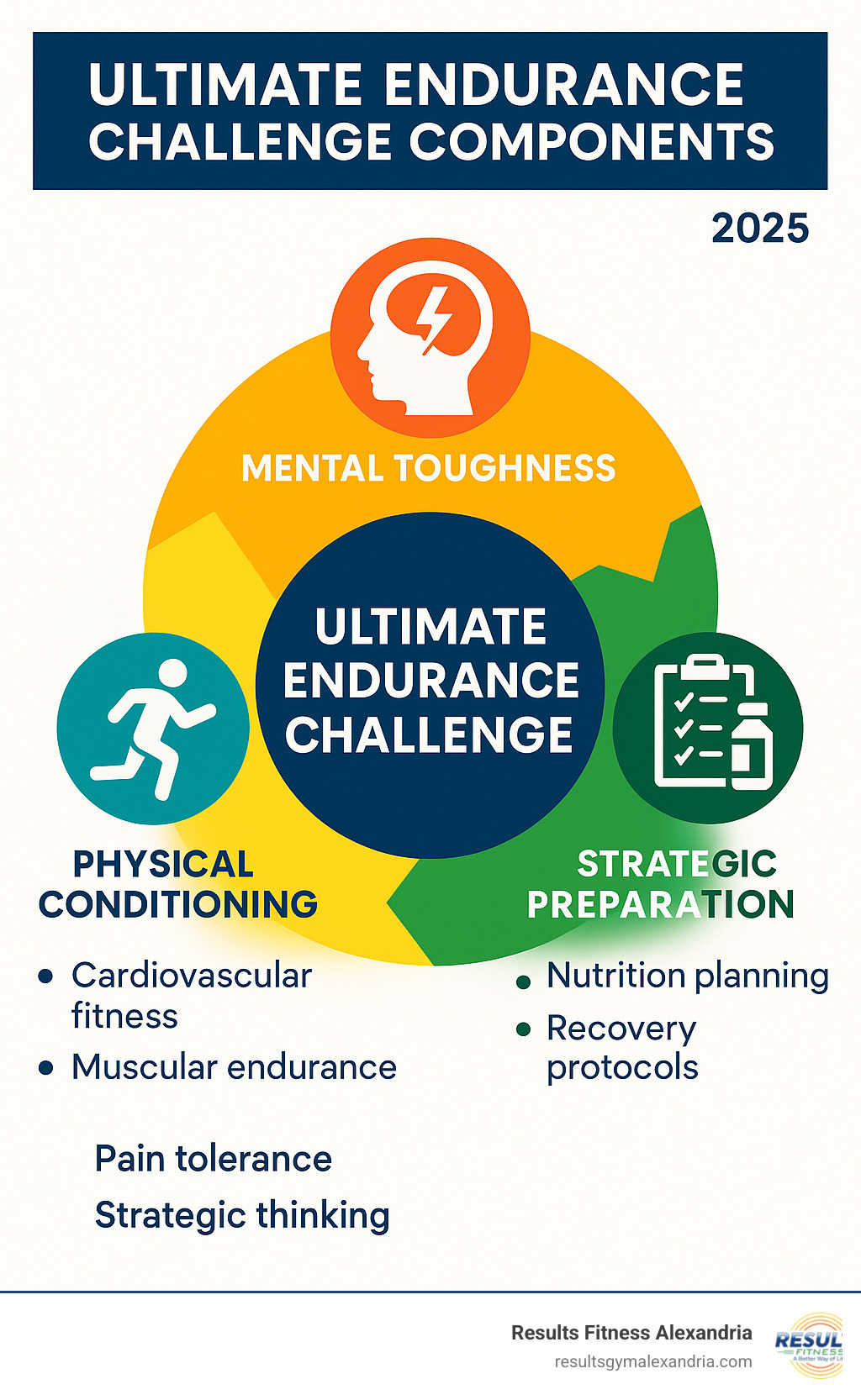
When you’re preparing for an Ultimate endurance challenge, success isn’t just about how fast you can go – it’s about how long you can sustain effort, adapt to adversity, and push through discomfort when your body wants to quit. Think of it this way: while physical conditioning gets you to the starting line, mental toughness gets you to the finish line.
Let’s start with the physical foundation. Your VO2 Max – your body’s maximum capacity to transport and use oxygen during exercise – is absolutely crucial. This metric indicates your aerobic power and determines how efficiently your cardiovascular system can deliver fuel to working muscles. But here’s what many people don’t realize: it’s actually muscular endurance that truly shines in these epic events.
Consider the Hardrock 100-mile endurance run, which involves 33,050 feet of climbing and descending. Your leg muscles need to handle that relentless up and down for potentially 48 hours straight! This isn’t about explosive power – it’s about your muscles’ ability to perform repeated contractions against resistance for extended periods without breaking down.
Building this kind of foundational strength requires smart, progressive training. We can help you develop the muscular endurance that forms the backbone of any endurance pursuit. You can learn more about effective approaches in The Science of Building Muscle: Tips for Effective Strength Training.

Beyond the physical demands, mental resilience is absolutely non-negotiable. These challenges will test your pain tolerance in ways you’ve never experienced. You’ll need to manage sleep deprivation, deal with unexpected obstacles, and maintain focus when everything hurts. It’s a mental battlefield where your inner voice becomes either your greatest ally or your worst enemy.
Strategic pacing is another critical skill that separates finishers from those who flame out early. Going out too fast leads to early burnout, while finding your sustainable rhythm allows you to conserve energy and finish strong. You’ll need to learn the delicate art of listening to your body while also pushing past its perceived limits.
Here’s how the primary demands vary across different types of endurance challenges:
| Challenge Type | Primary Physical Demands | Primary Mental Demands | Key Attributes |
|---|---|---|---|
| Running | Leg strength (quadriceps, hamstrings), glutes, calves, core endurance | Patience, self-discipline, managing repetitive tasks | Endurance, strength, flexibility, mobility |
| Cycling | Leg power, core stability, back strength | Mental fortitude, strategic thinking, focus | Endurance, leg strength, balance, stamina |
| Multi-Sport/Functional Fitness | Full-body strength, power, agility | Adaptability, mental grit, perseverance | Functional movement, versatility, mental flexibility |
| Swimming | Shoulders, arms, core, technique mastery | Self-discipline, determination, resilience | Breath control, cold tolerance, navigation skills |
The beauty of endurance training is that it transforms you both physically and mentally. Every long training session teaches you something new about your capabilities and limitations. You find that your body can handle far more than your mind initially believes possible.
At Results Fitness, we understand that building endurance isn’t just about logging miles or hours. It’s about developing the complete athlete – someone who can handle whatever an Ultimate endurance challenge throws at them. Our approach focuses on building that crucial foundation of strength, endurance, and mental toughness that every successful endurance athlete needs.
Pushing the Limits: Types of Ultimate Endurance Challenges

The world of endurance sports is truly amazing, constantly expanding as athletes and organizers dream up new, tougher challenges. We’re talking about events that span scorching deserts, icy tundras, vast open waters, and even the dizzying heights of mountain peaks. These challenges push the very limits of what’s possible for the human body and mind. Let’s explore some of the most iconic and demanding categories out there.
Ultra-Distance Running: Conquering Miles and Mountains
When most of us think of running, a marathon probably comes to mind. But ultra-distance running takes that idea and stretches it to an entirely different universe! These races are typically much longer than 26.2 miles, often hitting 100 miles, 200 miles, or even more. And they almost always happen in wild, rugged environments, demanding incredible grit and self-reliance.
Imagine trying to steer a course with no clear path, finding checkpoints by tearing pages from books, all while racing against cutoff times that very few can beat. That’s a glimpse into the Barkley Marathons, an intentionally “impossible” race in Tennessee. Only a handful of people have ever finished this over-100-mile monster, which includes roughly 55,000 feet of climbing. Then there’s the Hardrock 100-mile endurance run in Silverton, Colorado, known for its daunting 48-hour time limit and an average elevation over 11,000 feet – talk about thin air! And let’s not forget the legendary Western States 100, the oldest 100-mile ultra-marathon in existence.
Beyond these, ultra-running offers even more extreme options. You could brave the Badwater 135, a 135-mile race through Death Valley, California, famous for its scorching heat and traversing three mountain ranges. Or perhaps the Marathon des Sables, where participants cover about 150 miles over six days in the Sahara Desert, carrying all their own supplies through extreme heat and deep sand. For those who love mountains, the Ultra Trail du Mont Blanc (UTMB) is a 106-mile loop through the Alps that truly tests your climbing and descending skills. And if you prefer the cold, the 6633 Arctic Ultra offers 120 or 380-mile races in Canada’s freezing Yukon Territory, where temperatures can plummet below -58 degrees Fahrenheit! Finally, for a truly unique experience, The Four Deserts Marathon takes you across 240km of different deserts, including the Gobi, Sahara, and Atacama, with its final leg in — wait for it — Antarctica! (Yes, it’s considered a desert due to its extremely low rainfall.)
These races aren’t just about covering distance; they demand incredible physical endurance, strong self-navigation skills, and the ability to handle wild weather swings. To even dream of tackling such an Ultimate endurance challenge, building robust, resilient muscles is absolutely essential. That’s why we always emphasize strength training as part of your preparation. You can learn more about preparing your body for monumental efforts right here: Benefits of Strength Training for All Ages.
Endurance Cycling: From Coast to Peak
Long-distance cycling events take athletes across massive landscapes, often completely unsupported. This means you’re on your own, needing to be self-sufficient and master the art of managing sleep deprivation while constantly moving. These races throw everything at you, from smooth paved roads to gnarly gravel tracks and relentless mountain climbs.
One of the most epic is the Race Across America (RAAM), a 3,000-mile coast-to-coast race from California to Maryland. Competitors must finish in 12 days, with the lead racers often catching only 90 minutes of sleep per day! Even longer is the TransAM Bike Race, an unsupported, 4,200-mile journey across the continent.
Gravel riding, a booming segment of cycling, brings its own brand of toughness. Events like Unbound Gravel in Kansas feature a longest race distance of 350 miles (the Unbound Gravel XL). If you’re up for an trip in Europe, The Badlands in Granada, Spain, is another unsupported bikepacking gravel endurance race that covers over 750 miles of challenging terrain.
Mountain biking also steps up with events like the Cape Epic in South Africa, an eight-day mountain bike stage race spanning 435 miles with over 50,000 feet of climbing. And for those truly seeking a remote, unforgettable ride, the Silky Road in Kyrgyzstan offers a 1900km unsupported endurance trail/gravel ride across diverse and often unpredictable landscapes.

These cycling events are far more than just pedaling; they’re about masterfully managing your gear, dialing in your nutrition, snatching precious sleep, and even handling your own bike repairs, often in total isolation for days on end. It’s an Ultimate endurance challenge on wheels!
Multi-Sport and Functional Fitness Endurance Events
Beyond races focused on a single sport, multi-sport and functional fitness challenges combine various athletic skills. This demands an even broader range of physical capabilities and often requires a truly unique strategic approach.
Triathlons are well-known, but some push the concept to incredible extremes. Take the Norsemen Xtreme Triathlon in Norway, an iron-distance race with a massive 17,175 feet of elevation gain. It kicks off with a swim in freezing waters and finishes with a mountain summit climb. Even more mind-boggling is the Enduroman Arch 2 Arc challenge: running 87 miles from London to Dover, swimming the English Channel (which can be over 21 miles depending on tides), and then cycling 181 miles from Calais to Paris. Only 53 athletes have ever completed this beast!
Other extreme triathlons include the ULTRA520K Canada, a three-day endurance triathlon featuring a 10km swim, 425.6km bike, and 84.4km run – aptly described as “The Toughest 3 Days of Your Life!” Then there’s the Uberman, a self-supported 556-mile ultra triathlon spanning diverse and extreme environments. And for those who truly love to suffer, the Triple Deca Continuous in Italy involves completing 30 full Ironman distances consecutively. Yes, you read that right – thirty! That’s pushing the limits of human endurance to an unimaginable degree. Not to be outdone, the Brutal Extreme Triathlon in Wales includes an 11.4km swim in a freezing lake, a 540km bike ride, and a 126km run that includes ascending Mount Snowdon, making a regular Ironman “look like a fun run.”
A growing trend is swimrun events, like the famous ÖTILLÖ (the original Swimrun World Championship). Here, teams of two constantly switch between open water swimming and trail running across islands. It’s a test of constant transitions and adaptability.
More recently, functional fitness endurance challenges have gained huge popularity. Take HYROX, for example. These races consist of eight 1km runs, each followed by a different functional workout station (think sled pushes, burpee broad jumps, or wall balls). It brilliantly tests both your aerobic engine and your practical, functional strength in a standardized, accessible way. It’s a distinct challenge from CrossFit or traditional obstacle course races, and a fantastic way to see how well-rounded your fitness truly is. To understand more about this powerful blend of movement and strength, dive into The Benefits of Functional Fitness: Why It’s More Than Just a Workout.
These multi-sport and functional fitness events vary wildly, from surviving jungles (like the 124-mile “Escape from the Jungle” race in Belize, which even includes survival training) to performing highly specific functional movements under intense fatigue. The common thread is their multi-faceted approach to testing endurance, forcing athletes to be incredibly well-rounded and adaptable to truly conquer such an Ultimate endurance challenge.
Your Blueprint for the Ultimate Endurance Challenge
Starting on an Ultimate endurance challenge isn’t something you can wing. It requires a thoughtful, systematic approach that builds your body into a resilient machine capable of handling whatever you throw at it. Think of it as constructing a house – you need a solid foundation, proper fuel systems, and regular maintenance to keep everything running smoothly.
Building Your Engine: Foundational Training Principles
The cornerstone of any successful endurance journey is progressive overload – the art of gradually increasing demands on your body so it adapts and becomes stronger. This isn’t about jumping from couch to 100-mile race overnight. It’s about smart, incremental growth that builds the kind of resilience needed for those grueling hours on the trail or in the saddle. Our comprehensive guide on The Power of Progressive Overload: How to Keep Getting Stronger breaks down exactly how to apply this principle effectively.
Zone 2 training forms the backbone of your aerobic development. This is that “conversational pace” where you could theoretically chat with a training partner without gasping for air. It might feel almost too easy at first, but this moderate intensity is where the magic happens – your body becomes incredibly efficient at burning fat for fuel, which is exactly what you need during those long efforts when glycogen stores start running low.
But here’s where many endurance athletes make a critical mistake: they skip the strength conditioning. Whether you’re tackling the relentless climbs of the Ultra Trail du Mont Blanc or maintaining position on a bike for the 3,000 miles of Race Across America, your muscles need to be bulletproof. Strong glutes and quads power you up mountains, while a rock-solid core keeps you stable during those endless hours of repetitive motion. We’ve seen too many athletes sidelined by preventable injuries because they thought “more miles” was the only answer. Learn how to blend strength work seamlessly into your routine with Maximizing Results: Integrating Strength Training Into Your Cardio Routine.

Sport-specific training brings everything together. If you’re preparing for the Marathon des Sables, you need to practice running with a full pack in heat. Training for a high-altitude event like the Everest Marathon? You’ll need acclimatization strategies. Each challenge has its unique demands, and your training should mirror those as closely as possible.
Risk management isn’t just about race day – it starts in training. This means understanding your event’s specific dangers, having backup plans, and knowing when to push through versus when to back off. Our experienced personal trainers excel at designing programs that maximize your potential while keeping you healthy and injury-free throughout the journey.
Fueling for the Finish: A Guide to Your First Ultimate Endurance Challenge
Your body becomes a high-performance engine during an Ultimate endurance challenge, and engines need the right fuel to keep running. Get the nutrition wrong, and even the fittest athlete will hit a wall – sometimes literally.
Caloric intake during multi-day events can be staggering. You might burn 5,000+ calories per day, which means you need a well-planned strategy for getting enough energy in. This isn’t just about eating more; it’s about eating smart. Carbohydrates become your primary fuel source, proteins help with muscle repair during the event, and fats provide sustained energy for those ultra-long efforts.
Carb-loading in the days before your event tops off your glycogen stores, giving you that readily available energy when the gun goes off. But here’s the thing – what you eat during the event matters just as much as what you eat before it.
Hydration strategy can make or break your race. Dehydration leads to fatigue, poor decision-making, and in extreme cases, serious medical emergencies. Events like Badwater 135 in Death Valley demand meticulous attention to fluid and electrolyte balance to prevent heat-related illness. On the flip side, the Marathon des Sables rations water, making every sip precious.
The key to race-day nutrition success? Practice, practice, practice. Your stomach under stress behaves very differently than your stomach at rest. What tastes great during an easy training run might make you nauseous at mile 80 of an ultra. Experiment with gels, sports drinks, real food, and anything else you might consume during your event. For evidence-based approaches to fueling your body, check out The Best Health and Fitness Tips Backed by Science.
The Art of Recovery: How to Prepare for Your Next Ultimate Endurance Challenge
After pushing your body to its absolute limits, recovery isn’t optional – it’s when the real adaptation happens. Skip this step, and you’re setting yourself up for injury, burnout, or worse.
Active recovery might seem counterintuitive when you’re exhausted, but gentle movement like easy walking or light cycling helps flush metabolic waste from your muscles and promotes healing blood flow. Think of it as helping your body’s natural cleanup crew do their job more effectively.
Sleep hygiene becomes absolutely critical. Your body does its heaviest repair work during deep sleep phases. For events like Race Across America where sleep is limited to 90 minutes per day, understanding how to maximize those precious rest periods becomes a survival skill.
Mobility work through stretching and foam rolling helps restore your body’s natural range of motion, which takes a beating during long-duration efforts. Tight muscles don’t just feel uncomfortable – they change your movement patterns and increase injury risk.
Ignoring recovery leads to overtraining syndrome, chronic fatigue, and a cascade of problems that can sideline you for months. The goal isn’t just to survive one Ultimate endurance challenge – it’s to recover well enough that you can dream about the next one. Our comprehensive guide 10 Post-Workout Recovery Tips to Maximize Results provides practical strategies you can implement immediately.
Every elite endurance athlete will tell you the same thing: the work you do between training sessions is just as important as the training itself. Recovery isn’t weakness – it’s smart preparation for whatever challenge comes next.
The Mental Battlefield: Psychology, Motivation, and Support
You might think an Ultimate endurance challenge is all about how strong your legs are or how big your lungs are. But here’s a little secret: it’s often your mind that gets you to the finish line. These incredible events are just as much a mental game as they are a physical one, pushing your inner strength to its absolute limits.
So, how do you prepare your mind for such an epic journey? It starts with finding your ‘why’. Why are you choosing to push yourself through this? Is it for personal growth, to honor a special cause, or simply to see what you’re truly capable of? This deep, personal motivation will be your strongest anchor when the inevitable tough moments hit. Alongside that, visualization techniques can be incredibly powerful. Imagine yourself successfully navigating tricky sections, overcoming fatigue, and crossing that finish line. Mentally rehearsing these moments can build immense confidence and prepare you for any bumps in the road.
During the race itself, you’ll need smart strategies to deal with pain and adversity. One of the most effective ways to make a daunting task feel manageable is breaking down the race into smaller segments. Instead of fixating on the full 240 miles of the Moab 240, for example, your focus might simply be on reaching the next aid station, then the next checkpoint. This mental trick makes the colossal goal less overwhelming. And when the pain inevitably sets in – because it will! – your resilience is key. Just like someone training for years to solve a Rubik’s Cube under pressure, endurance athletes learn to accept the discomfort and push through. It’s a testament to the incredible “mental fortitude, patience, and dedication to a highly repetitive, long-term task” that these challenges demand. If you find yourself needing a little boost in your everyday fitness journey, these tips for building mental muscle can help: 15 Ways to Find Gym Motivation When You Feel Like You Can’t.
In multi-day events, sleep deprivation adds another layer to the mental challenge. Events like the Dragon’s Back Race, spanning over 200 miles in 5 days, can lead to strange experiences like hallucinations and impaired judgment. Learning to steer these altered states, and finding the will to keep going when every fiber of your being screams for you to stop, truly defines mental endurance.
And finally, never underestimate the power of your support system. For many Ultimate endurance challenge events, a dedicated support crew is absolutely essential. They’re not just there to hand you water; they provide crucial emotional encouragement, manage your gear, and ensure your safety. Their unwavering belief in you can be the very thing that prevents you from dropping out. Beyond your crew, the broader endurance community offers invaluable camaraderie. Sharing experiences, advice, and a laugh (or a cry!) with fellow athletes creates a powerful network of understanding. Having an accountability partner can be a game-changer, not just for training, but for maintaining motivation and resilience throughout your entire journey. Ready to find yours? Learn more here: Here’s Why You Need an Accountability Partner to Work Out With.
Conclusion: Are You Ready to Find Your Limits?
Wow, what a journey we’ve been on together! From defining what truly makes an Ultimate endurance challenge a beast, to breaking down the incredible physical and mental traits of the athletes who conquer them. We’ve explored the wild world of ultra-running, the vast stretches of endurance cycling, and the multi-talented demands of multi-sport events. And, most importantly, we’ve laid out your very own blueprint for how to prepare.
It’s clear that tackling an Ultimate endurance challenge is so much more than just a race against the clock or other competitors. It’s a profound journey of self-findy. It’s about learning to push past what you thought were your absolute limits, finding reserves of grit you never knew you had, and truly understanding what you’re made of when the going gets incredibly tough.
We’ve seen that smart preparation, from building your physical engine with progressive training and strength conditioning, to carefully fueling your body and prioritizing recovery, is absolutely non-negotiable. These challenges demand respect, and with the right approach and a strong support system, you can steer the risks and safely push your boundaries.
Here at Results Fitness, we don’t just understand this journey; we’re passionate about helping you start on it. We provide the tools, the expert personal training, and a supportive community to help you build the incredible strength and stamina needed for any challenge you set your mind to – whether it’s a local race or one of the world’s most demanding events.
So, the big question is: Are you ready to take that first step toward finding your extraordinary capabilities? We’re here to help you get started! Explore our cardio equipment and training options to start your journey.