
Treadmill endurance workouts: Top 3 Crush
Why Building Endurance on a Treadmill Changes Everything
Treadmill endurance workouts are structured exercise sessions that use varying speeds, inclines, and durations to systematically improve your cardiovascular stamina and ability to sustain effort over extended periods. Here’s what you need to know:
Core Treadmill Endurance Workout Types:
- Steady-State Running – Consistent pace for 20-60 minutes to build aerobic base
- Interval Training – Alternating high and low intensity (30 seconds sprint, 90 seconds recovery)
- Hill Workouts – Using incline (3-8%) to build leg strength and cardiovascular power
- Tempo Runs – Sustained “comfortably hard” pace for 20-40 minutes
- Long Runs – Extended duration at conversational pace to build endurance capacity
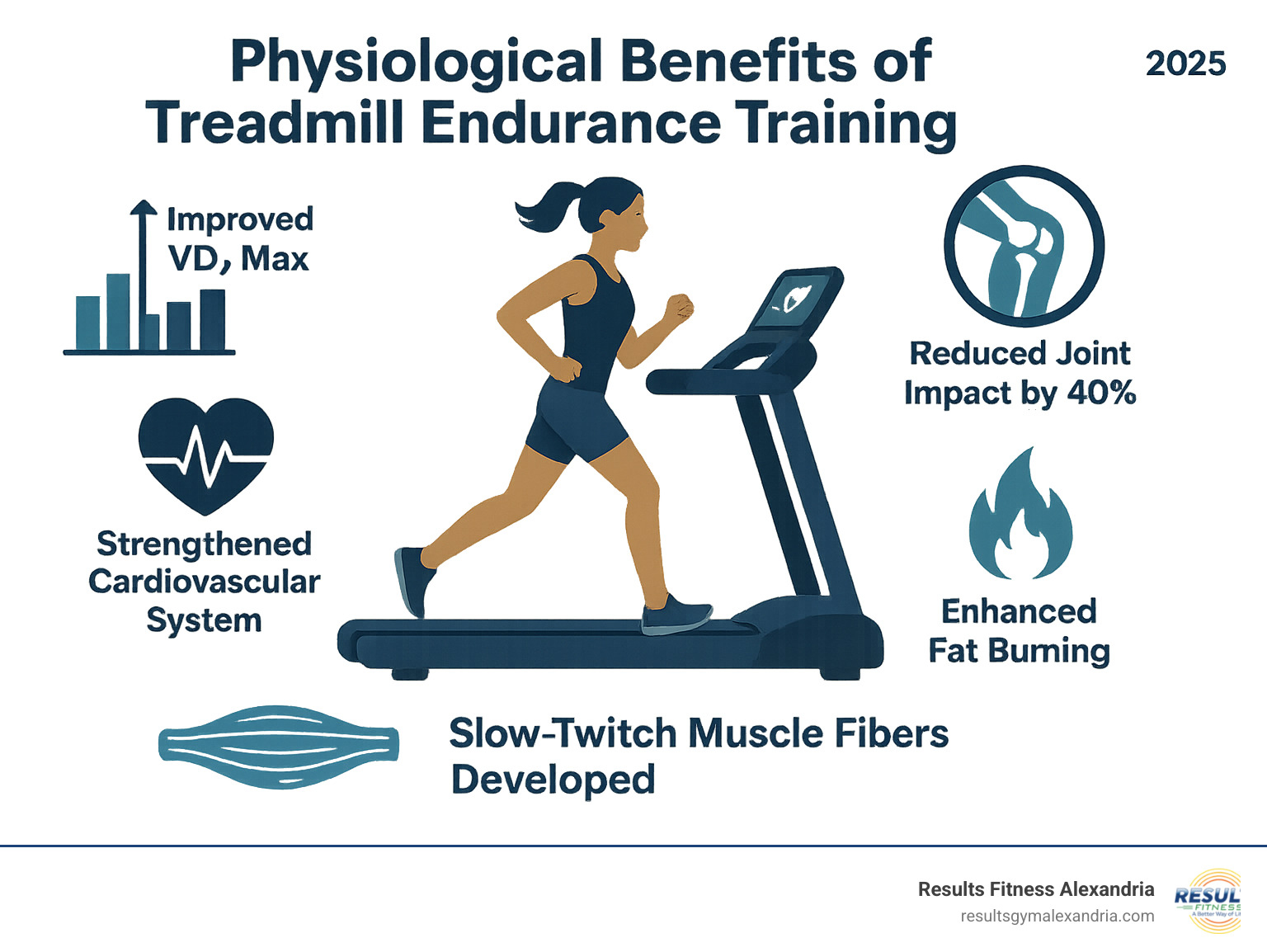
The beauty of treadmill training lies in its controlled environment. Unlike outdoor running, you can precisely manage your pace, incline, and conditions. Research shows that treadmill workouts can improve VO2 max – your body’s ability to use oxygen efficiently – while reducing joint impact by up to 40% compared to road running.
Whether you’re training for your first 5K or looking to break through a fitness plateau, the treadmill offers best consistency. As one fitness expert noted, “Many people choose treadmill training just for winter – but then they’re hooked on the endurance training advantages.”
I’m Jennifer Rapchak, Fitness Director at Results Fitness Alexandria, with over 14 years of experience designing effective training programs that deliver real results. Throughout my career, I’ve helped hundreds of clients master treadmill endurance workouts to build stamina, burn fat, and achieve their fitness goals in our supportive, time-efficient environment.
Why the Treadmill is Your Secret Weapon for Endurance
Here’s something that might surprise you: the humble treadmill sitting in your gym isn’t just a backup plan for rainy days. It’s actually one of the most powerful tools you can use to build serious endurance. While outdoor running gets all the glory, treadmill endurance workouts offer unique advantages that can take your fitness to the next level.
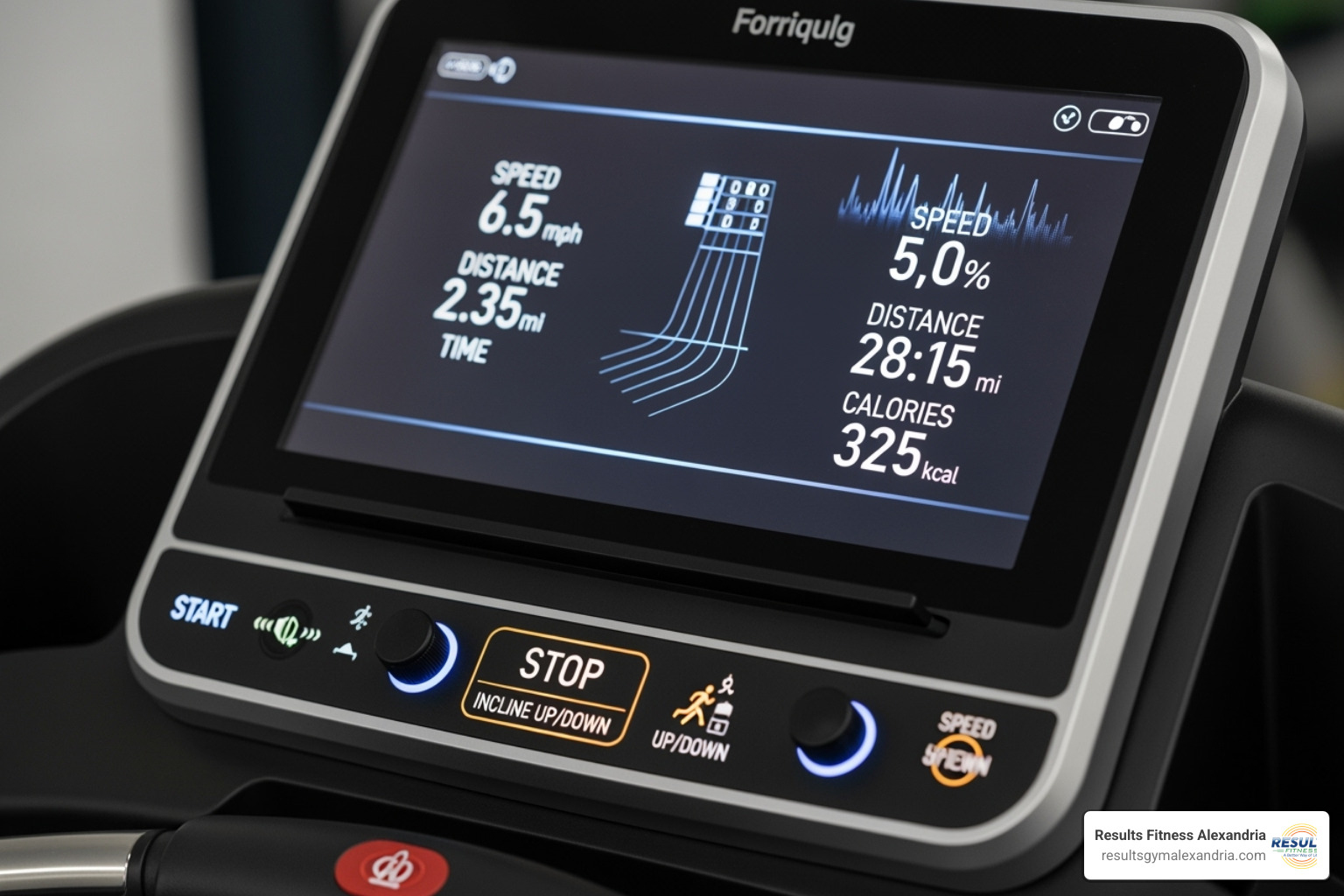
The biggest game-changer? Controlled pacing. On a treadmill, you can dial in your exact speed and stick to it. No more wondering if you’re running too fast or too slow – the belt keeps you honest. This precision is gold when you’re trying to build endurance, because consistency is everything.
Your joints will thank you too. Treadmills offer reduced impact through their cushioning systems, cutting down joint stress by up to 40% compared to pounding pavement. If your knees have been giving you grief or you’re recovering from an injury, this joint protection can be a real lifesaver.
Then there’s the weather independence factor. Rain, snow, or blazing heat – none of it matters when you’re training indoors. This consistency keeps your training on track year-round, which is crucial for building lasting endurance gains.
But here’s what really sets treadmill training apart: it builds serious mental toughness. When you’re staring at that console for 30 minutes, you learn to push through mental barriers and stay focused. This skill transfers beautifully to race day when things get tough.
The treadmill doesn’t replace outdoor running – it complements outdoor running perfectly. Use it for precise interval work, hill training, or those long steady runs when the weather isn’t cooperating. For more ways to boost your cardiovascular fitness, check out our guide on improving your cardiovascular health or explore the top 5 cardio exercises to boost your endurance.
The Science of Stamina
Let’s talk about what’s actually happening in your body during treadmill endurance workouts. Understanding the science helps you train smarter, not just harder.
Your VO2 max is like your body’s horsepower – it measures how efficiently you can use oxygen during exercise. The higher your VO2 max, the longer you can sustain intense effort. Good news: studies show interval training can improve VO2 max significantly, and treadmills are perfect for precise interval work.
Then there’s your lactate threshold – the point where your muscles start producing more lactate than they can clear. Think of it as your body’s “red line.” Training at or just below this threshold teaches your body to handle lactate better, letting you run faster for longer periods.
Building aerobic capacity is where the magic really happens. This is your body’s ability to produce energy using oxygen efficiently. Those longer, steady-pace runs might feel easier, but they’re doing incredible work behind the scenes, strengthening your heart and improving muscle efficiency.
All of this adds up to better heart health and a cardiovascular system that can handle whatever you throw at it. Want to create a well-rounded approach? Learn how to create a balanced fitness routine combining cardio, strength and flexibility.
The beauty of treadmill training is that you can target each of these systems precisely, making every workout count toward your endurance goals.
The Building Blocks: Key Treadmill Workout Types
Think of treadmill endurance workouts like ingredients in your favorite recipe – each one brings something unique to the table. Just like you wouldn’t make a cake with only flour, you can’t build complete endurance with just one type of workout. The magic happens when we mix different training styles to create a well-rounded program that keeps our bodies guessing and growing stronger.
Workout variety isn’t just about beating boredom (though that’s a nice bonus!). It’s about preventing those frustrating plateaus where progress seems to stall. When we challenge our cardiovascular system in different ways, we develop multiple energy pathways and muscle fiber types, leading to more complete endurance gains.
| Workout Type | Goal | Intensity | Duration | Key Benefit |
|---|---|---|---|---|
| Steady-State Running | Build aerobic base, improve efficiency | Moderate (conversational) | 20-60+ minutes | Sustained effort, fat burning |
| Interval Training | Boost VO2 max, improve speed & power | High bursts, low recovery | 20-30 minutes | Cardiovascular adaptation, time-efficient |
| Hill Workouts | Strengthen legs, increase cardiovascular challenge | Moderate to High | 20-40 minutes | Leg strength, glute activation, speed work |
Steady-State Running
This is your endurance foundation – the reliable friend who’s always there for you. Steady-state running means finding a comfortable pace and sticking with it for extended periods. We’re talking about that sweet spot where you could chat with a friend without gasping for breath.
The beauty of this approach lies in building your aerobic base. Think of it as constructing the engine that powers all your other workouts. During these long-duration training sessions, your body learns to become incredibly efficient at using oxygen and burning fat for fuel. It’s like teaching your metabolism to be a hybrid car instead of a gas guzzler.
Moderate intensity is the name of the game here. You’re working, but not suffering. This type of training excels at fat burning because your body has time to access and use stored fat as its primary fuel source. It’s also perfect for race simulation – if you’re training for a 10K or half marathon, these sessions teach your body what it feels like to maintain effort over time.
High-Intensity Interval Training (HIIT)
If steady-state running is the tortoise, HIIT is definitely the hare – but in this story, the hare actually wins! This time-efficient approach alternates short bursts of high-intensity work with recovery periods. Picture this: sprint for 30 seconds like you’re chasing the ice cream truck, then recover for 90 seconds. Repeat and watch the magic happen.
HIIT is absolutely fantastic at boosting VO2 max – your body’s ability to use oxygen efficiently. When we’re pushing our limits in these short, intense bursts, we’re essentially giving our cardiovascular system a crash course in handling stress. Research shows that interval training can improve cardiovascular health more effectively than steady-state training alone.
These workouts target our fast-twitch muscle fibers – the ones responsible for quick, powerful movements. A 20-minute interval session can deliver similar endurance benefits to a much longer steady run. It’s like getting a first-class ticket to Fitness Town while everyone else is taking the scenic route.
Hill Workouts
Don’t let that incline button intimidate you – it’s about to become your secret weapon! Hill workouts are like strength training in disguise, and they’re incredibly effective at building leg strength while simultaneously challenging your cardiovascular system.
When you increase that incline, you’re simulating outdoor terrain and engaging muscles that might otherwise take a backseat during flat running. Your glutes, hamstrings, and calves all get invited to the party, leading to better glute and hamstring activation. It’s amazing how a simple incline adjustment can transform your workout from good to incredible.
Here’s the cool part: hill training is essentially speed work in disguise. The increased effort required to run uphill develops the same muscle power you’d use for sprinting, but with less impact on your joints. Your legs get stronger, your heart works harder, and your overall endurance improves dramatically.
For those looking to maximize their training efficiency, hill workouts pair beautifully with strength training principles. Check out our guide on Maximizing Results: Integrating Strength Training into Your Cardio Routine to learn how to blend these approaches for even better results.
Mastering Your Treadmill Endurance Workouts
Here’s the truth: stepping onto a treadmill is easy, but truly mastering treadmill endurance workouts for real results? That takes some know-how. It’s not just about running until you’re exhausted – it’s about training smart, maintaining proper form, and tuning into what your body is telling you.

Think of your treadmill as a precision instrument, not just a moving belt. When we approach it with the right strategies, we can dial in exactly the workout our body needs to build serious endurance.
Gauging Your Intensity
One of the biggest mistakes I see people make is running by feel alone – and not the good kind of feel! We need reliable ways to measure our effort so we’re training in the right zones for endurance gains.
The Rate of Perceived Exertion (RPE) is your first tool. Picture a scale from 1 to 10, where 1 feels like you’re barely moving and 10 is an all-out sprint. For most endurance work, we want to hover around 6-7 – challenging but sustainable.
Then there’s the talk test, which is as simple as it sounds. Can you hold a conversation while running? If you’re chatting easily, you’re in low intensity. If you can speak in short sentences but singing is out of the question, you’re in that sweet spot for aerobic development. If you can barely grunt out a word, you’ve crossed into high-intensity territory.
For those who love data, heart rate zones give us the most precise picture. Zone 2 training – typically 60-70% of your maximum heart rate – is where the magic happens for endurance. A quick estimate: 185 minus your age gives you a ballpark Zone 2 target. This zone builds those powerful mitochondria in your cells, essentially upgrading your body’s energy factories. Staying in these zones prevents overtraining while ensuring you’re getting the right stimulus for real adaptation.
The Power of Incline
Here’s where the treadmill really shines compared to just running in place. That incline button isn’t just there to make you suffer – it’s a strategic tool that transforms your workout.
Even setting your incline to just 1-2% simulates wind resistance you’d face outdoors. It seems small, but this tiny adjustment makes your indoor run much more comparable to real-world conditions.
Want to increase intensity without cranking up the speed? Bump that incline. You’ll engage more muscles, especially your glutes and hamstrings, while boosting your heart rate naturally. Running uphill can burn up to five times more calories than flat running at the same speed – talk about efficiency!
This strengthening of your posterior chain pays dividends beyond the treadmill. Stronger glutes and hamstrings mean more power in every stride, whether you’re racing a 5K or chasing after your kids at the park. Plus, improved ankle strength from incline work helps prevent those annoying running injuries.
Common Mistakes to Avoid
Let’s be honest – we’ve all made these mistakes. The good news? They’re easy to fix once you know what to watch for.
Skipping warm-ups is like trying to drive your car on a cold morning without letting it warm up first. Your muscles need those five minutes of easy walking or light jogging to prepare for the work ahead. Same goes for ignoring cool-downs – those final five minutes of slower walking help your body transition back to rest and reduce tomorrow’s soreness.
I see people jump on treadmills and immediately set unrealistic paces. Endurance comes from sustained effort over time, not from sprinting until you’re gasping. Use that talk test or RPE scale we discussed – your future self will thank you.
Inconsistent training is the endurance killer. Your body adapts to regular challenges, not sporadic all-out efforts. Aim for consistency over intensity, and always allow 24-48 hours between your hardest sessions for proper recovery.
Finally, watch your form! Holding handrails might feel safer, but it actually makes your workout less effective and can mess up your natural running mechanics. Keep your head up, eyes forward, shoulders relaxed, and let your arms swing naturally. Stay light on your feet – especially when fatigue starts creeping in. Poor posture not only reduces your workout’s effectiveness but can lead to aches and pains that’ll keep you off the treadmill entirely.
Your Path to Progress: Sample Workouts for Every Level
The magic happens when we combine consistency with progressive overload. Think of it like building a house – you wouldn’t skip the foundation and jump straight to the roof! Our endurance grows the same way, brick by brick, workout by workout.

The key is listening to our body and customizing our approach. Some days we’ll feel like we could conquer the world, other days we might need to dial it back a notch. That’s completely normal! What matters most is showing up consistently and gradually challenging ourselves as our fitness improves.
Beginner Treadmill Endurance Workouts to Build Your Base
If you’re just starting your endurance journey, remember this golden rule: duration before speed. We want to teach our body to sustain effort before we worry about how fast we’re going. Think of it as learning to walk before we run – literally!
The Gradual Progression Walk/Run is perfect for building that initial base. Start with a 5-minute warm-up at a comfortable 2.0-2.5 mph walk. Then alternate 3 minutes of brisk walking (3.0-3.5 mph) with 2 minutes of light jogging (4.0-5.0 mph). Repeat this cycle 3-5 times, then cool down with 5 minutes of easy walking. This 20-30 minute workout teaches your body the rhythm of effort and recovery.
Our Simple Interval Run takes things up a notch while staying beginner-friendly. After your warm-up, alternate 2 minutes of moderate jogging (4.5-5.5 mph – you should still be able to chat) with 1 minute of brisk walking. Repeat 5-7 times. This builds your aerobic capacity while giving you plenty of recovery time.
Don’t overlook the Gentle Hill Walk – it’s a game-changer for building leg strength! Start at 1% incline and every 5 minutes, bump it up by 1-2%. Hold that incline for 3 minutes, then drop back to 1% for 2 minutes of recovery. Your glutes and hamstrings will thank you later, and you’ll be amazed at how much stronger you feel on flat ground.
Advanced Treadmill Endurance Workouts for a New PR
Ready to push your limits? These treadmill endurance workouts are designed to help experienced runners break through plateaus and chase those personal records we’ve been dreaming about.
Tempo Runs are the secret weapon of distance runners. After a solid 10-minute warm-up, settle into your “comfortably hard” pace for 20-30 minutes. This should feel like 70-80% of your max effort – challenging but sustainable. You should be able to speak in short phrases, but full conversations are off the table. If your easy pace is usually 6.5 mph, try pushing it to 7.5-8.0 mph. This trains your body to clear lactate efficiently and maintain faster speeds for longer periods.
Ladder Intervals are like a puzzle for your legs and lungs. Start with 2 minutes at a comfortable pace, then climb the ladder: 3 minutes slightly faster, 4 minutes faster still, then 5 minutes at your challenging pace. Each step should increase your speed by about 0.5 mph. Then climb back down the ladder. Take 1-2 minutes of walking recovery between each segment. It sounds tough, and it is – but it’s incredibly effective for building both speed and endurance.
For the ultimate challenge, try combining Hill Sprints with a Fast-Finish Long Run. Start with 5-8 hill sprints at 6-10% incline for 30-45 seconds, with walking recovery between each. Then transition into a longer run at your usual pace, but here’s the kicker – in the final 15-20 minutes, gradually increase your pace every 5 minutes. This trains your body to find that extra gear when you’re already tired, just like in a race situation.
These advanced workouts are meant to challenge you, but they shouldn’t leave you completely wiped out. If you can’t maintain good form or you’re gasping for air, it’s okay to dial back the intensity. Progress isn’t always linear, and some days are simply better than others.
Frequently Asked Questions about Treadmill Endurance
When it comes to treadmill endurance workouts, I hear the same questions over and over again from our members at Results Fitness Alexandria. Let me share the answers to the most common ones that come up during our training sessions.
How often should I do treadmill endurance workouts?
This is probably the question I get asked most! The sweet spot for most people is 3-4 sessions per week, but it really depends on your current fitness level and goals.
If you’re just starting your fitness journey, begin with 2-3 sessions per week. This gives your body time to adapt without overwhelming it. The U.S. government recommends about 150 minutes of moderate-intensity aerobic exercise weekly, which breaks down perfectly into manageable chunks.
For those training for specific events like a 5K or 10K, you might bump it up to 4-5 sessions weekly. Just remember to mix up your workout types – don’t do high-intensity intervals every single day! Your muscles need that 24-48 hour recovery window between intense sessions to actually get stronger.
The key is consistency over intensity. I’d rather see you do three solid workouts every week for months than seven brutal sessions that leave you burned out after two weeks.
Can I build enough endurance for a marathon just on a treadmill?
Here’s the honest answer: while you can build incredible cardiovascular endurance on a treadmill, training exclusively indoors for a marathon isn’t ideal.
Treadmill endurance workouts are fantastic for building your aerobic base, improving your VO2 max, and developing the mental toughness needed for long distances. You’ll definitely get stronger and more capable of sustained effort.
But marathons throw some curveballs that treadmills can’t replicate. Outdoor terrain varies constantly – think potholes, hills, and different surface textures that engage stabilizing muscles differently. Weather conditions on race day might be hot, windy, or rainy. Your running form also changes slightly between treadmill and outdoor running.
My recommendation? Use the treadmill as your foundation – it’s perfect for tempo runs, interval training, and those long steady-state sessions. Then complement it with outdoor runs to prepare for race-day realities. This combination gives you the controlled training benefits plus real-world preparation.
What’s a good starting speed for a beginner on a treadmill?
Start slower than you think you need to! I see new members jump on and immediately try to run at speeds that leave them gasping after two minutes.
Begin every session with a brisk walk at 2.0-3.0 mph for your warm-up. This gets your blood flowing and prepares your muscles for more intense work.
When you’re ready to jog, find your conversational pace – that’s the magic zone where you can speak in full sentences without huffing and puffing. For most beginners, this falls somewhere between 4.0-6.0 mph. Don’t worry if your conversational pace is closer to 4 mph – everyone starts somewhere different!
Focus on duration over speed in those early weeks. I’d rather see you maintain a comfortable 4.5 mph for 20 minutes than sprint at 7 mph for 3 minutes and then need to stop. Your speed will naturally increase as your endurance improves.
There’s no shame in starting with walk-jog intervals either. Many of our most successful members began with simple patterns like jogging for 2 minutes, walking for 1 minute, and repeating. Build that base first, and speed will follow.
Conclusion
We’ve explored the incredible power of treadmill endurance workouts and how they can transform your fitness journey. From building a solid aerobic base with steady-state runs to boosting your VO2 max with HIIT intervals, and strengthening your legs with challenging hill workouts, the treadmill offers a controlled, consistent, and highly effective environment for endurance training.
The most important takeaway? Consistency is everything. Your body adapts to what you consistently ask of it. Whether you’re a beginner starting with walk-run intervals or an advanced athlete chasing a new personal record, the key is showing up regularly and progressively challenging yourself.
Remember to accept workout variety to prevent plateaus and keep things interesting. Use tools like the Rate of Perceived Exertion scale and heart rate zones to gauge your intensity accurately. Don’t forget the power of incline – even a 1-2% grade can simulate outdoor conditions and engage more muscles. Most importantly, never skip your warm-ups and cool-downs, and always prioritize proper form over speed.
Your endurance journey is unique to you, and that’s exactly how it should be. Listen to your body, celebrate small victories, and trust the process. Every minute you spend on that treadmill is an investment in a stronger, more resilient you.
At Results Fitness Alexandria, our state-of-the-art treadmills and expert personal trainers can help you design the perfect plan to crush your endurance goals. We understand that everyone’s fitness journey looks different, and we’re here to guide you every step of the way – whether you’re taking your first steps toward better health or pushing toward your next breakthrough.
Ready to see what you’re capable of? Explore our cardio equipment and start your journey today! Your future self will thank you for taking that first step.